


Jader Gil
Marketing Expert
October 17, 2026
9 min read
If you run a detailing business, the fastest way to raise your average ticket is to sell what your competitors can’t reach: the undercarriage. And the fastest way to reach it is to put the whole car in the air. A full-height portable car hoist lets you clean, ceramic-coat, and rust-proof the entire underbody standing straight up — and underbody and corrosion-protection packages are some of the highest-margin add-ons in the trade, often adding a few hundred dollars per car at very little material cost. The auto detailing market is worth tens of billions of dollars a year, yet most shops leave the bottom half of every vehicle on the table because they have no safe way to get under it.
I talk to detailers every week who are still rolling on a creeper or wrestling a car onto ramps. That is slow, it is hard on your back, and it caps what you can charge. Here is how a portable two-post lift changes the math — and why “portable” matters more for a detail shop than almost any other operation.
Think about what a customer is actually paying for when they book a premium detail. They want the car to look new, last longer, and hold its value. The underbody drives all three. Road grime, brake dust, salt, and tar collect on the floor pans, subframe, exhaust, and suspension. Left alone, that is where rust starts and where a trade-in inspection loses points. When you can show a client a filthy before photo and a bright, coated after photo of their own undercarriage, you are not upselling — you are closing an obvious need.
The problem has always been access. On a creeper you can see maybe 40 percent of the underbody, you cannot swing a pressure wand freely, and you certainly cannot spray an even ceramic or rust-proofing coat across the whole floor. Ramps lift a few inches and still leave you flat on your back. A full-height two-post hoist raises the car to roughly chest height so you walk under it, light it properly, and work every square inch with both hands. That is the difference between offering undercarriage service and actually being able to deliver it at a premium.
Pro tip: Price undercarriage cleaning, underbody ceramic, and rust proofing as three separate line items, then bundle them into a “foundation” package. Clients who would never ask for “rust proofing” happily buy a package that “protects the parts you never see.” The lift is what lets you deliver all three in one pass.
Clean has to come before any coating — a ceramic or rust inhibitor is only as good as the surface under it. With the car in the air you can do a proper job instead of a rinse:
Up on the hoist you can pre-soak the whole underbody, agitate the heavy build-up on the subframe and control arms, and rinse it all down without crawling in and out a dozen times. Lighting is the quiet win here: a work light under a lifted car shows you the tar and salt you would never see on a creeper. You finish faster, you miss less, and the car comes down ready to coat. Shops that move to a lift routinely cut their undercarriage time roughly in half, which means more cars through the bay on the same day.
Blasting grime off an underbody creates a mess. Because the portable hoist carries the car on its own trailer deck, you can set it up over a wash pad or wheel the whole operation to wherever your water reclaim lives, instead of being locked to one plumbed bay. For a mobile detailer that is the entire business model — the lift travels with you.
Once a car is in the air, undercarriage cleaning naturally opens the door to the services that live right next to it. With the weight off the tires you can pull wheels to detail the faces and inner barrels properly, clean and dress the wheel wells, and coat calipers — the finishing touches that turn a good detail into a showroom result and justify a premium tier. You are already under the car; charging for the full lower half is just good packaging. It is the same reason serious collectors want their cars serviced on a lift rather than on the ground.
Ceramic coatings have exploded as a detailing service, and the underbody is the next frontier. A proper underbody ceramic or graphene coat makes future cleaning far easier, resists salt and brake dust, and gives you a visible, sellable result. But it demands even application, and even application demands access.
On a full-height lift you can reach the floor pans, rockers, wheel wells, and suspension components and lay down a consistent coat with no drips, no missed shadows, and no contortion. You can mask properly, you can let it flash in a controlled way, and you can inspect your own work under good light before the car comes down. Try that on a creeper and you get an uneven, half-covered coat that fails early and comes back as a warranty headache. The same full standing height that makes the car easy to coat is why detailers keep telling me the lift paid for itself in standing up instead of kneeling on every single job.
Rust proofing is the add-on that never goes out of season, especially anywhere they salt the roads. Oil-based rust inhibitors, waxes, and corrosion blockers all need to reach seams, pinch welds, frame rails, and the inside of panels — the exact spots you cannot touch with the car on the ground. With the vehicle lifted you can wand the underbody thoroughly, drill-free spray into cavities where the design allows, and actually show the customer the coverage.
Corrosion costs the U.S. economy an estimated few hundred billion dollars a year, and vehicle owners feel it directly in failed inspections and gutted resale value. When you can protect a client’s undercarriage properly and document it with photos, you are selling peace of mind on a schedule — many shops turn rust proofing into an annual recurring visit. For collectors and enthusiasts especially, that protection is an easy sell; it is the same thinking behind protecting resale value on any serious vehicle.
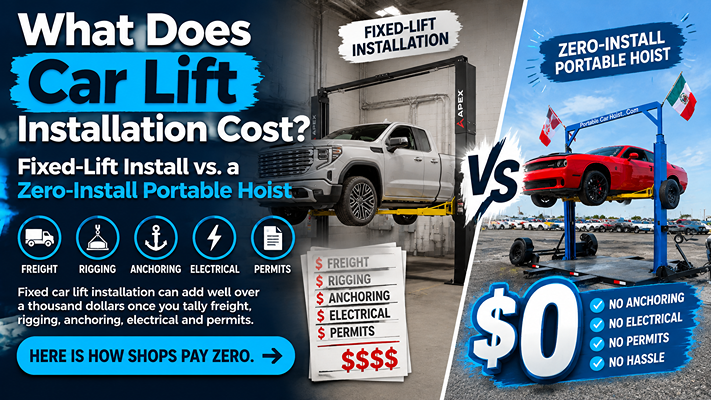
Plenty of detailers assume a car lift means jackhammering the floor, pulling permits, and committing one bay forever. It does not have to. A portable full-height two-post hoist sits on its own heavy diamond-plate trailer deck, so it needs zero concrete anchors and zero drilling. That changes the decision completely for a detailing business.
Most detail shops rent their space. A fixed lift means a hard conversation with the landlord and a permanent hole you cannot take with you. Because the portable unit anchors to nothing, you can run it in a leased bay with no slab work, and if you move, it comes with you. There is usually none of the permit or slab-engineering fight you get with an in-ground or bolted two-post lift.
The whole rig deploys in roughly 15 minutes and works on more than just a perfect shop floor — it will run on asphalt, gravel, or uneven ground, which matters if you detail at dealerships, events, or client sites. Mobile detailers can load it and tow it to the customer, then offer lifted undercarriage service on a driveway or in a parking lot where no competitor can. That is a service no mobile rival with a creeper can match. If you are building a van-based operation, it pairs naturally with a mobile setup that lifts cars anywhere.
Because nothing is bolted down, you can move the lift as your floor plan changes — roll it out for undercarriage and coating days, tuck it aside for paint correction and interior work. One bay does double duty instead of being sacrificed to a permanent machine.
For almost everything a detailer touches, capacity is not the limiting factor. The Model C portable hoist handles 8,000 to 11,000 pounds, and the broader line scales all the way up to 76,000 pounds for heavier commercial vehicles — so cars, trucks, and even a lifted Sprinter or Transit van are well within range. If you want to sanity-check a specific vehicle, here is how to pick the right capacity.
The hoist reaches a full working height of about 69 to 73.5 inches, so you stand upright under the car. Overhead clearance is the thing to check in your own space — this is the same math as any two-post lift ceiling-height question, just without the slab requirement. On safety, treat the portable unit like any professional two-post: set the vehicle on the factory lift points, shake-test it, and settle it onto the mechanical safety locks before you ever go underneath. It is a world safer than the way too many detailers still work — which is exactly why jack stands and creepers put people in the hospital.
Here is the part that matters for a business owner. Say you add undercarriage cleaning, underbody ceramic, and rust proofing as a package and sell it on even a third of the cars you already have in the shop. The material cost is small; the labor is fast once the car is in the air. A handful of those packages a week covers the payment on the lift and then runs as margin. Detailers consistently find the unit pays back quickly once you price the services it unlocks, and if cash flow is the hurdle, monthly financing usually costs less than the revenue a single week of lifted work brings in.
That is the whole case. The portable hoist is not an expense — it is the equipment that lets you sell the half of every vehicle you have been giving away for free, standing up, in any bay, with no concrete and no permit. If you want the full rundown on models and specs, start with the complete portable two-post buyer’s guide. And if you are ready to spec one for your shop or your mobile rig, tell us about your vehicles and your space and we will match you to the right unit. Book a Free Quote today and we will help you turn undercarriages into your highest-margin service.
Yes. Once the vehicle is set on its lift points and settled on the mechanical safety locks, a single detailer can wash, coat, and rust-proof the entire underbody standing up. The hoist sets up in about 15 minutes, so most of your day is billable work, not wrestling the car into position.
No — the structure is built from heavy American steel for a working shop, and because the unit rides on its own trailer deck you can position it over a wash pad or reclaim area instead of flooding a plumbed bay. Rinse the lift down like any shop equipment and touch up any chips so it stays corrosion-resistant, the same care you would give a car you are storing outside.
Usually not. The portable units run on standard shop power, and the Model C can even run on battery for off-grid and mobile work — no three-phase, no electrician, no panel upgrade. If you want the exact amp and plug details, here is the full breakdown on power requirements.
That is one of the biggest advantages. The whole rig tows to the customer and deploys on a driveway, lot, or event site, so you can offer standing-height undercarriage cleaning, ceramic, and rust proofing that no creeper-based mobile competitor can touch. It turns a van-based detail operation into a premium service.
Half Car Lift vs. Full-Height Hoist: Stop Kneeling, Start Standing
Portable Car Hoist Cost: ROI & Payback Calculator
Can You Leave a Portable Car Lift Outside? Weather, Rust & Storage