


Jader Gil
Marketing Expert
October 10, 2026
9 min read
Yes — the full-height portable car hoist is built on its own black diamond-plate flatbed trailer deck, so the whole rig is made to travel between jobs, and with the right tow vehicle and hitch you can pull it down the road like any other trailer. The hoist bolts to nothing, needs zero concrete and zero anchors, and sets up at the next location in about 15 minutes. That is the entire point of a portable unit: the lift goes where the work is, not the other way around.
I get this question constantly from mobile mechanics, multi-location shop owners, and event crews who want to run one hoist across several sites. “Can I actually tow this thing legally, and what do I need to pull it?” The honest answer is that towing a car hoist rig is straightforward once you understand three things: how much it weighs, what hitch and tow vehicle it needs, and the basic DOT rules that apply to any trailer on a public road. Let me walk through all three so you can plan a move with no surprises.
A portable car hoist is not a fixed lift you leave bolted to a slab. The two posts and the synchronized top beam are mounted on a steel flatbed deck with the strength and layout of a trailer. Because the lift lives on that deck, moving the hoist means moving the deck — and moving the deck means towing, hauling, or loading it the same way you would handle any heavy trailer.
That changes how you should think about it. You are not shipping a delicate machine that has to be re-installed and re-anchored at the far end. You are relocating a self-contained rig that drives in, sets up in roughly 15 minutes, and goes back on the road when you are done. If you have read how a portable car hoist works with no concrete and no bolts, the towing question is really just the logical extension of that same design: nothing is permanent, so nothing stops you from taking it with you.
The three things that decide whether a given move is easy or a headache are weight, hitch match, and road-legal compliance. Get those right once and every move after that is routine.
Towing starts and ends with weight. Every tow vehicle has a maximum trailer rating set by the manufacturer, and your job is to stay comfortably under it with the fully loaded rig — deck, posts, hydraulics, ramps, and anything else riding along.
Here is where I will be straight with you: the exact loaded weight depends on which model you run, since our hoists span a wide capacity range from 8,000 up to 76,000 pounds of lifting capacity, and a bigger-capacity unit is a heavier rig. Before you plan a tow, get the precise shipping and loaded weight of your specific configuration from our team — do not guess. Once you have that number, matching it to a truck is simple.
As a general frame of reference, a typical half-ton pickup (think F-150, Silverado 1500, Ram 1500) is rated to tow somewhere between about 5,000 and 13,000 pounds depending on engine, axle ratio, and tow package. A three-quarter-ton or one-ton truck (F-250/350, Silverado 2500/3500) steps that up into the 12,000 to 20,000-plus pound range when properly equipped. For most mobile operators, a well-optioned three-quarter-ton diesel is the sweet spot: plenty of margin, strong brakes, and the stability you want behind a heavy deck.
Pro tip: Never tow right at your truck’s maximum rating. Leave a cushion of at least 15 to 20 percent. A rig that sits at 90 percent of your tow rating in a parking lot behaves very differently on a mountain grade, in a crosswind, or during a panic stop. Margin is what keeps the move boring, and boring is exactly what you want.
Trailer weight is only half the math. Tongue weight — the downward force the coupler puts on your hitch — generally wants to land around 10 to 15 percent of the loaded trailer weight for a bumper-pull setup. Too little and the trailer sways; too much and you overload the rear axle and lighten the steering. Your truck also has a payload rating that has to absorb that tongue weight plus passengers, tools, and fuel. Weigh the loaded rig on a CAT scale once and you will know your real numbers forever.
Once weight is sorted, the physical connection is the next piece. For a deck in the weight class of a car hoist, you are almost certainly in Class IV or Class V receiver territory (rated roughly 10,000 to 20,000-plus pounds), not a light Class III. The receiver, the ball mount, the ball size, and the coupler on the deck all have to carry a rating equal to or above your loaded weight — the lowest-rated part in the chain sets your real limit, so one undersized component drags the whole setup down.
Confirm the coupler style and size on your specific deck with our team before you buy a ball mount. You will also want to plan for:
Safety chains rated for the load, crossed under the tongue so the coupler can’t drop to the pavement if it comes loose. A properly wired trailer light harness so your brake lights, turn signals, and running lights work — this is not optional on a public road. And trailer brakes with a brake controller in the cab if the loaded weight crosses your state’s threshold (more on that below).
None of this is exotic. It is the same gear any landscaper, boat owner, or equipment hauler already runs. The difference is simply that a car hoist deck is heavier than a utility trailer, so you spec every component up accordingly. If you are building out a dedicated mobile setup, it pairs naturally with the approach in building a mobile mechanic van that lifts cars anywhere and the broader playbook in taking your shop to the customer with a mobile car lift.
Here is the part people most want to hand-wave past, and the part that bites hardest if you ignore it. Towing a heavy deck on public roads puts you under the same trailer rules as anyone else hauling equipment. The specifics vary by state, but the categories are consistent, and you should confirm each one for where you operate.
Most states require a trailer used on public roads to be registered and plated, and many require a title. Whether your car hoist deck is titled and registered as a trailer, and what class it falls under, depends on its configuration — so confirm with us and with your state DMV how your specific unit should be registered before you tow it the first time. Do this once, up front, and you are covered.
Nearly every state requires independent trailer brakes above a weight threshold — commonly around 3,000 pounds, though the exact number varies. A loaded car hoist rig will be well above that, so plan on functioning trailer brakes and an in-cab brake controller. Beyond the law, brakes on a heavy deck are simply a safety must: your truck’s brakes alone should not be stopping that much mass.
Working tail lights, brake lights, turn signals, and side markers are required everywhere. The hoist and any loose parts — ramps, adapters, the power unit — must be strapped down so nothing shifts or falls off in transit. And if you are running the rig for a commercial business across state lines at high enough weights, you may cross into commercial motor vehicle territory with its own licensing, markings, and logbook rules. For a lot of operators that threshold never comes into play, but you should know where the line is for your weight and your operation.
For most mobile mechanics and shops towing a single hoist deck with a standard pickup, a regular driver’s license is enough. CDL requirements generally kick in at much higher combined weight ratings or for certain commercial classifications. Check your combined gross vehicle weight rating against your state’s CDL threshold — and if you are close, talk to your DMV rather than guessing. I would rather you make one phone call than get pulled over at a weigh station.
Towing the deck directly behind a truck is the most common method, but it is not the only one. Depending on your trucks, your trailers, and how far you are going, you have options.
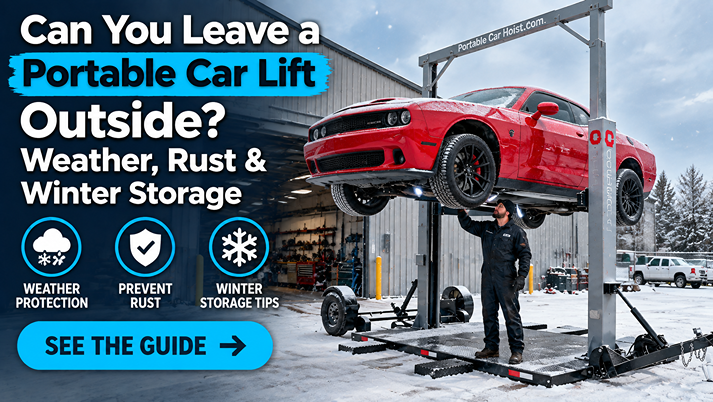
You can tow the deck as a trailer, which is the fastest hitch-and-go method for operators who move frequently. You can haul the deck on a flatbed or gooseneck if you already run one for other equipment. Or you can load the rig into an enclosed trailer or box truck for weather protection and security on long hauls — handy if you also worry about leaving it exposed, a topic I cover in whether you can leave a portable car lift outside.
The right choice comes down to frequency and distance. A mobile tech hopping between three driveways a day wants the quickest possible hitch-and-go. An event or race crew moving the rig a few times a season might prefer the protection of an enclosed haul. Both work because the hoist does not care — it sets up the same 15 minutes either way, exactly like the sequence in setting up a portable two-post lift in 15 minutes.
This is where a portable hoist leaves a fixed lift in the dust. You arrive, position the deck on a reasonably firm surface, level it, and go to work — no slab to pour, no anchors to drill, no inspection to schedule. It even handles less-than-perfect ground, which I break down in using a portable car lift on asphalt, gravel, or uneven ground. The deck that makes it towable is the same deck that makes it anchor-free, which is the whole reason the mobility story holds together. If you want the full mechanical picture, the portable car hoist buyer’s guide ties the design together.
Towability is not a gimmick — it is a revenue tool for specific kinds of buyers. Mobile mechanics turn a single hoist into service calls across an entire metro area instead of being tied to one bay. Multi-location shops share one high-capacity lift between sites instead of buying three fixed lifts. Dealerships and fleets move a lift to wherever a down vehicle is sitting. And event, race, and car-show operations roll in, lift all weekend, and roll out, the way crews already do with the gear in car-show portable lift equipment.
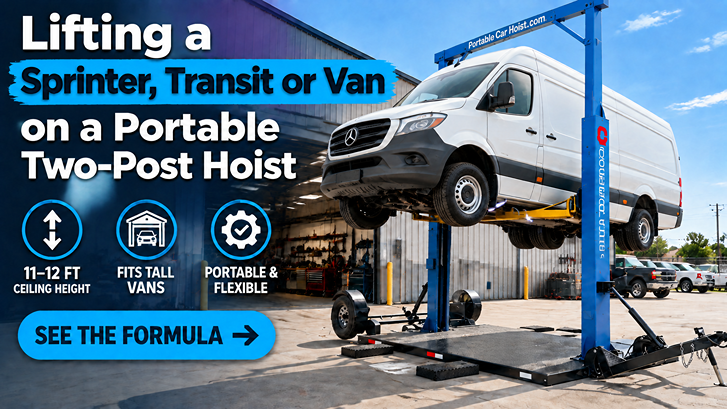
If you are weighing whether that flexibility pays for itself, run the numbers in the portable car hoist cost and ROI payback calculator — for a lot of mobile operators, the ability to bill from more locations is what makes the hoist pay for itself faster than a stationary lift ever could. Buyers towing heavier vehicles should also look at the portable truck lift for lifted pickups and duallies and lifting a Sprinter, Transit, or tall van on a portable hoist to confirm the right capacity before they tow anything. And because the hoist can run on battery power, a mobile setup does not even need shore power at the job — see the battery-powered car lift for the mobile mechanic.
Towing a portable car hoist is genuinely easy once you have done it once: know the loaded weight, match it to a truck and a Class IV or V hitch with a healthy safety margin, wire the lights, add trailer brakes, register it for your state, and strap everything down. After that, moving the rig is just another drive. The payoff is a full-height lift that follows your business instead of pinning it to one address, and when you want the exact spec of your unit before you buy, we will give you the straight numbers.
Book a Free Quote and tell us how you plan to move your hoist — we will confirm the loaded weight, the coupler and hitch class, and exactly what it takes to tow your configuration legally in your state, so your first move is smooth and your rig starts earning on day one.
It depends on the model, because our hoists span 8,000 to 76,000 pounds of lifting capacity and a higher-capacity unit is a heavier rig. The deck, posts, hydraulics, and ramps all add up. Rather than guess, get the exact shipping and loaded weight of your specific configuration from our team, then match it to a truck rated well above that number with a safety margin.
For most configurations you want a three-quarter-ton or one-ton pickup with a Class IV or Class V receiver (rated roughly 10,000 to 20,000-plus pounds) and a coupler, ball, and ball mount rated at or above your loaded weight. A half-ton can work for lighter units, but leave at least a 15 to 20 percent cushion under your truck’s tow rating no matter what you pull.
Most mobile mechanics and shops tow a single deck on a standard driver’s license, but CDL rules kick in at higher combined weight ratings, so check your number against your state’s threshold. Trailer brakes with an in-cab controller are required above a weight limit (often around 3,000 pounds) in nearly every state, and a loaded hoist is well past that — so plan on them.
Yes — the hoist lives on the deck permanently, which is exactly what makes it portable. You tow it in, set up in about 15 minutes with no anchors, work, then hitch up and go. Confirm registration and the road-legal package for your state once, up front, and every move after that is routine.
Build a Mobile Mechanic Van That Lifts Cars Anywhere
Mobile Mechanic Car Lift: Take Your Shop to the Customer
Can You Use a Portable Car Lift on Asphalt, Gravel, or Uneven Ground?