



Jader Gil
Marketing Expert
June 6, 2026
9 min read
You know the feeling. You had the lift installed, the concrete was poured, the inspector came and went, and then two months later, you realized the bay is in the completely wrong place. Now you can't fit your alignment rack where you need it. The airlines are awkward. Every time a big truck comes in, the whole floor turns into a puzzle.
That is not a workflow problem. That is a concrete problem.
And here is the uncomfortable truth: nearly half of shop owners who install fixed lifts end up wishing they had put them somewhere else. According to the Automotive Lift Institute, proper bay spacing requires a minimum of 10 to 12 feet between lift centers for safe operation and technician movement. But most shops only figure that out after they have already committed to a layout.
So what do you do when your floor is locked in, and your needs are still changing?
Think about how often things shift in a busy shop. You add a second tech. You start taking fleet vehicles. You land a contract to service lifted trucks. Your shop grows, and suddenly, the layout you built everything around is working against you.
Fixed lifts make that problem permanent. Once those anchors go into your slab, you have two options: live with it or spend $3,000 to $8,000 on demo and re-pours just to move equipment twenty feet.
That is the core issue with traditional two-post and four-post lifts. They are designed for a shop that never changes. But your shop does change, because that is what growth looks like.
A movable car lift, also called a relocatable 2-post lift or a portable hoist, is a full-height professional lift system that sits on its own wide-base frame. No bolts into the floor. No concrete anchors. No permits required.
You set it up, you use it, and when your shop layout needs to change, you move it. It really is that simple.
Here is what that flexibility means in real numbers:
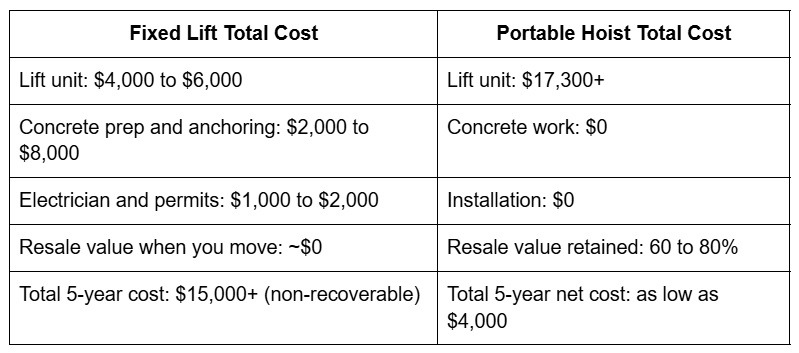
The math changes completely when you factor in that a portable hoist goes with you. It does not become part of someone else's building.
Let's say you have a fixed lift anchored at Bay 3. Great. Now a client brings in an extended-cab pickup that needs room to open the doors fully, but Bay 3 is tight because the tool chest is right there. You either squeeze in and risk a scratch, or you turn the job away.
According to a 2023 survey by Motor Age magazine, technician productivity drops by up to 23% when shop layouts do not support smooth vehicle movement. That is almost a quarter of your day gone, not because your team is slow, but because the floor design is fighting them.
A relocatable 2-post lift fixes these issues by letting you build the workflow first and then position the equipment to match, not the other way around.
You might think this information is only relevant for shops planning a move. It is not. Here is who gets the most value:
Growing mechanic shops: You start with one bay and expand. A portable hoist moves with your capacity instead of forcing a re-pour every time you add a bay.
Mobile mechanics: You need lifting capability at client sites, in driveways, or at fleet yards. A fixed lift does not go with you. A movable car lift does.
Car collectors and enthusiasts: Your garage gets reorganized every time you add a vehicle or project. You should not need to hire a contractor every time that happens.
Racing event planners: You need full-height lift capability at venues that are not set up for permanent equipment. "Portable" means you bring the shop to the event.
Commercial and fleet operators: You manage multiple sites. One hoist that can reposition car lift capacity across locations is an entirely different value proposition than five fixed installs.
This is the first question most shop owners ask. And it is a fair one.
Fixed lifts use concrete anchors for stability. Portable hoists use a different method: a wide-base footprint that distributes the vehicle's weight across a larger floor area instead of concentrating it at anchor points.
The Portable Car Hoist models, for example, are American-made in Menifee, California, and engineered with both mechanical and hydraulic redundancy in the locking system. The lift holds its position even if power is cut mid-lift. They go through the same ALI safety testing standard as fixed lifts. They have served 100+ professional shops with zero stability incidents when used per instructions.
So the answer is yes, a professional-grade movable car lift is just as stable as a fixed unit, just stable by different engineering.
Here is the practical part. If you are running a shop and want to reposition car lift placement without the usual headaches, here is what the process actually looks like with a portable hoist:
That whole process takes 20 to 30 minutes on a full-height two-post portable unit. Compare that to three days of demo, concrete patching, re-anchoring, re-inspection, and downtime on a fixed lift relocation.
If your shop runs on billable hours, you already understand what three days of lost productivity cost you.
"Portable lifts are not full height." Most portable lifts on the market top out at around 47 inches of lift height. The Portable Car Hoist models go from 69 to 73.5 inches, which is full standing clearance. You can work on transmissions, exhausts, and suspension systems standing up, not crouching.
"They are not rated for heavy loads." Capacity depends on the model. The Model A handles 8,000 to 15,000 lbs. The Model T handles combined loads up to 54,000 lbs for heavy commercial vehicles. These are not light-duty hobby lifts.
"I rent a shop space and cannot make permanent changes anyway." This is actually one of the best use cases for a portable hoist. You get full lift capability without violating your lease or losing your deposit. When you move, the lift moves with you.
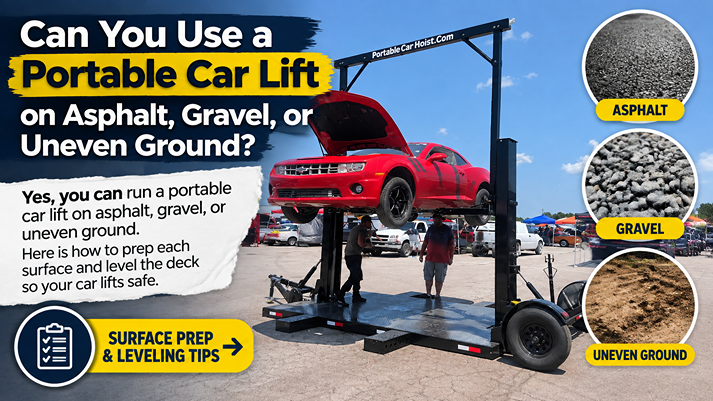
"What if my floor is not perfectly level?" The wide-base design of a professional portable hoist works on any level surface, be it concrete, asphalt, or epoxy. The keyword is "level." If your floor has a significant grade, you level the lift before operating, just as you would with any heavy equipment.
Not all portable lifts are the same. Here is a quick checklist before you commit:
Here is the bottom line. Your shop floor does not have to be a permanent commitment. The right movable car lift lets you build the shop layout that actually matches how your business runs today and change it again when your business grows tomorrow.
No jackhammers. No permits. No concrete bills. No downtime waiting for an inspector to come back out.
You get full professional lift height, the same safety standards as fixed equipment, and the ability to reposition car lift placement whenever you need to, in about the time it takes to drink a cup of coffee.
If you are ready to stop letting your floor make decisions for your shop, we can help you find the right model for your setup.
Schedule a free 15-minute consultation with the Portable Car Hoist team at portablecarhoist.com/contact.