



Jader Gil
Marketing Expert
July 22, 2026
9 min read
Here is the short answer: A well-kept portable car lift typically holds 60–80% of its resale value after several years of use, while a bolted-down two-post lift often sells for far less once you subtract the cost of removal, patched concrete, and freight. I have watched clean, American-made portable hoists change hands at three-quarters of their original price years after purchase, and there is a simple reason for it: the machine walks out the door on its own trailer, so the buyer inherits an asset, not a demolition project.
That single fact changes the math on whether a car lift is an expense or an investment. In this post I will break down exactly what drives resale value, what the used market actually pays, and how to protect every dollar of equity in your lift. If you are still weighing the purchase itself, my ROI and payback calculator pairs nicely with everything here.
Resale value comes down to one question a buyer asks themselves: "How much hassle and cost stands between me and a working lift?" With a permanently installed two-post lift, the answer is a lot. Someone has to unbolt it from the slab, deal with the anchor holes, load several hundred pounds of steel, and pay to ship a machine that was never designed to travel. Every one of those steps is a discount the buyer demands.
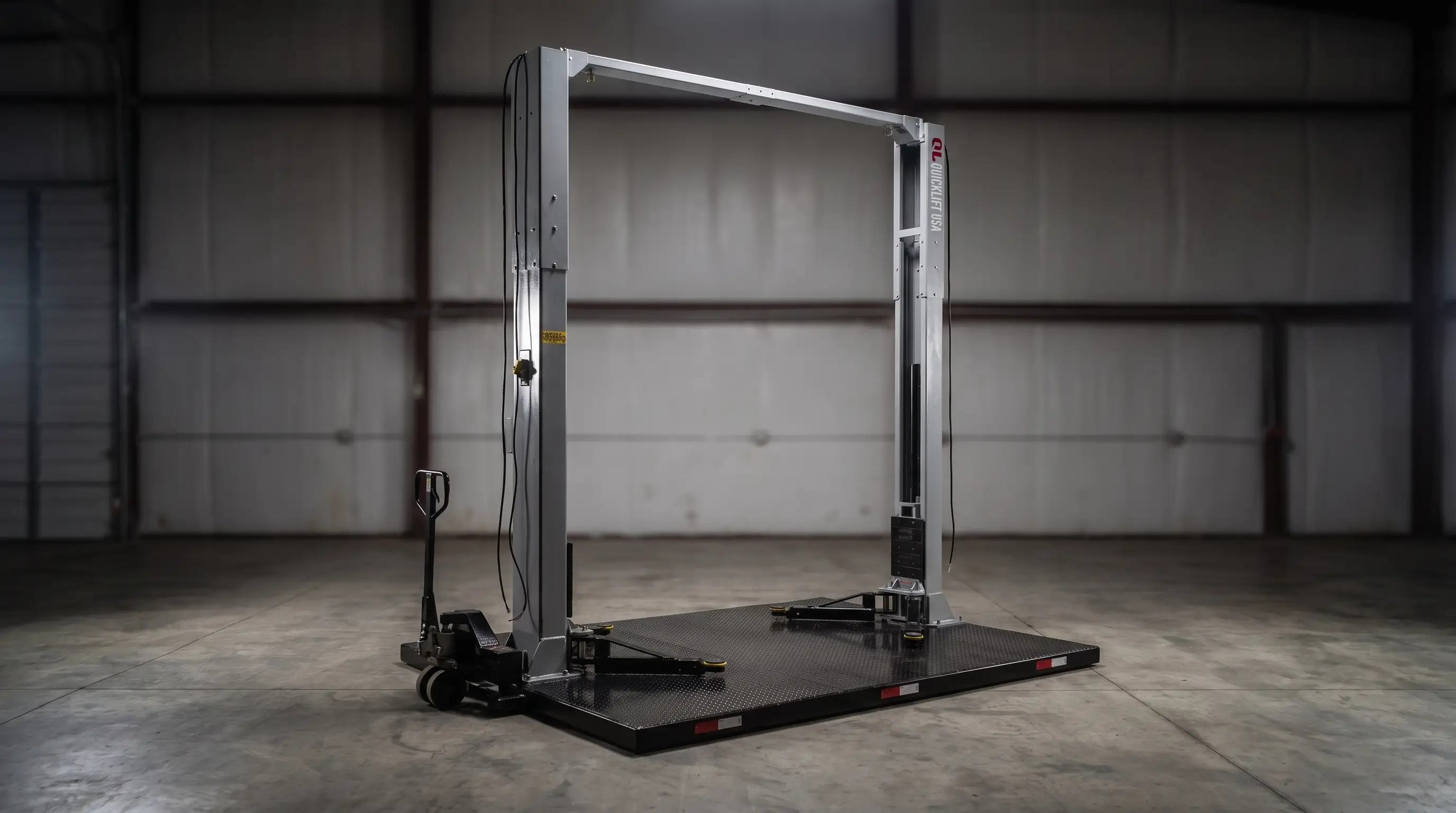
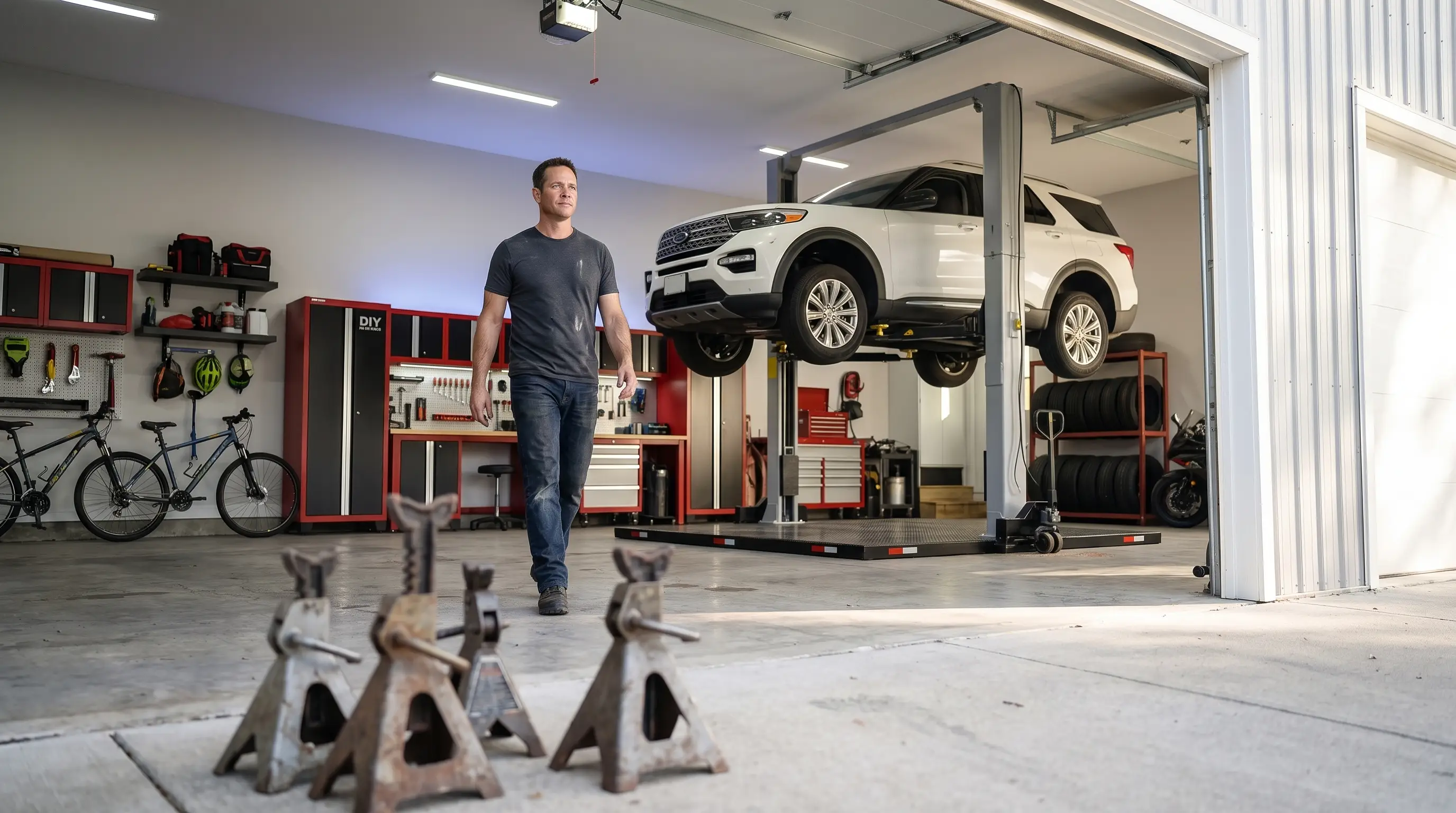
A portable car hoist flips that entirely. It lives on its own black diamond-plate flatbed trailer deck, needs zero concrete and zero anchors, and sets up in about 15 minutes. A buyer can hitch it, tow it home, and be lifting cars the same afternoon. That convenience is worth real money, and it is the biggest reason these units command 60–80% resale, whereas a comparable fixed lift might return 30–40%.
There is a second factor most people overlook: build quality. Our lifts are American-made from heavy-gauge steel with capacities from 8,000 to 76,000 lb. Steel like that does not "wear out" the way a cheap import does. I get into why in American-made vs. cheap import car hoists, but the resale takeaway is simple: durable machines keep working, and machines that keep working keep their price.
Let me put concrete figures on it. Say you buy a mid-capacity portable two-post hoist package. Here is roughly how the value curve tends to play out for a unit that has been maintained and kept clean:
In the first couple of years, a portable hoist behaves a lot like a quality trailer or a name-brand tool. The initial "drive it off the lot" dip is shallow because there is no title depreciation and no model-year obsolescence. Lifting is lifting. A two-year-old unit in clean condition routinely resells in the low-to-mid 80s, percentage-wise.
This is the sweet spot where most used units trade. The lift has proven itself, it is out of the "brand new premium" bracket, and buyers looking for value gravitate here. As long as the hydraulics are healthy and the locks are solid, you are comfortably inside that 60–80% band.
Even well past five years, a maintained American-made hoist holds a surprising floor. Because the frame and cylinders are the expensive parts and they are the parts that last, an older unit that has been serviced does not collapse in value the way electronics or vehicles do.
Pro tip: The single biggest swing factor is documentation. A used lift with service records, the original manual, and photos of a clean locking system sells faster and higher than an identical unit with no paper trail. Buyers pay for confidence.
Not every used hoist sells for the same slice of its original price. A handful of factors do most of the work, and the good news is that nearly all of them are within your control.
Condition of the locking and safety system. This is the first thing a serious buyer inspects. Clean, functional mechanical locks signal a well-cared-for machine. If you want to understand what buyers are checking for, my write-up on safety certification and locking systems is exactly the checklist they use.
Hydraulic health. Smooth, even lifting with no drift or seepage tells a buyer the cylinders and seals are sound. A lift that raises evenly and holds is worth a premium over one that limps.
Cosmetic condition. Surface rust, chipped paint, and a grimy deck do not affect function much, but they scare buyers and crater offers. A power wash and touch-up paint before listing can add hundreds to the final number.
Capacity and versatility. Higher-capacity and more flexible units tend to hold value well because they serve a bigger pool of buyers, from home garages to fleet shops. If you are choosing a capacity now with resale in mind, the complete portable two-post buyer's guide walks through matching capacity to use.
Brand and origin. American-made lifts with a known manufacturer behind them resell better than anonymous imports, because parts, support, and reputation all survive the sale.
When a machine returns most of its value at the end, its true cost of ownership is only the gap between what you paid and what you sell for, plus maintenance. That is a fundamentally different equation than renting, where every dollar is gone the moment you hand it back.
I ran the full comparison of renting vs. buying a portable hoist, and resale is the thumb on the scale that renting can never match. Rent a lift for a few years and you own nothing. Buy one, use it, and sell it, and you have effectively rented it from yourself at a steep discount, then recovered 60–80% of the principal.
Against a fixed lift, the story is even more lopsided. A bolted two-post lift not only resells poorly, but it can cost you money to remove. When you factor that in, the portable's resale advantage over a permanent lift is often larger than the sticker-price difference between the two. I lay out the head-to-head out in portable car hoist vs. two-post car lift.
The best time to think about resale is the day the lift arrives, not the day you list it. A few habits keep your equity intact:
Keep it clean and dry. Wipe down the deck, keep the cylinders free of caked grime, and store it out of standing water when you can. Rust is the enemy of resale.
Service on schedule. Check hydraulic fluid, inspect hoses and seals, and test the safety locks regularly. Keep a simple logbook—even a notes app with dates counts as documentation a buyer will value.
Keep the paperwork. The original manual, purchase invoice, and any capacity plates or certification labels all travel with the machine and reassure the next owner.
Do not over-modify. Buyers want a known, standard machine. Homemade adapters or unapproved modifications can actually lower the price by raising safety questions.
For a deeper view of total cost over the life of the machine—purchase, upkeep, and resale together—the cost and pricing guide ties all three numbers into one picture.
One mobile-service operator I spoke with bought a portable hoist, ran it hard for two years growing the business, then sold it to move up to a higher-capacity model. The lift sold in under a week at roughly 80% of what he paid, to a buyer who towed it away the next weekend. His actual cost for two years of daily lifting worked out to a small fraction of the purchase price—and that is before counting the revenue the lift generated while he owned it. That revenue side is its own story, which I cover in how one shop added $50k in revenue with a single portable lift.
The lesson is not that every lift sells at 80%. It is that a portable, well-maintained, American-made hoist gives you an exit that a fixed lift simply cannot. You are never stuck with it.
A portable car hoist is one of the few pieces of shop equipment that gives most of your money back when you are done with it. Between the 60–80% resale floor, zero installation cost, and the freedom to tow it anywhere, the real cost of ownership is far lower than the price tag suggests. If you want help choosing the right model for the strongest long-term value, Book a Free Quote and we will walk you through capacity, pricing, and what your unit is likely to be worth down the road.
A well-maintained, American-made portable car lift typically retains 60–80% of its purchase price, even several years after purchase. The exact figure depends on condition, hydraulic and lock health, capacity, and whether you kept service records. Fixed, bolted-down lifts usually resell for far less once removal, concrete repair, and freight are subtracted.
Because the buyer inherits a ready-to-use asset instead of a removal project. A portable hoist tows away on its own trailer and sets up in about 15 minutes with no concrete or anchors, while a fixed lift must be unbolted, patched over, and shipped—costing the buyer discounts heavily.
Condition of the safety and locking system, followed by hydraulic health and cosmetics. Documentation is the multiplier: a lift with service records, the original manual, and photos of clean locks sells faster and higher than an identical unit with no paper trail.
Usually, yes. When you recover 60–80% at sale, your true cost of ownership is only the price gap plus maintenance — far less than renting, where every dollar is gone for good. Owning also lets the lift earn revenue for you the entire time you have it.
Portable Car Hoist Cost: ROI & Payback Calculator
Car Lift Rental vs. Buying a Portable Hoist
Portable Car Hoist vs. Two-Post Car Lift
American-Made vs. Cheap Import Car Hoists: Why Quality Steel Saves Lives