

.png)

Jader Gil
Marketing Expert
April 1, 2026
9 min read
Choosing the right car lift for your workshop isn’t just about lifting a vehicle; it's about safety, efficiency, and long-term reliability. Vehicles vary widely in size and weight, from lightweight sports cars like Miatas to massive lifted trucks and heavy-duty SUVs. Without the proper lifting equipment, mechanics and shop owners risk damaging vehicles, overloading equipment, or creating dangerous working conditions. That’s why understanding hoist ratings and matching them with the types of vehicles you service is essential.
This car hoist capacity guide will help you understand how to select the ideal lifting capacity for your garage or professional shop. By considering vehicle weight, wheelbase (the distance between the front and rear axles), and future service needs, you can choose a hoist that handles everything from compact cars to monster trucks with confidence. Whether you’re setting up a new auto shop or upgrading your equipment, selecting the correct capacity ensures safe lifting, smoother workflow, and a smarter long-term investment.
Think about the last time someone grabbed the wrong tool for a job. It either broke, barely worked, or created a safety issue nobody wanted to deal with.
Picking a car lift is the same thing. Buy too light, and you're looking at a dangerous situation the first time a heavy truck rolls on. You've wasted money that could have been used for other shop improvements and purchased far more than you need.
Whether you're a shop owner lifting everything from sports cars to diesel pickups, a mobile mechanic who needs to work anywhere, a car collector protecting a rare build, or an event planner setting up for a race weekend, this post is for you.
Here's the problem most people don't talk about until something goes wrong.
Car hoists are rated to a maximum capacity, but that number isn't a suggestion or a "close enough" threshold. It's an engineering limit. When you exceed it, you're not just risking the hoist. You're risking the vehicle, the person underneath it, and anyone else in that workspace.
According to the U.S. Bureau of Labor Statistics, vehicle lifts and jacks are involved in hundreds of serious workplace injuries each year in automotive settings. The Occupational Safety and Health Administration (OSHA) specifically lists improper load capacity as a leading factor in lift-related incidents.
It's important to note that the weight indicated on your vehicle's sticker often differs from the actual weight your hoist is designed to support.
You need to think about:
So when a shop owner says, "I only lift cars to 5,000 pounds," they're often working from curb weight numbers rather than real-world loaded weights. That gap matters.
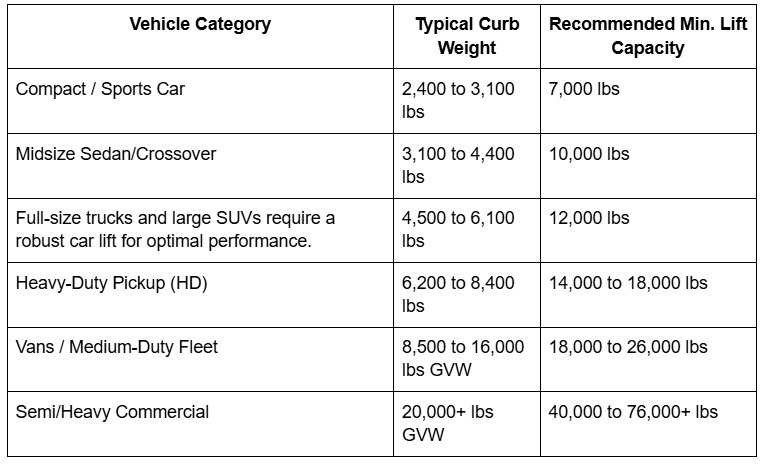
Let's get specific. Here is a realistic breakdown of what you'll be lifting across common vehicle categories.
Curb weight: 2,400 to 3,100 lbs
Real-world lift weight with fluids and driver gear: 2,600 to 3,400 lbs
A 7,000 lb-rated hoist, which is a device used to lift heavy objects, handles this category with ease and gives you room to grow.
Curb weight: 3,100 to 4,400 lbs
Real-world: 3,400 to 5,000 lbs
You should aim for an 8,000 to 10,000 lb-rated lift in this scenario.
Curb weight: 4,500 to 6,100 lbs
Real-world: 5,200 to 7,500 lbs (sometimes more with diesel engines, towing packages, and mods)
You want a minimum of 10,000 lbs of rated capacity for your hydraulic lift. Shops doing a lot of fleet work on these should consider 12,000 to 14,000 lb lifts.
Curb weight: 6,200 to 8,400 lbs
Real-world with loaded bed, fifth wheel prep, diesel engine: 9,000 to 12,000 lbs
You're in the 14,000- to 18,000-pound capacity territory here.
GVW: 8,500 to 26,000 lbs, depending on class
This range requires commercial-grade lift capacity. Portable Car Hoist's larger models go up to 76,000 lbs for serious heavy-duty applications, making them suitable for lifting vehicles like monster trucks and custom builds, which require significant lift capacity.
Let's be honest, most people reading this aren't lifting actual monster trucks daily. But the category is useful because it represents heavily modified, oversized, or custom-fabricated vehicles where factory weight specs mean almost nothing.
For anything in this class, you calculate the load from scratch based on the actual build, not a sticker. And you always add a 20% to 25% safety buffer on top of your calculated weight to ensure you choose a lift that meets safety standards.
Here's something that doesn't get mentioned enough in most buying guides.
Never run a hoist at its rated maximum capacity as a routine practice.
Industry standard across automotive lifting equipment, including guidelines from the Automotive Lift Institute (ALI), recommends working within 80% of rated capacity for regular commercial use. So a 10,000 lb lift should be your choice if you're regularly lifting vehicles in the 7,500 to 8,000 lb range.
This matters even more with portable lifts because of variables like surface grade, vehicle weight distribution, and how often the hoist is being repositioned. The buffer isn't paranoia. It's standard engineering practice.
Yes, and here is why lift height matters for effective vehicle servicing.
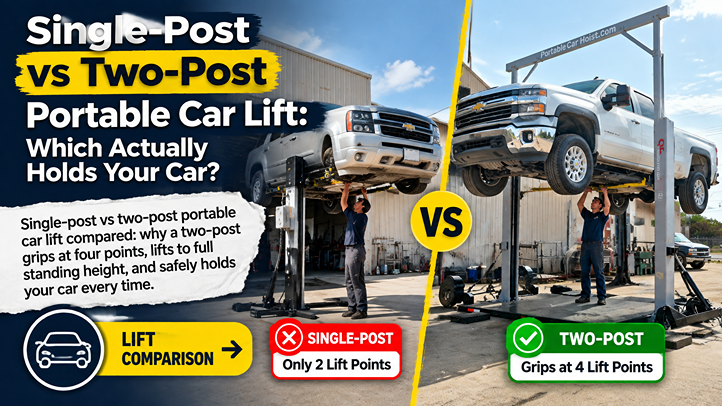
A two-post lift concentrates the load at the contact points under the vehicle's rocker panels or frame. Weight distribution issues show up here faster, especially with vehicles that are significantly front-heavy or have uneven loads across axles.
A four-post lift distributes the load across the tires and a wider platform, which is generally more forgiving with heavier, irregularly loaded vehicles.
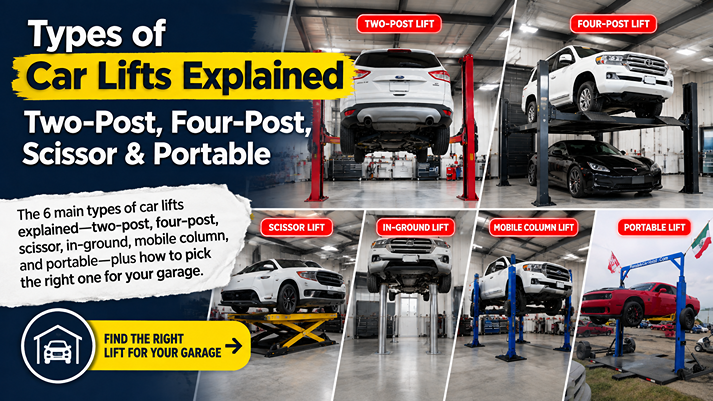
Both types can carry the same rated capacity, but four-post configurations are often preferred for heavy-duty trucks, fleet vehicles, and commercial applications where weight distribution is harder to control.
For shops doing a mix of sports cars and trucks, you're almost certainly going to want access to both configurations at some point.
You're probably servicing a mix of vehicles, including those that require a scissor lift for low-profile access. A light-duty shop doing mostly passenger cars and crossovers can handle most work with a hoist rated for lifting between 8,000 and 10,000 lbs, which is suitable for lighter vehicles. A shop that sees many trucks, fleet vehicles, or diesel work needs at least 14,000 lbs of rated capacity and should think carefully about two-post versus four-post, depending on the mix.
The other thing to think about is throughput. If you're moving multiple vehicles in and out daily, a portable hoist that sets up in minutes and doesn't require a fixed floor location can change your shop workflow significantly. Shops using Portable Car Hoist's models have reported being able to reconfigure their floor layout based on the day's job mix, which is something a bolted-in lift simply cannot do.
Your challenge is different. You don't have a consistent floor, a fixed bay, or a permanent setup. You need a hoist that is rated appropriately for the heaviest vehicle you'll regularly touch, is genuinely portable without a dedicated trailer, and can work on varied surfaces, while also considering ceiling height.
Overbuying capacity here is often smarter than underpaying for something that limits the jobs you can take. A job you must turn down because your equipment isn't rated for a customer's truck results in lost revenue.
Collectors generally work in the lighter end of the weight range unless the collection includes classic trucks, muscle cars with engine swaps, or restomod builds with significant added weight.
The bigger issue for collectors is usually vehicle clearance and pad placement rather than raw capacity. Low-slung classics and sports cars need careful positioning. Four-post lifts are often safer for long-term storage situations since the vehicle rests on its tires rather than contact points.
Capacity requirements at events vary wildly based on the vehicle classes attending. A track day with Miatas and BRZs has completely different lift requirements than a truck and off-road event.
Smart event planners specify lift capacity minimums in their vendor and equipment checklists. Portable hoists are especially useful at events because you're not drilling into rented venue concrete, you're not waiting for an electrician, and you can reposition the setup between sessions.
Here is a practical process you can use right now.
Step 1: Write down the three to five heaviest vehicle types you lift regularly or expect to lift.
Step 2: Look up the curb weight for each. Use the manufacturer's spec sheet, not Google summaries, since those are sometimes wrong.
Step 3: Add 10% to 15% for real-world loaded weight (fluids, modifications, cargo).
Step 4: Take the highest number from that list.
Step 5: Add a 20% to 25% safety buffer on top of that number.
Step 6: That final number is your minimum rated capacity.
For example: Your heaviest regular vehicle is a Ram 2500 with a service body, which requires careful consideration of lift height. Curb weight is 7,200 lbs. Add 15% for loaded weight, getting to 8,280 lbs. Add a 25% safety buffer, and your minimum rated hoist capacity is about 10,350 lbs. So you're shopping for at least a 12,000 lb-rated lift.
One thing that makes portable hoists different from fixed lifts is that you can actually match your equipment to your needs over time without being locked in.
Traditional fixed lifts require you to guess your future vehicle mix at installation time. If you get it wrong, you will either be under-equipped for the incoming jobs or have 20,000 lbs of capacity mostly unused.
Portable Car Hoist's lineup ranges from models suited for passenger vehicles all the way up to 76,000 lb capacity for heavy commercial applications, all without concrete, permits, or floor modifications. That means you can right-size your equipment at any point, add a second unit for a different vehicle class, or move the whole setup to a new location when your business changes.
This car hoist capacity guide comes down to one core idea: precision beats guesswork every time.
Know what you're lifting. Calculate the actual loaded weight. Apply the safety buffer. Match that number to a rated capacity with room to work comfortably.
If you're lifting a weekend Miata at home, a 7,000 to 8,000 lb unit gets the job done cleanly. If your shop handles a mix of trucks, crossovers, and fleet vehicles, you're looking at 12,000 to 18,000 lbs minimum for a post lift. And if your operation touches commercial or semi-class vehicles, you need to be in a completely different tier.
The right capacity isn't just about safety, though that's the most important part. It's also about being able to take every job that walks through the door without hesitation, regardless of lift points.
Get your free consultation at portablecarhoist.com