


Jader Gil
Marketing Expert
October 24, 2026
9 min read
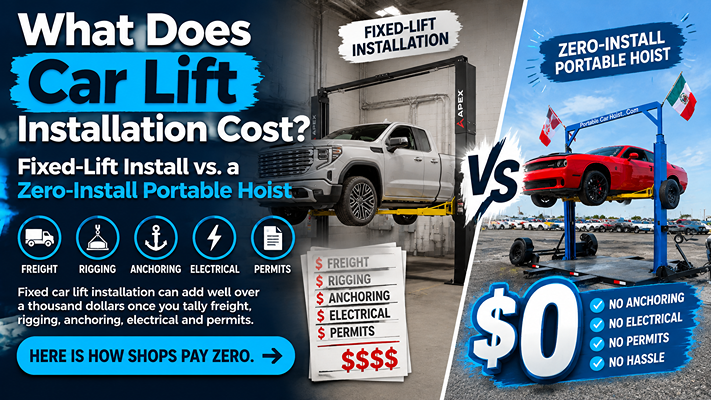
Here is the straight answer: with a traditional fixed car lift, installation is a separate bill, and once you add freight and liftgate delivery, rigging the columns into place, anchoring them into the slab, wiring a dedicated circuit, and any permit or concrete work, that bill commonly runs from a few hundred dollars to well over a thousand — on top of the lift price. A portable two-post hoist costs essentially $0 to install, because it stands on its own diamond-plate trailer deck and you set it up yourself in about 15 minutes. I have watched plenty of shop owners budget carefully for the lift and then get blindsided by the install quote, so let me break down exactly where that money goes — and how you can pay nothing.
When you price a fixed two-post lift, the number on the product page is almost never the number you pay to actually be lifting cars. A bolt-down lift is a piece of construction equipment that becomes part of your building, and getting it there safely takes freight, labor, tools, and in many places a sign-off from your city. Shops searching for car lift installers near me or car lift with installation are really asking one question: what is the all-in cost before I turn the first wrench? The trouble is that the answer hides in half a dozen separate charges that rarely show up on the same page. Let me walk each one.
A fixed two-post lift ships on a pallet that can weigh 1,500 pounds or more. Freight by itself is a real cost, and if you do not have a forklift or a loading dock, you pay extra for a liftgate truck and a driver who can set the crate on the ground. Miss the delivery window and you can get hit with redelivery or storage fees. Then the crate still has to be uncrated and the pieces carried into the bay. None of this has touched the actual installation yet — it is just the price of getting a half-ton of steel from the freight terminal into your shop.
Two-post columns are tall, heavy, and awkward to handle. Standing them upright, squaring them to each other, setting the correct spacing for the vehicles you service, routing the equalizer cables and hydraulic lines, and then bleeding the system is a careful two-person job that most shops hand to a professional crew. That is billable labor by the hour, and the clock keeps running if your floor needs leveling first or your bay layout fights the install. This is the part of the quote that swings the most from one installer to the next, because it depends entirely on your building — and it is the part a portable hoist removes completely, since the geometry is already set at the factory.
This is the step that makes a fixed lift permanent. Installers drill into your concrete and set wedge anchors to hold each column against the full load of a lifted vehicle. That assumes your slab is thick enough and strong enough in the first place — most fixed two-post lifts want roughly four inches of concrete at around 3,000 PSI, and taller or higher-capacity lifts want more. If your floor falls short, you are suddenly paying to saw-cut and pour a proper pad before anyone bolts anything down, which can dwarf the install itself. I break those numbers down in our guide to concrete thickness for a two-post lift, and I lay out the anchor-free alternative in our anchor-free portable hoist overview.
Most fixed lifts need a dedicated circuit, and many run on 220V or three-phase power that your bay may not already have. Running a new circuit means an electrician, materials, and often an electrical permit on top. If your panel is already full, add a subpanel to the tab. It is one more trade to schedule and one more thing that can stall the whole project while a vehicle waits. I get into the voltage and amperage details in does a portable car lift need 220V — the short version is that a portable hoist is built to sidestep this headache entirely.
Bolting a lift into the building and hard-wiring it frequently triggers a building permit, an electrical permit, and an inspection. Fees, plan review, and waiting on an inspector all cost time and money, and if you lease your space, your landlord may demand sign-off before you alter the bay at all. I cover that whole maze in do you need a permit or inspection to add a car lift to your shop. Stack these items together — freight, rigging, anchoring, electrical, and permits — and it is easy to see why the install quote sometimes rivals a meaningful fraction of the lift price itself.
When a shop types car lift installation cost into Google, the honest answer is it depends — and that uncertainty is exactly the problem. Your quote depends on your region’s labor rates, whether the installer has to travel to you, the condition and thickness of your slab, your electrical situation, your local permit fees, and how cleanly the lift fits under your ceiling. Two shops a few miles apart can get wildly different numbers for the identical lift. And that is before you count downtime: a bay that is being drilled, wired, and inspected is a bay that is not billing hours, so the real cost includes the jobs you could not take that week. If you want to understand what drives the price of the machine itself, separate from install, our portable car lift cost and pricing guide lays it out plainly.
Here is the part that changes the math. A portable two-post hoist is engineered so there is nothing to install. The two posts are already mounted and synchronized on a heavy black diamond-plate trailer deck, so the deck — not your floor — carries the load of the vehicle. That single design choice erases most of the line items above in one move.
There is no freight crew needed to wrestle a crate you cannot move, because the unit arrives on its own trailer and rolls into place. There is no rigging or squaring of loose columns, because that geometry is set and tested at our Menifee factory before it ever ships. There is no drilling, no anchors, and no slab spec to meet, because nothing bolts into your concrete — the very same reason it works fine on a shop floor with no concrete requirement. There is no electrician to book, because it is built to run without a special high-voltage circuit. And there is no permit to pull in most places, because a freestanding machine is equipment, not construction. You roll it in, level it, and go: the full setup takes about 15 minutes, and I have detailed exactly how working pros skip installation entirely.
Pro tip: When you compare two lift quotes, make each seller write the installed, running, and inspected price, not just the box price. The moment you force freight, labor, anchoring, electrical, and permits onto the same line, a portable hoist’s zero-install number stops looking like a nice feature and starts looking like real money back in your pocket on day one.
Installation is a one-time charge, but a bolt-down lift keeps costing you in ways a portable never does. It is stuck in one spot, so if you rearrange the shop or move buildings you pay to de-install and re-install it — or you walk away and leave it behind. A portable hoist lets you reconfigure the floor whenever the work demands it, and it can even roll out to a customer site. When you eventually outgrow a fixed lift or close that location, a lift anchored into someone else’s slab is nearly worthless, while a portable unit holds strong resale value you can actually recover. Add it all up and the gap only widens over time. I ran the complete picture in our ROI and payback calculator, and if cash flow is your real concern, our financing options spread the purchase into monthly payments while you still skip the install bill on day one.
I will be straight with you: a permanently anchored lift does have its place. If you own your building outright, already have a thick engineered slab, run a single high-volume bay that will never move, and want the lowest possible profile bolted to the floor, a fixed lift can be the right call — and in that case you should absolutely pay a qualified installer and pull the proper permits rather than cut corners to save a few dollars. Safety is never the place to economize; whatever lift you choose, insist on real mechanical safety locks and proper certification. But if you lease your space, want flexibility, care about the true total cost, or simply do not want to turn a lift purchase into a construction project, a portable hoist wins before the installer ever pulls into your lot. That is a big part of why so many shop owners are switching away from fixed lifts, and why the portable is an easy pick in our small-shop buyer’s guide.
If you take one habit away from this, let it be this: never compare lifts on the box price alone. Ask every vendor to itemize freight and liftgate, delivery and uncrating, rigging and assembly labor, anchoring hardware, any required slab or electrical work, and permit or inspection fees — then compare the bottom lines, not the top ones. Ask who is liable if the installer cracks your slab, how many days the bay will be down, and whether the quote quietly assumes your floor already meets spec. A fixed lift can pass that test for the right shop, but you want the full number in writing before you sign. With a portable hoist, that same worksheet is short: the purchase price, shipping, and nothing else, because there are no floor anchors to set, no trades to coordinate, and it drops straight into a lease-friendly shop with no concrete work. I have seen that clarity alone decide the purchase, which is a big reason so many mechanics skip the installation step altogether.
If the installation quote is the thing holding up your decision, that is honestly the best reason yet to go portable. There is no crew to schedule, no concrete to pour, no electrician to book, and no permit to chase — just an American-made full-height two-post hoist on its own deck, ready in about 15 minutes, backed by capacities from 8,000 all the way up to 76,000 pounds. Tell us your bay and the vehicles you service and we will spec the right model for the work. Book a Free Quote and we will hand you a real out-the-door number — with zero installation line attached to it.
Installation is usually quoted separately from the lift itself. Once you add freight and liftgate delivery, rigging the columns into place, anchoring them into the slab, running a dedicated circuit, and any permit or concrete work, a fixed two-post install commonly lands anywhere from a few hundred to a couple thousand dollars — and it swings widely by region, by installer, and by the condition of your floor. A portable two-post hoist sidesteps that entire line item because it stands on its own trailer deck and you set it up yourself.
No. The whole point of a portable hoist is that it ships ready to run and you set it up in roughly 15 minutes with no anchors, no concrete, and no electrician. There is no installer to schedule, no crew to pay, and nothing to bolt down. If you want the step-by-step, I walk through it in our 15-minute setup guide.
Bolting a fixed lift into your slab and hard-wiring it often triggers a building and electrical permit plus an inspection, though it varies by city and county. A freestanding portable hoist is treated as equipment, not construction, so it usually skips that process. We cover the details in our guide to permits and inspections for a shop car lift.
When you weigh the fixed lift’s sticker price plus freight, install labor, anchoring, electrical, and any slab or permit work against a portable hoist you set up for free, the portable almost always wins on total out-the-door cost — and it keeps winning because you can move it, take it with you, and resell it. Run your own numbers with our cost and ROI payback breakdown.
Why Mechanic Shop Owners Are Switching From Fixed Lifts to a Portable Car Hoist
What Thickness Concrete Do You Need for a Two-Post Lift?
Do You Need a Permit or Inspection to Add a Car Lift to Your Shop?