


Jader Gil
Marketing Expert
August 26, 2026
9 min read
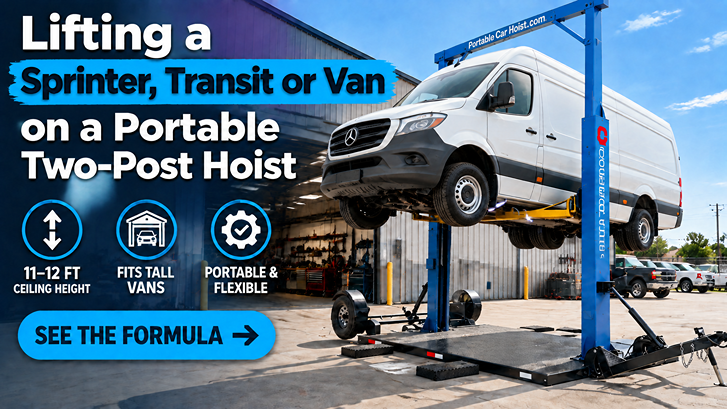
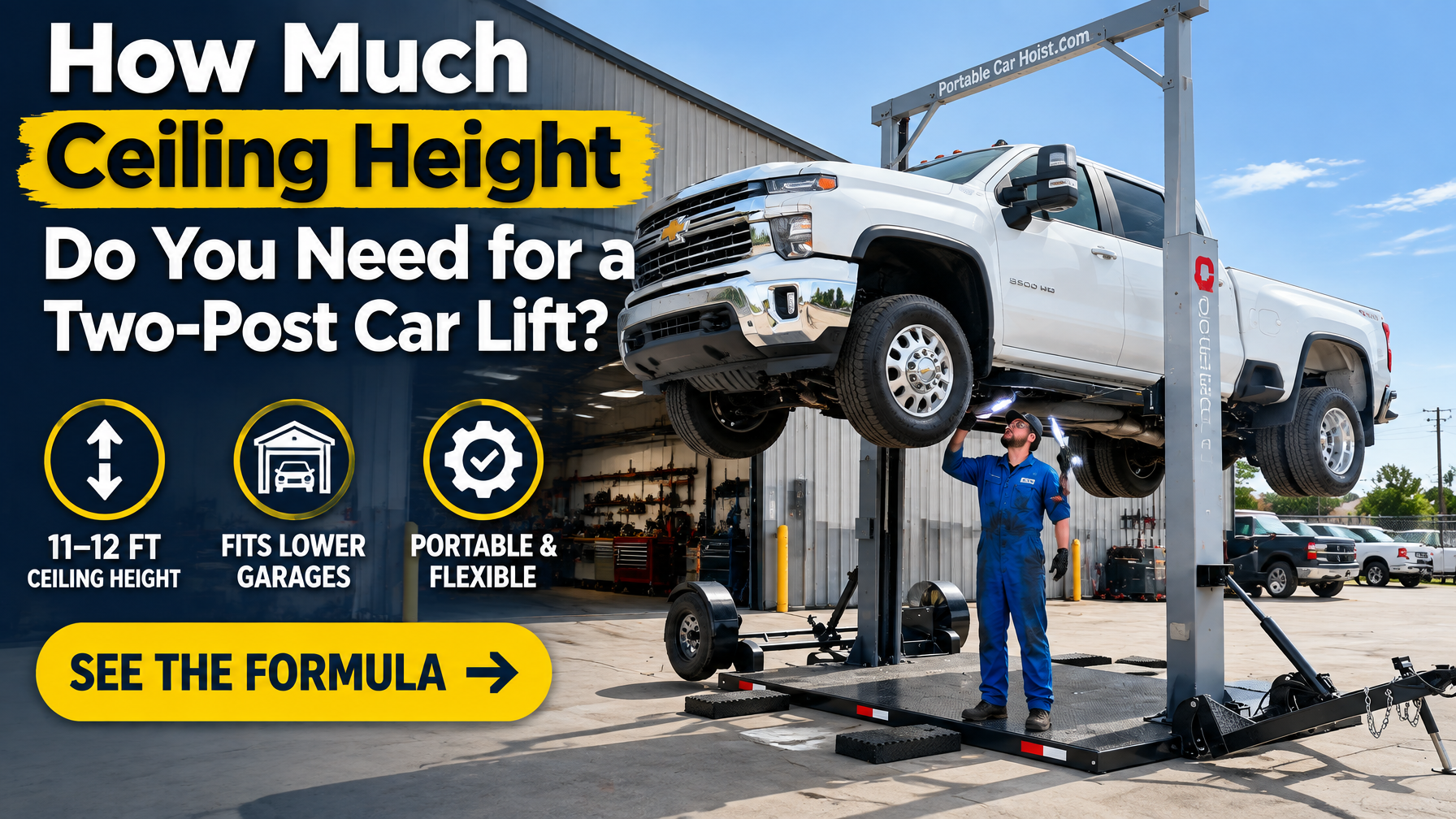
Here's the short answer: for a full-height two-post car lift, you want roughly 11 to 12 feet of ceiling clearance to raise a full-size vehicle all the way up and still walk under it comfortably. Most residential garages are built with 8-foot ceilings, and that gap is exactly why so many people assume a real two-post lift is off the table at home. It isn't. Our full-height portable car hoist rises to a 69–73.5″ lift height, and because it stands on its own trailer deck instead of bolting into a fixed overhead beam, you have far more control over how the numbers work in your space than a traditional in-ground lift ever gives you.
I've walked dozens of shop owners and home mechanics through this exact measurement, and I'll tell you the same thing I tell them: the ceiling number that matters isn't the one on the brochure. It's the one you get when you climb a ladder and measure your lowest obstruction. Let me show you how to figure out your real clearance, why the standard 12-foot rule exists, and how a portable hoist changes the math.
A two-post lift raises the whole vehicle off the ground on a pair of columns. Once the car is in the air, its roof keeps climbing right along with it. So the ceiling has to clear three stacked things at once: the height of the lift structure, the rise you're lifting the car through, and the height of the vehicle itself. Get any one of those wrong and the roof meets the rafters.
That's the whole reason the industry throws around numbers like 11 or 12 feet. A traditional two-post lift with an overhead synchronization bar puts a steel beam across the very top of both columns, and that beam sits higher than any vehicle you'll ever raise. Fixed lifts are engineered around that beam, which is why installers ask about your ceiling before they'll even quote you. If you want the full breakdown of how these machines are built and rated, our complete two-post car lift buyer's guide walks through every spec.
Our portable hoist uses the same two-post lifting principle, but the geometry is friendlier. The synchronized top beam is part of a self-contained frame on a diamond-plate trailer deck, and the lift travels to that 69–73.5″ range rather than the towering full-column rise of a permanently installed unit. You can read exactly how a portable car hoist works — no concrete, no bolts — if you want the mechanical picture.
Forget the marketing number for a second. Here is the math that actually decides whether a lift fits your building:
Minimum ceiling = lift rise height + tallest vehicle height + a safety buffer.
Break it into pieces and it stops being intimidating:
This is how far the carriage travels up. On our full-height hoist that's up to 73.5″ — about 6 feet. At full rise, the underside of a car sits roughly 6 feet off the floor, which is what lets most adults stand upright and work without stooping. That standing-room clearance is the entire point of buying a full-height lift instead of a low-rise pad.
Measure the roof height of the biggest thing you'll ever lift. A low sedan is around 56–58 inches. A crossover or midsize SUV runs 66–72 inches. A lifted pickup or a cargo van can push past 80 inches. This single number swings your ceiling requirement more than anything else.
Always add at least 6–12 inches of margin so a raised roof never kisses a light fixture, a garage-door track, or an HVAC duct. That cushion is also where the top beam of the lift lives.
Run a real example. Say your daily driver is a 68-inch-tall SUV and you want to raise it to full height so you can stand under it. Six feet of rise (72 inches) plus a 68-inch roof would put the top of that SUV around 140 inches — but you don't need to go to full rise to work. Lift it to a comfortable standing height of, say, 48 inches instead of the full 73.5, and the top of the roof lands near 116 inches — a hair under 10 feet. That's the flexibility a variable-height lift gives you that a fixed-height ramp never can.
Pro tip: You almost never have to raise a vehicle to the lift's maximum height. You only raise it until you can work comfortably. That means a garage that can't clear a full-rise SUV can still run the lift beautifully for oil changes, brakes, and suspension work at a lower, roof-safe height. Measure for the job you actually do, not the theoretical maximum.
Eight feet — 96 inches — is tight but not useless. You won't be raising a tall SUV to full stand-up height, but you can absolutely lift a sedan or sports car high enough to get under it for most service. This is the classic case where people wrongly write off a two-post lift entirely. A portable full-height hoist lets you lift only as high as the room allows, so an 8-foot garage becomes workable for lower vehicles. Our guide to space-saving car lifts for a tight one-car garage covers this scenario in depth.
This is the sweet spot for a lot of home mechanics. Nine to ten feet gives you enough room to raise most cars and crossovers to a genuine stand-under height. If you're setting up a home bay, pair the clearance math with our home garage setup and safety guide so the electrical, floor, and clearance all line up before the lift arrives.
This is the professional gold standard. With 11–12 feet you can raise almost anything — full-size trucks, tall vans, SUVs — to full height and still have safe overhead margin. If you're comparing lift styles for a commercial bay, the trade-offs between designs are laid out in our 2-post vs. 4-post lift comparison.
Here's where a portable hoist quietly wins. A fixed two-post lift bolts into one specific slab under one specific ceiling forever. If that ceiling is too low, you're done — the lift can't move. Our hoist lives on its own trailer deck, so the machine goes wherever the clearance is best.
Low garage ceiling but a tall carport or an open driveway? Roll the hoist outside and work under the sky. That mobility is the reason you don't even need a garage to lift a car safely. And because the whole system is anchor-free and needs zero concrete work, you're never committing your building to a single fixed height. If your first spot doesn't clear a big vehicle, you relocate in about 15 minutes instead of hiring a contractor to re-pour a slab.
Ceiling height gets all the attention, but the garage door track is the sneaky clearance-killer. Sectional garage doors ride on horizontal tracks that hang below the ceiling, and open door panels stack up in that same overhead space. Your usable clearance is often the height of the door tracks, not the drywall above them.
Measure from the floor to the lowest point of the open door and its track, not just to the ceiling. Same goes for light fixtures, exposed ductwork, sprinkler heads, and storage racks. The lift only cares about the lowest thing hanging over the vehicle's path.
Sometimes the numbers just don't work — a finished basement bay with pipes overhead, or a garage with a sub-8-foot ceiling and no outdoor option. You still have moves. The first is patience with your measurement: I've seen people condemn a garage over the drywall height when the actual joists gave them another 10 inches between the beams. Measure the true structural clearance, not the finished surface.
The second move is honesty about the work you do. If most of your jobs are wheels-off — brakes, tires, rotors, suspension — you may not need to send the car to full stand-up height at all, and a lower working height opens up spaces that a full-rise fixed lift would rule out. And if the ceiling truly can't clear a proper full-height lift, that's the moment to weigh a low-rise alternative honestly rather than force a bad fit. Because our hoist is portable, though, most people find a taller spot on the property before they have to compromise at all.
While you're measuring up, size up too. The vehicles that need the most ceiling — trucks, vans, big SUVs — are also the heaviest, so your clearance plan and your capacity plan should be made at the same time. Our hoist family runs from 8,000 all the way to 76,000 pounds, and picking the right rating is its own decision. The full rundown from Miatas to monster trucks helps you match capacity to what you drive.
And whatever height you settle on, the lift has to hold the car there safely. Mechanical locking ladders, redundant safety systems, and proper certification are what keep a raised vehicle raised. If safety is on your mind — and it should be — see how our portable lifts stay safe with certified locking systems.
Before you buy any two-post lift, spend ten minutes with a tape measure and answer these:
Measure your true ceiling height at the lowest point over the lift's footprint. Measure the height of your tallest vehicle at the roof. Measure the lowest point of your open garage door and its tracks. Note any lights, ducts, or racks in the overhead path. Then plug those into the formula: rise you need, plus vehicle height, plus a buffer. If you're new to all of this, our plain-English portable car hoist buyer's guide is the friendliest place to start.
A traditional two-post lift wants 11 to 12 feet of ceiling, and that number scares a lot of people out of ever owning one. But a full-height portable car hoist changes the conversation. Because it lifts to a 69–73.5″ range, only rises as high as you need, and can be moved to wherever the clearance is best, it fits garages, shops, carports, and driveways that a fixed lift never could. Measure your lowest obstruction, run the simple formula, and you'll usually find you have more room to work than you thought.
Not sure your space qualifies? That's exactly what we're here for. Tell us your ceiling height and the vehicles you drive, and we'll tell you straight whether a full-height hoist fits — no guessing, no pressure. Book a Free Quote and let's get your car in the air.
Yes, with the right lift and realistic expectations. You won't raise a tall SUV to full stand-up height under 8 feet, but a full-height portable hoist lets you lift lower vehicles like sedans and sports cars high enough to work under them. Because you only raise the car as high as the room allows, an 8-foot garage that can't handle a fixed lift can still run a portable one for most service jobs.
Plan on 11 to 12 feet of clearance to raise a tall truck or SUV to full height with safe overhead margin. Take your rise height, add the vehicle's roof height, then add 6–12 inches of buffer. A 6-foot rise under a 70-inch-plus roof adds up fast, which is why the biggest vehicles drive the tallest ceiling requirement.
No — it usually needs less flexibility from your building, not more. A fixed lift is locked to one ceiling forever. Our hoist rides on its own trailer deck, so if a spot is too low you simply move it to a taller carport, driveway, or bay in about 15 minutes. You match the machine to the clearance instead of pouring a new slab.
Measure the lowest point of your open garage door and its horizontal tracks, since those hang below the ceiling. Also check light fixtures, HVAC ducts, sprinkler heads, and overhead storage racks. Your real clearance is the lowest thing hanging over the vehicle's lift path, not the drywall above it.