

August 8, 2026
9 min read
If you are choosing between a half car lift and a full-height portable car hoist, here is the short answer: a half (low-rise or mid-rise) lift raises a vehicle 24–48 inches, which still leaves you crouched on a creeper, while a full-height portable hoist lifts to 69–73.5 inches so you stand straight up under the car. In my years around shop floors, that difference in working height is the single biggest reason mechanics stop dreading brake jobs and exhaust work. If your back hurts by noon, the lift is the problem — not you.
I have run vehicles up on both kinds of equipment, and I want to walk you through exactly where a half car lift makes sense, where it quietly costs you money and mobility, and why a full-height hoist that needs no concrete and no anchors has become the default for so many home garages and small shops.
The term “half car lift” gets thrown around loosely, so let me define it the way techs actually use it. It usually refers to a low-rise or mid-rise lift — a scissor-style or portable-frame unit that raises the whole vehicle roughly 24 to 48 inches off the ground. Think of the QuickJack and MaxJax family: quick to deploy, easy to store, and genuinely useful for wheel-off jobs.
The appeal is real. A half lift is light, it tucks away, and it gets your tires off the floor faster than jack stands ever will. For rotating tires, swapping brake pads, or pulling wheels, it is a night-and-day upgrade over crawling around on the ground. If you have ever read why jack stands are dangerous, you already know that any stable lift beats balancing a car on steel pins.
But “half” is the operative word. You are lifting the car halfway to where you actually need it. And that gap — the couple of feet between a mid-rise lift and true full standing height — is where the frustration lives.
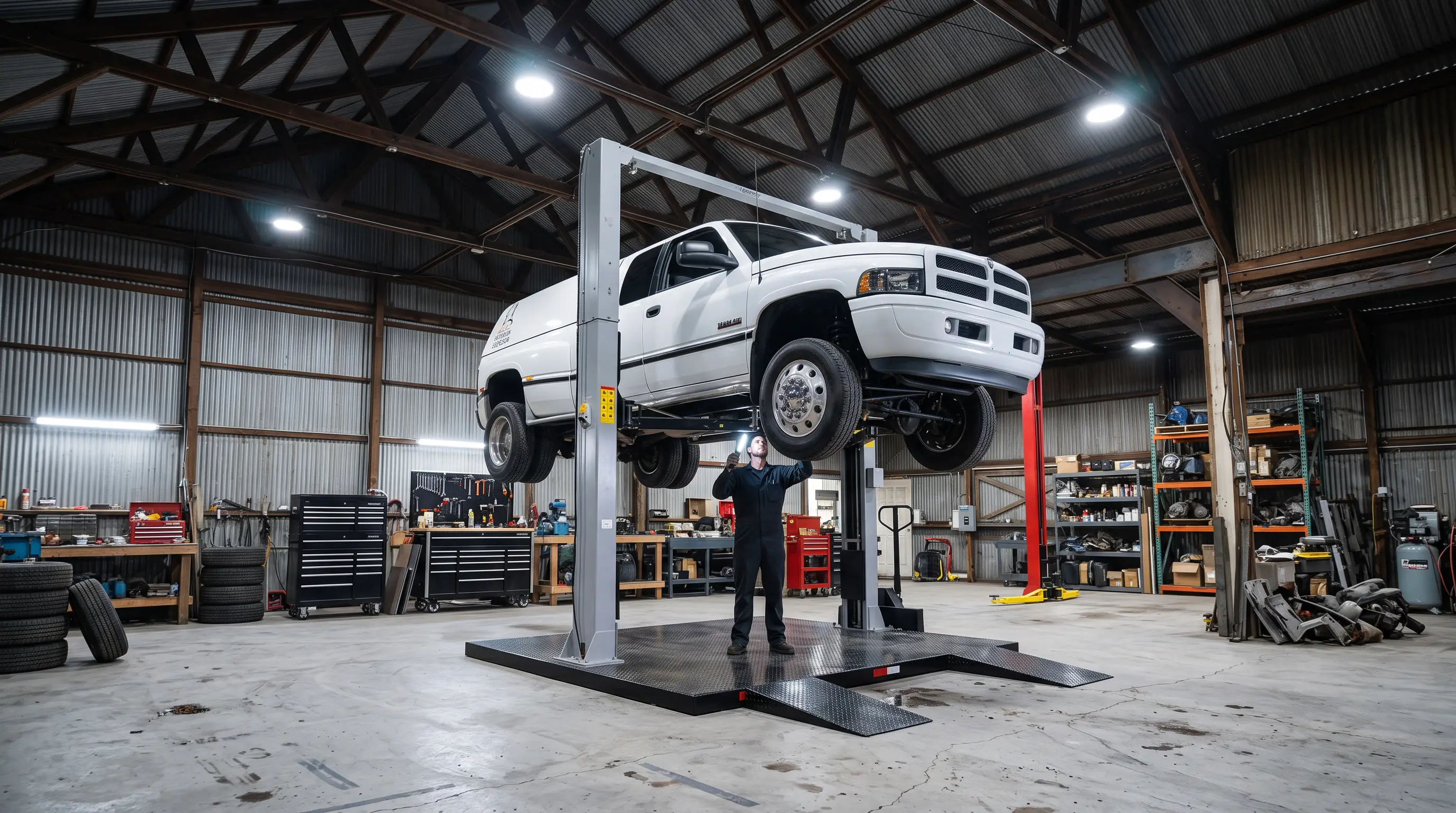
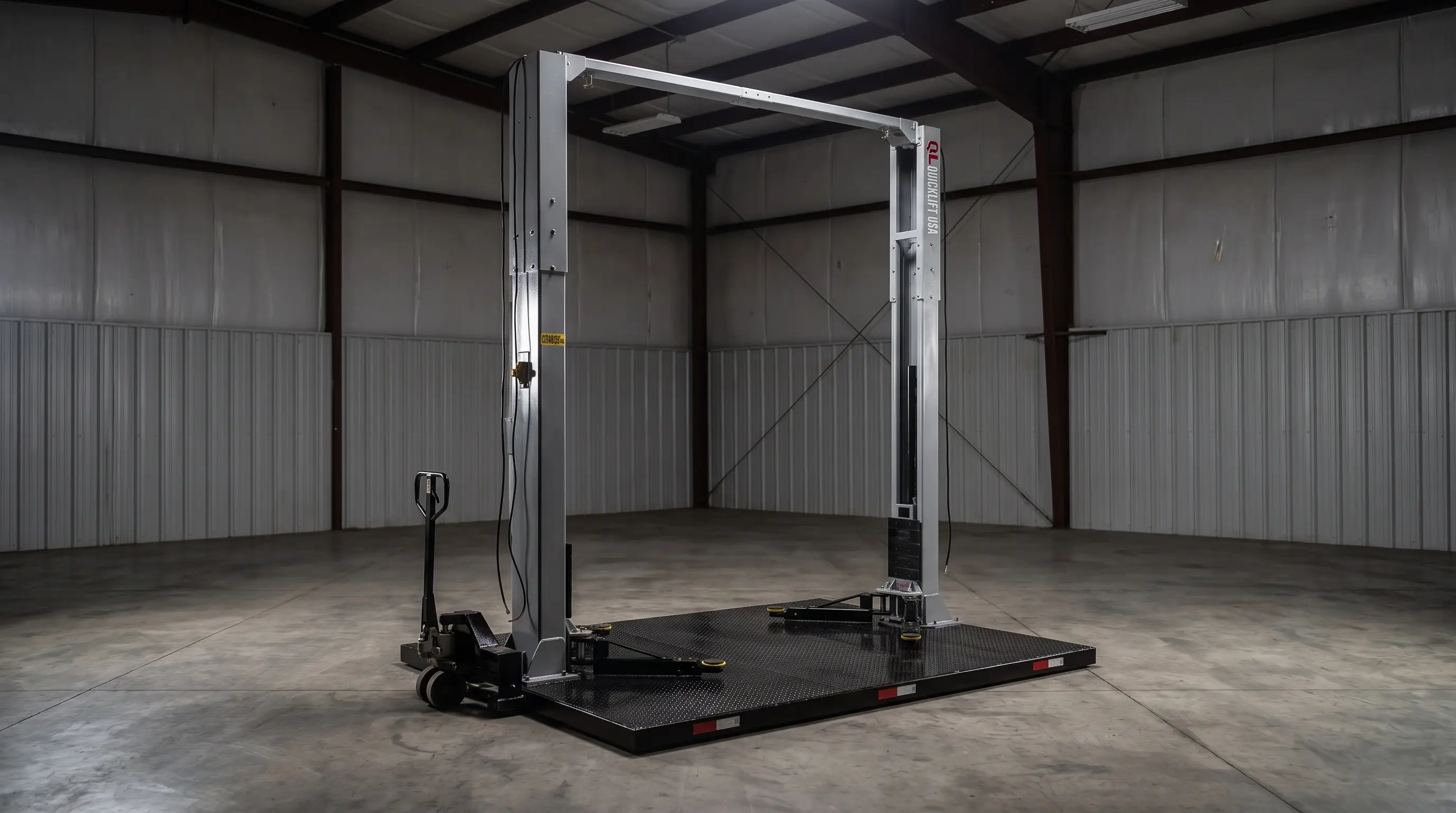
A full-height portable two-post hoist raises the vehicle to 69–73.5 inches. That is chest-to-eye level for most of us. You walk under the car, you stand upright, and you work with both hands over your head or straight in front of you instead of contorted under a machine.
Here is what that unlocks in practice:
Undercar access that half lifts can't touch. Transmission drops, exhaust systems, fuel tanks, driveline work, full underbody inspections — these need real clearance. On a mid-rise lift you are still on a creeper for most of it. On a full-height hoist, you roll a transmission jack under and never kneel.
Speed. Every time you have to stop, reposition, crawl out, and crawl back in, you lose minutes. Multiply that across a day and a half lift can quietly cost you a whole job's worth of billable time. Standing work is faster work.
Your body. This is the one nobody puts on a spec sheet. Kneeling on concrete, twisting your neck, and holding parts overhead from a crouch wrecks knees and lower backs. Standing under a full-height hoist is the difference between finishing the day tired and finishing the day injured.
The old objection to full-height two-post lifts was always installation: bolting into a thick concrete slab, pulling permits, and never moving the thing again. The portable full-height hoist erases that. It mounts on its own diamond-plate trailer deck, so it brings its own foundation. If you want the mechanical details, I broke down how a portable car hoist works with no concrete and no bolts in a separate guide.
This is the whole ballgame. A half lift gets you 24–48 inches; a full-height hoist gets you 69–73.5 inches. If the majority of your work is wheels-off (tires, brakes), a half lift is adequate. If you touch anything underneath the car with any regularity, the full-height hoist pays for itself in comfort alone.
Half lifts are usually built around cars and light trucks. Full-height portable hoists span a much wider capacity range — from 8,000 lb all the way up to 76,000 lb for heavy-duty models — so the same platform handles a Miata today and a dually tomorrow. If you are unsure which rating you need, this guide on picking the right hoist capacity walks through it.
Both are portable, which is why people cross-shop them. A half lift is lighter to carry. But a full-height portable hoist sets up in about 15 minutes and, because it lives on a trailer, you can tow it to a customer's driveway or reposition it across the shop without dollies. That mobility is exactly what makes it a fit for the mobile mechanic who takes the shop to the customer.
A traditional full-height two-post lift demands 4–6 inches of anchored concrete. Half lifts are gentler on the floor, which has long been their selling point for renters and thin slabs. The portable full-height hoist matches that advantage — zero anchors, zero drilling — so you get standing height and a floor you never touch. That is a big deal for lease-friendly shop setups where you can't modify the building.
Sticker-to-sticker, a half lift is cheaper up front. But cost per useful hour is a different math. If a lift keeps you crouched for half your jobs, you are paying for a tool that only solves half the problem. I lay out real numbers in the portable car lift cost and pricing guide, and if budget is the sticking point, financing a full-height hoist often lands at a monthly payment smaller than the time you are losing.
Pro tip: Before you buy anything, spend one week logging your jobs and marking each one “wheels-off” or “under-car.” If more than a third of your work is under-car, a half lift will frustrate you within a month — buy the height once instead of buying the half lift and then upgrading anyway.
I am not here to bash half lifts. They earn their place in three situations. First, if you truly only do tires, brakes, and quick wheel-off jobs and never plan to go deeper, a mid-rise lift is enough. Second, if ceiling height is the hard limit — some garages simply can't fit a car raised to 6 feet plus the car's own height — a low-rise lift may be your only option. Third, if you need something one person can lift and carry into a closet, a compact half lift wins on pure stowability.
If any of those describe you, a half lift is a smart, honest tool. Just go in knowing what it won't do. For a deeper look at that exact tradeoff, I compared a QuickJack against a full-height portable hoist for when low-rise just isn't enough.
Go full-height if you do any real volume of under-car work, if you want to service a wide range of vehicles on one machine, or if your body has already told you that crouching all day is not sustainable. Go full-height if you are running a small shop and want a lift that raises billable throughput instead of capping it. And go full-height if you rent your space or have a slab you can't drill — because the portable version removes the one reason people used to settle for less.
If you are weighing specific models, two more comparisons are worth your time: MaxJax vs. the portable car hoist and the broader portable car hoist vs. a traditional two-post lift. And if you are setting up in a tight bay, these space-saving options for a one-car garage show how full height still fits.
Let me make this concrete, because spec sheets don't tell you how a tool feels at 4 p.m. Picture a Saturday with five jobs: two tire rotations, a brake job, an exhaust repair, and an oil change with an underbody inspection.
On a half car lift, the two rotations and the brake job go great — wheels come off at a comfortable height, you're happy. Then the exhaust job starts and you drop to a creeper, sliding in and out three or four times to get angles on the clamps. The underbody inspection means more crawling. By the last job your knees are done, your neck is stiff, and you've spent as much time repositioning your body as turning wrenches. You finished, but you paid for it.
On a full-height hoist, the same five jobs flow without you ever touching the floor. Wheels off at eye level, exhaust work standing up, inspection done by simply walking the length of the car and looking up. You end the day with something left in the tank. That is the intangible that shows up in your throughput and, over years, in your joints.
One honest planning note that catches people: full-height means the car goes up to roughly 6 feet, and then you add the height of the vehicle itself. In a standard garage that's usually fine, but measure your ceiling before you buy. A tall SUV raised to full height can need well over 9 feet of clearance. If your ceiling truly can't accommodate it, that is one of the few legitimate reasons to choose a mid-rise half lift instead — and it's better to know that now than after delivery. For tight spaces, I'd still start by reviewing space-saving lift options for a one-car garage before assuming full height won't fit.
People assume any lift is safer than jack stands, and that's true — but the two categories aren't equal to each other either. A full-height two-post hoist holds the vehicle on its frame with mechanical locking positions, giving you a stable, walk-under platform. Whatever you choose, look for solid locking systems and quality steel, and understand what the certifications on the label actually mean. If you're new to that, this primer on portable car lift safety and ALI certification is worth ten minutes. The point is simple: buy on build quality and locking design, not just on price, because you're going to stand under this thing.
A half car lift solves the “get the wheels off” problem. A full-height portable hoist solves the “stop kneeling and actually work on the car” problem — and it now does it with no concrete, no anchors, and a 15-minute setup. If your work stays at the wheels, save the money. If it goes under the car, buy the standing height the first time. The cheapest lift is the one you don't have to replace when you outgrow it.
Want help matching a capacity and configuration to the vehicles you actually service? Book a Free Quote and we'll walk through it with you — no pressure, just straight answers from people who build these things in Menifee, California.
A half car lift (low-rise or mid-rise) raises a vehicle roughly 24–48 inches off the ground, which is enough for wheels-off work but still leaves you crouching for anything underneath. A full-height portable hoist raises the vehicle to 69–73.5 inches so you can stand upright and walk under the car. The practical difference is undercar access and working comfort.
Not comfortably. Mid-rise lifts leave only a couple of feet of clearance, so transmission drops, exhaust systems, and driveline work still put you on a creeper. If you regularly do under-car jobs, a full-height hoist is the tool that actually lets you stand and work with both hands free.
No. A traditional full-height two-post lift needs 4–6 inches of anchored concrete, but a portable full-height hoist mounts on its own diamond-plate trailer deck. It brings its own foundation, so there is zero drilling, zero anchoring, no permits, and about a 15-minute setup — the same floor-friendly advantage half lifts are known for, but with full standing height.
If more than about a third of your work is under the car, yes. A half lift costs less up front but only solves the wheels-off half of the problem, so many buyers end up upgrading anyway. Buying the standing height once is usually cheaper than buying a half lift and then replacing it. Financing options can make the monthly cost smaller than the time you lose crouching.