


Jader Gil
Marketing Expert
October 3, 2026
9 min read
Yes, you can lift a Mercedes Sprinter, Ford Transit, or any tall cargo van on a portable two-post hoist — as long as you respect three numbers: the van’s real weight, your lift’s rated capacity, and your overhead clearance. Here’s the number that surprises most shop owners I talk to: a full-size cargo van rolls off the scale between roughly 5,000 and 6,500 pounds empty, which sits comfortably inside the 8,000–11,000 lb range of our Model C portable hoist. The van looks huge, but it usually weighs less than a loaded dually pickup.
I’ve spent a lot of time helping mobile mechanics, fleet shops, and van upfitters figure out whether a portable lift will actually hold their biggest vehicles. The honest answer is “almost always yes” — but only after you check the right specs. Let me walk you through exactly what to measure before you raise a tall van off the ground.
A two-post hoist does not care how tall a vehicle is. It lifts from the chassis, carries the load through its columns, and holds it on mechanical safety locks. A Sprinter and a sedan both hang from the same arms. What changes with a big van is the weight you put on those arms and the room you need above the roof — not the lift’s ability to raise it.
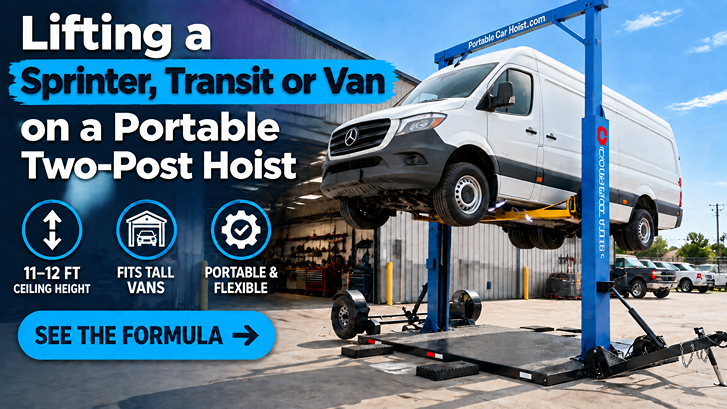
That is why a full-height portable two-post hoist is such a strong match for van work. It gets you standing fully upright under a 19-foot Sprinter instead of rolling around on a creeper, and it does it without a single anchor bolt in the floor. If you already service lifted pickups and duallies, a tall van is the same conversation with a different silhouette — I cover the pickup side of it in our guide to the portable truck lift for lifted pickups and duallies.
This is where people get tripped up, because a van has two very different weight figures and only one of them matters for lifting.
Curb weight is what the van weighs empty, with fuel and no cargo. That is the number you lift on, because you service a van empty — shelving cleared, no payload. GVWR (gross vehicle weight rating) is the maximum the van is ever allowed to weigh fully loaded, and it is always much higher. You do not lift at GVWR.
Here is the real-world range for the vans I see most:
A Mercedes Sprinter 2500 runs about 5,000–5,900 lb at the curb. A Ford Transit sits around 4,900–5,800 lb empty depending on roof and wheelbase. A RAM ProMaster lands near 4,600–5,400 lb. Even a long, high-roof configuration almost never crosses 6,500 lb empty. Every one of those fits inside the Model C’s 8,000–11,000 lb window with a real safety margin.
The time to step up in capacity is when you are lifting a van that stays loaded — a plumber’s rig packed with fittings, a locksmith van, or a Sprinter 3500 that lives near its 11,000+ lb GVWR and cannot be fully emptied. Our hoist line runs all the way to 76,000 lb, so the fix is simply choosing the right model, not giving up on portability. If you are unsure which capacity fits your fleet, our guide to picking the right car hoist capacity walks through the math, and our portable truck and van lifts for fleets and dealerships piece covers mixed fleets.
Pro tip: Don’t guess your van’s weight off a brochure. Drive it across a certified scale (most truck stops have one, or a CAT scale costs about $15) with the van emptied the way you’d service it. Write that number on a sticker inside the door jamb. You’ll reference it every time you lift, and it ends the “will it hold?” question for good.
Weight is rarely the wall. Overhead clearance is. A high-roof Sprinter stands about 9 feet 2 inches tall. A high-roof Transit is close behind at roughly 9 feet 1 inch. Now raise that roof six feet into the air to get the chassis to a comfortable working height, and you are looking at 15 feet or more from floor to roofline.
The formula is simple: van height + how high you lift + a safety gap = the ceiling you need. Lift a 9’2” Sprinter four feet off the ground and you’re already past 13 feet at the roof. Most standard commercial bays run 12 to 14 feet, so a tall van often needs either a partial lift, a taller bay, or — the move I recommend most — outdoor setup. If low ceilings are your constraint across the board, our breakdown of the ceiling height needed for a two-post car lift gives you the exact clearances.
This is where a portable hoist quietly wins the van game. Because it mounts on its own trailer deck and needs zero concrete and zero anchors, you can roll it out of a tight bay and raise a tall van under open sky — in the yard, on the apron, or at a customer’s fleet lot. Ceiling height stops being a problem the moment the ceiling is the sky. I explain why the whole thing works without drilling in how a portable car hoist works, and you can run it on surfaces that aren’t perfect shop floors — see using a portable car lift on asphalt, gravel, or uneven ground.
Lifting a van safely is all about putting the pads on structure, never on sheet metal or a plastic rocker cover. Vans split into two camps here, and it changes where you set the arms.
The Mercedes Sprinter is body-on-frame, so it has honest frame rails running the length of the van — strong, predictable lift points, much like a truck. The Ford Transit and RAM ProMaster are unibody, so you lift at the factory pinch-weld pads and reinforced jack points, the same way you would a car, just heavier. Either way, the rule is the same: match the pads to the manufacturer’s designated lift points, which live in the owner’s manual and are usually marked under the rockers.
Long-wheelbase vans (the 170-inch Sprinter, the extended Transit) spread those points far apart. A full-height two-post hoist with swing arms reaches them because the arms telescope and rotate to find the structure — the same adjustability that lets it grab a short sedan or a long van. For a deeper look at reading lift points on a heavy, oddly-balanced vehicle, our guide to lifting an EV on a two-post hoist covers jack-point discipline that applies directly to vans.
Once the pads are set, raise the van a few inches, stop, and shake-test it before you go higher. Then take it up and let it settle onto the mechanical safety locks. Those locks — not the hydraulics — are what hold the van while you work. If lock systems and certification matter to you (they should), read are portable car lifts safe.
The reason this matters isn’t bragging rights — it’s the work you unlock. A van flat on the ground hides almost everything that pays. Get it up to chest height and the whole underside opens up.
Brake and suspension jobs stop being a wrestling match — you can reach both sides of the axle, swing a caliper off, and torque to spec standing up. Exhaust and fuel-tank work, which on a long van means dropping heavy components, becomes a controlled, two-hands-free operation instead of a balancing act over your face. Oil changes, transmission service, and differential work all happen at eye level. For the growing number of electric Sprinters and E-Transits coming into shops, battery-pack inspection and undercarriage sensor work demand clean, square access to the floor pan — exactly what a full-height two-post gives you.
Rust is the other big one. Commercial vans live outdoors and rack up miles in road salt, so underbody inspection and rust treatment are recurring revenue. You can’t sell what you can’t see, and you can’t coat a frame you’re lying on. Up on the hoist, you walk the whole underside with a light and a camera, show the customer the photos, and quote the work on the spot. That is throughput and trust in one lift — and it’s why shops that add real lifting capacity for vans tend to grow their commercial book fast.
Vans are a mobile-service goldmine — fleets don’t want their vehicles driven across town for a brake job, they want you to come to the yard. A portable full-height hoist lets you bring real, stand-up lifting to the customer instead of crawling under a Transit on the gravel. That is the whole premise behind taking your shop to the customer and building a mobile mechanic van that lifts cars anywhere.
It also fits the lease-friendly, no-permit reality most van shops live in. No drilling means no landlord fight and no slab engineering — see a two-post car lift without concrete. And it sets up fast between jobs; I timed the whole process in how to set up a portable two-post lift in 15 minutes. When the numbers need to pencil out for a growing van operation, our car lift financing guide shows how a single lift pays for itself on throughput alone.
Service a van standing up, in your own yard, with no concrete under it — that is the difference between taking van work and turning it away.
If your shop or mobile operation turns wrenches on Sprinters, Transits, ProMasters, or a mixed van fleet, a portable full-height hoist is the piece of equipment that lets you say yes to all of it. Tell us your vans and your typical weights, and we’ll point you to the exact capacity that fits. Book a Free Quote and let’s get your tall vans off the ground the right way.
You should service a van empty, and an empty Sprinter runs about 5,000–5,900 lb — well inside the Model C’s 8,000–11,000 lb range. If you truly must lift a van that stays near its 11,000+ lb GVWR, step up to a higher-capacity model (our line goes to 76,000 lb). Always weigh the van on a scale first and lift on curb weight, not GVWR.
Add the van’s height (about 9’2” for a high-roof Sprinter), the lift travel you want, and a safety gap. That often lands past 13–15 feet, more than most 12–14-foot bays. The portable fix is to set up outdoors, where ceiling height no longer limits you — one of the biggest reasons van shops choose a portable hoist.
On the manufacturer’s designated lift points only. A body-on-frame Sprinter lifts on its frame rails; a unibody Transit or ProMaster lifts at the factory pinch-weld pads. Check the owner’s manual, set the pads to structure, raise a few inches, shake-test, then settle onto the mechanical safety locks.
Yes — that is one of its best use cases. Because it needs no concrete or anchors, you can bring it to the fleet yard and service vehicles on site, then tow it to the next location. For mixed fleets, match the hoist capacity to your heaviest van and you’re covered across the board.