


Jader Gil
Marketing Expert
October 21, 2026
9 min read
Here’s the short answer most shop owners are hoping for: if you buy a portable, freestanding car hoist that sits on its own trailer deck, you almost never need a building permit or a structural inspection to start using it. If you install a permanent, bolted-down two-post lift, you usually do — because the moment you anchor steel columns into your slab, most jurisdictions treat it as permanent construction. That one difference can be the gap between lifting cars this afternoon and waiting three to six weeks for a plan review, a permit, and a sign-off.
I talk to independent shop owners, mobile mechanics, and guys leasing a couple of bays almost every week, and the permit question stops more of them than the price does. So let me walk through what actually triggers a permit, what an inspector looks for, why a landlord is often the bigger hurdle than the city, and how a portable full-height hoist sidesteps most of it. None of this is legal advice — codes vary by city and county — but it’ll tell you exactly what to go confirm before you commit.
These get blurred together, but they’re separate steps, and a portable hoist changes your exposure to each one.
A building permit is permission to do the work. For a car lift, the permit is usually tied to one thing: are you altering the building? Anchoring a fixed two-post lift means drilling into the structural slab and bolting down columns that will carry a loaded vehicle overhead. That’s a permanent modification, and most building departments want to see it on paper before it happens.
An inspection is someone from the city verifying the work was done to code — correct slab thickness, correct anchors, correct torque, sometimes an electrical sign-off for the power unit. Fixed lifts frequently get both a plan review on the way in and a physical inspection after install.
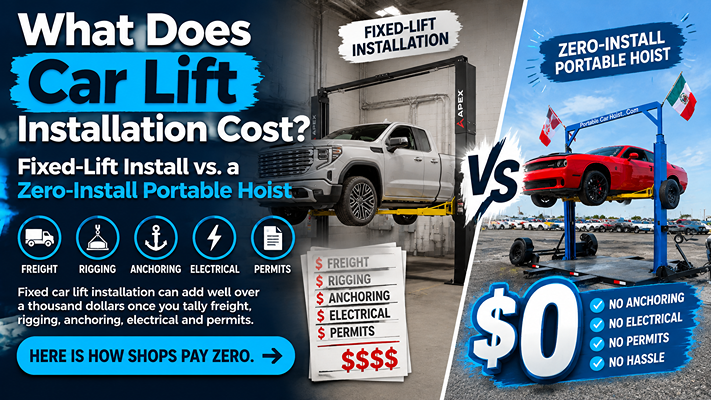
A portable, anchor-free hoist short-circuits this because there’s nothing permanent to permit. You’re not pouring concrete, not drilling anchors, not modifying the building. You’re rolling in a piece of equipment the same way you’d roll in a floor jack, an air compressor, or a transmission jack — nobody permits those. Our own hoist lives on a black diamond-plate trailer deck and sets up in about 15 minutes with zero concrete, zero anchors, and zero drilling, which is the whole reason it reads as equipment instead of construction. If you want the mechanics of that, here’s how a portable car hoist actually works without concrete or bolts.
From everything I’ve seen shop owners run into, permits get triggered by a handful of specific things — and most of them are about attaching to the building, not about the lift itself.
This is the big one. The second you bolt columns to the floor, you’ve created a permanent anchored structure that holds a car in the air. Building departments care because a failure is a life-safety event. They’ll often want to confirm the slab is thick enough and strong enough — typically a minimum around four inches at 3,000 PSI for a standard two-post, more for higher-capacity or taller columns. If you’re weighing a fixed install, read what thickness of concrete a two-post lift really needs first, because a thin or cracked slab turns a simple install into a pour-and-cure project with its own permit.
A freestanding hoist carries its own load path through its trailer deck, so there’s nothing going into your floor. That’s also why it works on slabs you’d never be allowed to drill, like post-tension slabs or a floor with radiant heat lines in it.
Hard-wiring a 220V/240V circuit for a fixed lift’s power unit is often its own permit and its own inspection. A lot of portable units dodge this too — ours runs on a standard outlet or battery depending on the model, so there’s no electrician and no electrical permit for most shops. I broke the power side down here: does a portable car lift need 220V?
If your space isn’t already zoned or classified for vehicle repair — say you’re converting retail or warehouse into a service bay — that’s a bigger conversation with the city than the lift alone, and the lift just rides along with it. Equipment you can wheel back out doesn’t change the building’s classification the way a bolted-in installation can.
Pro tip: before you call the city, ask them one precise question: “Do I need a permit to use a freestanding, non-anchored vehicle lift that is not attached to the building or the slab?” Framed that way, most building departments will tell you it’s equipment and outside their permit scope. Ask the vague version — “do I need a permit for a car lift?” — and you’ll often get a reflexive yes aimed at fixed installs.
Here’s the part nobody warns leaseholders about: even when the city doesn’t require a permit, your lease might stop you cold. Most commercial leases have a clause about alterations and “attachments to the premises.” Drilling anchors into the landlord’s slab is a structural alteration — you’ll typically need written landlord consent, sometimes a bond, and often a promise to remove the lift and patch the holes when you leave.
That’s a genuine problem if you’re in a 3- or 5-year lease and not sure you’ll renew. You’re paying to install something you can’t take with you, and you may be paying again to rip it out at move-out.
A portable hoist is the clean way around this. Nothing is attached to the premises, so it generally falls outside the alterations clause entirely — and when you move or renew somewhere else, the hoist comes with you on its trailer. That lease-friendliness is exactly why I see so many leaseholders choose this route; I went deeper on it in the lease-friendly two-post setup with no concrete and in why a mechanic’s shop doesn’t need to pour concrete at all. It’s also a big reason shop owners are switching off fixed lifts.
The same logic helps mobile and multi-location operators even more. If you run a mobile mechanic business out of a leased unit or a home-based shop, or you’re opening a second bay across town, anchoring a fixed lift at every spot is a non-starter — you’d be permitting and paying for installs you can’t move. One freestanding hoist follows the work: it services at the leased bay this week and loads onto the trailer for a fleet job across town the next, without a single permit application or a landlord signature along the way.
Whether or not a permit is required, you still answer to one real authority every day: safety. An OSHA walk-through or an insurance audit doesn’t care whether your lift is bolted or portable — it cares whether it’s rated, maintained, and operated correctly. That bar is the same either way, and a quality portable hoist is built to meet it.
What gets scrutinized in practice:
Load rating and capacity. The lift has to be rated for what you put on it. Our range runs from 8,000 lb up to 76,000 lb across models, so matching capacity to your vehicle mix is straightforward — here’s how to pick the right capacity.
Mechanical safety locks. Inspectors and insurers want positive mechanical locks, not hydraulics alone, holding the car. Certification and locking systems matter here — I covered what to look for in are portable car lifts safe.
Clearance and operation. Enough overhead and side clearance to run it safely. If you’re tight on height, check how much ceiling height a two-post lift needs before you buy either type.
The honest point: “portable” does not mean “unregulated” or “lower standard.” It means the safety lives in the machine instead of in your slab. You still train your techs, you still follow the lift-point diagram, and you still settle the car onto the mechanical locks before anyone goes under it.
When shop owners price a fixed lift, they price the lift. They forget to price the permission. A fixed two-post install can carry: the building permit fee, an electrical permit, a possible engineer’s letter on the slab, the plan-review wait, the install labor, and the inspection sign-off before you can legally use it. Depending on your city, that’s weeks of lost production and hundreds to a few thousand dollars on top of the lift — before the first car goes up.
Every one of those line items is downtime. For a shop, downtime is the expensive part, because a bay that isn’t lifting cars isn’t billing hours. A portable hoist you can run the day it arrives flips that math. If you want to see what a single added lifting bay is worth, I ran the numbers in how one shop added $50K in revenue with a single portable hoist and in the cost and ROI payback breakdown.
There’s a flexibility dividend too. Because it’s not bolted down, you can reconfigure your shop floor whenever your workflow changes, move a bay to make room for a big job, or relocate the whole operation without leaving a lift behind.
A short, honest checklist I give every shop owner:
For most independent and leased shops I talk to, the permit question answers itself once they realize a portable full-height hoist is equipment, not construction. No slab drilling, no electrical permit, no plan-review wait, no landlord fight, no tear-out at move-out — and the same lifting height and daily workflow as a fixed two-post. If that sounds like the headache you’re trying to avoid, tell me your city, your bay, and your vehicle mix and I’ll help you confirm the path. Book a Free Quote and we’ll get you lifting cars without the paperwork.
In most jurisdictions, no — because a freestanding, non-anchored hoist isn’t attached to the building, so it’s treated as equipment rather than permanent construction. A bolted-down fixed lift usually does require a permit. Always confirm with your local building department, and ask specifically about a non-anchored lift. Your lease’s alterations clause matters too: a portable unit avoids it, while drilling anchors into the landlord’s slab typically needs written consent.
Yes, when it’s a quality unit used correctly. Safety audits care about load rating, positive mechanical locks, proper lift-point placement, and trained operators — not whether the lift is bolted to the floor. “Portable” means the engineering lives in the machine instead of your slab, not that it’s held to a lower standard.
It varies by city, but expect a building permit fee, often a separate electrical permit for the 220V power unit, sometimes an engineer’s letter on the slab, plus the plan-review and inspection wait before you can legally lift a car. That can mean weeks of downtime and hundreds to a few thousand dollars on top of the lift. A portable hoist you can run the day it arrives avoids that permission cost entirely.
Yes. It breaks down and loads onto its own trailer deck in about 15 minutes, so you move it to the next shop instead of leaving a bolted-in lift behind and patching the anchor holes. That portability is a major reason leaseholders and growing shops choose it over a fixed install.
The Lease-Friendly Two-Post Car Lift Setup With No Concrete
What Thickness Concrete Do You Need for a Two-Post Lift?
Why Mechanic Shop Owners Are Switching From Fixed Lifts to a Portable Car Hoist
The Best Portable Car Lift for a Small Auto Shop (2026 Buyer’s Guide)