



Jader Gil
Marketing Expert
December 19, 2025
9 min read
There have been a lot of changes in lifting equipment for the auto repair business in the last ten years. One of the most essential new items is the portable two-post car lift. It is changing the way that mechanics, shop owners, and serious do-it-yourselfers think about fixing and taking care of cars. The portable two-post car lift is safe and works well, but it is also adaptable. This is different from standard fixed installations that need concrete anchors and a permanent commitment to one area.
This complete guide has all the information you need to make an informed decision before buying a portable two-post car lift. If you're a mobile mechanic looking for tools that can be used in the field, a small shop owner trying to make 2026 the most of limited space, or an automotive enthusiast upgrading from jack stands, knowing how portable lifting systems work will help you choose the best one for your needs that will last for years.
When buyers know the real differences between portable and fixed systems, they can have realistic expectations. One of the best things about portable systems is how quickly they can be put together. Setting up a fixed two-post lift normally requires a professional concrete project, electrical connections, and several days of labor. This usually costs $2,000 to $4,000 more than the apparatus itself. A portable two-post car lift, on the other hand, can be ready to use in around 15 minutes once it is delivered and set up.
In the previous few years, stability testing has changed a lot. Independent testing labs now hold portable lifts to the same high standards as fixed installations. Modern portable versions contain a multitude of safety features, like hydraulic locks, mechanical safeties, and automated load-balancing systems, that make them just as stable as stationary lifts that are set up appropriately. The main difference isn't how stable they are while they're working normally; it's how well they can handle strong side-to-side forces. In this area, anchored systems have an advantage.
Cost Analysis Comparison:
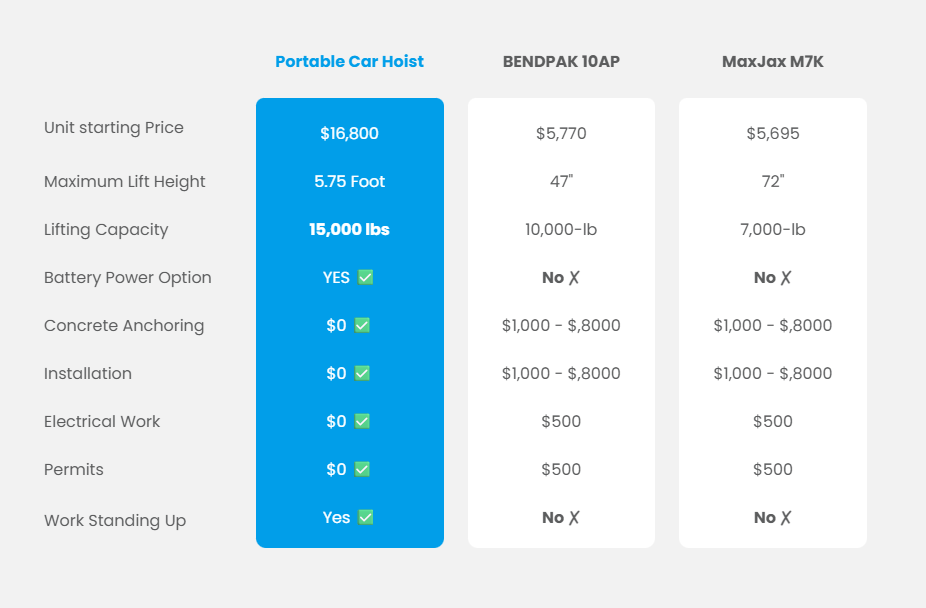
The portable two-post car lift cuts down on prices even more, making professional-grade tools available to smaller organizations and individual fans. Portable lifts can help renters or shop owners preserve the value of their property because the equipment goes with them instead of being a permanent feature with few options for resale.
There are two major types of design that most portable two-post car lifts use: symmetrical and asymmetrical arm layouts. You need to look at how cars are parked on each system and what your job needs in terms of access to figure out which design is best for you.
Symmetrical arm designs feature arms of the same length coming out of both posts. This keeps the car in the middle of the columns. This configuration makes it easy to position vehicles with centralized weight, such as older rear-wheel-drive cars, trucks, and many commercial vehicles, by giving them a balanced weight distribution. The symmetrical design is useful for working on elements of the suspension, exhaust systems, and undercarriage, where it's helpful to be able to get to them from the center. But with symmetrical arms, the doors of the car are closer to the lift posts, which could make it tougher to get to the passenger compartments during specific procedures.
With asymmetrical arm designs, the arms move the vehicle so that it is a little behind center and rotates around 30 degrees. This new design fixes the problem with door clearance by allowing the door to open all the way so you can work inside, take off the seats, and get in more easily for mechanical work that needs access to both the cabin and the undercarriage. Businesses that perform a lot of different things, notably those that work on newer front-wheel-drive cars that need to get to the engine bays and passenger compartments often, are currently most likely to choose asymmetrical portable two-post car lifts.
You should think about what kind of car you have when you pick a design. Both kinds of sports cars perform well with low ground clearance and compact sizes, but asymmetrical designs make it easier to fix the battery and the car's electrical system. Full-size trucks and SUVs usually perform better with symmetrical designs that can fit longer wheelbases and give heavy rear axles stable support. More and more professional businesses that serve a lot of different types of customers are preferring asymmetrical portable models since they can operate with a lot of different types of vehicles.
The kind of power system you choose has a huge impact on how easy it is to operate, how much care it needs, and how much it costs to own. There are three basic ways that modern two-post car lifts obtain their power, and each one has its own set of pros and cons.
You can plug electric-powered tools into standard 110V or 220V outlets, and they can lift anything as long as they need to. These kinds function well in stores that are always open and have reliable electricity. They can run for as long as they need and usually get up faster. Battery-powered options use lithium-ion or lead-acid systems that can be recharged, so they may be taken anywhere for mobile repairs and field service work. Batteries today can lift items several times on a single charge (typically 8 to 12 full lifts), and it takes 2 to 4 hours to recharge them, depending on how big they are.
Hydraulic systems are at the heart of almost all two-post lifts, but the way the hydraulic pressure is made is different. Hand-pumped mechanics are used to make pure hydraulic models work. This implies they don't need electricity, but they do demand more work. These systems are useful for places that don't have power or where electrical systems are unsafe.
Problems with runtime and maintenance are not the same. Electric systems are the easiest to use every day, but they need frequent motor maintenance and checks of the electrical parts. Battery-powered portable two-post car lifts need battery maintenance, which involves keeping track of the charging cycle and changing the battery as it goes out (typically every 2 to 5 years, depending on how often it is used). All systems need to have their hydraulic fluid checked once a year, their seals replaced if they need it, and their safety devices examined, no matter what kind of power they utilize.
Our portable auto hoist is great because it's so easy to move about. You can set up our portable system in seconds and move it anywhere you need it. This is not the same as ordinary fixed lifts, which must be permanently placed and anchored in concrete. You don't have to do any concrete work with this new design, which means you can:
In the car business, time is money, and this is especially true. Setting up our portable auto hoist doesn't take hours or days; it only takes a few minutes. There are no complicated installation stages, special tools, or time needed for concrete to dry with the self-contained design. You just need to set up the hoist, and you're ready to go.
We promise that every portable auto hoist is manufactured with care and will last a long time. Our two-post design is the most popular in the vehicle repair industry for a good reason: it makes the underbelly easy to reach while keeping the car very stable and safe.
It's a major deal that you don't have to lay concrete anymore. You won't have to:
We know that every user has different needs:
We don't think that one answer works for everyone. We can make your order exactly how you want it:
Let us know what you need, and we'll find the best way to meet it.
The most crucial item to look for when buying a portable two-post vehicle lift is its capacity rating, but this is also the thing that people get wrong the most. If you get this wrong, you not only waste money, but you also put yourself and others in danger, which can lead to broken equipment, damaged cars, or even deadly accidents.
It's vital to realize that the maximum safe vehicle weight is not the same as the combined capacity, which is not the same as the per-post capacity. A lift has two posts that can each handle 7,500 pounds. Together, they can lift 15,000 pounds. But this doesn't mean you can safely lift any automobile or truck that weighs less than 15,000 pounds.
It matters a lot how the weight is distributed out. Most cars don't exert the same amount of weight on all four wheels. A 4,000-pound sedan may put 2,400 to 2,600 pounds on the front posts because most of the weight of a front-engine car is on the front axle. When lifting vehicles with massive diesel engines or SUVs with a lot of things in the back, it's even more crucial to make sure the weight is uniformly spread out. A dually diesel vehicle that weighs 8,000 pounds may put 5,000 pounds on the front axle by itself.
Manufacturers must meet the standards defined by the Automotive Lift Institute (ALI) for capacity certification in order to acquire specific ratings. The tests for ALI certification are highly stringent. It has static load testing at 150% of rated capacity, dynamic raising and lowering cycles, and checks to make sure the structure is sound. When you acquire a portable two-post vehicle lift, it's crucial to be sure it satisfies safety standards by getting ALI certification from a third party. Non-certified elevators might work OK for light use, but there is no confirmation from outside sources that they can accomplish what they say they can.
It's easy to choose when you use specific cars to figure out how much space you need:
Mazda Miata (2,400 lbs): This light sports car is easy to raise with any portable two-post car lift. You can safely raise Miatas with even the simplest lifts that can hold 6,000 pounds. With a weight distribution of 55/45, the front axle has roughly 1,320 pounds on it and the back axle has about 1,080 pounds on it. This is well within the limits of even low per-post.
Ford F-150 (5,000 lbs): When buying a popular pickup truck, there are more crucial factors to think about. The weight of a typical F-150 crew cab is roughly 5,000 pounds, and the weight is split 58% to 42%. The front posts can withstand around 2,900 pounds, and the back posts can hold about 2,100 pounds. A portable two-post auto lift needs to be able to hold at least 10,000 pounds (5,000 pounds per post) to keep F-150s safe.
Portable lifts have a hard time lifting heavy-duty pickups with diesel engines and two rear wheels. A dually that weighs 8,000 pounds with a weight distribution of 62/38 puts around 4,960 pounds on the front axle. It needs a portable two-post auto lift that can raise at least 15,000 pounds to keep the car safe. Even then, you should verify the load and your posture before lifting.
Commercial trucks, semi-tractors, and cars that weigh more than a typical two-post car lift can manage and need heavy-duty equipment. The PCH 76 and other systems built for professionals feature higher capacity ratings and stronger structural pieces that can bear very big loads.
Sometimes, marketing materials make portable two-post vehicle lift setups look relatively simple. While modern designs have made the process considerably easier, first-time buyers should know what to expect. You may spend two hours of pain or 15 minutes of seamless assembly if you're putting something together for the first time.
Usually, it takes two people and the necessary tools between 1.5 and 2 hours to set up for the first time. Taking everything out of the boxes and verifying it all, leveling the posts, connecting the hydraulic lines, installing the arm assemblies, and completing safety tests before the first lift are all part of the procedure. People who know how to use their model can set it up in about 15 minutes, which illustrates that the learning curve shouldn't prohibit people from buying equipment that is generally helpful for them.
Portable two-post vehicle lifts don't need as rigorous floor surfaces as fixed systems, but they still need to be taken care of. Concrete is still the best surface since it is the most sturdy and can hold the most weight. But portable designs can also work on other surfaces, like well-compacted level asphalt, industrial epoxy coatings, and even thick plywood platforms on solid ground (albeit this is the bare minimum surface that is allowed). It should be level (within 1/8 inch of the lift footprint), solid (it shouldn't bend when you put weight on it), and clean (it shouldn't have any oil, water, or debris that could make it slippery).
Safety features keep professional tools from being confused with deadly fakes. When you are looking at portable two-post car lifts, you should pay particular attention to some things because they will affect safety and reliability over time.
The locking mechanisms are the most important safety feature. Two safety measures are built into good portable lifts. The first is hydraulic locks that automatically engage when the lift is lifted. The second is mechanical safeties that stop the lift from falling down if the hydraulic systems fail. Pressure-activated pawls on hydraulic locks hook onto slotted racks on the lift posts. This makes sure that mechanical connections are strong and don't depend on hydraulic pressure. When these locks engage at different heights (typically every 3 to 6 inches), they should produce a noise. This lets you configure them at safe intervals.
What happens if the battery or electricity goes out while the lift is going up? A lot of operators forget to ask this question. The greatest portable two-post car lifts offer manual descent systems that let you lower the lift even if the power goes out completely. This feature normally has a manual release valve that can be reached from the ground. This lets the hydraulic pressure progressively drop so that the car can be lowered securely. Cheaper designs that don't allow vehicles to go down on their own keep them stranded until the power comes back on, which can be very bad in an emergency or even when the electricity goes out.
The Occupational Safety and Health Administration (OSHA) sets minimum standards for portable lifting equipment that enterprises use. OSHA normally demands regular inspections, proof of operator training, and following the manufacturer's instructions. However, the exact rules depend on the jurisdiction and the application. Commercial operators must preserve records of inspections that prove that certified technicians do comprehensive inspections every year and visual inspections every month. These criteria are useful for even people who do things themselves because they help detect wear and tear before it causes difficulties.
You should check the level and quality of the hydraulic fluid, test the safety features, inspect for cracks or bends in the construction, make sure the fasteners are tight, and check the electrical system (for powered versions) every year. These checks normally cost between $150 and $300 when done by licensed specialists. They are a big element of routine maintenance that makes sure equipment works safely and for a long period.
There are many different costs for portable two-post car lifts on the market. If buyers know what makes equipment at different price points different, they may be able to better manage their budgets. Price alone doesn't tell you how much anything is worth. The best approach to be happy in the long run is to match your skills to what you really need.
It costs between $1,500 and $3,000 to buy a low-rise scissor lift. QuickJack systems are one example of this type of technology because they can lift anything up to 18 to 24 inches. These systems are marketed as portable lifting solutions; however, they are not at all like actual two-post designs. They are ideal for getting to oil changes, brake work, and suspension checks fast, but they don't have the height and access that post lifts do. They are helpful for some forms of undercarriage maintenance, such as taking off wheels, but they shouldn't be confused with being able to raise a full two-post vehicle.
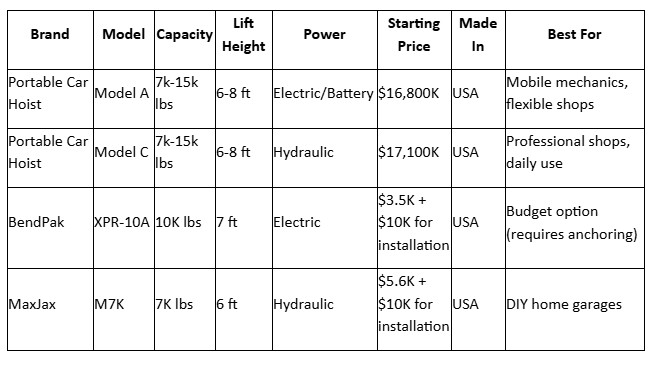
$3,500–$6,000: Entry-level Portable Two-Posts: Most entry-level portable two-post car lifts are from China and have basic hydraulic systems and not many extra features. Most of these models can carry between 9,000 and 10,000 pounds, feature manual locking systems, and have standard symmetrical arm setups. You need to do your research because the quality of the buildings in this group varies a lot. A lot of them are good for light labor and occasional use, but professional shops frequently think they aren't tough or polished enough.
$16,800–$25,000: Professional-grade American-made: Premium portable two-post car lifts cost more, but they are built better, have more safety features, and last longer. Tools created in the US (or goods that fulfill "American-made" requirements that demand a lot of US-made parts and assembly) frequently include thicker steel, better hydraulic parts, more modern safety systems with backup mechanisms, and longer warranties. These versions are great for professional shops, serious enthusiasts, and mobile technicians that need them to work every day without fail.
The Federal Trade Commission says that the phrase "American-made" has a specific connotation. A product must have at least 60% of its parts come from the US and be put together there in order to be dubbed "American-made." This requirement ensures that products that are normally imported have true US content, not just a token US presence.
Small car repair shops have to cope with some unique issues when it comes to keeping their skills, money, and space in balance. Portable two-post car lifts are flexible and easy to install, which means they may address a lot of problems at once and save money.
When calculating the return on investment (ROI) for small firms, you should consider both the direct income-generating benefits and the indirect efficiency benefits. A simple plan: find out your average hourly shop rate (which is normally between $80 and $150), determine how many extra jobs you could perform each week if you had lift access instead of working on jack stands or ramps (realistically, 3 to 5 extra jobs), and then calculate out how much each job is worth. For example, a store that costs $100 an hour and adds four tasks a week, each lasting two hours, makes an extra $800 a week, or nearly $41,600 a year. In this case, even a $15,000 portable two-post car lift will pay for itself in five to six months.
You can observe these benefits in real-life case studies. A repair shop in the suburbs of Ohio reported that once they put in a portable two-post car lift, they were able to hire eight more people every week. The lift made it easy to quickly move equipment around, which meant they could work on bigger vehicles without taking up too much space in the bay. The store owner stated that the lift's flexibility to be moved around was especially helpful when there wasn't much going on, because it could be moved out of the way to make space for extra storage or activities that didn't involve cars.
Mobile vehicle servicing is one of the fastest-growing sections of the repair business. Portable two-post car lifts let mobile mechanics execute services that used to demand firms that were open all the time. But you need to think carefully about key operational issues while making mobile apps.
The type of service you choose will determine how long the battery lasts. Mobile mechanics that travel to people's homes need a lot of battery power so they can run a lot of lifts without having to stop and charge them. Modern lithium-ion battery systems can lift 8 to 12 times on a single charge. This is usually enough for a whole workday, during which they can serve 3 to 4 customers with numerous cars each. Find out how much lifting you'll need on your busiest day, and then get a battery that can hold 150% of that amount. This will offer you some extra space.
People who love vehicles have to make different choices than people who own businesses. It's a huge financial investment that won't make money right away, so it's necessary to think about how it will be utilized and what safety issues are most critical.
When you acquire goods for yourself, safety should be your top priority. It is much safer to go from jack stands to the right lifting tools, but only if the tools are appropriate for the user's skill level and the conditions in the workspace. Good manufacturers and merchants provide out training materials like installation videos, safety procedure papers, and, occasionally, even in-person instruction. Before using any lifting tools, even if they seem simple, people who do it themselves should read the instructions first.
Portable installations are substantially better for resale value than fixed ones. Only people who wish to buy a house and are automobile enthusiasts are interested in buying fixed two-post lifts that are already in place in garages. Portable two-post vehicle lifts, on the other hand, hold their value well when they are sold since they are popular with retailers, mobile mechanics, and car lovers. If you take care of them, portable devices commonly sell for 60% to 75% of their original price in 3 to 5 years. Fixed installations, on the other hand, rarely make back even 30 to 40 percent of their total investment (equipment plus installation costs).
It's better to learn from other people's mistakes than to make your own. These four blunders make most customers who buy a portable two-post auto lift wish they hadn't:
1. Not taking into account the weight of the vehicle: Many buyers use the curb weights that the manufacturer tells them to figure out how much room they need, but they don't think about any real-world additions. The curb weight of a car is how much it weighs with all of its normal fluids and equipment, but no people, cargo, or aftermarket parts. For full gas tanks, add 200 to 300 pounds. For passengers, tools, and luggage that are generally on board during service, add another 150 to 400 pounds. For aftermarket equipment like winches, armor, and heavy-duty bumpers on trucks, add 500 pounds or more. A truck that weighs 5,500 pounds can easily weigh more than 6,500 pounds in the real world. Always find out how much capacity you need, adding 20% to the greatest weights that are realistic.
2. Not Paying Attention to Ceiling Height Requirements: A lot of garage owners are shocked to find out that portable two-post vehicle lifts need a lot of room above them. Add the lift's maximum rise, the height of the car, and the working clearance (which should be at least 6 inches) to find out how high you need to go. For a portable lift to work, it needs at least 153 inches (12.75 feet) of ceiling height that is not blocked. This is because the lift can raise a full-size SUV that is 75 inches tall and has a maximum rise of 72 inches. Most garages have ceilings that are 8 to 9 feet high, which means that many portable two-post vehicle lift models won't work. Before you buy, always measure the height of your actual ceiling and think about any lights, garage door tracks, or other objects that could get in the way.
3. If "portable" means easy to set up on your own, then marketing brochures that depict one person using portable lifts are correct about how they operate but false about how to set them up. Two people are absolutely needed to set up and place it the first time for safety and ease of use. It's not safe to move the columns and bases by yourself because they weigh between 200 and 400 pounds each. Make plans to hire help or set aside money for help to be available for setup and any future moves.
4. Not Checking the Requirements for Level Floors: Portable two-post car lifts can work on floors that aren't precisely level, but they need floors that are very level to be safe. Most manufacturers indicate that the overall footprint can only be off by 1/8 inch, which is a very little amount that many garages couldn't meet. Use a long straightedge and level to make sure your floor is level before you buy. You can grind down the high parts of your floor, apply self-leveling epoxy coatings, or put in a level platform if it is too high. But these charges should be part of the overall budget for the project.
Very stable, but only if you use it well.
Load testing, lateral stability tests, and tests in the real world are just some of the many tests that modern portable lifts go through. Mobile mechanics always state that their lifts are just as sturdy on flat areas as tethered lifts.
Yes, but you need to be careful:
Training is the finest thing to do. Most businesses provide free checklists and safety recommendations for using their products. You have to read them.
Commonly used terms:
Yes. Most manufacturers cooperate with equipment lenders to offer financing options like no-down-payment programs for shop owners and low-interest payment plans for regular people.
The portable two-post car lift is a huge investment in your ability to work on automobiles, whether you're launching a professional business, adding more mobile services, or putting up a high-tech home workshop. In this guide, we've talked about the engineering principles that make modern portable lifts stable and safe, looked at the practical differences between design variations and power systems, explained capacity ratings to make sure you choose the right one, and given you guidelines for matching equipment to specific uses.
To effectively own a portable two-post vehicle lift, you need to be honest about what you need, have realistic expectations about what it can and can't do, and be committed to utilizing and caring for it properly. An excellent portable lift from a well-known brand can survive for decades if you choose, install, and care for it correctly. On the other side, skipping critical requirements to save a few hundred dollars often means that the equipment doesn't operate as it should or, even worse, makes things unsafe.
Are you ready to get better at taking care of your car using professional-grade tools for lifting? Portable Car Hoist offers high-quality two-post car lifts that are portable, safe, reliable, and last a long time. Our systems produced in the USA are just as stable and function just as well as fixed installations, but they are more flexible, which is what modern enterprises require.
No matter if you're launching a business, a mobile service, or the ultimate enthusiast garage, we can assist you in choosing the best portable two-post car lift for your needs. We give you complete support, which means: