


Jader Gil
Marketing Expert
September 19, 2026
9 min read
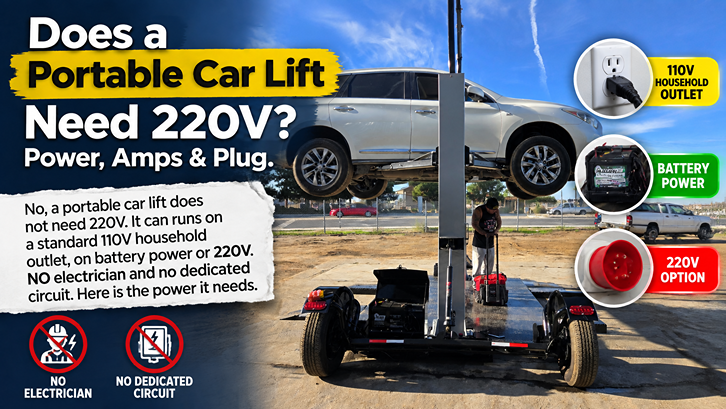
If you have been holding off on a car lift because you think you need to rewire your garage for 220V, here is the short version: you don’t. Our portable full-height car hoist runs on standard 110V single-phase power — the same ordinary outlet that already runs your shop vac, battery charger, or air compressor. There is no dedicated 220V/240V circuit, no electrician, and no permit involved. On the mobile Model C, you can even skip the wall outlet entirely and run the power unit off a battery pack. That single fact is why a hoist you assumed needed an electrical upgrade can be lifting cars in about 15 minutes instead.
I get the 220V question almost every week, usually from someone who priced out a traditional two-post lift and got quoted just as much for the electrical work as for the lift itself. So let me walk through exactly what a portable car hoist needs to power up, why fixed lifts are different, and the handful of power questions that actually matter when you are deciding where to set one up.
A portable two-post hoist uses a self-contained hydraulic power unit. An electric motor drives a hydraulic pump, the pump pushes fluid into the cylinders, and the cylinders raise the carriage. That is the whole story — and it is the same basic principle I explain in detail in how a portable car hoist works. The motor on our portable unit is sized to run on a normal 110V (also written 120V) household circuit, the kind you have in every garage, shop bay, and carport in the country.
In practical terms, that means a standard 15–20 amp outlet is enough to raise a vehicle. You are not lifting the car with the outlet — you are lifting it with hydraulic pressure. Electricity just runs the pump. Because the lift is designed around 110V from the start, plugging it in is genuinely as simple as plugging in a power tool. If you want the full picture of setup, I break it down step by step in my guide to setting up a portable two-post lift in 15 minutes.
Compare that to what most people expect from a car lift, and you can see why the question comes up so often.
Here is where the confusion starts. Traditional bolt-down two-post lifts — the kind you see anchored into a shop floor — very commonly ship with a 220V/240V single-phase motor. Bigger commercial units sometimes want three-phase power, which most home garages and even a lot of small shops simply do not have. So the buyer’s real cost is never just the lift. It is the lift plus an electrician running a new 220V circuit, plus a breaker, plus possibly a panel upgrade if the box is already full.
On top of the wiring, a fixed lift needs 4 to 6 inches of properly cured concrete and anchor bolts drilled into the slab. So the ‘power problem’ is really one piece of a much larger installation problem. I unpack the concrete side of that in the anchor-free, no-concrete approach, and if you are weighing a fixed unit against a portable one, the trade-offs are laid out in why shop owners are switching from fixed lifts.
Our portable hoist sidesteps both problems at once. It rides on its own black diamond-plate trailer deck, so the deck is the foundation — no drilling, no anchors, no cured slab required. And because the whole system is engineered for 110V, there is no dedicated circuit to install. You remove two objections with one machine.
The reason I harp on this is money. When a buyer tells me a fixed lift ‘only’ costs a certain price, they are almost never counting the electrical. Running a new 220V circuit means an electrician’s labor, a dedicated breaker, conduit and wire across the garage, and sometimes a panel upgrade when the existing box has no room. In a lot of home garages that adds a meaningful chunk to the total — occasionally as much as the lift. Then, if the shop needs three-phase power for a commercial motor and the building only has single-phase, you are looking at a phase converter or a call to the utility, which is a different level of expense and delay entirely.
With a portable hoist, all of that line-items away to zero. You plug into the outlet you already have. That is a big part of why the overall numbers work out the way they do in my portable car lift cost and pricing guide, and why the monthly math is so friendly in the car lift financing breakdown. When you are not paying an electrician on top of the equipment, the payback period shrinks and the decision gets a lot easier.
Let me get specific about what you should have on hand before your hoist shows up.
Ninety percent of the time, this is all you need. A grounded 110V outlet on a 15–20 amp circuit will run the power unit. That is the outlet your garage door opener, your battery tender, and your bench grinder already share. I still tell people to confirm the exact amp draw printed on their unit’s spec sheet and to avoid sharing the circuit with a big draw like a welder or a 220V compressor at the same moment you are lifting, just so the pump gets clean, steady power. But you are not installing anything new.
This is the part that surprises people. On the mobile Model C, you don’t even need a building. The power unit can run off a battery pack, which is exactly what makes it work in a customer’s driveway, at a car show, or on a job site with no power. I go deep on this in my breakdown of the battery-powered car lift for mobile mechanics and the wider list of battery-powered lift benefits. If you run a mobile operation, the ability to lift a full-size vehicle to full height with zero grid power is the whole ballgame — it is what lets you take your shop to the customer instead of the other way around.
This is not just a home-garage story. A small commercial shop running on ordinary single-phase 110V service can add lifting capacity without touching its electrical system, and can even move the hoist between bays as the workflow changes — something a bolted-down 220V lift can never do. If you run a small shop, the fit is exactly what I lay out in the best portable car lift for a small auto shop. The lift scaling with your outlets instead of your panel is a quiet advantage that shows up every time you rearrange the floor.
Because you are plugging into an existing, code-compliant outlet rather than adding a circuit, there is nothing about the hoist’s power that triggers an electrical permit. Contrast that with a hardwired 220V lift, where the new circuit is exactly the kind of work an inspector wants to see. Combined with zero anchoring, this is why our units can go from delivery to lifting the same afternoon.
Once folks hear ‘110V,’ the follow-ups are pretty predictable. Here are the ones I answer most.
For a portable hoist running on an existing 110V outlet, no. If your garage already has working outlets, you are done. The only time I would suggest an electrician is if your outlets are old, ungrounded, or on a circuit that is already overloaded — and that is a general home-safety upgrade, not something the lift specifically requires.
Yes, and mobile pros do it all the time. A generator that can cleanly deliver 110V at the unit’s rated amperage will run the pump fine. I’d use a quality inverter generator sized with some headroom so the motor gets steady voltage on startup. For fully off-grid work, though, the battery option is usually simpler and quieter than dragging a generator around.
You can, but size it correctly. A long, thin cord causes voltage drop, and a hydraulic pump motor does not like starving for voltage. If you must reach across a bay, use a short run of heavy-gauge cord rather than 100 feet of light-duty cable. Better yet, set the hoist near the outlet — the lift is portable, so moving it two feet is easier than fighting a cord.
Pro tip: before your hoist arrives, plug a heat gun or shop vac into the outlet you plan to use and run it for a minute. If the outlet holds strong with no dimming lights or tripped breaker, it will handle the pump. If it struggles, that outlet was already marginal — move to a better circuit rather than blaming the lift.
Here is the mindset shift I try to give every buyer: once you know the hoist runs on a normal outlet, voltage stops being a deciding factor at all. The real questions are about the vehicle and the space. How much do you need to lift? Our range runs from 8,000 pounds up to 76,000 pounds, and picking correctly is covered in choosing the right hoist capacity. How much overhead room do you have? That is a real constraint, and I measured it out in how much ceiling height a two-post lift needs. Are you lifting an EV with its heavier battery pack? I cover the lift-point specifics in lifting an EV on a two-post hoist.
Safety is the other thing worth more of your attention than voltage. A full-height lift with mechanical safety locks is a completely different animal from a jack and stands, and it is why I keep pointing DIYers toward a proper hoist — the reasoning is in my piece on whether portable car lifts are safe. If you are still lifting on a home floor, the setup and safety walkthrough in the home-garage safety guide is worth ten minutes of your time.
When you stack it all up — standard 110V power, no 220V wiring, no electrician, no anchors, no concrete, no permit — the portable hoist removes the exact roadblocks that stop most people from ever owning a lift. If you want to compare models and see where the numbers land for your bay or driveway, start with the complete two-post buyer’s guide or the plain-English what-is-a-portable-car-hoist guide.
Have a specific outlet, garage, or vehicle in mind and want to know if it will work? That is the easiest question in the world for us to answer. Book a Free Quote and tell us your space — we will confirm the power, the fit, and the capacity before you spend a dime.
No. A portable full-height car hoist runs on standard 110V (120V) single-phase power — an ordinary grounded household or shop outlet on a 15–20 amp circuit. There is no need for a dedicated 220V/240V circuit, unlike most fixed bolt-down two-post lifts. On the mobile Model C, the power unit can also run off a battery pack for off-grid use.
Not for the power. Because you plug into an existing 110V outlet rather than adding a circuit, there is nothing to wire and no electrical permit involved. You would only call an electrician if your existing outlets are old, ungrounded, or already overloaded — which is a general home upgrade, not a requirement of the lift.
Yes. A quality inverter generator that cleanly delivers 110V at the unit’s rated amperage will run the hydraulic pump. For fully off-grid work — driveways, car shows, remote job sites — the battery-powered option on the Model C is usually simpler and quieter than a generator.
A standard 15–20 amp 110V circuit is enough to raise a vehicle, because the pump motor only powers the hydraulics rather than doing the lifting directly. Always confirm the exact amp draw on your specific unit’s spec sheet, and avoid sharing the circuit with a heavy load like a welder while you lift.
How a Portable Car Hoist Works (No Concrete, No Bolts, No Magic)
Battery-Powered Car Lift for the Mobile Mechanic