


Jader Gil
Marketing Expert
August 5, 2026
9 min read
You can build a mobile mechanic van that lifts cars anywhere for a fraction of what a fixed shop costs, and the average mobile tech who adds real lifting capability charges 20–40% more per job because they can finally do brakes, suspension, exhaust, and undercar work standing up instead of crawling. The secret isn't a giant box truck with a built-in bay. It's a work van for your tools paired with a full-height portable hoist that needs zero concrete and zero anchors, so you carry a real two-post lift with you to any driveway, parking lot, or job site.
I've helped a lot of mobile guys make this jump, and the biggest thing I want you to understand up front is this: your van is the toolbox, and the hoist is the shop. Get that division of labor right and you can run a professional, standing-height service operation out of a vehicle you park in your own driveway at night.
Mobile mechanics have been stuck doing the same short list of jobs for years: oil changes, batteries, starters, alternators, diagnostics, and light electrical. Why? Because everything else lives under the car, and you can't safely or comfortably get under a car on jack stands in a customer's driveway all day. Ramps only lift a few inches. Bottle jacks and stands are slow, sketchy, and back-breaking. So the profitable work — suspension, brakes, exhaust, transmission service, timing components — goes to the brick-and-mortar shop down the street.
A lift changes the entire equation. The moment you can raise a vehicle to chest height in about fifteen minutes on any flat surface, your service menu doubles overnight. You stop turning down the jobs that actually pay. And you do it without the crushing overhead of a leased bay, because a mobile car lift lets you take your shop to the customer instead of the other way around.
Here's the part people miss: jack stands aren't just limiting, they're the single most dangerous thing in the average mobile setup. There's a reason jack stands cause so many serious injuries every year. When you're working alone in a driveway with no one around, a proper lift with mechanical safety locks isn't a luxury. It's the thing that gets you home at night.
The cleanest mobile build isn't one truck trying to do everything. It's a two-part system.
Your van carries tools, parts, fluids, and a power source. A standard cargo van — a Transit, ProMaster, Sprinter, or even a well-organized minivan when you're starting out — gives you weatherproof storage and a mobile office. Shelve it out with bins for consumables, a rolling tool chest strapped down, an air compressor, and a battery jump pack. This is your parts department and your bench. Keep it organized, because on a mobile job your time is your entire margin.
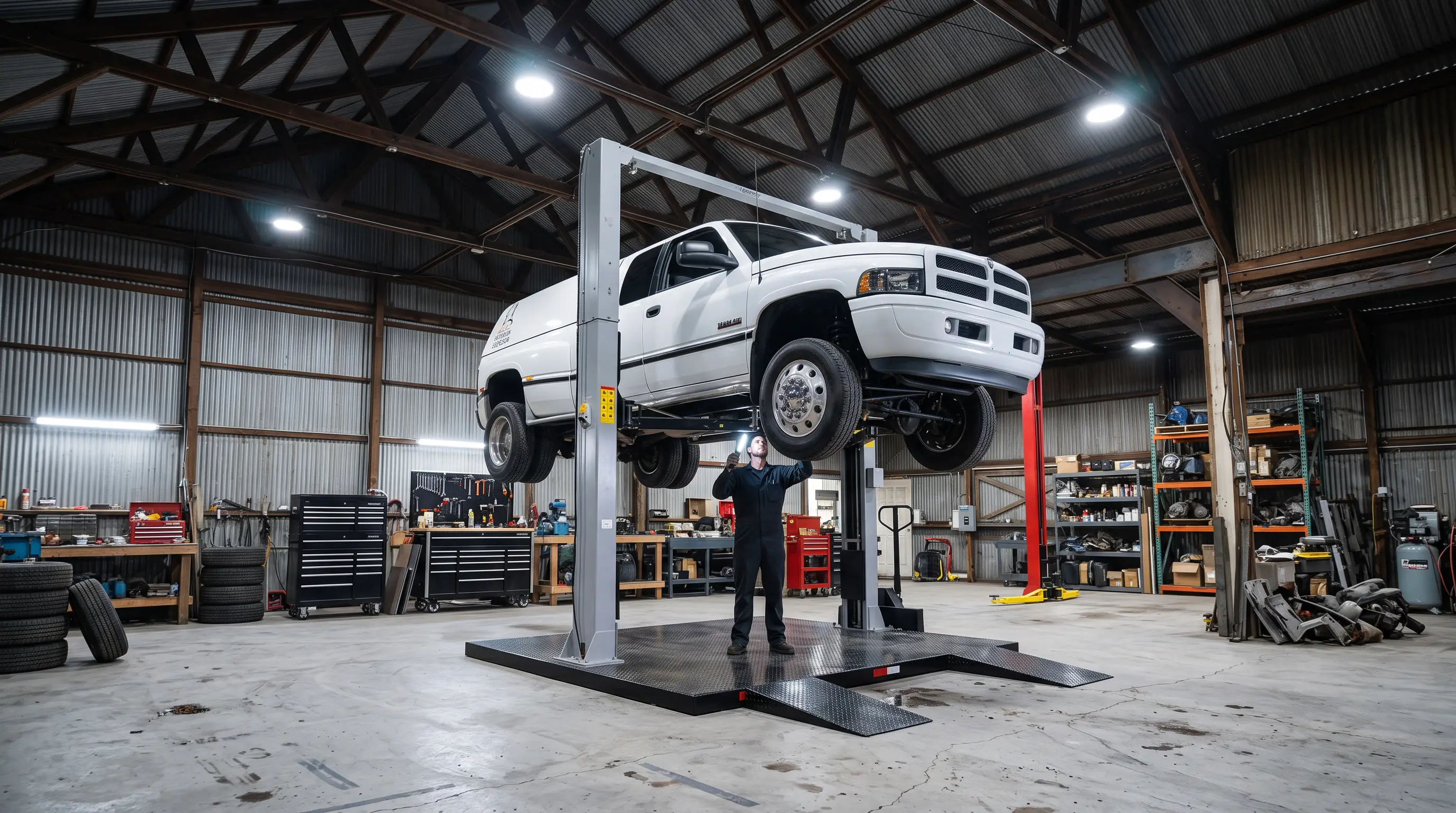
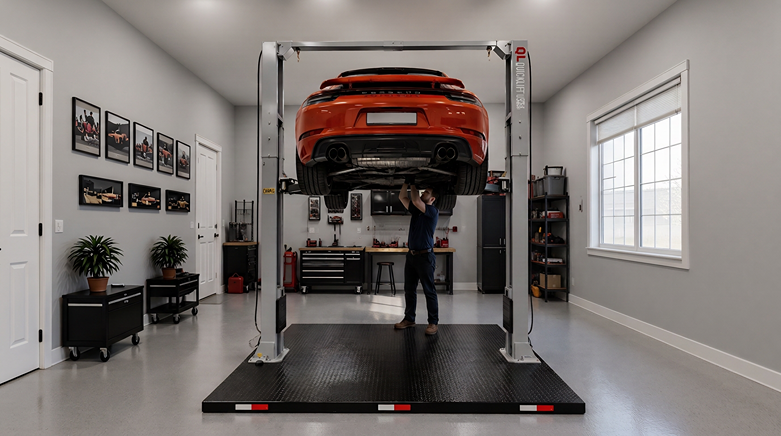
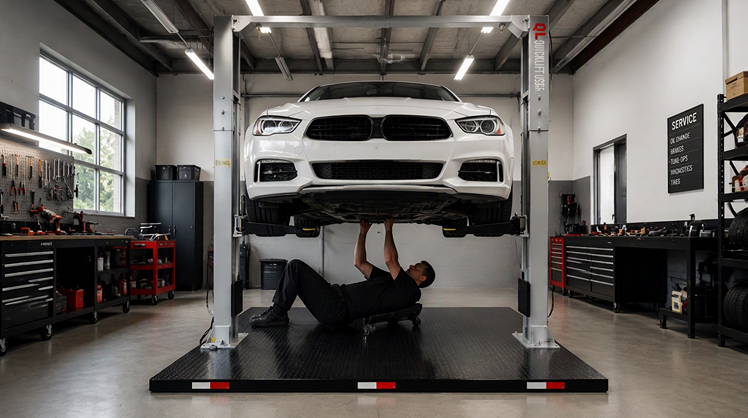
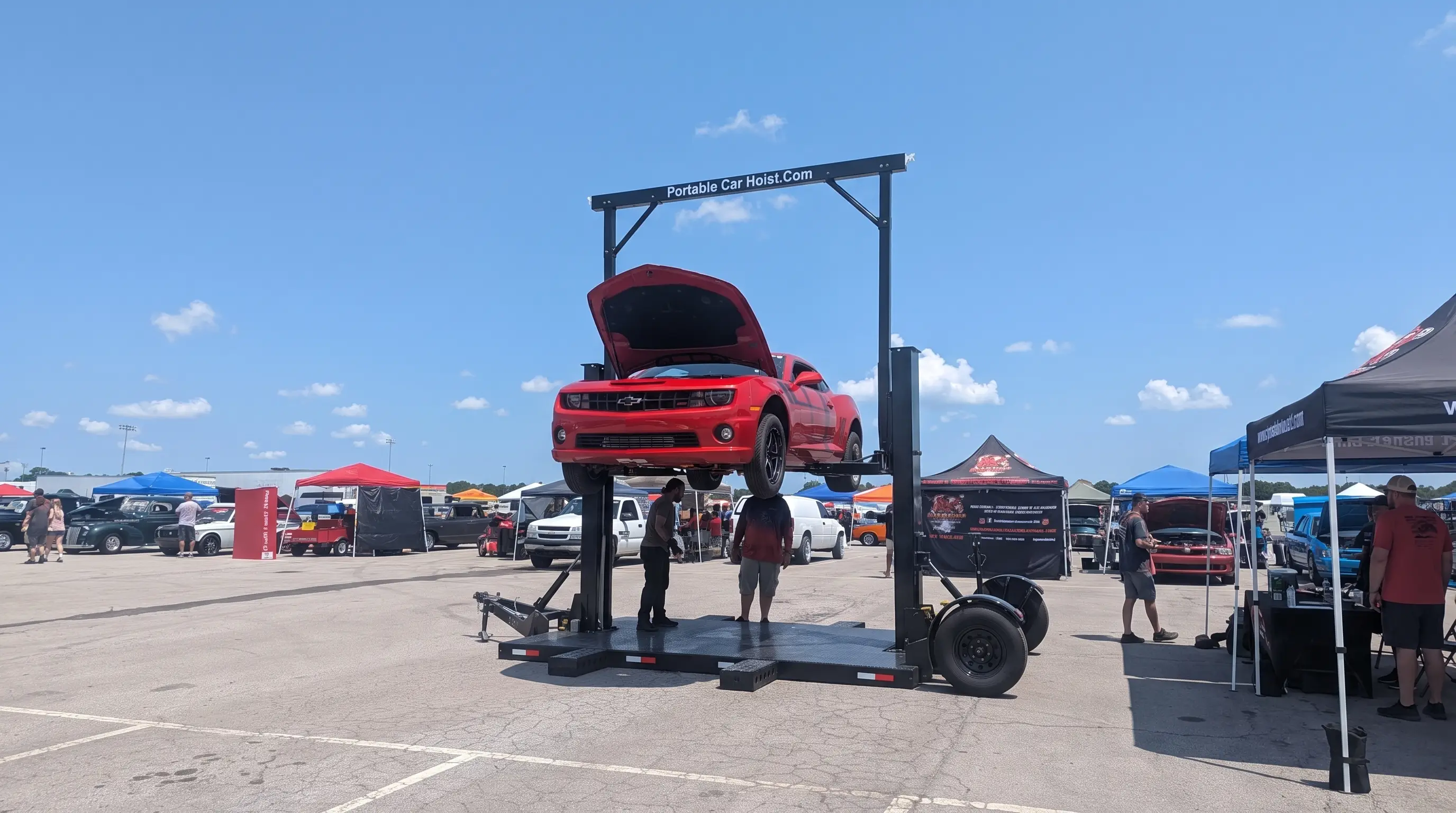
This is where our customers get their edge. The portable car hoist is a full-height, 69–73.5" two-post lift mounted on its own black diamond-plate flatbed trailer deck. You tow it behind your van. When you arrive, you drop the deck, level it, drive the customer's car onto the platform, and the hoist raises the vehicle to full standing height. No drilling. No bolting. No permit. It carries its own foundation with it, which is exactly why it works with no concrete, no bolts, and no magic — the engineering lives in the deck, not in the floor.
Why not just build a lift into a box truck? Because a fixed-in-a-truck lift ties up an expensive vehicle, limits you to the vehicles that fit inside the box, and turns a routine repair into a permanent installation you can't reconfigure. The trailer-deck approach keeps your van free to haul parts and lets you unhook the lift and leave it on a job site or in a lot while you run for a part. Flexibility is the whole point of going mobile.
Before you buy anything, match three things: the lift capacity to the vehicles you'll service, the tow rating to the trailer, and your power source to the lift.
Portable hoists run from 8,000 lb up to 76,000 lb. For a mobile mechanic working passenger cars, light trucks, and SUVs, an 8,000–12,000 lb model handles nearly everything you'll see. If you plan to chase fleet work, box trucks, or heavier duty vehicles, size up. Don't guess — our guide on how to pick the right car hoist capacity from Miatas to monster trucks walks through exactly how to match the number to your real workload.
The hoist rides on a trailer, so your van (or a pickup) needs the tow rating and a proper hitch for the loaded deck. Most half-ton and three-quarter-ton vehicles handle it comfortably, but check your gross combined weight rating before you load a customer's 6,000 lb SUV onto the deck and hook it to a van already full of tools. This is a five-minute math problem that saves you a very bad day.
Some portable lifts run on standard 110V or 220V shore power; others offer a battery-powered car lift setup built for mobile mechanics so you're never hunting for an outlet in a customer's driveway. If you go battery, plan your charging around your route. If you go shore power, carry a heavy-gauge extension cord and confirm the customer has a working exterior outlet before you commit to the appointment.
Pro tip: Before your first paid job, do a full dry run in your own driveway with a friend's car. Time yourself from "trailer parked" to "car at working height" and back down to "loaded and hooked up." Knowing your real setup and teardown time lets you quote jobs accurately and stops you from running late on day one.
The whole promise of this build is speed, so build a repeatable on-site routine and run it the same way every time.
Start by choosing a flat, solid surface — a driveway, a shop apron, or a level section of parking lot. Position the trailer, chock it, and level the deck. Drive or push the vehicle onto the platform, set the arms under the manufacturer's lift points, and raise it in stages, confirming the vehicle is stable before you go to full height. Once it's up, drop it onto the mechanical safety locks before you get under it — every time, no exceptions. Those locks are what make the difference between a real lift and a gamble, which is why the safety certification and locking systems on portable lifts matter as much as the lifting capacity itself.
Because the whole rig is designed to lift vehicles without floor anchors, you're not depending on the surface underneath being bolt-ready. That's the freedom: a customer's cracked driveway, a fleet yard's asphalt, or a friend's flat lot all become a working bay for the afternoon.
Let's talk numbers, because that's what makes or breaks the decision. A mobile mechanic without a lift is capped at the easy jobs. Add lifting capability and you open up brake jobs, suspension and steering work, exhaust replacement, transmission services, CV axles, and inspection work — the repairs that carry real labor hours.
The revenue jump is not small. When a single lift lets you take on undercar work you used to turn away, one shop's story of adding $50K in revenue from a single portable lift starts to look less like a headline and more like a projection you can run for yourself. To pressure-test your own numbers, our portable car hoist cost and ROI payback calculator shows how fast the equipment pays for itself at your job volume and average ticket.
And you don't need the cash up front to start. Car lift financing turns the hoist into a low monthly payment that a handful of extra undercar jobs a month more than covers. For a mobile operation with almost no fixed overhead, that's about the cleanest return on equipment you'll find in this trade.
It helps to picture the concrete work that opens up the day you can lift. Without a hoist, a mobile call sheet is mostly diagnostics and bolt-on electrical. With one, you add brake pads and rotors on all four corners, caliper and line work, control arms, ball joints, tie rods, sway-bar links, wheel bearings, CV axles and boots, exhaust from the manifold back, oil pan and gasket jobs, fuel and transmission drops, and full undercar inspections for buyers and fleets. Every one of those is a longer, better-paying ticket than a battery swap.
The scheduling changes too. When a job takes you fifteen minutes to set up and gives you full standing access, you can realistically run two or three substantial repairs in a day from one van instead of a dozen quick errands. Fewer stops, bigger tickets, less windshield time. That's a healthier business, and it's easier on your body, which matters when this is a career and not a side hustle. Many of our customers started exactly here — a driveway, a borrowed car, and one hoist — and the reason the model works is the same reason a shop can run a movable lift that reconfigures the floor with no concrete: the equipment adapts to you instead of chaining you to a location.
Two things sink new mobile lift operators, and both are easy to avoid.
The first is skimping on the lift to save a few dollars. A cheap import hoist that miniaturizes its steel to hit a price point is not a bargain when it's holding a car over your head in a stranger's driveway. Buy American-made steel built to a real capacity rating and let the certification and locks earn their keep.
The second is treating the van and the lift as one rushed purchase. Get the lift right first — it's the profit engine — then build the van storage around the way you actually work. If you're weighing a full portable two-post setup, the complete portable two-post car lift buyer's guide for 2026 covers every spec worth arguing over before you commit.
A work van plus a full-height portable hoist is the most affordable way I know to run a real, standing-height service operation without ever signing a shop lease. You carry your bay with you, you set up in fifteen minutes on any flat surface, and you finally get to say yes to the jobs that pay. Every hoist is American-made in Menifee, CA, and ships nationwide, so wherever you're running your routes, we can get one to you.
If you're ready to stop crawling and start standing — and start earning on the jobs you've been turning away — book a free quote today and let's spec the right hoist for your mobile build.
No. Because the hoist is a full-height lift mounted on its own trailer deck and needs no concrete, no anchors, and no permanent installation, there is nothing to permit at the job site. You will need the normal driver's license and trailer towing that your tow vehicle and local rules require, plus your usual business licensing to operate as a mobile mechanic — but the lift itself does not trigger a building or installation permit the way a bolted-down shop lift does.
It depends on the model you choose. Portable hoists range from 8,000 lb up to 76,000 lb of capacity. For a mobile mechanic servicing cars, light trucks, and SUVs, an 8,000–12,000 lb lift covers the vast majority of jobs, while fleet and heavy-duty work calls for a higher-capacity model. Match the capacity to the heaviest vehicle you realistically plan to service.
Roughly fifteen minutes from parked trailer to a vehicle at working height, once you have run the routine a few times. You position and level the deck, chock it, load the vehicle, set the arms at the lift points, raise in stages, and drop onto the safety locks. Teardown is just as quick, which is what makes multiple stops a day realistic.
The portable hoist is built on its own flatbed trailer deck, so you tow it behind your van or truck. That is by design: it keeps your work van free for tools and parts, lets you drop the lift at a job site and leave, and avoids tying up an expensive box truck as a permanent installation. The trailer carries its own foundation, which is exactly what lets it work on any flat surface.