


Jader Gil
Marketing Expert
July 29, 2026
9 min read
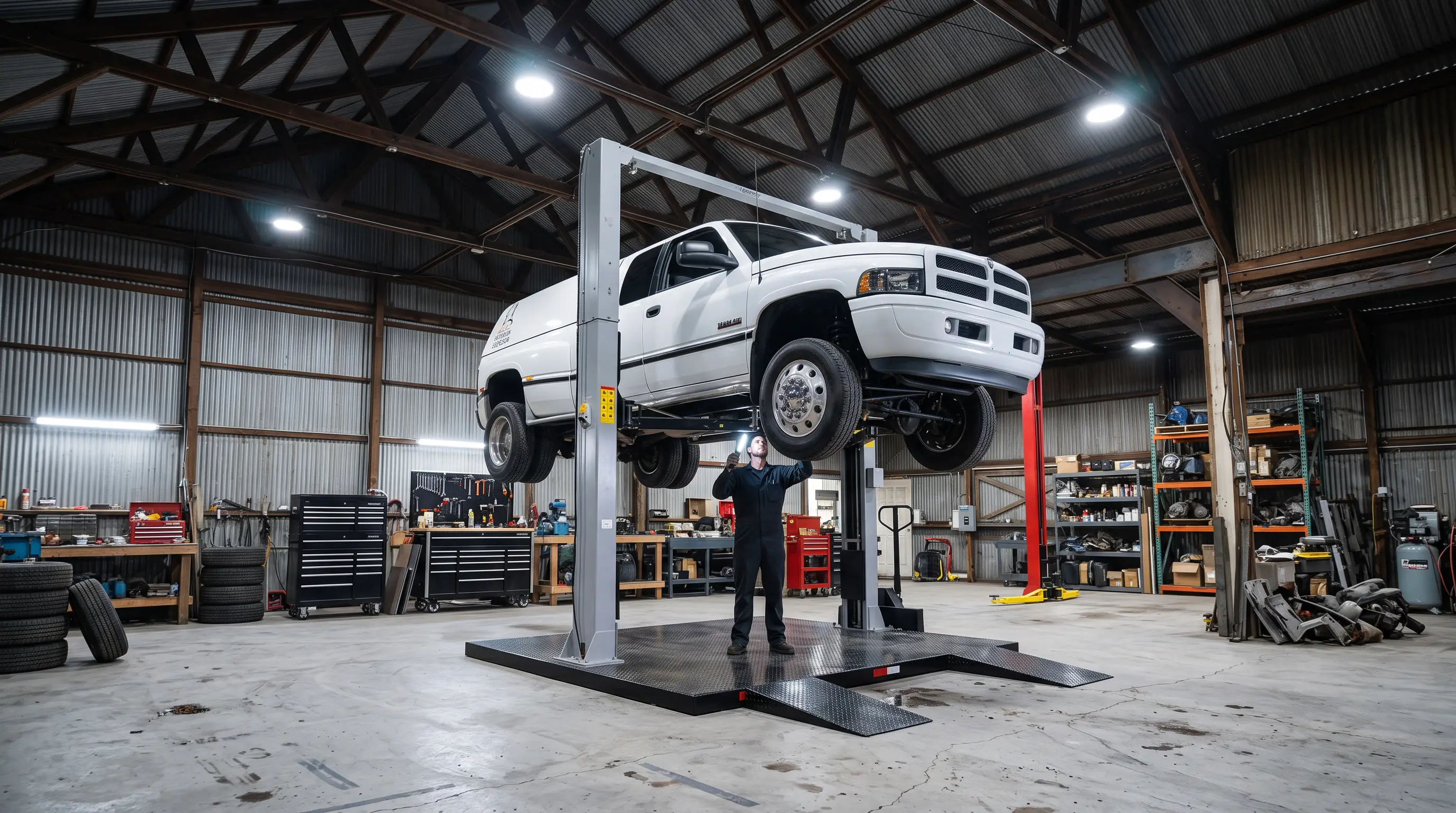
Here's the short answer: a portable car hoist works by mounting a full-height two-post lift onto its own steel trailer deck, so the deck — not your concrete — absorbs the load. You drive the vehicle onto the platform, the two hydraulic posts raise it to a full 69–73.5 inches of standing room, and mechanical safety locks catch the arms at height. No drilling, no anchors, no permits, and setup takes about 15 minutes. In fact, our decks are rated to carry vehicles from 8,000 all the way up to 76,000 pounds without a single bolt going into your floor.
I get asked "but how does it actually hold the car up if it isn't bolted down?" almost every week. It's a fair question — every fixed two-post lift you've ever seen was anchored into 4+ inches of reinforced concrete, and that's the mental picture most people start with. So let me walk you through exactly what's happening, part by part, with zero magic involved.
A traditional two-post lift transfers the entire weight of the vehicle down through its two columns and into the anchor bolts. Those bolts fight against the concrete to keep the posts from tipping. That's why shops need thick, cured, engineered slabs — and why a cracked or thin floor is a dealbreaker.
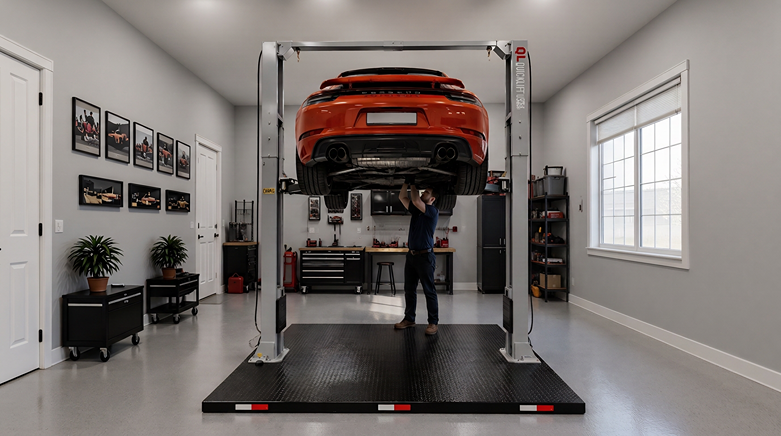
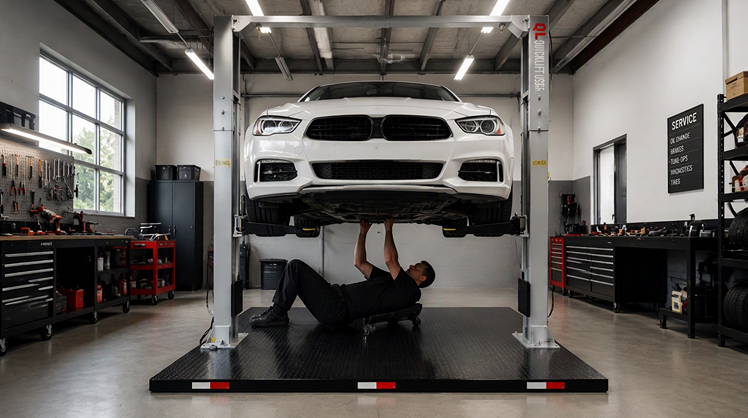
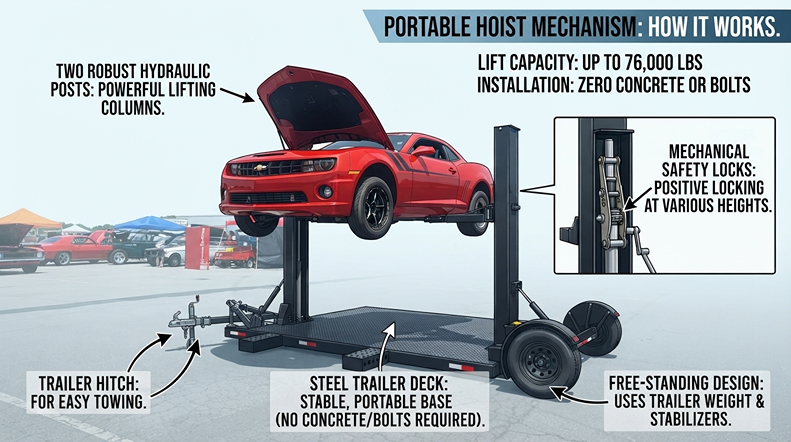
Our portable car hoist changes the geometry. Both posts are welded to a single, heavy diamond-plate steel flatbed deck. When the lift raises a vehicle, the load pushes down and the posts want to lean — but instead of ripping bolts out of a floor, the leaning force is countered by the mass and rigidity of the deck itself. The vehicle you're lifting is sitting on the same structure that's resisting the tip-over force. It's a closed, self-contained system. The floor underneath just needs to be flat and firm enough to hold the total weight, the same way it already holds a parked car.
This is the single concept that unlocks everything else people love about it. If you've read our explainer on how an anchor-free portable hoist actually works, this is the engineering reason it's possible.
Everything starts with the deck. It's fabricated from thick American steel plate, wide enough to drive a vehicle onto, and engineered as the structural base. Because it doubles as a trailer, you can hitch it, tow it to a job, and drop it wherever you need to work. That's what makes it "portable" in the truest sense — it's not a lift you disassemble and haul; it rolls as one unit.
Two vertical columns rise from the deck, just like a shop two-post lift. Inside each post, a carriage travels up and down. Swing arms extend from the carriages and tuck under the vehicle's factory lift points. When the carriages rise, the arms rise, and the vehicle goes with them — evenly, on all four contact pads.
A hydraulic cylinder does the actual lifting muscle. A pump (electric, or battery-powered on our mobile-focused models) pressurizes fluid, the cylinder extends, and cables or a direct ram raise the carriages in sync. If you want the deeper mechanical detail on the pump, seals, and fluid side of things, I broke it down in our hydraulic technology and maintenance guide.
This is the part that matters most, so pay attention here. Hydraulics do the lifting, but hydraulics are not what holds the car up once it's parked at height. As the carriages rise, spring-loaded pawls click into a ladder of steel locking positions on each post — that ratcheting sound you hear. Once engaged, those mechanical locks physically carry the load. Even if hydraulic pressure bled off completely, the vehicle stays put on the steel locks. That's a fundamentally different and far safer situation than balancing a car on jack stands, where one bad bump ends badly.
Let me put the pieces in motion so you can picture a real session. Here's the whole sequence, which I'll number so it's dead simple to follow:
First, you position the deck on any flat, firm surface — a shop floor, a driveway, packed gravel, asphalt. Second, you level it (the unit accommodates minor grade). Third, you drive or roll the vehicle onto the deck between the posts. Fourth, you swing the arms under the manufacturer's lift points and snug the contact pads. Fifth, you hit the up control; the hydraulics raise the carriages while the safety pawls click past each lock position. Sixth, once you're at working height, you lower a hair onto the nearest mechanical lock so the steel — not the fluid — is bearing the weight. Now you've got a full standing bay under the car.
To bring it down, you raise slightly to release the pawls, disengage the locks, and lower on hydraulic control. The whole raise-or-lower cycle is a matter of seconds. Total time from towing the unit into place to lifting your first vehicle is about 15 minutes, which is the number that tends to surprise people the most.
Pro tip: Always rest the lift on its mechanical locks before you get under a vehicle, even for a "quick" two-minute job. Treat the hydraulics as the elevator and the locks as the parking brake. Never trust fluid pressure alone to hold weight over your head — that habit is the difference between a lift and a liability.
People assume "no concrete required" has an asterisk. It doesn't — but let me be precise about what it does and doesn't mean. You still need a surface that can bear the combined weight of the hoist and the vehicle without sinking or crumbling. A normal driveway, garage slab, asphalt pad, or compacted gravel all qualify. What you don't need is a thick, specially engineered, anchor-rated slab with bolts drilled into it. That's the expensive, permanent, permit-triggering part of a conventional install, and it's exactly what the deck design eliminates.
That distinction is a game-changer for renters, mobile mechanics, shops on post-tension or radiant-heated floors you can't drill, and anyone who might move. I covered the leasing angle in detail in our guide to setting up a lease-friendly shop without concrete, and the driveway scenario in how to lift cars in your driveway safely.
Yes — and the safety comes from the same principles that make any professional lift safe: rated capacity, redundant mechanical locks, and proper use. The self-contained deck doesn't reduce safety; it relocates where the stabilizing force comes from. The lock ladder still catches the load at every height, the arms still lock into position, and the whole unit is engineered around its rated capacity. If certification and locking systems are on your mind, I dug into that in this piece on portable lift safety and certification.
The one thing you own as the operator is matching the lift to the vehicle. Every unit has a rated capacity, and staying inside it is non-negotiable. If you're not sure which model fits your fleet — a garage of Miatas is a very different spec than a shop pulling in one-ton duallys — our guide on picking the right hoist capacity walks you through it.
Since the deck is also a trailer, portability isn't a compromise you bolt on afterward — it's the whole point of the design. When you're done for the day, you don't break anything down. You lower the lift, retract the arms, hitch the deck, and tow it home or to the next job behind a properly rated truck. That means the same unit that gave you a full-height bay this morning can be lifting a different customer's truck across town this afternoon.
Storage is just as painless. Because nothing is anchored, you're never "committed" to a corner of the shop. Need the bay for something else next week? Roll the whole hoist out of the way. Moving to a bigger space or a new lease? The lift comes with you instead of staying bolted to a landlord's floor. For shop owners who like to reconfigure their floor plan as the work changes, that flexibility is worth as much as the lifting capacity itself — and it's the reason so many crews are switching from fixed lifts to a portable car hoist.
Because the whole thing works without touching your floor, it fits situations a fixed lift simply can't. Mobile mechanics tow it to the customer and lift in a customer's driveway. Home enthusiasts get a full-height bay in a rented garage. Fleet and shop owners reconfigure their floor space whenever they want, since nothing is bolted in place. If you're weighing whether a portable unit even makes sense for your use, our portable car hoist buyer's guide and the numbers in our cost and ROI payback breakdown are the two I'd read next.
Now that you know there's no magic — just a smart deck, two posts, hydraulics, and steel locks — the next step is matching a model to your vehicles and your space. Every hoist is American-made in Menifee, California, and ships nationwide. Tell us what you're lifting and where, and we'll point you to the right capacity. Book a Free Quote and get a real answer, no pressure.
Correct — zero anchors. The two posts are welded to a steel trailer deck, and that deck resists the tip-over force instead of anchor bolts in concrete. You place it on any flat, firm surface and lift. Nothing gets drilled into your floor.
No. Hydraulics do the raising and lowering, but mechanical steel safety locks hold the vehicle at height. Spring-loaded pawls ratchet into locking positions as the lift rises, and those locks carry the load even if hydraulic pressure is lost. Always set the lift on its locks before going underneath.
Any flat, firm surface that can bear the combined weight — a standard garage slab, driveway, asphalt pad, or compacted gravel all work. You do not need a thick, engineered, anchor-rated concrete slab, which is what conventional bolted lifts require.
About 15 minutes from towing the unit into position to lifting your first vehicle: place it, level it, drive the car on, set the arms, and raise. Because it's self-contained, there's no installation crew, no curing time, and no permit process.