

.png)

Jader Gil
Marketing Expert
April 1, 2026
9 min read
You probably already know you need a lift. The part that's stalling you is the price tag.
Maybe you've looked at a portable car hoist and thought, "That's a few thousand dollars I don't have sitting around." Fair. But here's a better question to ask: how much is it costing you NOT to have one?
This post breaks down the real math behind portable car hoist cost, how long it takes for a car lift investment to pay for itself, and which buyers get there the fastest. No hype, just numbers.
Most people treat equipment like an expense. You spend money, it disappears, and now you have an item.
But a lift is not a coffee maker. A lift affects your work speed, amount, and daily capacity. That changes the math completely.
The smarter question is not "what does it cost?" but "what does it earn?"
According to the 2025 PartsTech Report, nearly half of all auto repair shops in the U.S. charge between $120 and $159 per hour for labor. That means every extra hour of productive work your lift creates, you're potentially adding $120 to $160 to your weekly revenue. Do that five days a week, and the numbers stack up fast.
Portable car hoist costs vary by model and capacity, but here's a realistic breakdown of where buyers land:
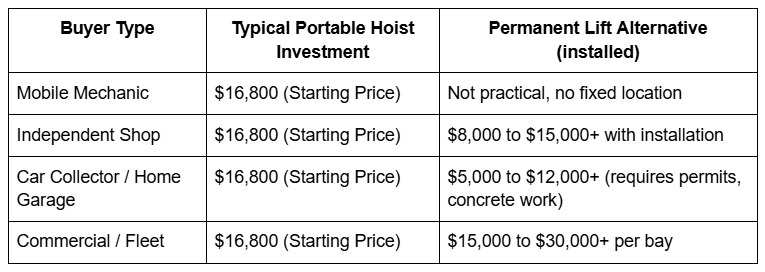
A few things are worth noting here. The price gap between portable and permanent widens dramatically once you factor in installation. Permanent two-post lifts typically require thick concrete bases, professional installation, permits, and electrical work. Those costs can easily run $3,000 to $7,000 on top of the lift itself.
A portable hoist arrives, you set it up, and you're working. No permits, no contractors, no waiting three weeks for a concrete pour to cure.
Let's use a realistic scenario for an independent mechanic shop.
Assumptions:
Weekly Revenue Gain: 1.5 jobs x 0.75 hours x $130 = $146.25 per day x 5 days = $731.25 per week
Payback Calculation: $4,500 / $731.25 = 6.15 weeks
That means, at a conservative estimate, a shop doing moderate volume can recover the full portable car hoist cost in about six to seven weeks.
That's not a year. That's not even two months.
Now stretch that math out. Over one year, the same lift adds roughly $38,000 in incremental revenue from the extra capacity alone, not counting the time saved on each job because the technician is working at a comfortable height instead of crawling around on the floor.
Not everyone's math looks the same. Here's how different users typically see their payback period.
Shops do the most volume, so they see the fastest return. The lift isn't just a convenience; it's a capacity multiplier. One extra oil change and brake job per day adds up to roughly three to four extra billable hours per week. At $130 per hour, that's $520 a week before any efficiency gains from better ergonomics or faster setup.
If your shop is currently turning customers away or booking out two weeks because you're bottlenecked on bay space, a portable hoist can act as a second lift without the $10,000+ investment of a permanent installation.
For a mobile mechanic, the case for investing in a car lift is slightly different. You're not just gaining speed; you're gaining access to entire job categories you literally cannot do without a lift. Suspension work, exhaust replacements, full brake jobs, and transmission pans: all of these require getting under the car safely.
A mobile mechanic charging $100 to $130 per job who can now add undercarriage-dependent services to their menu is essentially adding a new revenue stream. If the hoist enables even two additional jobs per week that you could not have done before, the payback window is ten to twelve weeks.
For someone who is not running a business, the ROI math is more personal. Please consider the current expenses you incur for routine maintenance. Oil changes, brake inspections, and tire rotations: at $120 to $160 per shop visit, two cars serviced three times a year equals $720 to $960 per year in labor costs, before any actual repair work.
If you start handling those jobs yourself with a hoist, you cut most of that cost. A $2,500 portable hoist could pay for itself in service savings within two to three years, and it holds strong resale value if you ever decide to sell.
For car show organizers or commercial fleet managers, the math is more event-driven. If you're renting lifts for each event at $300 to $500 per day, a portable unit that costs $5,000 pays for itself after ten to seventeen uses. A busy event season with monthly shows can hit that number in a single year.
The ROI conversation usually focuses on revenue gained. But there's a real cost on the other side, too.
Lost jobs: If you turn away a customer due to bookings, slowness, or inability to perform undercarriage work, you're losing out on revenue.
Technician wear: Working under a car on the floor is slow, physically demanding, and prone to mistakes. The ergonomic argument is real: a lifted vehicle is faster and safer to work on. One injury from working in a cramped position can cost far more than a hoist.
Reputation: Shops that can turn work around faster book more repeat customers. Speed is a competitive advantage, and a lift is a speed multiplier.
Here's why the portable car hoist cost argument is stronger than most buyers initially realize.
A traditional two-post lift runs $3,000 to $5,000 for the unit alone. Add professional installation at $1,500 to $3,000, concrete reinforcement at $500 to $2,000 if your floor needs it, electrical work at $300 to $800, and permits where required, and you're looking at $7,000 to $12,000 all-in before your first car goes up.
A portable hoist, by contrast, arrives ready to use. No floor anchors, no permits, no concrete work. You can move, store, or take it with you.
That flexibility has real dollar value. Especially for mobile mechanics, shops in leased spaces, or buyers who want to expand capacity without committing to a permanent installation.
Not all portable hoists are equal, and the cheapest option is rarely the best value. Here's what actually matters for your ROI:
Lift capacity: Make sure the rated capacity matches your actual vehicle mix, with room to spare. Trying to use an undersized lift on heavier trucks or SUVs is both dangerous and limits your job range.
Setup time: A hoist that takes forty-five minutes to set up is a barrier to daily use. Look for models that deploy quickly and consistently.
Portability: If you're a mobile mechanic, weight and transport dimensions matter. If you're a shop, wheel-ability matters. A hoist that requires two people and a forklift to move is not actually portable in practice.
Safety certification: ALI (Automotive Lift Institute) certification is the industry standard. It is not optional. This is what your insurance carrier will ask about if there's ever an incident.
Durability: A lift that lasts ten years at one job per day generates far better ROI than a cheaper unit that fails after two years of heavy use.
Fill in your numbers to see your personal payback window.
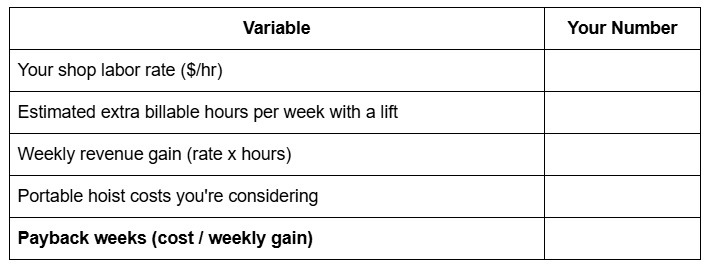
If you are a non-commercial buyer, calculate the annual service costs you currently pay and divide that by the hoist price to determine your savings-based payback.
Most mechanics, shop owners, and serious enthusiasts who actually run the numbers are surprised by how short the payback window is on a decent portable car hoist. Six weeks. Ten weeks. A season of car shows. The portable car hoist cost stops looking like an expense and start looking like one of the smarter equipment purchases you can make.
The real risk is not buying a lift. It's staying slow, turning away jobs, and watching your margin get squeezed while the tools that could fix it are sitting in a product listing you haven't clicked yet.
If you're ready to see which model fits your specific setup and volume, check out the full lineup at portablecarhoist.com and reach out to the team with your setup details. They will help you match the right hoist to your actual use case, so your car lift investment starts paying back as fast as possible.