


Jader Gil
Marketing Expert
April 1, 2026
9 min read
If you've been shopping for a lift and keep running into the same wall, the prices are confusing, the installation requirements are unclear, and nobody seems to explain what these things actually do, you're not alone. Most buyers come in with more questions than answers.
So let's fix that. This is the no-fluff breakdown of what a portable car hoist is, how it works, who actually needs one, and what you should look for before putting any money down.
A portable car hoist is a vehicle lift that doesn't require you to bolt it into the floor, pour fresh concrete, or call a structural engineer. You set up the hoist, lift the car, do your work, and move it when done.
That's the short version. Here's the slightly longer one.
Traditional car lifts are anchored to the floor. They're permanent, which means they're strong but completely fixed. Want to rearrange your shop? Too bad. Moving buildings? You're leaving that lift behind. The installation alone, including concrete prep, electrical wiring, and permits, can run you between $8,000 and $14,800 on top of the lift itself.
A portable car hoist solves all of that. It uses a wide base footprint to distribute the vehicle's weight across the floor surface rather than concentrating it at anchor points. No drilling. No inspections. There is no need to contact a concrete contractor.
What you get instead is a lift that goes wherever you go.
The mechanics are simpler than they sound. Most portable hoists use a two-post design, where two upright columns rise from wide, stable base feet. The lifting arms connect to hydraulic cylinders, which are powered either by a standard electric motor (110V or 220V) or a battery pack for off-grid use.
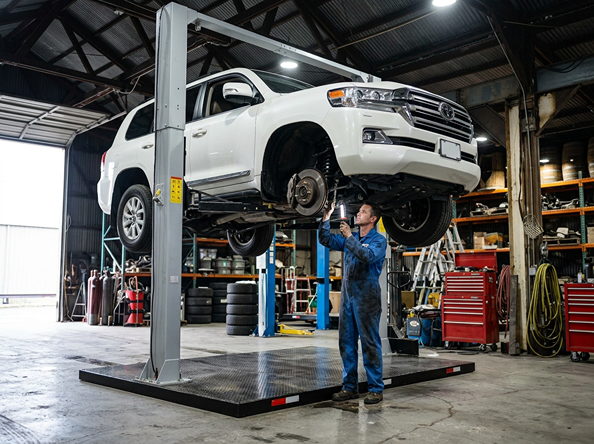
When you're ready to lift, you position the arms under the vehicle's designated lift points, power the motor, and the hydraulics raise both arms simultaneously. On quality units like the Portable Car Hoist models, you're looking at 69 to 73.5 inches of lift height, which means you're standing fully upright under the car, not crouching or kneeling.
No more creeper. You will no longer experience back pain from squatting under a car on jack stands.
The key to why this model works without anchors comes down to base engineering. The wider and heavier the base frame, the more stable the unit is under load. When combined with mechanical and hydraulic locking mechanisms that maintain position even in the event of a power outage mid-lift, a properly constructed portable hoist is just as safe as a fixed one.
Here's where things get practical. Let's talk about who this equipment is built for.
If your shop is in a leased space, you likely can't bolt permanent equipment into the floor. Or maybe you've already priced out a traditional lift installation and got sticker shock. A portable car hoist gives you full professional lift capability without touching the landlord's concrete. You also keep the flexibility to reconfigure your floor layout any time you want.
According to the Small Business Administration, nearly 65% of small auto repair businesses operate in leased commercial spaces. That's a lot of shops locked out of traditional lifts for reasons that have nothing to do with budget.
This is probably the single best use case for a portable hoist. If you're doing roadside or on-site repairs, the ability to bring a full lift to the customer changes everything. Battery-powered models run 8 to 12 full lift cycles per charge and fold down to fit in a standard pickup truck bed.
Think about what that means for your billing. Jobs that used to require the customer to tow their car to a shop can now be done anywhere. That's more revenue and a better experience for everyone.
You possess a vintage vehicle stored in your garage and wish to undertake the maintenance yourself, rather than incur the expense of paying a professional shop $180 per hour for the service. A portable car hoist gives you the same setup the pros use, in your space, without a multi-day installation project. And if you ever sell the house or move the car to a different storage unit, the lift comes with you.
Track repairs happen fast and usually nowhere near a shop. Having a portable car hoist on-site at a racing event means that a transmission issue in the paddock doesn't end your weekend. Several racing crews and event organizers already use these for exactly this reason.
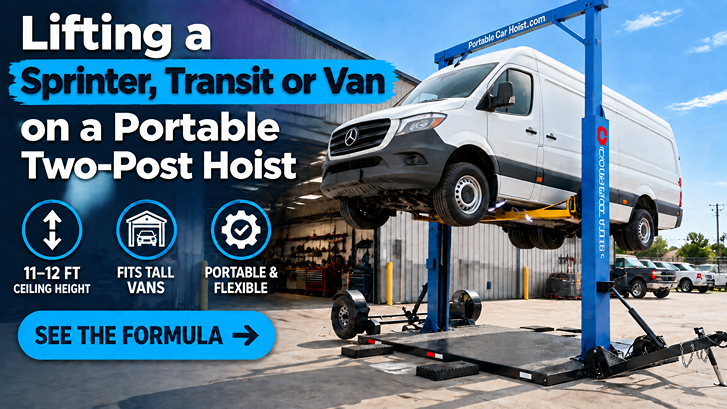
Fleet managers dealing with trucks, vans, and heavy commercial vehicles need lift solutions that can move between facilities or adapt as the fleet grows. Fixed lifts don't scale with you. Portable hoists, especially heavier-duty models capable of 16,000 to 54,000 lb capacity, handle that flexibility without the infrastructure headache.
People always want to know if a portable hoist is "as good" as a fixed lift. It's the wrong question. A more relevant question might be, which option best suits your needs?
Here's an honest side-by-side:
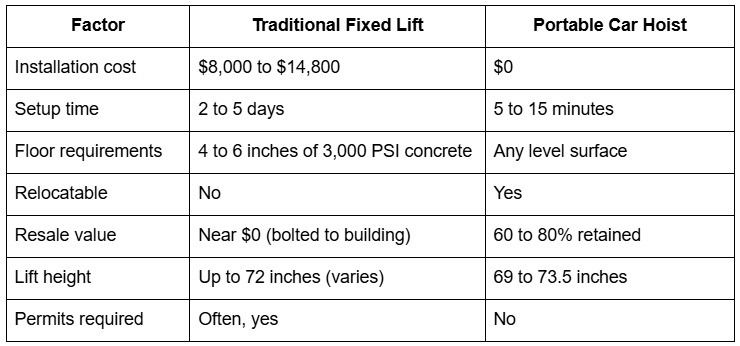
The lift height numbers are close enough that for most jobs, there's no practical difference. Where a portable hoist clearly wins is cost of entry, flexibility, and what happens to your investment if your business circumstances change.
Not all portable lifts are created equal. Here's what separates a solid investment from a headache waiting to happen.
Lift height: This one matters more than most buyers realize. Cheap portable lifts max out at 47 inches, which means you're still hunching over. Look for a unit that reaches at least 69 inches so you can actually work standing up.
Weight capacity: Match the capacity to the heaviest vehicle you'll regularly lift, and add a buffer. If you're doing light cars only, an 8,000- to 11,000-lb.-rated hoist is plenty. Please ensure that the specifications align if you are working on trucks or vans.
Power source: Electric models need access to 110V or 220V outlets. Battery-powered models are more versatile for mobile use but require overnight charging. Some buyers want both options, which some manufacturers offer.
Base stability: Ask specifically how the unit distributes load without anchors. A wide base footprint with quality steel construction is what you're looking for. Thin base plates on cheaper units can flex under load.
Safety mechanisms: Look for both hydraulic holding and a mechanical lock. If a hose fails, the mechanical lock should keep the car in position. This part is non-negotiable for any serious shop use.
Country of manufacture and warranty: This matters more than people think about long-term support. American-made units typically come with better parts availability and longer structural warranties. Portable Car Hoist, for example, offers a 2-year structural warranty and a 10-year mechanical warranty and is built in Menifee, California.
Financing availability: Equipment of this size is a real investment. Quality units start around $16,800. Many reputable suppliers offer financing through equipment lenders, which, for a typical shop, can translate to roughly $250 to $375 per month, far less than the cost of renting lift equipment long-term.
The biggest concern people raise about portable hoists is trust. Can you really lift a vehicle without attaching it to the floor?
Yes, and here's why it works. The laws of physics don't care whether you drilled into concrete or not. What matters is base surface area, total weight distribution, and locking reliability. Wide-base portable hoists spread the load over a larger footprint than you'd get from anchor points alone. When combined with proper locking, the vehicle remains stationary.
The ALI (Automotive Lift Institute) sets safety testing standards for vehicle lifts in the US, and reputable portable hoists are engineered to meet those same standards. When you're evaluating any lift, ask the manufacturer directly whether the unit has been tested to ALI (Automotive Lift Institute) specifications, which are the safety standards set for vehicle lifts in the US.
Does the floor need to be perfectly level?
Reasonably level, yes. Perfectly flat, no. Most shop floors and garage slabs qualify. If you're working outdoors on asphalt, the same rule applies.
Could you please let me know how long the setup typically takes?
Most models require a setup time of five to fifteen minutes. The first time takes a little longer because you're learning the process. By the third setup, most users are fully operational, well under ten minutes.
What happens if the power cuts out mid-lift?
If the units are of high quality, the situation remains unaffected. The mechanical lock holds the position independently of the hydraulic system.
Can one person set it up?
Yes, though having a second person for the initial unboxing helps. Daily setup and breakdown is a solo job.
If you're in a leased space, run a mobile operation, need equipment that moves with your business, or just don't want to spend $10,000 on installation before you turn a single bolt, the answer is probably yes.
The automotive lift market has shifted in a real way over the last several years. Demand for portable and flexible equipment has grown alongside the mobile mechanic industry, which has expanded by roughly 9% annually since 2020, according to IBISWorld industry data. More mechanics and shop owners are choosing solutions that give them optionality, not just capability.
A portable car hoist doesn't ask you to commit to one building, one layout, or one business model. It moves when you move.
If this guide got you thinking, the next step is easy. The team at Portable Car Hoist offers free 15-minute consultations where they'll match you to the right model based on your space, your vehicles, and your goals. There is no pressure or sales pitch during these consultations.
Call +1 (951) 400-5290, or visit portablecarhoist.com to schedule a consultation or request a custom quote. If you want to see the lift in action before you commit, they also offer virtual demos.
Your floor doesn't have to stop you from running a professional shop.