



Jader Gil
Marketing Expert
March 31, 2026
9 min read
You've probably done it a hundred times. You pop the floor jack under the frame, crank it up, slide the jack stands into position, and get to work. It feels solid. It feels safe.
But here's the thing: it might not be.
Jack stand accidents are more common than most people want to admit, and the consequences are not just scary; they can be fatal. This post is going to be honest about the risks and then point you toward something better.
Let's not sugarcoat this. Jack stands fail. And when they do, the results are catastrophic.
A 2020 recall by Torin Inc. affected over 30,000 jack stands due to a manufacturing defect that could cause the ratchet mechanism to slip, dropping a vehicle unexpectedly. The U.S. Consumer Product Safety Commission (CPSC) has documented dozens of injuries and deaths related to vehicle lift failures every year in the United States.
The Bureau of Labor Statistics reports that being struck by or caught under a falling object, including vehicles, is one of the leading causes of fatality for automotive service workers. And that's in professional environments. Home garages are even more unpredictable.
So what actually goes wrong?
Common failure modes of jack stands include:
That last one matters. When you're tired, distracted, or in a hurry, you might fail to notice that a stand is not seated quite right. Alternatively, you may place it on an uneven patch of concrete. Or the vehicle shifts when you loosen a stubborn bolt. One small mistake and the car comes down.
Here's what people don't talk about enough: you don't have to be doing something "wrong" for a jack stand failure to happen.
Consider the physics. A vehicle weighing 3,500 pounds sits on two 3-inch contact points, with only a ratcheting mechanism standing between you and disaster. The margin for error is extremely narrow.
A 2019 study published in the Journal of Safety Research found that DIY automotive work accounted for a significant portion of at-home workshop fatalities, with improper vehicle support identified as the primary risk factor in the majority of crush injury cases.
That's not meant to scare you away from working on your own car. That's meant to help you take this seriously.
And if you run a mechanic shop, think about your liability exposure. One incident involving an improperly supported vehicle can end your business and, worse, hurt someone you care about.
This is where the conversation needs to shift from fear to action.
Car lift safety isn't just about using the right technique with jack stands. It's about using the right tool for the job. And for anyone doing serious vehicle work at home or in a professional shop, that tool is a portable car hoist.
Here's the difference:
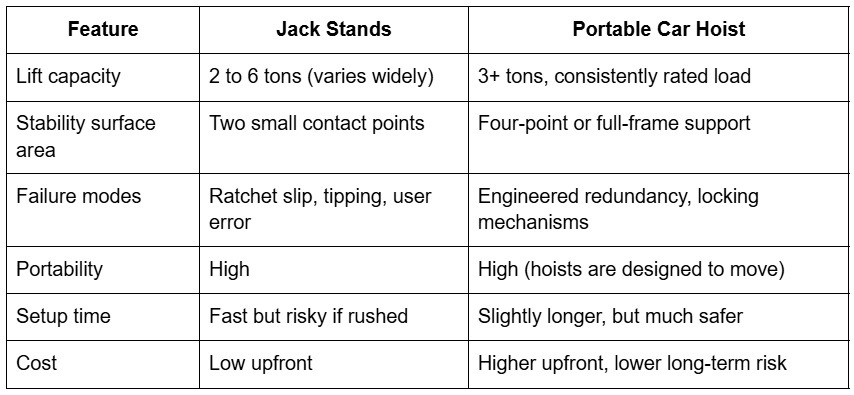
A portable car hoist distributes load more evenly, uses engineered locking systems rather than ratchet teeth, and is designed specifically for the kind of sustained static loads you create when you're working under a car for hours.
The market is paying attention. According to a report from Grand View Research, the global automotive lift market was valued at over $2.1 billion in 2022 and is expected to grow at a compound annual growth rate of around 4.5% through 2030. What factors are expected to significantly contribute to this growth? This growth is primarily driven by small shops, mobile mechanics, and home enthusiasts who seek professional-grade safety without the need to construct a full commercial lift in their garage.
A portable car hoist fills that gap perfectly.
For mechanics who travel to job sites, a portable car hoist means you're not relying on whatever equipment a customer happens to have. You bring your own, and you know it's rated and maintained.
For car collectors and enthusiasts working on multiple vehicles, a hoist gives you the flexibility to work on different ride heights and vehicle types without constantly reconfiguring your setup.
For racing event organizers and pit crews, speed matters, but car lift safety matters more. A blown race weekend is recoverable. An injury to a crew member is covered.
Not all portable car hoists are the same. Here's what actually matters when you're evaluating one:
Rated load capacity: Always choose a hoist rated for more than your heaviest vehicle. If your truck weighs 5,000 pounds, a 3-ton hoist is your minimum. Go higher if you can.
Locking mechanism: Look for multi-position mechanical locks, not just hydraulic hold. Hydraulics can fail slowly over time. Mechanical locks are your backup.
Build material: Steel construction with quality welds. Ask for certifications or third-party testing documentation if buying commercial equipment.
Footprint and portability: A good portable car hoist should break down or roll into a space manageable for a home garage. Weight matters here.
Lift height range: Make sure the hoist can accommodate your lowest and highest vehicles.
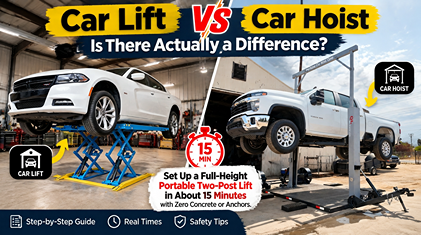
Setup requirements: No prior setup or installation requirements.
From DIY mechanics to professional shops to semi-truck maintenance, our hoist systems handle it all. Lift sports cars, trucks, SUVs, and commercial vehicles with up to 76,000 lb capacity.
You might be wondering: why not just install a traditional two-post lift?
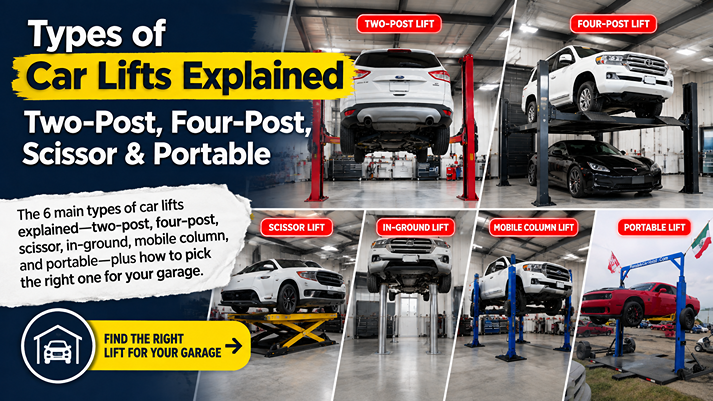
Good question. Two-post lifts are excellent pieces of equipment, but they require permanent installation, a minimum ceiling height of around 11 to 12 feet, and reinforced concrete flooring. They're immobile, expensive to install, and impractical for most home mechanics or mobile professionals.
A portable car hoist gives you most of the safety benefits of a two-post lift with far less commitment. You can use it in a standard garage, take it to a job site, store it when you're done, and move it between locations as your work changes.
That's why professionals who care about portable car hoist options are increasingly choosing this route over permanent installations when flexibility matters.
Let's do some rough math.
A quality set of jack stands typically costs between $5500 and $6500. A single unit of a portable car hoist starts from $16800, depending on capacity and features.
Now factor in this: a single workers' compensation claim from a jack-stand-related injury can run tens of thousands of dollars. A lawsuit from a shop incident can run into the hundreds of thousands. A fatality is immeasurable.
For business owners, the ROI on proper lift equipment is not hard to calculate. It comes down to how much your safety is worth to home mechanics.
And here's something most people don't factor in: better equipment makes you faster and more confident. When you're not worrying about whether the car might shift, you work more efficiently. That's a real productivity benefit, not just a safety one.
A few market trends worth knowing about:
Mobile mechanic growth: The mobile mechanic industry in the U.S. has grown significantly post-pandemic, with platforms like YourMechanic and Wrench expanding into more markets. Mobile mechanics need portable, reliable lift solutions that don't require a fixed shop.
Home garage upgrades: Consumer spending on home workshop equipment has climbed since 2020. More people are doing their maintenance, and they're investing in better tools to do it safely.
Insurance scrutiny: Commercial shop insurance providers are increasingly asking about vehicle support equipment during policy underwriting. Shops using rated, certified equipment may see better rates and fewer claim disputes.
YouTube and DIY culture: The DIY automotive community has exploded online. With more home mechanics attempting complex jobs (suspension work, transmission pulls, and brake jobs), the demand for safer lifting solutions is only going up.
Here's the honest truth. Jack stands are not going away, and for simple, quick jobs where you're not spending extended time under a vehicle, a properly placed, quality jack stand can be acceptable. But for anything longer, heavier, or more complex, you're taking a risk that isn't necessary anymore.
Car lift safety has evolved. The equipment has evolved. And the smart move for any mechanic, shop owner, car collector, or DIY enthusiast is to match their safety equipment to the work they're actually doing.
A portable car hoist gives you real stability, real rated capacity, and real peace of mind. It's not a luxury at this point. It's the responsible choice.
If you're ready to stop improvising and start working safely, check out the portable car hoist options at PortableCarHoist.com. Find the right fit for your garage, your vehicle lineup, and your budget. Your body will thank you.