


Jader Gil
Marketing Expert
September 2, 2026
9 min read
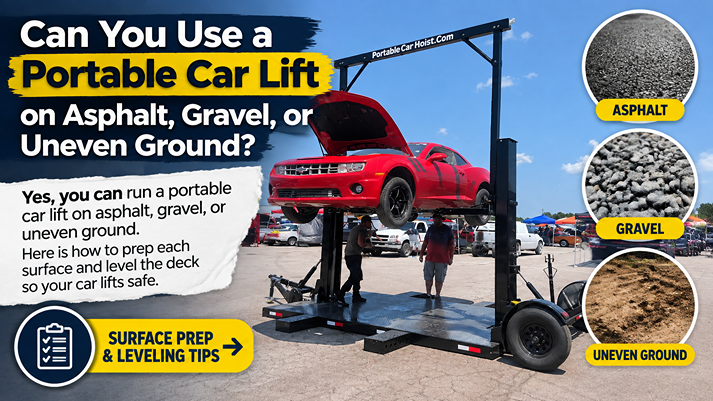
Yes, you can run a portable car lift on asphalt, gravel, or uneven ground, and I do it all the time. The catch is the ground has to be firm and close to level, not perfectly smooth. Our full-height hoists mount on their own steel trailer deck, so the machine carries its own foundation with it. In field tests, a properly leveled trailer-deck lift spreads a lifted vehicle's weight across roughly 40 square feet of contact, which is why it works on surfaces that would crush a bolt-down post. Below I will walk you through exactly what each surface needs so your car goes up safe.
This is the number one question I get from mobile mechanics, off-grid gearheads, and guys with a gravel driveway who are tired of crawling around on jack stands. The honest version of the answer is longer than a yes or no, because the lift does not care about concrete, but it does care about whether the ground under it will hold still. Let me break it down surface by surface.
Here is the thing most people get backwards. A traditional two-post lift is bolted into a thick concrete slab, and that slab is the foundation. It has to be, because all the lifting force runs down through two skinny posts into a handful of anchor bolts. Pour the wrong slab and the whole thing is unsafe.
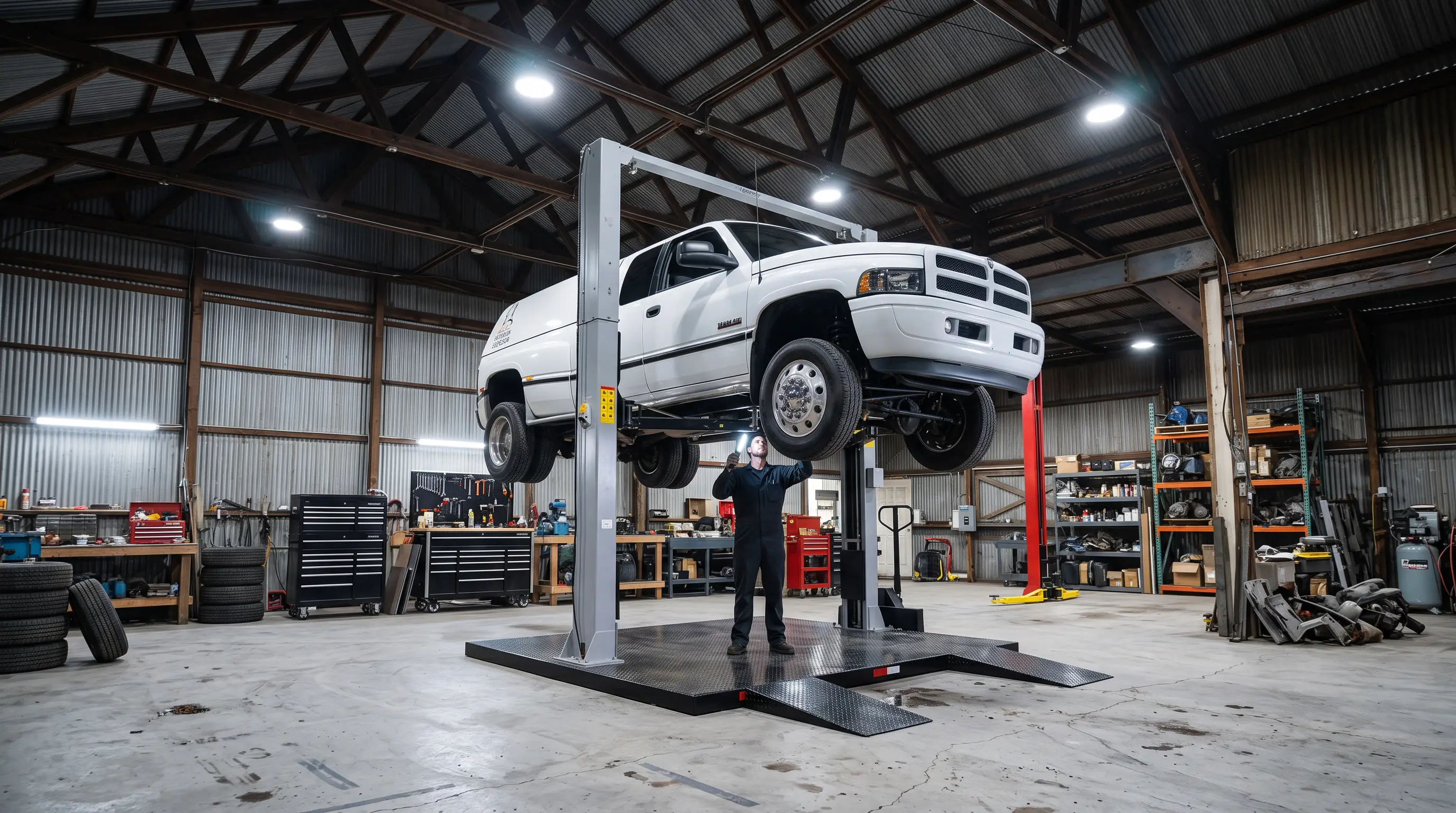
Our design flips that around. The two posts are welded to a heavy black diamond-plate trailer deck, and that deck is the foundation. When you lift a car, the load pushes down through the deck and spreads out across its entire footprint instead of concentrating on a few bolts. That is the whole reason you can skip the concrete. If you want the full mechanical picture, I laid it out in how a portable car hoist works with no concrete and no bolts.
So the real question is never is this surface strong enough to anchor into. It is will this surface hold my deck firm and level while the car is up. Once you think about it that way, asphalt, gravel, and dirt all become workable, as long as you prep them right.
Asphalt is one of my favorite surfaces to work on because it is everywhere, from shop parking lots to residential driveways. A standard driveway or lot will hold a lifted car with no drama. But asphalt has two personalities you need to respect.
The first is heat. On a blistering summer afternoon, asphalt goes soft. Park a loaded trailer deck on soft asphalt and the outriggers or foot pads can slowly press dimples into the surface, which lets the unit settle out of level while a car is up top. That is the failure mode you want to avoid.
The second is point loading. Even a firm asphalt lot can dent under a small, concentrated contact area. The fix for both is the same, and it is dead simple: spread the load.
I put a set of pads or short lengths of thick plywood under each contact point of the deck. This turns a few small pressure points into a big flat footprint, so the asphalt never sees enough pressure per square inch to deform. On a hot day I also try to set up in shade or earlier in the morning when the surface is cooler and harder. Then I do the same thing I do on every surface: level the deck, cycle the lift, and confirm it holds rock steady before a car ever goes near it. Mobile guys do this every single day, and I broke down the whole road-ready setup in taking your shop to the customer with a mobile car lift.
Gravel and packed dirt scare people off, and I get why. It feels loose. But a compacted gravel pad is genuinely one of the more forgiving outdoor surfaces once you set it up correctly, because gravel drains water and does not go soft in heat the way asphalt can.
The enemy on gravel and dirt is not weight, it is sinking and shifting. Loose stone or soft soil can let a foot pad settle unevenly, and uneven settling is what puts a lift out of level. So the whole game on these surfaces is building a stable base under each contact point before you lift.
My go-to on gravel or dirt is to lay a wide, thick piece of plywood, or a set of proper cribbing pads, under each foot of the deck. The plywood floats on the gravel and spreads the load across a much larger area, so no single stone gets driven down into the ground. I like to knock the high spots off the gravel first, set my pads, then set the deck and level it. If the ground is soft dirt after rain, I wait for it to firm up or I move to a better spot. Patience beats a tilted car every time.
Pro tip: after you lift the first foot or two, stop and look at your pads. If any of them are starting to press into the ground unevenly, lower the car back down and re-level. Thirty seconds of checking beats an hour of regret. This same slow-and-verify habit is the theme of my list of car-lifting safety mistakes DIY mechanics make.
Uneven ground is where a lot of buyers assume they are out of luck. Good news: you are not leveling the entire driveway, you are leveling the deck. A slope or a dip that would make a bolt-down lift a nightmare is usually a non-issue for a portable one, because the deck sits on top and you shim it flat.
For mild slopes, I build up the low side with pads or plywood until the deck reads level on a bubble or torpedo level. A gentle grade, the kind you would barely notice walking across it, takes just a shim or two. What I do not do is force it. If the ground is so steep or so broken up that I cannot get the deck genuinely level and stable, I find a flatter patch a few feet over. There is almost always a better spot nearby, and the portability of the unit is exactly what lets you go find it.
This flexibility is why guys with no proper garage lift cars in their own driveways safely every day. I walked through that exact scenario in no garage, no problem: how to lift cars in your driveway safely.
I want to be straight with you, because safety matters more than a sale. There are a few situations where I tell people to stop and reset:
Soft, waterlogged soil right after heavy rain. Wait for it to firm up. Sinking is real and it happens slowly enough that you might not notice until the deck is tilting.
Fresh, unpacked fill dirt or a brand-new gravel pad that has not been compacted. Give it time to settle, or compact it, before you trust it under a loaded lift.
A steep grade where you cannot get the deck level even with shimming. Move to flatter ground. It is not worth it.
None of these are limits of the lift. They are just common sense about the ground. The machine is rated to handle enormous loads, from a light hatchback all the way up to heavy trucks, and if you are unsure which capacity you need I broke that down in how to pick the right car hoist capacity. The steel is not the weak link. The dirt under your pads is the thing to manage.
Step back and it clicks: because the foundation travels with the lift, you are freed from the single biggest constraint in this whole industry, which is pouring and curing a special slab. No permits, no anchors, no waiting on concrete, and roughly a fifteen-minute setup once you know the routine. That is what lets one lift serve a shop bay on Monday, a customer driveway on Tuesday, and a car show on Saturday.
It also means renters and folks on a lease finally have an option, because you are not drilling into a floor you do not own. If concrete has been the thing standing between you and getting off the ground, read the anchor-free portable hoist that needs no concrete and how to lift vehicles without floor anchors. And if you are weighing whether a portable unit is the right long-term call at all, the full portable two-post car lift buyer's guide lays out every angle.
Every one of our hoists is built in our Menifee, California factory and ships nationwide, so wherever your asphalt, gravel, or uneven ground happens to be, we can get a lift to it.
Before I lift a car on any outdoor surface, I run the same quick mental checklist. It takes under a minute and it has kept me out of trouble on hundreds of setups.
First, is the ground firm? I press a boot heel into it. If it dents easily, it needs pads, plywood, or a better spot. Second, is it close to level? A gentle grade is fine to shim; a steep one is not. Third, are my load-spreading pads under every contact point? On asphalt, gravel, and dirt I never skip them. Fourth, is the deck reading level on an actual level, not just my eyeballs? And fifth, after I raise the car the first foot, does everything hold dead still with no settling or lean? Only then do I go all the way up and get to work.
That routine is the same whether I am set up in a driveway, a gravel lot behind the shop, or the grass field at a weekend car show, where portable lifts have quietly become standard event and paddock equipment. Do the checklist, and the surface stops being a question. And because the whole rig sets up fast with no anchors, running through it costs you almost nothing.
Stop letting your driveway, your gravel lot, or a sloped pad decide whether you can work standing up. A portable full-height hoist goes where the work is, sets up in about fifteen minutes, and lifts safely on the surfaces you already have. Tell me about your setup and the vehicles you service, and I will help you match the right model and capacity to your ground. Book a Free Quote today and let us get you off the concrete-only leash for good.
No. The lift mounts on its own steel trailer deck, which acts as the foundation, so there is no slab to pour and nothing to bolt down. You just need firm, reasonably level ground under the deck. Asphalt, compacted gravel, packed dirt, and of course concrete all work when set up correctly.
Not if you spread the load. I place pads or thick plywood under each contact point of the deck, which turns concentrated pressure into a large flat footprint. On hot days I also set up in cooler shade so soft asphalt does not dimple. On gravel or dirt, the plywood floats the load so no single stone gets driven down.
The ground itself does not need to be perfectly level, because you level the deck, not the lot. A gentle grade takes just a shim or two of pads or plywood under the low side until the deck reads level on an actual level tool. If a slope is so steep you cannot get the deck flat and stable, move a few feet to a better spot.
Absolutely, that is one of the most popular uses. Setup runs about fifteen minutes, and the same load-spreading and leveling routine works in any driveway, parking lot, or gravel yard you roll up to. That is what lets you take a full-height lift to the work instead of making the work come to you.
The Anchor-Free Portable Hoist That Needs No Concrete
Mobile Mechanic Car Lift: Take Your Shop to the Customer