


Jader Gil
Marketing Expert
October 14, 2026
9 min read
If you have ever stood in front of a two-post lift and wondered why the front arms are short and the rear arms are long — or why the whole car sits rotated a little on the posts — the answer is the arm design, and it decides whether every lift feels effortless or like a fight. Here is the direct answer: symmetric arms split the vehicle 50/50 between the two posts, asymmetric arms rotate the vehicle back about 30 degrees so the doors clear the columns, and the swing arms plus adapters are what actually carry the load at the factory lift points. Industry data pins the vast majority of lift accidents on the contact point — the car coming off the pads — not on the steel failing, which is exactly why understanding your arms matters more than the capacity sticker.
I set up, load, and break down two-post hoists for a living, and the question I get most from shop owners and mobile techs is some version of ‘which arm setup should I buy?’ So let me walk you through what the arms do, the symmetric-versus-asymmetric decision, how to run a swing-arm setup without clipping a rocker panel, and why a portable full-height hoist changes the math on all of it.
On a two-post lift, the posts and the top beam or hydraulic cylinders do the lifting, but the arms are the hands. Each arm is a telescoping steel boom that swings out from the carriage, slides in and out to reach the vehicle’s factory lift point, and tops out in a rubber or poly pad that touches the pinch weld or frame rail. Four arms, four contact points, one car in the air. Simple in theory — and the place where almost every mistake happens.
Two things about the arms matter before you ever think about symmetric or asymmetric. First, the arms must telescope far enough to fit both a short Miata and a long dually without the pads landing in the wrong spot — reach range is everything, and it is the same reason capacity alone never tells the whole story when you are sizing a lift. If you want the full picture on matching a hoist to the vehicles you actually service, our guide on picking the right car hoist capacity from Miatas to monster trucks breaks it down. Second, the arms have to lock. A spring-loaded arm restraint — usually a gear-and-pawl mechanism at the arm pivot — keeps the arm from swinging out from under the car as you raise it. If that restraint is worn or skipped, the arm walks, and the car follows.
This is the decision that trips people up, because both designs lift the same car — they just place it differently between the posts. The difference is about door clearance and weight balance, and it changes how you work every single day.
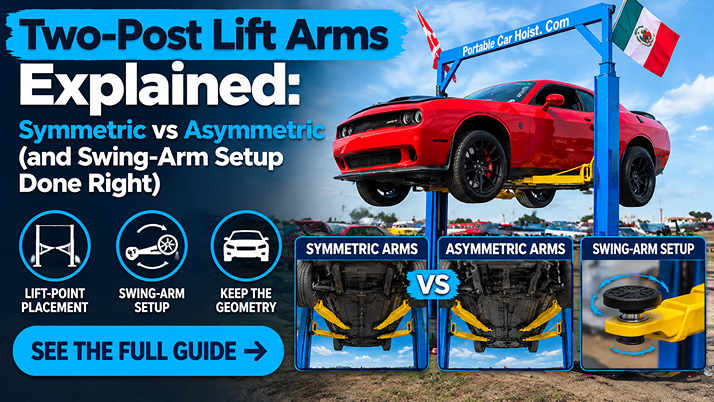
On a symmetric lift, all four arms are the same length, and the vehicle sits centered — half its weight in front of the posts, half behind. The posts line up roughly with the center of the car, which means the doors open right into the columns. Symmetric setups shine with trucks, vans, and anything long and heavy, because the load is balanced dead-center and the arms reach frame rails cleanly. If you mostly service pickups and fleet vehicles, symmetric reach is your friend — the same reason it comes up in our write-up on servicing lifted pickups and duallies on a portable truck lift. The trade-off is obvious the first time you try to open a car door: you cannot, not fully, without dinging the post.
Asymmetric lifts solve the door problem with geometry. The front arms are shorter than the rear arms, and the posts are rotated inward about 30 degrees. You drive in and the car ends up sitting back on the lift — roughly a third of the vehicle behind the posts, two-thirds in front. Now the door openings sit forward of the columns, so you and your tech can swing the doors wide and actually get in and out. For a shop that lives on cars — brakes, interiors, diagnostics where someone is in and out of the cabin all day — asymmetric is a quality-of-life upgrade. The catch: the weight balance is less forgiving, and if you load a long, heavy truck on a true asymmetric setup, you can push the vehicle’s center of gravity toward the edge of its envelope.
Here is the honest version most sales pages skip. A huge share of modern two-post lifts are not purely one or the other — they are a hybrid, sometimes marketed as ‘versymmetric’ or ‘symmetric/asymmetric,’ where the arms and column design let you load cars asymmetrically and trucks symmetrically. If a lift gives you that flexibility, take it. If you are forced to choose, match the arm style to your bay’s bread and butter: cars and daily-driver work lean asymmetric for the door clearance; trucks, vans, and mixed heavy fleets lean symmetric for the balance and reach. And if you are still deciding between a two-post and something else entirely, our breakdown of single-post versus two-post portable lifts is the right next read.
You can own the best arms in the world and still put a car on the ground if you set them up lazily. The swing arm is a multi-stage telescoping boom, and running it right is a short checklist that too many people rush.
Start by swinging both arms on one side out of the way, drive the vehicle in slowly, and stop with the lift points roughly between the posts. Then swing each arm under the car and telescope it in or out until the pad sits directly under a factory lift point — not near one, under one. Spin the screw-up pad or stack the adapter so it makes full, flat contact before you lift. As you start raising, go up just an inch or two, then stop. Push on the car. If it rocks, the pads are not seated, and you reset before anything else happens. This ‘lift an inch, shake, confirm’ habit is the single biggest difference between pros and the stories you read in our piece on the car-lifting safety mistakes that put mechanics in the hospital.
Pro tip: Before the car ever leaves the ground, confirm the arm restraints have engaged on all four arms — you should feel and hear the pawl drop into the gear teeth when the arm is positioned. If an arm still swings freely under load, stop and fix it. A failed or bypassed arm restraint is the quiet cause behind a shocking number of ‘the car just slid off’ incidents.
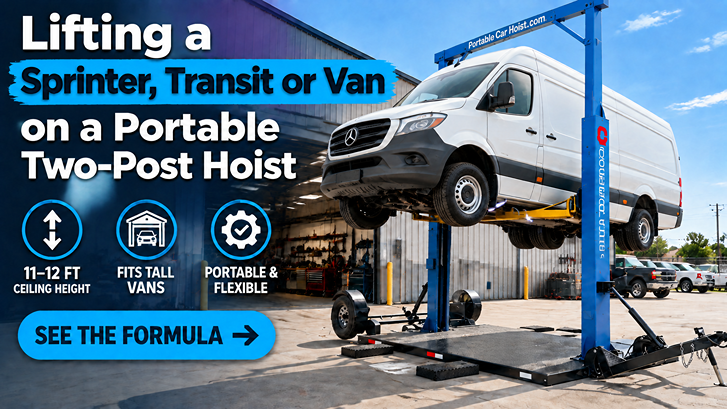
Most vehicles need more than the bare pad. Trucks and SUVs ride high and want tall adapters or stacked blocks to reach the frame; low sports cars want a flat pad and sometimes a slim pinch-weld adapter so you are not crushing a rocker. Unibody cars have specific pinch-weld points; body-on-frame trucks lift on the frame rails. Keep a set of adapters sorted by the vehicles you see most and your setups get faster and safer. This matters even more on tall and heavy vehicles — it is a running theme in how we handle lifting a Sprinter, Transit, or tall van on a portable hoist, where frame-rail contact and balance are non-negotiable.
I will say this plainly because it is the thing that actually hurts people: no arm style, symmetric or asymmetric, protects you if the pad is not on a real lift point. The arms only position the pad. You are responsible for where it lands. Every manufacturer publishes a lift-point diagram — the reinforced spots on the pinch weld or frame engineered to take the whole vehicle’s weight on a small pad. Put a pad an inch off, on a floor pan or a brake line bracket, and you can fold sheet metal or drop the car.
This gets more serious with electric vehicles, where the battery pack sits low and the lift points are specific and often different from a gas car. We dug into exactly that in our guide on lifting an EV on a two-post hoist — battery weight, jack points, and safety, and the short version is: check the service manual every time, because guessing near a battery pack is how expensive mistakes happen. The arms give you the reach; the lift-point diagram gives you the target. Use both.
And none of this replaces the locking system. Good arms position the car; mechanical safety locks hold it. Once the vehicle is at working height, you lower it onto the locks and let the mechanical catches — not the hydraulics — carry the weight. If you are fuzzy on how those locks work or why they matter, our overview of whether portable car lifts are safe, ALI certification, and locking systems is worth ten minutes.
Here is where I get to the part I care about most. Everything above assumes a lift bolted into a concrete slab, which brings its own headaches — slab thickness, anchor placement, column plumb, permits. Our portable car hoist versus a traditional two-post lift comparison covers that whole fight. The portable full-height hoist I run every day keeps the exact two-post arm geometry you want — real telescoping swing arms, real adapters, real mechanical locks — but mounts the posts on its own black diamond-plate trailer deck instead of your floor.
That changes the arm question in two practical ways. First, because the posts sit on the deck, the arms reach and lock the same way every time regardless of whether you are in a leased bay, a gravel lot, or a customer’s driveway — the geometry travels with the machine. Second, you skip the entire slab-spec rabbit hole; there is no drilling, no anchors, no wondering if your floor is thick enough, which we cover in what thickness concrete you need for a two-post lift. Setup runs about 15 minutes, the unit handles 8,000 to 76,000 pounds depending on the model, and the full 69 to 73.5 inches of lift height means you walk under the car and stand up straight — the standing-up-straight part being the whole point we make in half car lift versus full-height hoist. You get professional two-post arms without surrendering a bay to concrete forever.
If you want to see the arms, adapters, and locks on the actual machine — or figure out which model and arm configuration fits the vehicles you service — the fastest path is to Book a Free Quote and tell us what rolls through your bay. We will match you to the right hoist and walk you through the setup so your first lift feels like your hundredth. For the full lay of the land before you decide, the complete 2026 portable two-post buyer’s guide ties it all together.
Neither is inherently safer — they are safe when the pads sit on factory lift points and the arm restraints engage. Asymmetric wins on door clearance for car work; symmetric wins on balance and reach for trucks and vans. The real safety variable is setup discipline, not arm style: seat the pads, lift an inch, shake-test, and settle onto the mechanical locks every time.
Yes. Many modern two-post lifts are hybrid designs that let you load cars asymmetrically for door access and trucks symmetrically for balance. If you service a mixed fleet, that flexibility is worth prioritizing over a lift locked into a single arm geometry.
Use the vehicle manufacturer’s lift-point diagram, not your best guess. Body-on-frame trucks lift on the frame rails; unibody cars lift on reinforced pinch-weld points. Position each pad directly under a designated point, make flat contact with the right adapter, and confirm the car does not rock before you raise it past a couple of inches.
They do. A portable full-height hoist keeps real telescoping swing arms, adapters, and mechanical safety locks — the same geometry as a bolted-down two-post lift — but mounts the posts on its own trailer deck, so there is no drilling, no anchors, and about a 15-minute setup wherever you work.
Portable Car Hoist vs. Two-Post Car Lift: Which One Wins?
Single-Post vs Two-Post Portable Car Lift: Which Actually Holds Your Car?
Are Portable Car Lifts Safe? ALI Certification & Locking Systems
How to Pick the Right Car Hoist Capacity, From Miatas to Monster Trucks