

.png)

Jader Gil
Marketing Expert
April 1, 2026
9 min read
So you found a lift you like. The specs look solid. The price is right. Upon reading the installation requirements, you may find yourself feeling disheartened.
"Minimum 4 inches of 3,000 PSI reinforced concrete."
If your shop floor is older, cracked, or built on a post-tension slab, that sentence basically means, "This lift is not for you." And even if your floor technically qualifies, you still have to factor in the electrician, the concrete work, the permits, and the inspector who may or may not show up when they say they will.
Here's the thing nobody talks about enough: the lift is rarely the expensive part. The installation is.
That is exactly why more and more mechanics, car collectors, and mobile pros are asking about a car lift, no concrete setup. This is not due to a desire to economize, but rather a realization that anchor-free hoists perform equally well and come at a significantly lower cost than traditional fixed lifts, even before you lift your first vehicle.
Let's explore the practical implications of "you need good concrete."
According to the Automotive Lift Institute (ALI), the leading safety authority for vehicle lifting equipment in North America, traditional two-post lifts require a concrete slab that meets strict thickness and PSI standards. ALI guidelines specify that the concrete must be in good condition with no visible cracking, and the installer must confirm load capacity before any anchor bolt goes in.
Here is where it gets messy. A 2022 survey by ALI found that a significant percentage of shops, particularly those in older commercial buildings, cannot meet standard anchoring requirements without major floor remediation. That is a significant inconvenience. Floor reinforcement can run anywhere from $3,000 to $8,000, depending on your slab. And that is before a single piece of lift equipment arrives on site.
Then there is the permit process. Many municipalities require a building permit for fixed lift installations, which means inspections, waiting periods, and paperwork. If your shop is in a leased space, your landlord may not approve the modification at all.
The result is that plenty of shop owners end up with a $4,000 lift that actually costs $12,000 to $15,000 by the time it is usable. And it is bolted to a building they do not own.
You might be wondering how a lift can be stable without being drilled into the floor. It is a fair question, and the answer comes down to engineering, not just marketing.
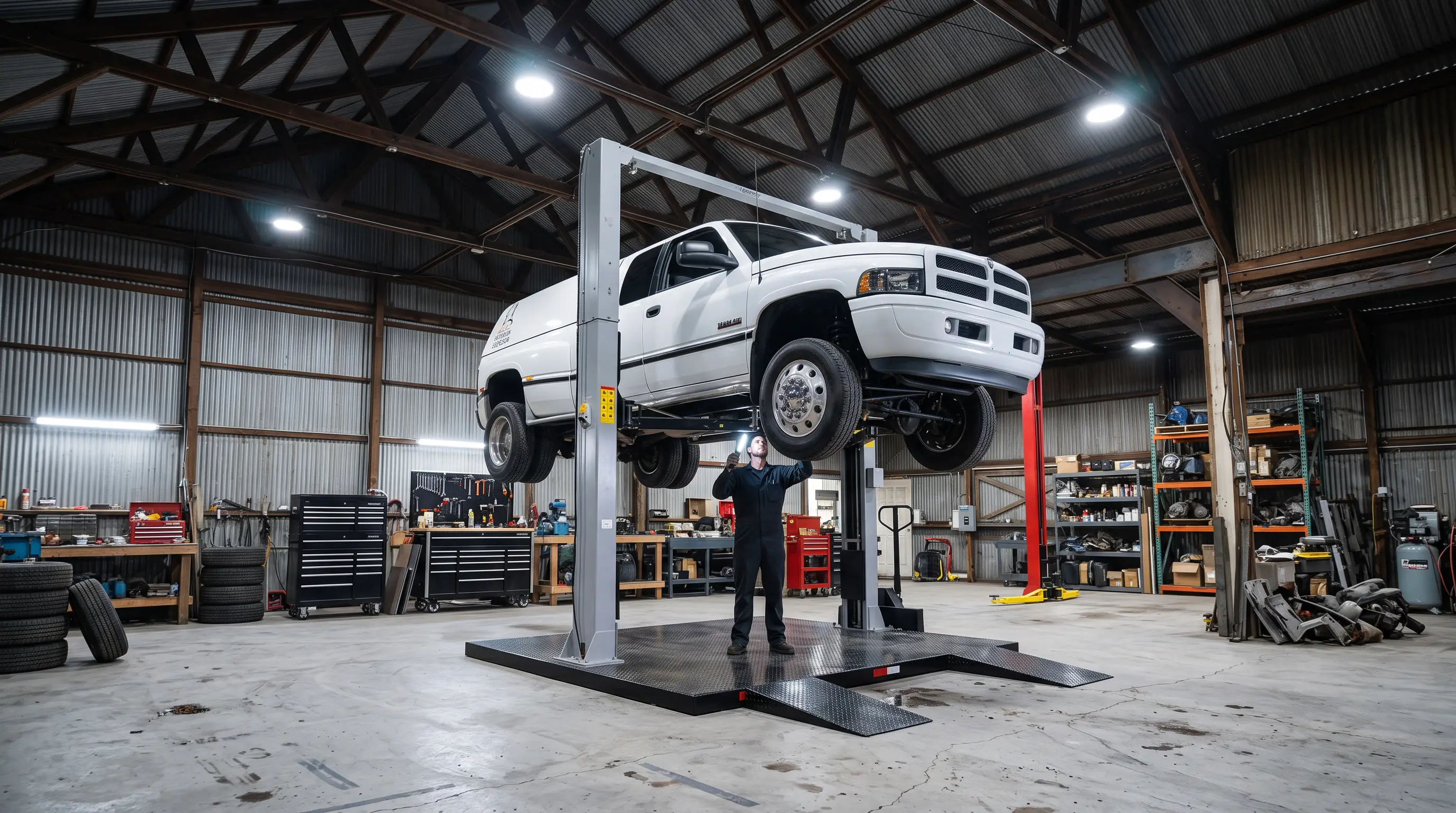
A quality portable two-post lift achieves stability through wide-base weight distribution rather than anchor tension. Instead of relying on bolts to keep the columns upright under load, the base spreads the vehicle's weight across a larger surface area. Think of it like a tripod versus a nail. The tripod does not need to be hammered into anything to stand firm.
Portable Car Hoist, which manufactures its units in Menifee, California, uses this principle across its full product line. Their lifts reach 69 to 73.5 inches of lift height, carry up to 15,000 pounds per unit, and have been rated through the same load-testing standards that traditional lifts undergo. The difference is not what they can lift. The difference is what they need underneath them to do it.
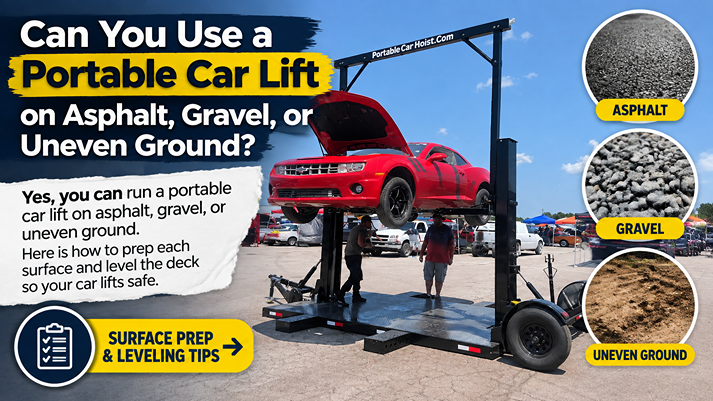
According to their engineering specs, the units can operate safely on concrete, asphalt, or epoxy-coated floors without any anchoring. Setup takes 5 to 15 minutes. No electrician. No inspector. No waiting.
That is not a compromise. That is a different design philosophy.
Here is a breakdown that most lift sellers do not put front and center.
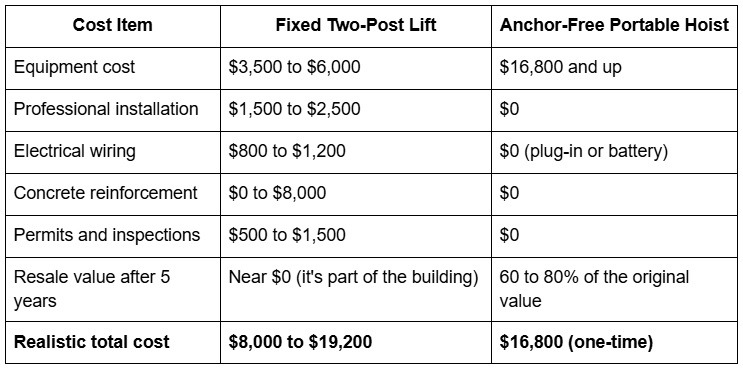
When you look at it this way, the portable hoist is not the expensive option. It is just honest about its price upfront.
And if you are a mobile mechanic or someone who moves locations, the fixed lift has an additional hidden cost: you leave it behind. Every move means starting over. A portable hoist goes with you.
Not every situation is the same, so it is worth being specific about where anchor-free lifts make the most sense.
Mechanic shops in leased spaces: If you do not own the building, drilling into the floor is either prohibited or carries liability. A portable setup gives you full lifting capability without touching the landlord's property.
Mobile mechanics: A battery-powered portable two-post lift folds down to fit in a pickup truck bed and runs 8 to 12 full lift cycles per charge. You deliver professional-grade lifting services directly to the customer's location, eliminating the need to travel back and forth.
Car collectors and automotive enthusiasts: If you are working on a classic car in a home garage, you probably do not want to permanently alter the floor. And you likely do not need a lift five days a week, which makes the flexibility of a portable setup genuinely useful.
Racing event crews: When your team is at a track or staging area, there is no slab to anchor to. A portable hoist turns any paved lot into a fully functional service bay in under 15 minutes.
Fleet operators and commercial accounts: If you are maintaining vehicles across multiple sites or need to move equipment seasonally, a fixed lift is a logistical problem waiting to happen. Portable means adaptable.
This is the most common pushback, and it deserves a real answer rather than a dismissal.
Fixed lifts feel safer because they are physically connected to the building. There is a certain psychological confidence in knowing something is bolted down. But stability under load is not the same thing as being bolted to concrete. A 500-pound base with proper geometry can hold more securely than a bolt in a compromised slab.
The ALI (Automotive Lift Institute) sets safety standards for all vehicle lifting equipment in the U.S. Its requirements cover load capacity, locking mechanisms, and failure protocols. Any lift worth buying, portable or fixed, should meet these standards. Portable Car Hoist runs its units through load testing at 150% capacity before shipping. Mechanical and hydraulic redundant locking systems hold the vehicle in position even if power is lost mid-lift.
The real safety risk is not the anchor-free design. The real risk is buying a low-quality portable lift that was not engineered for it. The $2,500 import lift on a marketplace site and a properly engineered American-made portable hoist are not the same product, even if they both say "no anchors required."
There are a few other products in the anchor-free category that are worth mentioning so you can understand what you are comparing.
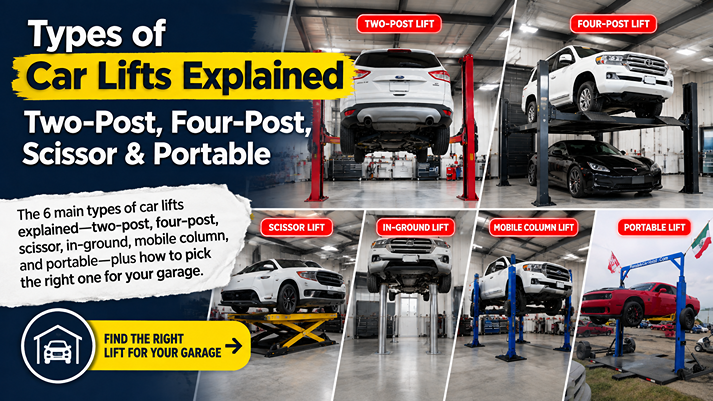
QuickJack and MaxJax are popular low-profile options for home garage use. They work, but they lift from underneath the vehicle rather than from a column, which limits the access you get to suspension, exhaust, and drivetrain components. They are also significantly lower in lift height, typically topping out around 24 inches rather than 69 to 73 inches. That is fine for an oil change. It is not fine for a full transmission job.
Scissor lifts and four-post platforms are another category. Four-post lifts are stable and often do not require anchors, but they restrict undercarriage access because the vehicle sits on runways. For most mechanical work, that is a real limitation.
A portable two-post lift with full arm clearance and 69-plus inches of height sits in a different class entirely. You get the same working access as a traditional shop lift, just without the permanent installation.
Not all portable lifts are built the same. Before you commit, check these specific things:
Lift height. Anything under 60 inches means you are crouching. Look for 69 inches or more to work standing up.
Weight capacity. Make sure it covers your heaviest regular vehicle, plus a safety margin. 8,000 to 11,000 pounds handles most cars and light trucks.
Power options. Electric (110V or 220V) is fine for a fixed location. Battery-powered (12V or 24V) is what you need for mobile work or locations without convenient outlets.
Build origin and materials. Domestic manufacturing with US-sourced steel matters if you want longevity and accessible support.
Locking system. Both mechanical and hydraulic locks should be standard. If it only has one, keep looking.
Warranty terms. Look for at least a one-year warranty on hydraulics and electrics and a longer structural warranty. Portable Car Hoist covers structural components for five years and hydraulic and electrical systems for one year.
One shop owner running a mobile repair business in Southern California switched to a battery-powered portable hoist after spending two years turning down jobs that required full undercarriage access. With a portable two-post lift in his truck, he now takes on suspension jobs, brake work, and exhaust repairs at customer locations. His revenue per day increased because he stopped leaving money on the table.
A car collector in the Pacific Northwest installed a portable hoist in a rented garage space. Because he did not need to drill anything, the setup took an afternoon. When the lease ended, and he moved to a larger space, he took the hoist with him. No loss. No reinstallation cost.
Racing event organizers have used portable hoists at track events to provide on-site repair capability for competing teams. A parking lot becomes a functional shop. Teams that would have trailered a car home for a fix can get back on track the same day.
These are not edge cases. They are the point.
If you have been waiting to get a lift because of floor requirements, installation costs, lease restrictions, or just the general headache of a permanent installation, you are not waiting for the right budget. You are waiting for the right product.
A car lift with no concrete setup is not a workaround or a compromise. For a growing number of mechanics, collectors, and mobile professionals, it is the better answer. Stable, moveable, full-height, and ready in minutes. No permits. No electrician. No slab reinforcement.
The question is not whether a portable hoist can do the job. It is whether you can afford to keep working without one.
Portable Car Hoist builds American-made, anchor-free hoists for shops, mobile mechanics, collectors, and event teams. Schedule a free 15-minute consultation to find out which model fits your setup.