



Jader Gil
Marketing Expert
June 6, 2026
9 min read
Here is a situation a lot of shop owners know way too well.
You find a great bay space. The rent is fair. The location is solid. You sign the lease, start planning the layout, and then you read the fine print.
"Tenant shall not make structural modifications or drill into the concrete slab without written landlord approval."
And just like that, your plan to install a standard two-post lift falls apart. You either spend weeks going back and forth with your landlord, pour money into a concrete project you will leave behind when you move, or you scale back your operation and keep cramping your workflow.
This is not a rare situation. According to a 2024 survey by the Independent Garage Owners of America, nearly 1 in 3 independent shops is operating in a leased space with some form of restriction on permanent equipment modifications. And that number is not going down.
So, what do you actually do if you need real lift capability but cannot or do not want to drill into your floor?
You find a 2-post car lift without concrete. And that is exactly what this post breaks down.
Commercial landlords have gotten stricter about floor modifications in the last few years, and there are a few practical reasons for it.
Concrete anchoring for a standard two-post lift requires drilling holes typically 3 to 4 inches deep, using anchor bolts rated for the load. This permanently alters the slab. When a tenant leaves, those holes are left behind, and the landlord either has to patch them or show them to every future tenant. Add the fact that incorrectly anchored lifts have caused concrete failures in older or thinner slabs, and you can see why landlords are cautious.
From your side as a shop operator, the math also works against concrete installation. A standard fixed two-post lift installation runs an extra $2,000 to $4,000 on top of the equipment cost, just for the concrete work, electrical tie-in, and labor. You are paying that cost for a building you do not own, for equipment you cannot take with you.
A portable setup changes all of that.
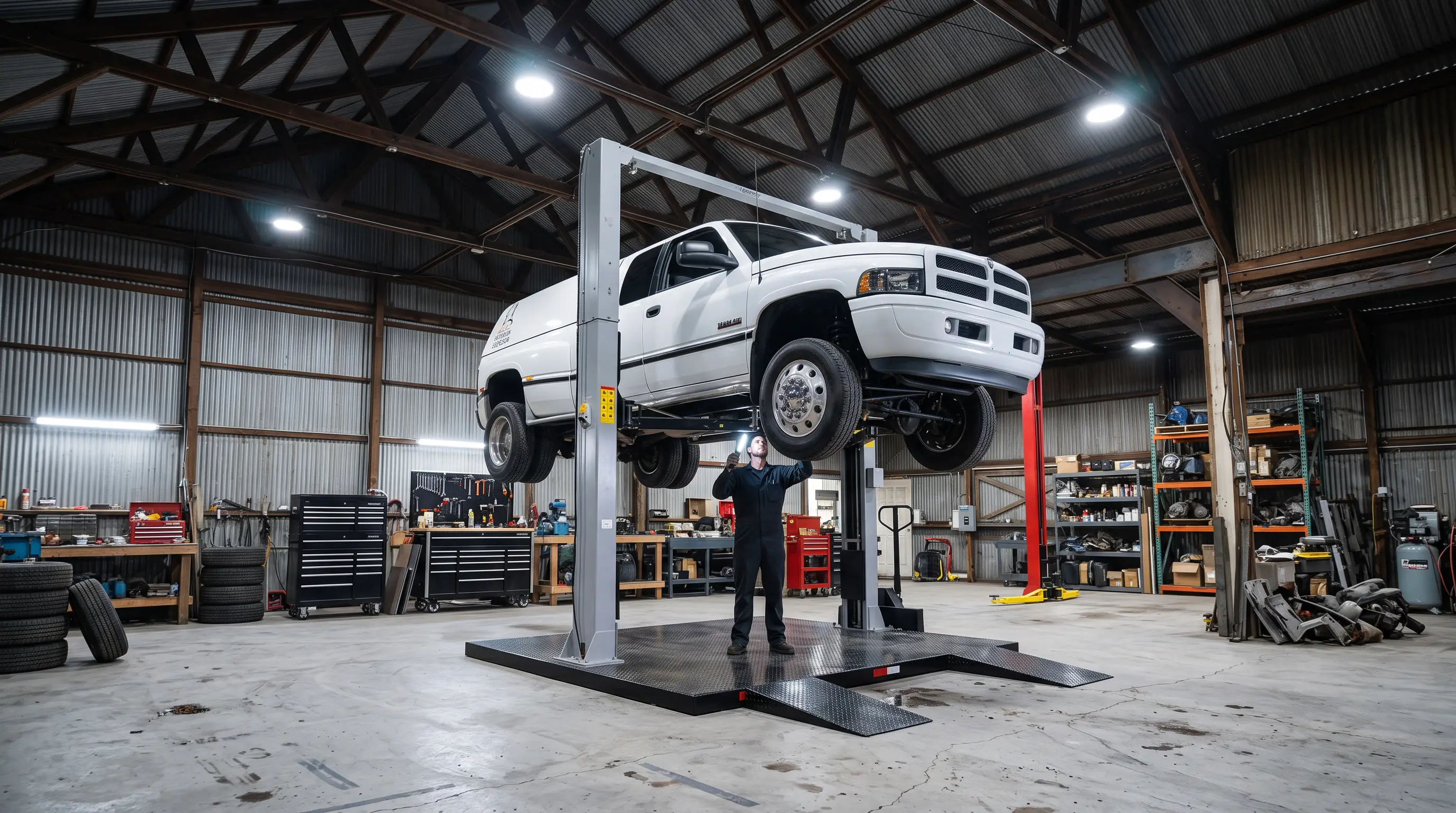
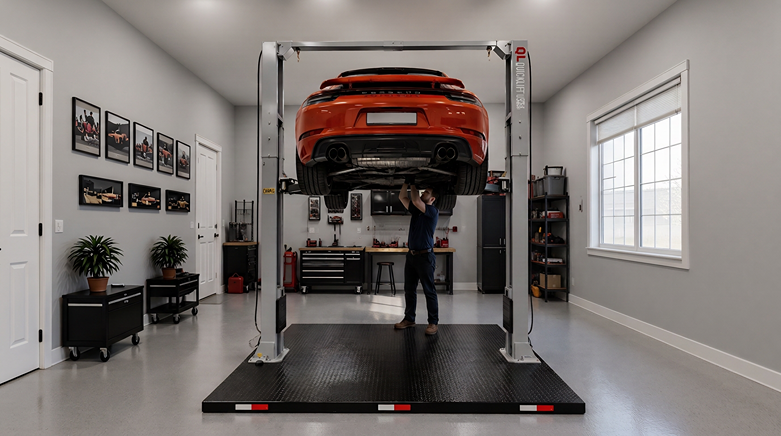
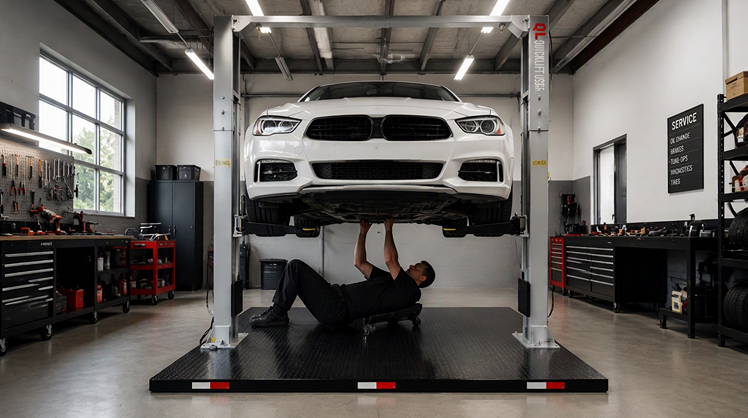
Modern portable two-post lifts use wide, engineered base plates and a stable column design that distributes the vehicle's weight across a broad contact area. Instead of relying on floor anchors to keep the posts from tipping, the weight of the vehicle itself, combined with the geometry of the lift frame, keeps everything stable during operation.
This is not a new idea. Think about how a hydraulic floor crane operates without being bolted down. The physics of weight distribution and counterbalancing do the work.
That said, there are important distinctions between a legitimate engineered portable two-post lift and a cheap import that just skipped the anchor step. A properly designed 2-post car lift without concrete should:
The Automotive Lift Institute sets the certification benchmark in this industry. Their testing protocol includes static load testing at 150% of rated capacity, plus dynamic raise and lower cycles. If a lift is not ALI-certified, that is not a minor detail; that is a hard pass.
This is where things get practical. Here is a real framework for setting up lift capability in a leased space without violating your lease or risking your deposit.
Pull out your lease agreement and look for language about:
Most leases that restrict drilling do NOT restrict portable equipment. A portable lift is no different from a large toolbox or a floor jack in terms of your lease, because it does not attach to the building. But confirm that with your landlord in writing if there is any gray area.
You do not need a freshly poured slab, but you do need a flat, solid one. Portable two-post lifts require the floor to be level within 1/8 inch across the lift's footprint. That is not as tight as it sounds, but a floor with large cracks, settled sections, or oil-soaked soft spots can create problems.
Walk the bay with a 4-foot level. Check the area where you plan to position the lift. If the floor has minor variance, most quality portable lifts include leveling feet that can compensate.
If you are on asphalt (some outdoor bays or pop-up shops), you will need load distribution pads. Asphalt compresses under point loads, so spreading the weight is essential.
This is the mistake that catches most first-time buyers. Before you fall in love with a specific lift model, measure your ceiling height, accounting for light fixtures, HVAC ducts, and garage door tracks.
Use this quick formula:
Minimum ceiling height needed = Vehicle height + Lift rise + 6 inches working clearance
A full-size SUV at 75 inches tall, lifted on a unit with 72 inches of rise, needs at least 153 inches (roughly 12 feet 9 inches) of clear ceiling. Many standard commercial bays have 10-foot ceilings, which limits your lift selection significantly.
Check this before anything else.
Do not buy based on the heaviest vehicle you might someday work on. Buy based on what you actually work on, and then add 20% margin.
Here is a simple reference:
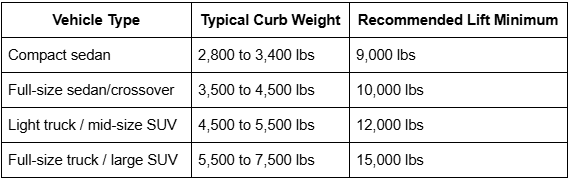
Always account for real-world weight, not just manufacturer curb weight. A crew cab F-150 with a full tank, tools in the bed, and aftermarket bumpers can be 1,000 to 1,500 pounds over the listed curb weight.
If you are not sure how long you will be at your current location, bolting equipment into the floor is a bad financial decision. A portable lift moves with you. The shop in Ohio added eight more service slots per week after adding portable lift capability, largely because they could rearrange the bay layout when demand changed.
Low-profile scissor lifts are useful for tire rotations and brake jobs. But if you are doing suspension work, exhaust replacement, or transmission drops, you need real working height. A 2-post car lift without concrete gives mobile mechanics the same access they would have in a fixed shop, without the fixed shop.
A lot of collectors rent climate-controlled storage units for their vehicles. Those landlords will never approve anchor drilling. A portable two-post lift changes what you can do in that space, from long-term storage to actual maintenance and inspection work.
Track events need lift capability at temporary locations. Portable two-post setups can be staged, used for a weekend, and transported to the next event. No concrete, no permits, no permanent installation.
Here is something that does not get talked about enough: the total cost comparison between a fixed and portable setup is not just the equipment price.
Fixed two-post lift (installed):
Portable two-post lift (professional-grade, American-made):
Yes, a quality American-made portable lift costs more upfront. But you keep it. You move it. And you do not pay $4,000 in concrete work that stays in someone else's building.
Most manufacturers, including Portable Car Hoist, offer equipment financing options through partners like ClickLease and TrioCapital, which brings the monthly payment to a range that fits most small shop budgets.
Safety is not optional here, and it is worth being direct about what you need to look for.
As the Automotive Lift Institute states, safe lifting depends not just on the equipment itself, but on proper setup, level floors, correct positioning on factory lift points, and operator training. Buy the equipment from a company that actually provides that training documentation.
Yes, when properly engineered. The weight of the vehicle itself contributes to stability during normal operation. Modern portable lifts go through the same static and dynamic load testing as anchored systems. The key is buying a lift that has been independently tested and certified, not just a cheap import that has removed the anchor hardware.
Almost certainly not. A portable lift is movable equipment, the same legal category as a large toolbox or alignment rack that is not bolted down. That said, check your specific lease language if you are unsure, and get written confirmation from your landlord if you want documentation for your records.
First-time setup with two people typically runs 1.5 to 2 hours. Once you know the equipment, setup takes 15 to 30 minutes. You will need a torque wrench, a 4-foot level, and a second person for safety when moving the columns.
Yes, with one consideration: use non-slip rubber pads under the base plates. Epoxy coatings are smooth and can allow lateral movement under load without grip material. The pads protect the coating and keep the lift positioned correctly.
You should not have to choose between a professional lift setup and keeping your lease intact. Those are not mutually exclusive things anymore.
A properly engineered 2-post car lift without concrete gives you the same working height, the same access, and the same throughput capacity as a fixed installation, without the drilling, without the deposit risk, and without leaving thousands of dollars of equipment improvements in a building you do not own.
If you are running a leased shop, a mobile operation, or a collector's garage where anchor drilling is off the table, the portable route is not a compromise. For a lot of operations, it is genuinely the smarter call.
Ready to spec the right setup for your bay? The team at Portable Car Hoist offers free 15-minute consultations to match you with the right lift for your ceiling height, vehicle mix, and shop setup.
Schedule your free consultation at portablecarhoist.com