


Jader Gil
Marketing Expert
September 24, 2026
9 min read
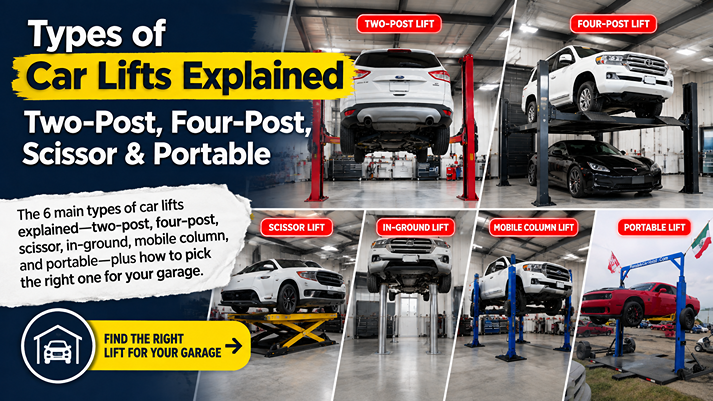
If you have ever typed “types of car lifts” into a search bar and come away more confused than when you started, you are not alone. Here is the short answer: there are six main kinds of car lifts — two-post, four-post, scissor, in-ground, mobile column, and portable — and each one solves a different problem. Two-post and four-post lifts run the professional world, together making up the large majority of the roughly 1.4 million-plus vehicle lifts installed across North American shops. But the fastest-growing option is the one that needs no bolts, no concrete work, and no permit at all: the portable car hoist. In this guide I will walk you through every type, the honest pros and cons of each, and how to pick the right one for your bay, your budget, and the vehicles you actually work on.
A “car lift” and a “car hoist” are the same machine — the words are used interchangeably, and I break that down in detail over in car lift vs. car hoist. What actually separates one lift from the next is how it raises the vehicle and what it has to be attached to. Some lifts grab the frame; others drive the whole car up on runways. Some are bolted into a thick slab forever; others fold onto a trailer and travel with you. Get the category right and everything else — capacity, height, price — falls into place. Get it wrong and you are stuck with a machine that does not fit your space or your work.
Below I break down all six, starting with the two you have almost certainly seen in a shop.
A two-post lift raises the vehicle by its frame or pinch welds using four swing arms, leaving the wheels hanging free. That open access underneath is exactly why mechanics love it — you can pull wheels, drop an exhaust, or reach the transmission without a runway in the way. Two-post lifts are the single most common professional lift for a reason: they are compact, affordable, and they give you full underbody access.
Two-post lifts come in two arm layouts. A symmetric lift has equal-length arms and centers the vehicle between the posts. An asymmetric lift rotates the posts and uses shorter front arms, so the car sits back and the doors clear the columns — a big deal in a tight bay. Most modern lifts blend the two. The trade-off that trips people up is not the arms, though. It is the foundation.
A traditional bolted two-post lift needs a thick, cured concrete slab — commonly four to six inches of reinforced concrete — and it gets anchored permanently into that floor. If you rent your building, have a post-tension slab, or ever want to move the lift, that is a hard stop. I wrote a full breakdown of that anchoring problem in how to lift vehicles without floor anchors, and a version specifically for post-tension slab floors. The good news: a portable two-post hoist gives you the same frame-lifting geometry with zero anchoring, which I will get to below. If you are shopping traditional two-post units, our two-post lift buying guide covers what to look for.
A four-post lift uses four columns and two long runways. You simply drive the car up onto the ramps, and the whole vehicle rises with its weight resting on the tires. Because the load sits on the wheels instead of the frame, four-post lifts are the go-to for two jobs: long-term storage (stacking one car over another in a home garage) and alignment work, where you need the suspension loaded naturally.
The downside is access. With runways under the tires, you cannot easily pull all four wheels or do brake work without adding rolling jacks. Four-post lifts also have a bigger footprint than two-post units and cost more up front. Most home hobbyists who buy one are chasing the storage benefit — parking two cars in one bay — more than the service benefit. If you are weighing the two head to head, I compared them directly in 2-post vs. 4-post lift for a professional shop and, from a budget angle, in portable 4-post vs. 2-post to save money.
A scissor lift raises the car on a crisscrossing folding mechanism that tucks flat when lowered. There is no post beside the car at all, which makes scissor lifts great where ceiling height or floor space is tight. They come in two flavors: mid-rise scissor lifts that come up to about waist height (perfect for tire, brake, and detailing work while you sit), and full-rise scissor lifts that stand you fully underneath.
Mid-rise scissors save your back but never let you stand up straight under the car — you are still crouched. That kneeling-versus-standing gap is the whole reason I wrote half car lift vs. full-height hoist. Low-rise scissor jacks like the QuickJack are handy but capped in height; I put one against a full-height portable in QuickJack vs. full-height portable hoist. Scissors are a solid middle ground, but if you want to walk upright under the vehicle, they are not it.
Two more categories round out the professional world. An in-ground lift hides its pistons beneath the floor, so the bay looks clean and open — but installation means excavation, plumbing, and a big commitment you can never undo. Mobile column lifts are sets of wireless columns you roll up to each wheel to raise buses, semis, and RVs; they are brilliant for heavy fleet work but expensive and overkill for cars.
Both of these solve real problems at the top end. In-ground lifts trade a permanent, expensive install for a clean, open bay, while mobile columns trade portability for serious heavy-duty muscle. Neither makes sense for a home garage, a mobile mechanic, or a small shop watching its budget — which is exactly where the last category shines.
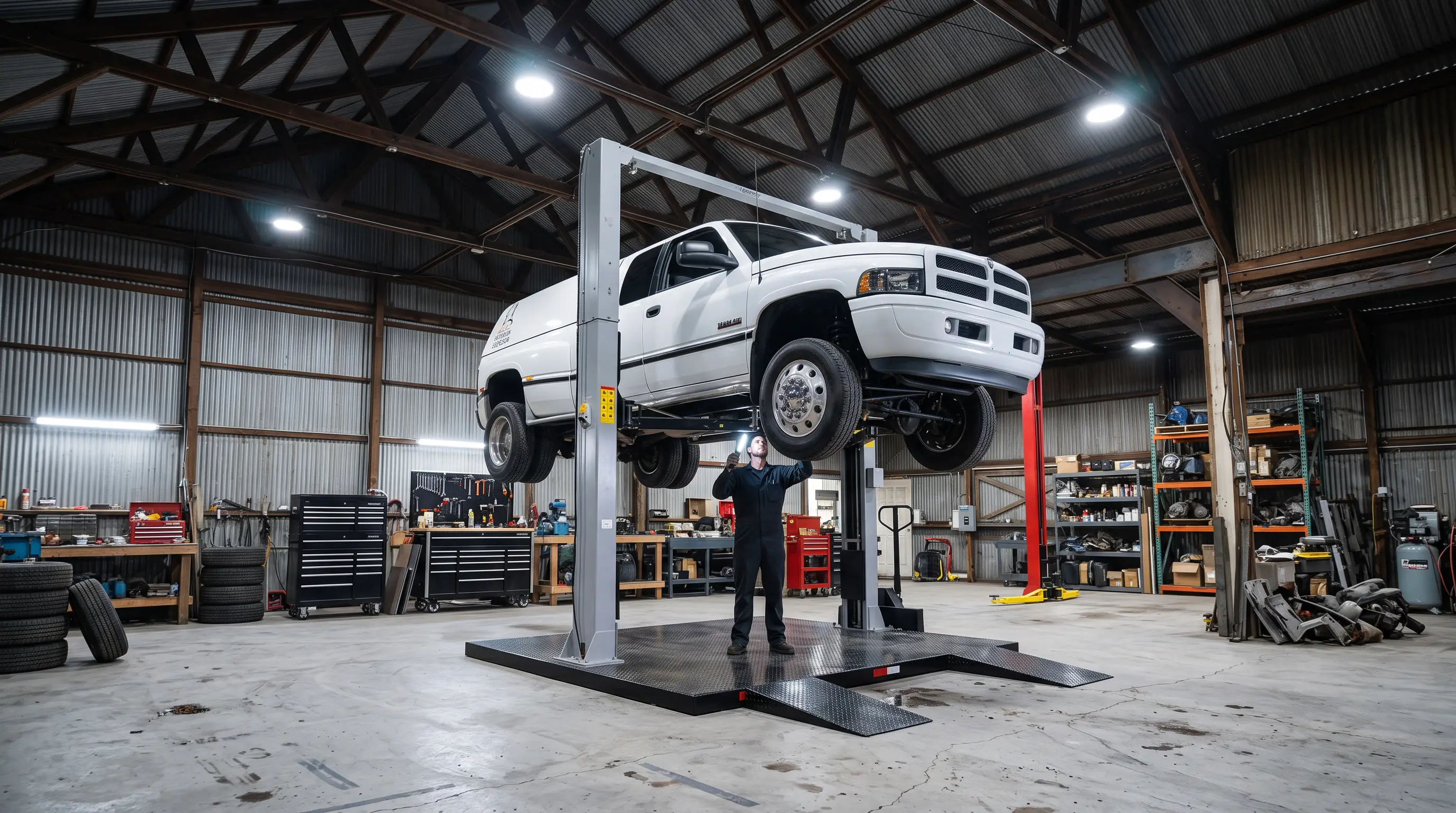
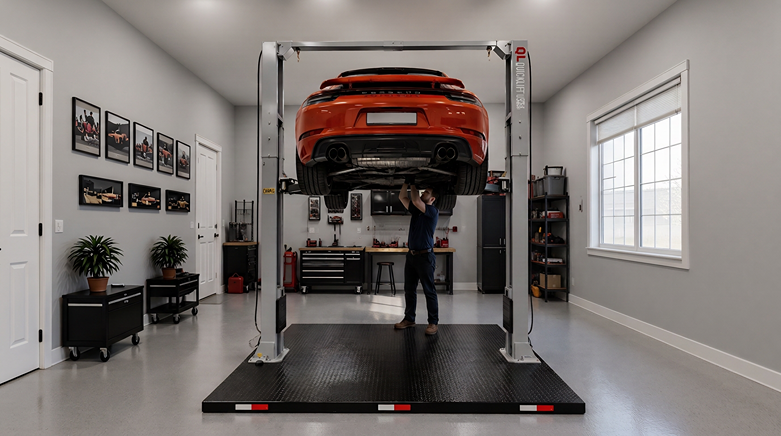
A portable car lift takes the frame-lifting power of a full-height two-post lift and mounts it on its own trailer deck — so it brings its own foundation with it. No drilling, no anchors, no concrete work, no permit. You roll it in, level it, and in about 15 minutes you are lifting. When you are done, it folds down and travels to the next job or tucks into the corner of the garage. If you have never seen how that is possible without bolting into the floor, how a portable car hoist works explains the whole mechanism.
This is the machine I build and sell, so I will be straight with you about who it is for and who it is not. It is a genuine full-height, two-post-style hoist — our units run from 8,000 pounds up to a 76,000-pound heavy-truck model, and they raise the car to a true 69 to 73.5 inches so you stand up straight underneath. What makes it different from every category above is that it is not tied to a building.
Pro tip: before you pour a slab or sign off on a permanent lift, price out the true cost of the concrete, the electrical, the permit, and the downtime. When I run those numbers with shop owners, the portable option often wins before we even talk about the freedom to relocate it. Our portable car lift cost and pricing guide lays the figures out.
Renters and lease-holders who cannot modify the floor. Mobile mechanics who want to take the shop to the customer. Home enthusiasts working in a home garage or even a driveway with no garage at all. Small shops that want to reconfigure the floor without breaking concrete. If any of that is you, the portable category is worth a serious look — and our complete portable two-post buyer’s guide is the deep dive.
Forget the category names for a second. The real decision comes down to five honest questions.
If you rent, have a thin or post-tension slab, or want the freedom to move the lift later, a bolted two-post, four-post, or in-ground lift is off the table and a portable hoist is the natural answer. If you own the building and never plan to move, an anchored lift is fine.
Wheels-free service (brakes, suspension, transmission) points to a two-post or a full-height portable. Alignments and storage point to four-post. Heavy trucks and fleets point to mobile columns or a high-capacity hoist. Match the lift to the job, and size the capacity honestly — my rule of thumb lives in how to pick the right car hoist capacity.
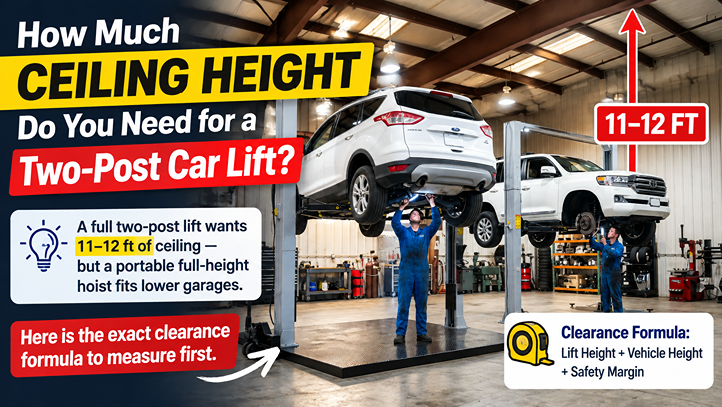
Full-height two-post and portable lifts need overhead clearance; scissor and mid-rise lifts do not. Measure before you buy — I show you exactly how in how much ceiling height you need for a two-post lift.
Whatever type you land on, look for mechanical safety locks and third-party certification. I cover what to actually verify in are portable car lifts safe, and why cutting corners on steel is a false economy in American-made vs. cheap import hoists.
Add the concrete, the electrical, the permit, and the install to any fixed lift’s price before you compare it to a portable that needs none of that. Once you do, the math often surprises people — run your own numbers with the ROI and payback calculator. And if you are torn between a low-rise unit and a full-height hoist, MaxJax vs. Portable Car Hoist and single-post vs. two-post settle the common comparisons.
Two-post lifts win on access, four-post lifts win on storage and alignments, scissor lifts win on tight spaces, and in-ground and mobile column lifts own the heavy-duty extremes. But every one of those except the portable ties you to a building with concrete, anchors, and a permit. If you want full-height, stand-up service without giving up the freedom to move — or without ever touching your floor — the portable car hoist is the type built for you. It is American-made, ships nationwide from our Menifee, California factory, and sets up in about 15 minutes.
Not sure which type fits your space and your vehicles? Tell me what you drive and where you work, and I will point you to the right setup with no pressure. Book a Free Quote and let’s figure it out together.
The two-post lift is the most common professional car lift because it is compact, affordable, and lifts the vehicle by the frame so the wheels hang free for full underbody access. Its one drawback is that a traditional two-post unit must be anchored into a thick concrete slab — which is why a portable two-post hoist that needs no anchors has become such a popular alternative.
For most home garages, the best choice is either a four-post lift (if you mainly want storage) or a full-height portable two-post hoist (if you want to actually work under the car). The portable wins for renters and anyone who does not want to drill their floor. See our home garage setup and safety guide for the full rundown.
A two-post lift raises the car by its frame with the wheels hanging free, which is ideal for brakes, suspension, and transmission work. A four-post lift drives the car up on runways with the weight on its tires, which is better for storage and alignments but blocks wheel access. I compare them fully in 2-post vs. 4-post for a professional shop.
No. Two-post, four-post, and in-ground lifts must be anchored into a thick, cured slab, but a portable car hoist carries its own trailer-deck foundation, so it needs zero concrete work, zero anchors, and no permit — it sets up in about 15 minutes on almost any firm, level surface. Here is how lifting without floor anchors works.
The Complete Portable Two-Post Car Lift Buyer’s Guide (2026)
2-Post vs. 4-Post Car Lift: Which Wins in a Professional Shop?
Single-Post vs. Two-Post Portable Car Lift: Which Holds Your Car?