

April 1, 2026
9 min read
You've probably seen the QuickJack ads. The ads for QuickJack feature two frames, a power unit, and a promise to quickly lift a car into the air. And look, that's not wrong. For certain situations, it works fine.
However, it's important to note that once you purchase it, you're still reliant on yourself.
Twenty-four inches of clearance sounds like a lot until you're trying to do a transmission drop, wrestle with a stuck caliper, or actually see what you're doing without a headlamp strapped to your forehead. That's the moment a lot of mechanics, shop owners, and serious car enthusiasts start searching for a QuickJack alternative, something that gives them real standing-height access without drilling into a shop floor they don't own.
This post is going to break that down honestly. We'll discover the areas where QuickJack excels, identify its shortcomings, and explain why a full-height portable lift offers a unique solution, particularly for tasks that extend beyond routine oil changes and brake replacements.
Let's start with the scenario most people are actually in.
You run a mechanic shop, and you're renting your space. Or you're a mobile mechanic who needs to work at a customer's home, a fleet lot, or a job site. Maybe you're a car collector who wants to do serious restoration work in your garage but can't pour concrete for a permanent 2-post lift.
The QuickJack was originally designed for track use, letting racers swap tires quickly. It has since grown into a solid home-garage tool. But here's what the specs tell you clearly: every QuickJack model maxes out at 24 to 27 inches of lift height, depending on the model and whether you're using the truck adapter kit.
That's not standing height. That's a height that is "slightly more comfortable than jack stands."
A review from Everyday Driver puts it plainly: the QuickJack is absolutely not a substitute for a traditional 2-post car lift, which raises a vehicle high enough for a mechanic to stand under and look up at the undercarriage. By that definition, you're still a creeper, just with a bit more room.
That's a real limitation. And for professionals, it adds up fast.
This is where it gets practical.
Think about what a professional repair job actually looks like. You're diagnosing exhaust issues, checking subframe welds (the connections that hold the vehicle's frame together), pulling a differential (the component that allows wheels to rotate at different speeds), and inspecting CV axles (the shafts that transfer power from the engine to the wheels) with both hands free. You need to see, move, and think clearly. None of that happens well when you're lying on your back staring up at a vehicle with limited clearance.
And there are real business costs here, too.
When you're flat on your back, you slow down. Jobs that should take 90 minutes stretch to two hours. You miss things you'd catch standing up. And over a full day of work, that physical toll is real. Back strain, shoulder fatigue, and neck issues are genuinely common for technicians who spend their careers on creepers.
There's also a customer perception issue. If you're a mobile mechanic pulling up to a client's driveway with a setup that still puts you on the ground, you look exactly like someone doing a driveway repair, because you are. Presenting a full-height portable lift completely transforms this perception.
So yes, the search for a QuickJack alternative is a professional decision, not just an "I wish I had more room" wish.
Here's the core difference, and it matters a lot.
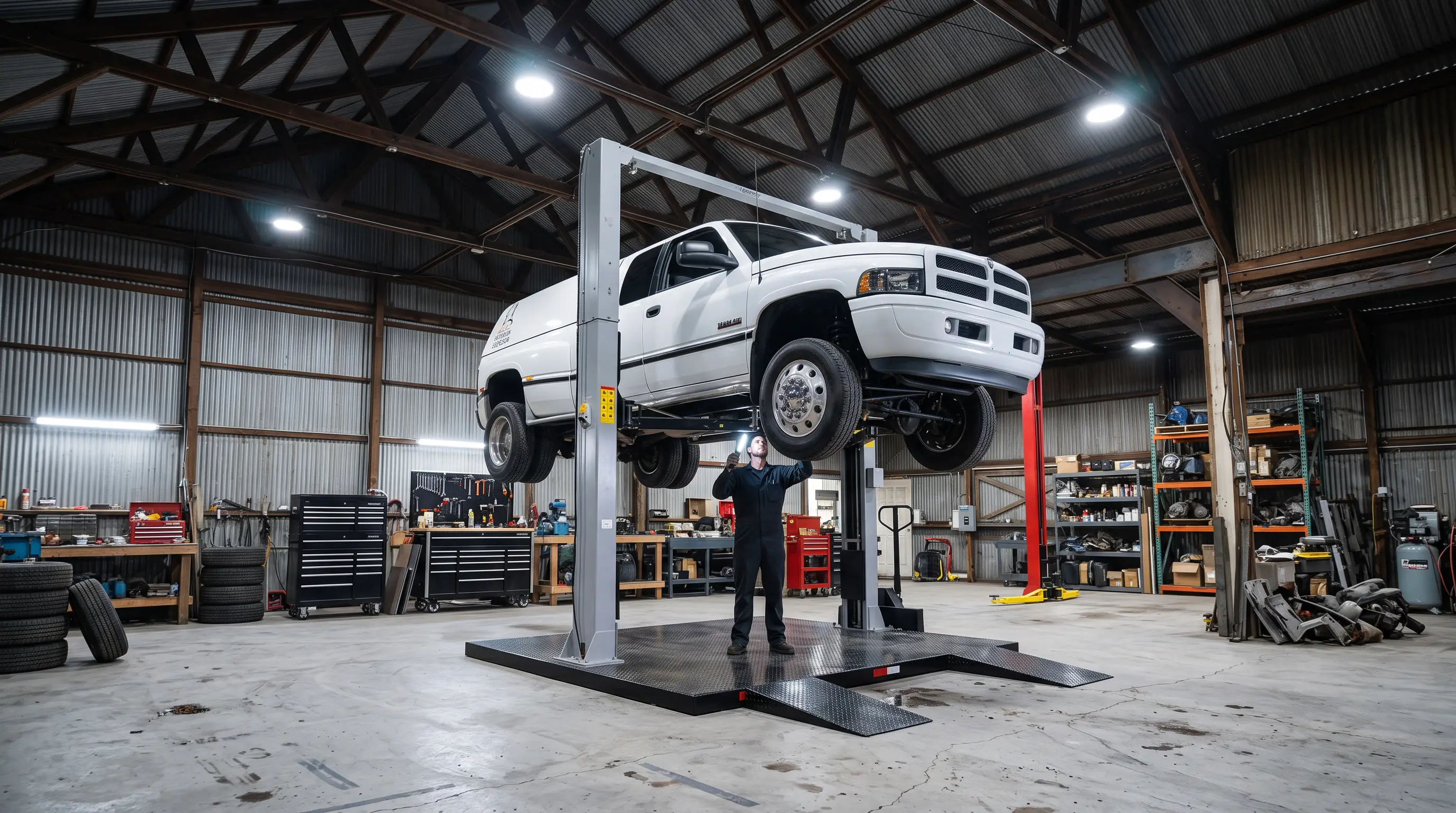
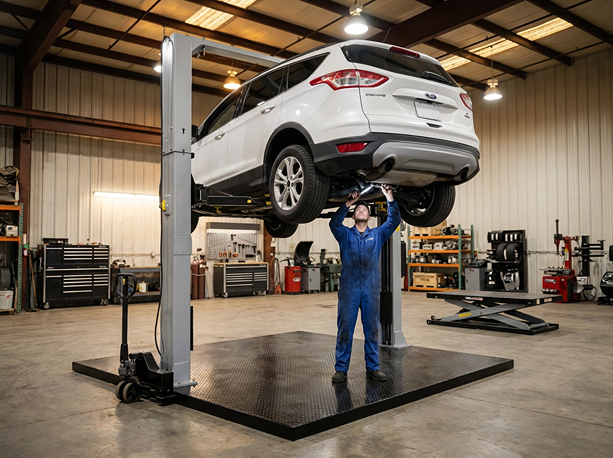
A full-height portable lift raises your vehicle to the same working height as a permanent 2-post shop lift, typically enough for a mechanic to stand upright and walk under the vehicle. That's a significant improvement over the QuickJack. That is a fundamentally different tool.
The Portable Car Hoist is built on this exact principle. It's a true 2-post lift system that requires zero concrete bolting, zero permanent installation, and works on any level surface. You can set it up in a driveway, a parking lot, a customer's garage, a race paddock, or a rented shop bay. Electric-powered and battery-powered options mean you're not hunting for outlets at every job site.
Consider the practical opportunities this opens up:
That last point is huge for shops that operate in leased spaces. Commercial property landlords typically prohibit permanent floor modifications. A portable full-height setup means you get the functionality of a professional lift without touching the landlord's concrete.
Let's put the numbers side by side so you can make a clear comparison.
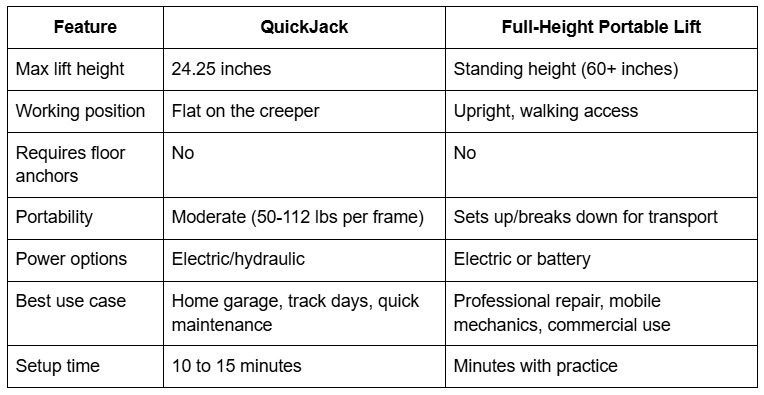
The QuickJack is better than jack stands. That's true, and it's worth saying. For someone who does their own car maintenance on weekends and isn't running a business, it's a legitimate upgrade.
But if you're turning jobs for money, or if you're doing anything more involved than oil, brakes, and tires, the clearance ceiling becomes a real problem pretty fast.
Let's be specific, because "it depends on your needs" is not actually helpful.
Mechanic shops in rented spaces: You can't bolt anything down. You need a full working height to stay productive and competitive. A portable 2-post lift solves that without requiring any landlord negotiations or construction permits.
Mobile mechanics: This is probably the biggest use case people overlook. If your business model is going to the customer, you need a lift that goes with you and still gives you real working height. The QuickJack goes with you, too, but it puts you on your back at every stop. A full-height portable setup changes how customers see your professionalism and how efficiently you work.
Car collectors and restoration enthusiasts: Long-term restoration projects require sustained access to the undercarriage. Spending hours per week on a creeper is not just uncomfortable; it's genuinely detrimental for your body over time. Standing-height access is worth the investment if you're serious about this hobby or craft.
Car racing event planners and paddock crews: At race events, time is everything. You need to lift, inspect, adjust, and get a car back on track as fast as possible. Standing-height access from a portable lift makes that workflow possible in locations that will never have a permanent lift bay.
Commercial and fleet operators: Fleet vehicles need regular maintenance. Bringing a full-height portable solution to a fleet lot versus setting up a permanent lift bay is often the only viable option for cost and logistics reasons.
The portable lift segment is growing fast, and it's not because hobbyists suddenly got more enthusiastic about oil changes.
According to market research, the portable car lift market was valued at approximately $2.4 billion in 2024 and is projected to grow at a CAGR (compound annual growth rate) of 5.9% through 2035, reaching $4.5 billion. That growth is being driven by urban workshop space constraints, more vehicles on the road, and a rising number of independent mobile service operators who need professional-grade tools they can take anywhere.
The trend is clear: the future of automotive service is increasingly mobile, flexible, and non-permanent. The shops winning right now are the ones that can serve customers anywhere without sacrificing capability.
A low-rise scissor-style lift can't keep up with that model. A full-height portable lift can.
Here's something worth considering from real-world experience.
Technicians who switch from creeper-based work to standing-height lifts consistently report completing jobs faster, with fewer mistakes and less physical fatigue. The ergonomic case is not subtle. You think more clearly standing up. You see more. You reach more easily. You make fewer errors.
This is not marketing language. It's basic physics and physiology. Working hunched over or flat on your back for extended periods leads to fatigue that compounds across a workday. Standing access changes the whole experience of doing the job.
For shop owners and managing technicians, this also matters from an employee retention angle. Technicians who work in better conditions stay longer. That's a real business benefit that doesn't show up in the spec sheet but absolutely shows up in your labor costs over time.
Fair point. And there are real scenarios where keeping both makes sense.
If you have a low-clearance sports car that you do quick maintenance on, the QuickJack's 3-inch collapsed height and easy positioning still have value. For fast tire swaps at the track, it's hard to beat the convenience.
But if you're trying to grow a professional operation, expand your service offerings, or just stop punishing your body every time you get under a car, a QuickJack alternative that gives you full height is worth the conversation.
These are not competing tools fighting for the same job. The QuickJack is a convenience upgrade over floor jacks. A full-height portable lift is a professional shop replacement that requires no permanent installation.
The appropriate question to consider is what type of work you are engaged in and whether your lifting equipment aligns with those needs.
If you're doing professional repair work, running a mobile business, restoring a vehicle long-term, or setting up at events where standing-height access makes all the difference, then a low-rise lift is going to keep limiting you.
A full-height portable lift closes that gap. No concrete. No permits. No anchoring. Just the same standing-height access you'd get from a permanent shop lift, set up wherever you need it.
The Portable Car Hoist is built for exactly that situation. American-made, available in electric and battery-powered configurations, and designed for the mechanic shops, mobile operators, collectors, and event crews who need professional capability without the permanent installation.
If that sounds like your situation, let's talk about which model fits your setup. Ready to stop working flat on your back? Get a free consultation with our team and find the right fit for your operation.