



Jader Gil
Marketing Expert
January 12, 2026
9 min read
You need a car lift. But every time you look at the installation requirements, you hit the same wall: "Requires minimum 4 inches of 3,000 PSI concrete with proper anchor bolts."
Maybe you're renting your shop space, and the landlord won't let you drill. Maybe you've got radiant floor heating, and one wrong hole means a flooded garage. Maybe you're running a mobile mechanic operation, and "permanent installation" is the opposite of what you need. Or maybe you're managing a building where automotive service wasn't part of the original plan, but now it's exactly what tenants or operations require.
Whatever the reason, you're searching for something that seems obvious: a car lift that actually lifts vehicles to standing height without drilling holes in your floor.
Here's what you're going to learn: what options actually exist for no-concrete lifting, why most of them fall short for professional use, and why the Portable Car Hoist solves the problems that other "portable" lifts pretend don't exist. By the end, you'll know exactly which solution fits your situation, and you might save yourself $15,000 in construction costs you thought you couldn't avoid.
Let's be fair about what's available. The market has responded to the "no bolt-down" demand with several options. Here's what you'll find when you start shopping:
What they are: Low-profile lifts that slide under a vehicle and use a scissor mechanism to raise it 24 to 30 inches.
Price range: $2,000 to $4,000
Concrete needed: Some models require bolting; others sit on the floor. A flat, level surface is always required.
What they are: Two separate scissor frames that slide under the vehicle and connect to a hydraulic pump. Lift height maxes out around 24 to 27 inches.
Price range: $1,400 to $2,200
Concrete needed: No bolting required. Works on any flat surface.
What they are: Traditional 4-post lifts designed with optional wheel kits that allow repositioning. The vehicle drives onto the ramp runways.
Price range: $3,000 to $6,000
Concrete needed: Most manufacturers say bolting is "optional," but still require a minimum 4-inch-thick concrete for safe operation.
What they are: Heavy-duty individual columns that position at each wheel. Common in bus and heavy truck service.
Price range: $15,000 to $50,000+ for a full set
Concrete needed: No bolting, but still requires a rated concrete floor for weight distribution.
What they are: A single column that lifts one end of a vehicle at a time. Lightweight and very portable.
Price range: $2,500 to $5,000
Concrete needed: No bolting, but limited capacity and only lifts one end.
What they are: Full-height 2-post lift systems engineered to operate without concrete anchoring. This is where our portable car hoist fits.
Price range: Varies widely; contact for pricing; rental options available
Concrete needed: No. Designed specifically for use without floor anchors on any level surface.
Here's what manufacturers don't tell you when they market "portable" or "no bolt-down" lifts.
Most lifts that skip concrete anchoring compensate by staying close to the ground. QuickJack maxes out at 27 inches. Mid-rise scissor lifts top out around 30 inches. That's not standing height. That's creeper height with extra steps.
For an oil change or brake job on your personal car, this works fine. For running a professional operation where technicians spend hours under vehicles daily, it's a recipe for back injuries and slow work.
Four-post lifts with casters solve the drilling problem, but they create new ones. The vehicle's wheels sit on runways, meaning you can't do any wheel service without adding bridge jacks. The posts themselves limit access. And while manufacturers claim you don't "need" to bolt them down, their liability language always includes concrete specifications.
One forum user put it bluntly: "If the lift has holes for bolts, the manufacturer expects you to use them. They're just giving you an option that's technically legal but not really recommended."
Many so-called portable lifts are portable in the sense that you could move them if you really had to. QuickJack frames weigh 50 to 112 pounds each. Four-post lifts with casters can weigh over 2,000 pounds. Mobile column lifts require powered movement systems.
For a mechanic shop that needs to reconfigure floor space or a mobile operation that needs to set up at different locations, this isn't real portability.
Here's the dirty secret of most "no bolt" lifts: they still require concrete. The specifications typically read something like "4 inches minimum thickness, 3,000 PSI strength, level within 3 degrees."
What they're really saying is, "You don't have to bolt us down, but you better have a proper shop floor, or we're not responsible for what happens."
This doesn't help the mobile mechanic working from a trailer. It doesn't help the event organizer set up at a car show venue. It doesn't help that the collision shop is renting warehouse space with questionable flooring.
Let's get specific about use cases and why the common "no concrete" options fail each one.
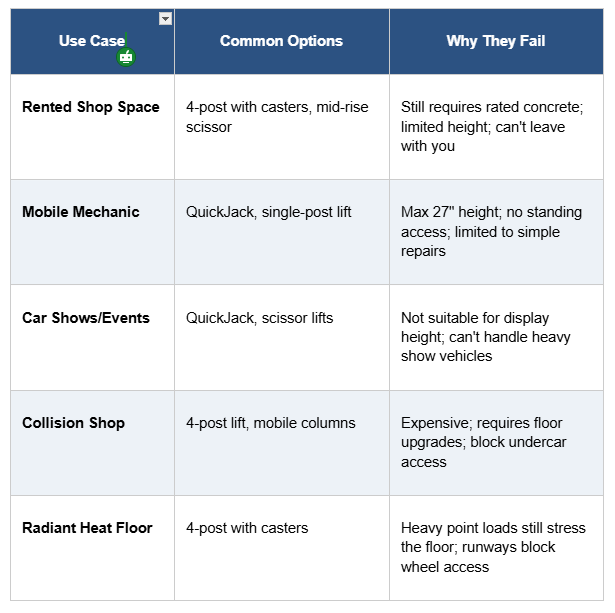
The pattern is clear: most "portable" lifts are really "semi-permanent lifts with optional anchoring." They're designed for facilities that already have proper concrete but prefer not to drill. They're not designed for people who genuinely need to operate without permanent infrastructure.
We manufacture the Portable Car Hoist in Menifee, California, specifically because the market needed something that didn't exist: a true 2-post lift with full standing height access that requires zero floor anchoring and works on any level surface.
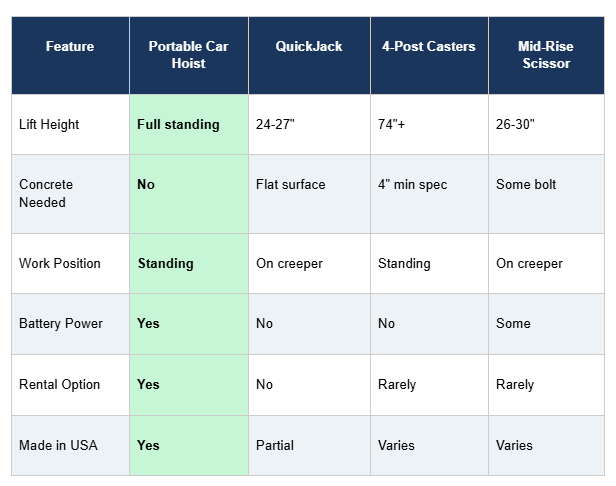
Here's what makes it different:
Option A: Fixed Lift (BendPak XPR-10A)
TOTAL: $11,600 (permanently installed, zero resale value if you move)
Option B: Portable Car Hoist Model A
TOTAL: $12,000 (portable, retains full resale value, take it when you move)
Winner: Portable lift is literally your only option
With traditional 2-post lifts, no. They're engineered assuming anchor bolts transfer load into concrete. Our Portable Car Hoist is specifically engineered for non-anchored use with a base plate design that distributes forces across a wide footprint.
Any flat, level surface that can support the combined weight. This includes concrete (even thin slabs), asphalt, compacted gravel with proper preparation, and indoor flooring in warehouses or event spaces.
Yes. Mobile mechanics transport them to customer sites. Event organizers set them up at car shows. Shops reconfigure floor layout as needs change. This is genuine portability, not marketing language for "optional bolts."
We offer multiple models: Model A for passenger vehicles, Model C for heavy-duty, and our truck hoist with a combined 76,000-pound capacity across two units. Contact us for recommendations based on your vehicle mix.
Self-contained 24-volt hydraulic pump system. Charge the batteries, transport the lift, and operate completely independent of external power. Designed for mobile mechanics servicing clients where power access is limited.
Yes. We offer rental options with daily, weekly, and monthly rates. Delivery and setup included. Test the equipment in your actual working environment before making a purchase decision.
Requirements vary by jurisdiction. Because our Portable Car Hoist doesn't require permanent installation, it often falls outside the building permit scope. Verify with local authorities and your insurance provider. We provide specifications and documentation to support these conversations.
The market has spent years telling you that if you can't bolt a lift to concrete, you have to accept limitations: lower lift heights, creeper-only access, runway-blocked wheels, or massive equipment that's technically movable but practically permanent.
That was true until someone decided to engineer a real solution.
The Portable Car Hoist exists because we got tired of the same compromises you're facing. We build 2-post lifts that provide full standing height access, complete undercarriage access, zero concrete anchoring, genuine portability, and professional-grade capability, all manufactured right here in Menifee, California.
Discover the Portable Car Hoist difference. Our Model A and Model C lifts are engineered specifically for no-concrete installations, delivering professional-grade performance without permanent modifications to your space.
Don't let your garage floor dictate your capabilities. Learn how thousands of home mechanics have broken free from concrete requirements while maintaining complete safety and functionality. Contact our team today for a free consultation on which portable lift system is right for your specific situation.