


Jader Gil
Marketing Expert
July 18, 2026
9 min read
Short answer: yes. You can run a full-height car lift on a post-tension slab if you skip anchors entirely and use a free-standing portable car hoist. That matters, because roughly 40% of shop floors fail the anchor inspection a bolted two-post lift requires—and drilling into a post-tension slab can sever a steel cable and cause structural damage that runs $30,000 or more. A portable car hoist sits on top of the floor, spreads the weight across a wide base, and never touches a drill bit. No holes. No permits. No gamble.
I've watched shop owners find this out the hard way. They buy the lift, book the installer, and then the concrete guy shows up, spots the tension cables, and says the words nobody wants to hear: "I can't drill this." Suddenly a "$4,000 lift" is a stalled project. Let's fix that before it happens to you.
A post-tension slab isn't ordinary concrete. During the pour, high-strength steel cables (tendons) are run through the slab and then stretched tight—think of a bunch of drawn bows locked inside your floor. That tension is what lets the slab span long distances and carry heavy loads without cracking. It's great engineering. It's also a minefield if you plan to drill.
A standard two-post lift needs floor anchors—usually four bolts per column—sunk into concrete that meets strict specs.
On a post-tension slab, one bad hole can nick or cut a live tendon. When a tensioned cable lets go, it releases with real force and can crack the slab from the inside out. The repair isn't cheap, and it isn't fast. That's the whole reason drilling a post-tension floor usually requires x-ray or GPR scanning first, sign-off from an engineer, and sometimes a flat "no" from the building owner.
Here's the quiet problem underneath all of this: most shop floors in buildings older than 20 years won't pass a clean anchor inspection anyway. Post-tension slabs are especially common in California commercial spaces. So even mechanics who want the traditional route often can't take it. If you've already read our breakdown of how to lift vehicles without floor anchors, this is the same wall—just a more expensive version of it.
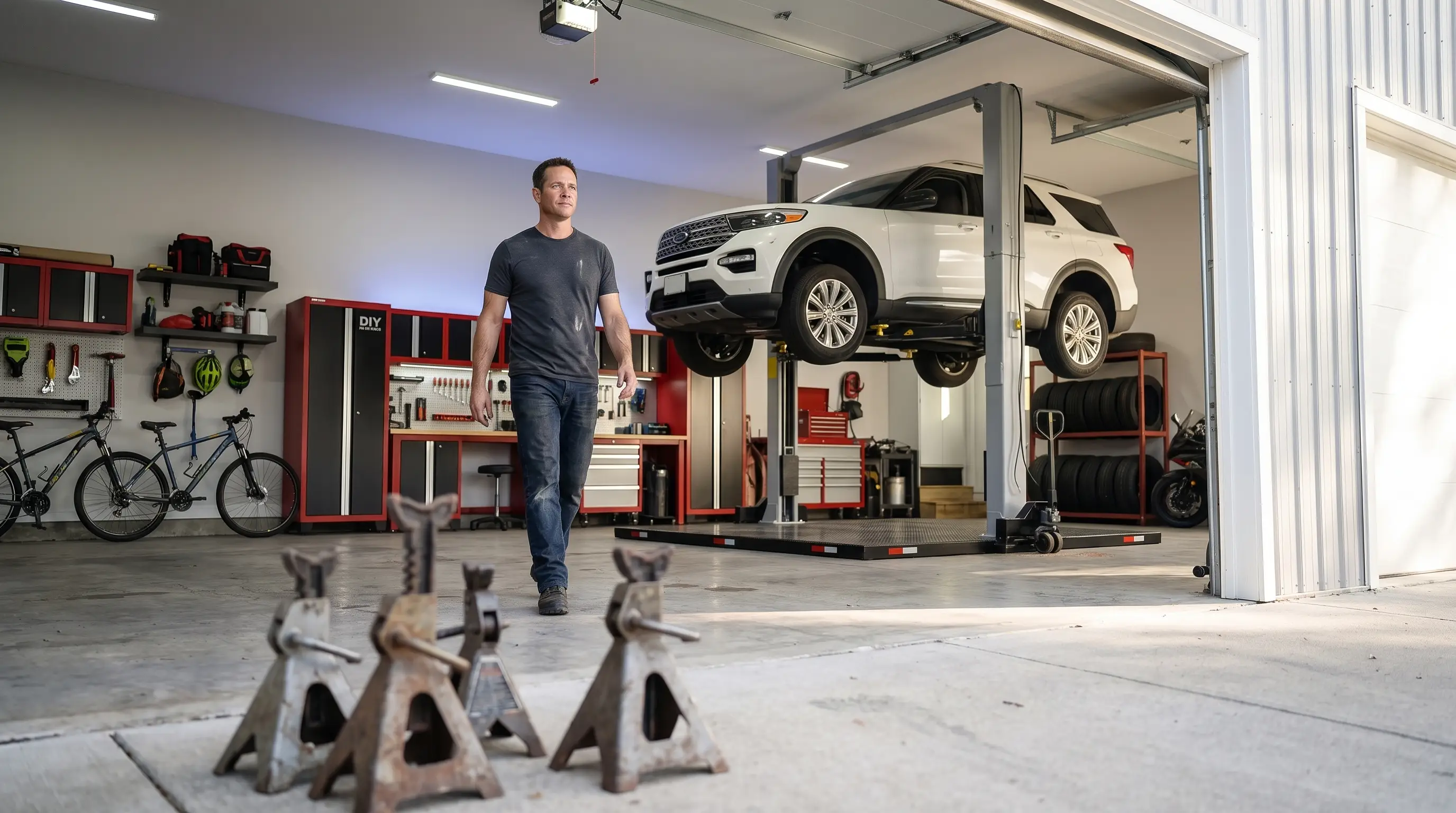
A portable car hoist flips the whole equation. Instead of bolting posts into your floor, it stands on your floor. A wide, engineered base distributes the vehicle's weight across a large surface area, so the lift stays planted without a single anchor. It works on concrete (standard or post-tension), asphalt, epoxy-coated floors, and even pavers—any level surface.
And this is the part that separates a real hoist from a toy: full standing height. Most "portable" lifts you'll see—QuickJack, MaxJax, and similar ones—are low-rise frames that raise a car 18 to 24 inches. You're still on a creeper, on your knees, fighting for clearance. A portable car hoist lifts to a full 69–73.5 inches, the same standing height as a permanently installed shop lift. That means you do real work standing up: transmissions, exhaust, full suspension rebuilds, undercoating.
Capacity scales with the job, from 8,000 lb on Model A up to 76,000 lb on Model T for commercial trucks and semis. Setup runs about 15 minutes. American-made. No installer, no electrician hardwiring (battery and standard-outlet options exist), no permit, and no drilling. If you're weighing the fixed-versus-portable tradeoff in general, our guide on the difference between a portable 4-post and 2-post lift is a good companion read.
Pro tip: Before you spend a dime scanning or reinforcing a post-tension slab, ask your landlord one question in writing—"Am I allowed to drill anchors into this floor? "A surprising number of commercial leases flatly forbid it. If the answer is no, an anchor-free hoist isn't just the easier choice; it's the only one that keeps your deposit.
It's the first question every mechanic asks, and it's the right one. The safety doesn't come from bolts — it comes from geometry. A wide-base hoist keeps the vehicle's center of gravity low and inside the footprint of the lift, so tipping isn't a normal-use risk. Every unit is load-tested before it ships and includes redundant mechanical locks that hold the load independently of the hydraulics. We go deeper on the engineering in our post on how the hydraulic system works and how to maintain it. If you've ever trusted a car to jack stands, you already know the alternative is far riskier—a point we hammer in about why jack stands are dangerous.
The sticker price on a fixed two-post lift is the part they show you. The rest of the bill shows up later — and on a post-tension slab, it can double.
Fixed two-post lift (on a floor that needs help):
Portable Car Hoist:
For most shops the portable route pays for itself inside the first year, before you even count the flexibility of being able to move the lift between bays—or take it with you when the lease ends. That resale angle is bigger than people expect; it's the whole reason a hoist behaves like a business asset instead of a sunk cost. Shop owners in leased space feel this most, which is exactly why we wrote the lease-friendly, no-concrete shop setup guide.
A portable car hoist is the right call if you:
If that last line is you, the portable semi-truck lift guide for fleet managers covers the heavy-capacity models in detail. And if you're comparing us head-to-head with the low-rise crowd, QuickJack vs. Portable Car Hoist lays out where the 24-inch lifts fall short.
People assume "no installation" is marketing fluff. It isn't. Here's the honest, start-to-finish version so you know exactly what you're signing up for.
First, you confirm your surface is level and solid — a post-tension slab almost always is, since load-bearing is the whole point of the design. You don't scan for cables, because you're not drilling. You don't book an engineer. You roll the columns into position, set the spacing to your vehicle, and connect the power unit (plug it into a standard outlet, or run the battery-powered option if you're off-grid or moving between sites). From uncrated to first lift is usually under 15 minutes once you've done it once.
Because nothing is bolted down, reconfiguring is just as easy. Need the bay clear for a weekend? Roll the hoist aside. Moving to a bigger space next year? It comes with you — try that with a lift anchored into someone else's floor. I've had shop owners tell me the "portable" part sounded like a gimmick until the first time they moved a lift in ten minutes instead of hiring a crew to un-bolt and re-anchor a fixed one. That flexibility is the same reason mobile pros love it; our piece on the battery-powered car lift for mobile mechanics walks through the take-it-anywhere setup in detail.
One more thing worth saying plainly: an anchor-free design isn't a workaround or a compromise you accept to dodge drilling. It's a different engineering philosophy. The Automotive Lift Institute has spent decades pushing shops toward proper lifting practices precisely because improvised setups cause injuries every year. A purpose-built portable hoist — load-tested, mechanically locked, wide-based — gives you a professional, standing-height lift without asking your building to absorb the risk. If you're still torn between fixed and portable at a philosophical level, our comparison of a portable car hoist vs. a traditional two-post car lift is the clearest side-by-side we've published.
Your floor shouldn't decide what your shop can do. If you've got a post-tension slab, aging concrete, a lease that bans drilling, or a floor that just won't pass inspection, you don't need a concrete crew or a permit — you need a lift that works with your building instead of tearing into it. That's a portable car hoist: American-made, full standing height, set up in 15 minutes, and worth real money the day you decide to sell it.
Tell us about your floor and your vehicles, and we'll match you to the right model. Book a free quote today and find out how fast you can be lifting cars — no drilling required.
Not a bolt-down one — not safely, and often not legally. Drilling anchors risks striking a tensioned cable, which can cause major structural damage. The safe path is a free-standing portable car hoist that requires zero anchors and sits on top of the slab, distributing weight across a wide base.
How do I know if my floor is a post-tension slab?
Look for a stamped warning near the edges or columns that reads "Post-Tensioned Slab—Do Not Cut or Core," check your building plans, or ask the property owner. When in doubt, treat an unknown commercial slab as post-tensioned and scan before drilling — or skip drilling entirely with a portable hoist.
Yes. Unlike 18–24 inch low-rise lifts, a portable car hoist raises vehicles to 69–73.5 inches—full standing height—with capacities from 8,000 lb to 76,000 lb. You can do transmissions, exhaust, and full suspension work standing up, the same as on a bolted shop lift.
It can. Severing a tendon can crack the slab and compromise its load rating, with structural repairs commonly running $30,000 or more — plus downtime. That single risk is why so many shops choose an anchor-free lift instead of gambling on a drill hole.