



Jader Gil
Marketing Expert
June 5, 2026
9 min read
You've probably been at this crossroads before. A customer needs suspension work. Your current setup is slowing you down. You're thinking about adding a lift or replacing the old one, and suddenly you've got a decision on your hands: 2-post or 4-post?
It seems simple on the surface. But once you start pricing them out and thinking about your actual workflow, things get complicated fast. The lift you pick is going to shape how you run your shop every single day, what jobs you take, how fast you turn cars around, and how much floor space you're left with.
This guide breaks it down plainly. No sales pitch, just the real differences that matter to a working shop.
Here's a scenario a lot of shop owners know too well. You invested in a 4-post lift because it seemed like the safer choice. Stable, easy to load, great for quick oil changes. But now your best-paying jobs are brake jobs and full suspension rebuilds, and that 4-post is killing your efficiency. You either need a bridge jack to get wheel access, or you're watching techs work around a platform that was never designed for that kind of repair.
Flip the situation, and the same problem shows up in reverse. You went with a 2-post because you do repair work, but now you're getting alignment and storage requests, and you're turning business away.
Wrong lift for the wrong shop is a real thing. And the automotive lift market is not getting simpler. The global vehicle lift market was valued at over $3.2 billion in 2024 and is projected to grow steadily through 2035, according to industry reports. More options, more configurations, and more chances to buy the wrong thing.
So let's fix that.
Before getting into which one is right for your shop, you need to understand what each is actually doing when it lifts a car.
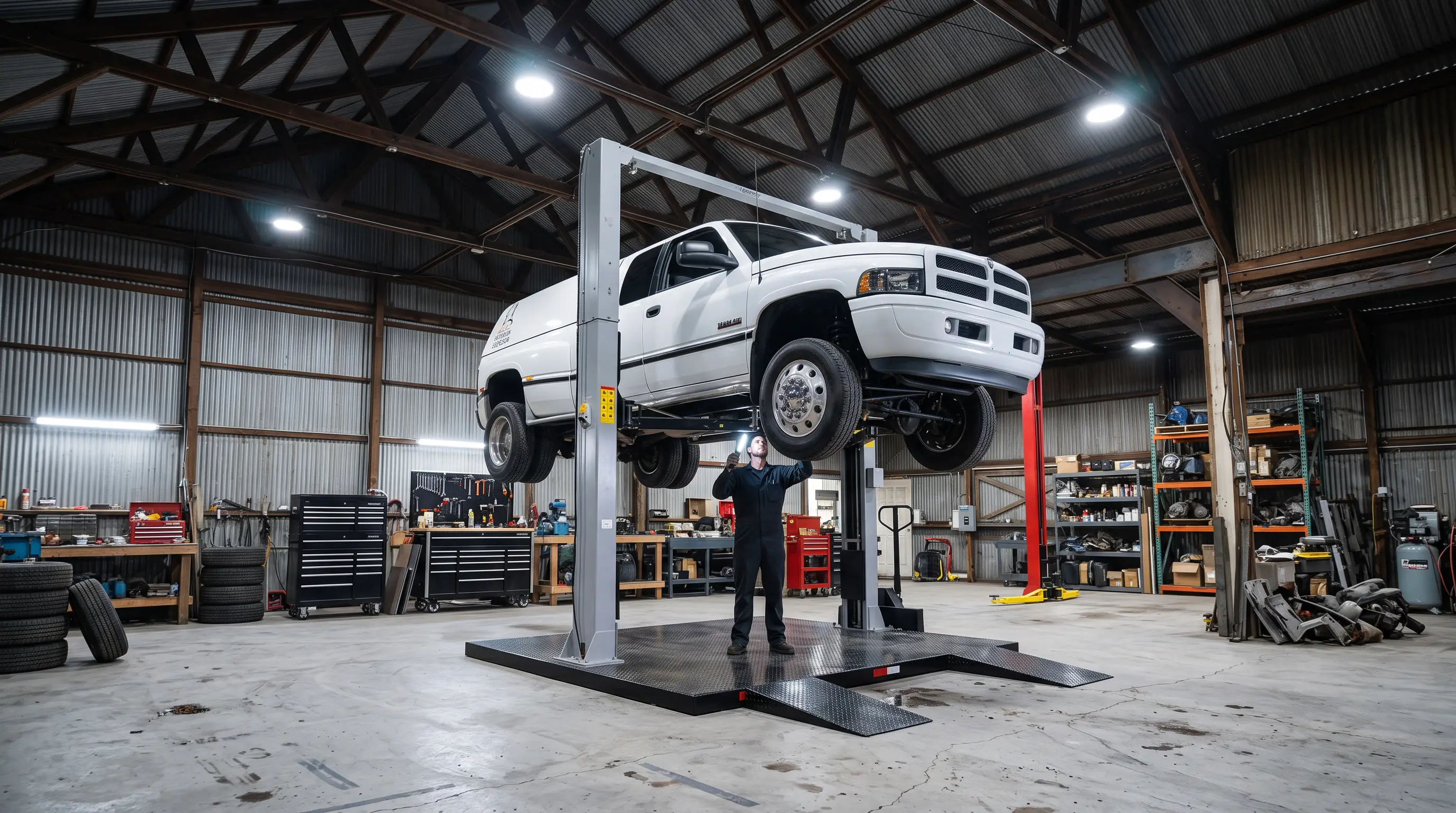
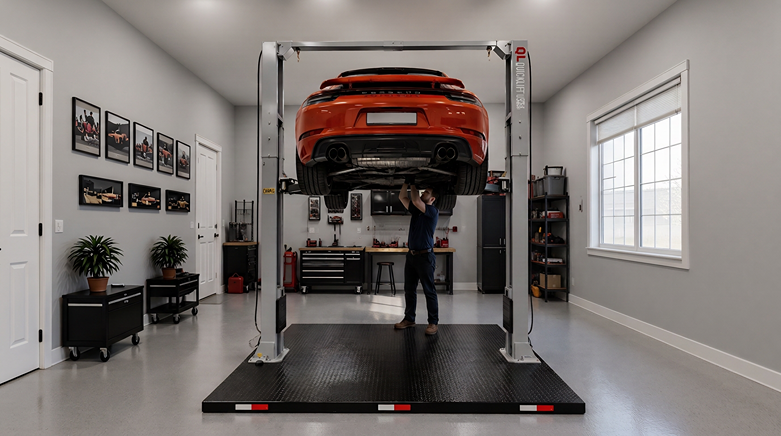
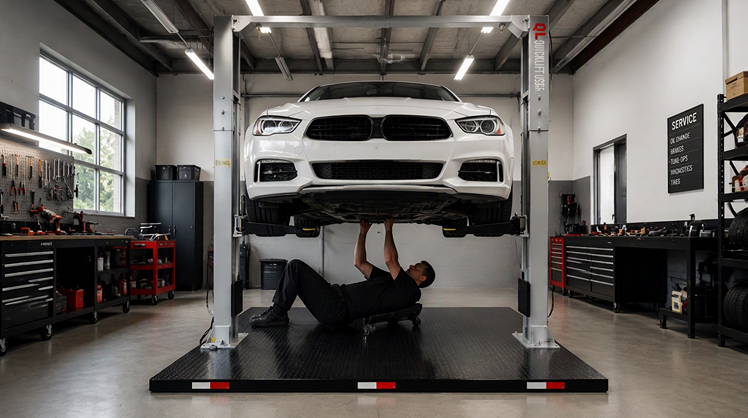
A 2-post lift has two vertical columns, one on each side of the vehicle. Adjustable swing arms extend from those columns and contact the car at designated lift points along the frame or pinch welds. The vehicle is lifted entirely off the ground with all four wheels hanging free.
That free-hanging design is the key detail. It means you have full, unobstructed access to everything underneath: brakes, rotors, calipers, exhaust, suspension components, fuel lines, transmission, and more. Nothing in the way.
This is why shops that do repair work live and die by 2-post lifts.
A 4-post lift, sometimes called a drive-on or runway lift, uses four columns and two flat runways. The vehicle drives directly onto the runways and gets lifted with all four tires still resting on the platforms.
The upside is that the setup is fast and nearly foolproof. There is no need to identify lift points or carefully position swing arms. The vehicle drives on, and you lift.
The downside is that the runways block undercarriage access. You can still reach certain areas, but if you need to pull a wheel, do brake work, or get full access to suspension components, you need a rolling bridge jack to lift the axle from the runways. That adds time and equipment costs.
Here is where the real decision lives. When you're running a professional shop, these are the factors that actually affect your day.
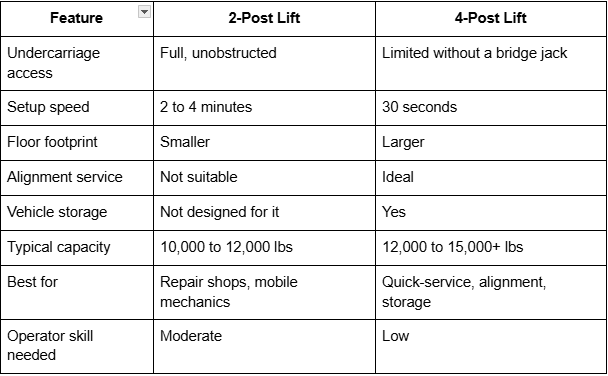
2-post wins here, no contest. Wheels hang free, arms swing away, and you can get to anything without obstruction. If your shop does a lot of brake jobs, control arms, tie rods, exhaust swaps, or transmission work, this matters every single day.
4-post lifts require a separate bridge jack for any wheel-off service. That is an additional cost, usually $400 to $1,000+, and an additional step every time you need wheel access. Fine for occasional work, but it gets old fast if you're doing it multiple times a day.
4-post wins easily. The vehicle drives on in about 30 seconds. No positioning, no checking lift points, no arm adjustments.
With a 2-post lift, you are looking at 2 to 4 minutes per vehicle to position correctly, locate lift points, set the arms, and confirm weight distribution before lifting. That is not a long time, but multiply it by 8 to 10 vehicles a day, and it adds up.
For high-volume quick-service shops doing mostly oil changes and tire rotations, that difference is worth thinking about.
A typical 4-post lift takes up 12 to 14 feet of length and 8 to 9 feet of width when deployed. Because of the runway design, there is no way to reduce that footprint when the lift is in use.
A 2-post lift has a smaller active footprint, typically 10 to 12 feet long and 8 to 10 feet wide, and the columns sit at the sides rather than extending under the vehicle. For a shop where every square foot matters, that adds up over multiple bays.
If you're using a portable system, both lift types can be moved or stored when not in use, which changes this calculation entirely.
Most 2-post lifts in the professional range handle 10,000 to 12,000 lbs. That covers virtually every passenger car, SUV, and light truck you'll see in a typical shop.
4-post lifts often run higher, from 12,000 to 15,000+ lbs. If you're regularly servicing heavy-duty trucks, cargo vans, or commercial vehicles, that extra capacity might matter. For the average shop, though, it rarely comes into play.
4-post lifts are specifically designed for alignment work. Because the vehicle sits on runways, the tires are in a normal load-bearing position, which is exactly what alignment equipment needs to calibrate correctly. Many 4-post systems have built-in alignment turntables as a result.
2-post lifts, with wheels hanging free, are not suitable for alignment procedures. So if alignment is a meaningful part of your revenue, that is a concrete reason to have a 4-post in your shop.
4-post lifts are the only practical choice for vehicle storage or display. The vehicle sits stable on the runways for days, weeks, or longer without any issue.
2-post lifts are not designed for long-term holds. They are work tools, not storage platforms. Keeping a vehicle on a 2-post for extended periods creates unnecessary stress on the hydraulics and lift points.
Car collectors and anyone using their shop for vehicle storage will want a 4-post for this reason alone.
4-post lifts are more forgiving. There are no lift points to identify, and the vehicle sits on a stable platform even if something goes wrong. For shops with newer tech or rotating staff, that lower error margin is worth something.
2-post lifts require the operator to correctly identify and set lift points before every single lift. Getting this wrong can damage the vehicle and, in rare cases, cause it to fall. Modern safety locks and arm stops significantly reduce this risk, but it still requires training and attention.
The Automotive Lift Institute (ALI) publishes lift certification standards specifically because improper use of 2-post lifts is a real source of incidents. Their guidelines recommend verifying lift point locations in the vehicle's service manual before every lift cycle.
Rather than giving you a generic answer, here is a framework based on what your shop actually does.
You should lean toward a 2-post lift if:
You should lean toward a 4-post lift if:
Consider running both if:
Your shop handles a wide mix of work. Many high-volume professional shops run at least one of each. A 4-post for alignment and quick service, a 2-post for repair bays. The combination eliminates the need to compromise on either workflow.
Here is something a lot of shop owners overlook when they're comparing 2 post vs 4 post car lift options: the biggest limitation of both types is usually not the design, it's whether the lift is fixed or portable.
A fixed 2-post bolted to your concrete is a tool that lives in one place forever. It cannot follow you to a client, it cannot move to a better spot when you rearrange the shop, and when you relocate, it stays behind.
A portable 2-post or 4-post changes all of that. You set it up where you need it, move it when you don't, and take it with you if you grow or relocate. For mobile mechanics, that is the difference between having a professional-grade setup and improvising on a job site.
The portable car lift market is one of the fastest-growing segments in automotive equipment, with reports projecting compound annual growth of around 8% through 2033. Shops are catching on.
Portable Car Hoist builds American-made portable systems that give you the flexibility of both lift types without the concrete, permits, and installation headaches of traditional fixed equipment. No permanent installation needed, and setups that take minutes, not days.
According to a 2024 IBISWorld industry report on auto repair shops in the US, shops that offer specialized repair services, including suspension, brake, and drivetrain work, report higher average revenue per job compared to quick-lube and tire-focused operations. That is directly relevant to which lift makes you more money.
The equipment you choose should match the jobs you want to take. If you're trying to grow into higher-margin repair work, a 2-post lift opens more of those doors. If you're building a high-volume quick-service operation, a 4-post keeps things moving faster.
The right lift is the one that matches your actual business model, not just the one that's cheapest or easiest to set up.
Ask yourself these four questions before you spend anything:
If most of your answers point toward repair access and flexibility, go 2-post. If they point toward alignment, storage, and quick service, go 4-post. If the answers are genuinely split, invest in one of each, and consider a portable version so you are not locked into a single bay forever.
No, and this is one of the most common mistakes shops make when buying their first lift. A 2-post design lifts the vehicle by its frame with wheels hanging free, which takes the suspension out of its normal load-bearing position. Alignment equipment needs tires contacting a platform under normal weight conditions to calibrate correctly. For alignment service, you need a 4-post drive-on lift, ideally one with built-in turntables.
Yes, if you plan to do any wheel-off service. A 4-post lift holds the vehicle on runways, meaning the tires are still resting on the platform when raised. To remove a wheel for brake work, suspension repairs, or tire changes, you need a rolling bridge jack to lift the axle off the runway. Budget an additional $400 to $1,000 for a quality bridge jack when pricing out a 4-post setup.
A 4-post drive-on lift is more forgiving for newer techs. The vehicle drives straight onto the runways, so there is no need to locate frame lift points or adjust swing arms before every lift. A 2-post lift requires the operator to correctly identify and set lift points each time, which takes training and attention. The Automotive Lift Institute (ALI) recommends verifying lift points in the vehicle's service manual before every lift cycle, which adds a step that inexperienced staff can miss.
Yes, and more professional shops are doing exactly that. A portable 2-post or 4-post system gives you the same lifting capability as a fixed lift without the concrete anchoring, installation costs, or permanent bay commitment. The practical advantage is flexibility: you can move the lift to where you need it, reconfigure your shop layout, take it on-site for mobile jobs, and bring it with you if you relocate. Portable systems from manufacturers like Portable Car Hoist are built to professional-grade specs and require no installation at all.
The 2 post vs 4 post car lift debate does not have one universal answer. What it does have is the right answer for your shop, based on the work you actually do.
A shop doing serious repair work needs 2-post access. A shop built around alignment and quick service needs 4-post stability. And a shop that wants to grow in multiple directions needs both, in a portable format that doesn't anchor you to one floor, one city, or one configuration.
Portable Car Hoist makes American-designed portable lift systems for professional shops that refuse to be limited by their equipment. No concrete required. No installation headaches. Just a lift that goes where your business needs it.
Ready to figure out which setup is right for your specific shop? Call us at +1 (951) 400-5290 or visit portablecarhoist.com to schedule a free 15-minute consultation. We'll walk through your workflow, your space, and your goals, and help you choose the lift that actually fits.
Your shop shouldn't work around your equipment. It should be the other way around.