


Jader Gil
Marketing Expert
September 16, 2026
9 min read
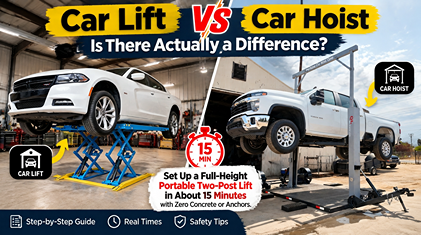
Here is the short answer, and it surprises almost everyone who asks me: a car lift and a car hoist are the exact same machine. There is no mechanical difference, no safety difference, and no price difference hiding behind the two words. They both raise a vehicle off the ground so you can work under it. Our own portable full-height units lift anywhere from 8,000 to 76,000 pounds and set up in about 15 minutes with zero concrete — and they answer to either name. So if a shop quotes you a “hoist” and a neighbor swears by his “lift,” relax. You are comparing the same thing.
I get this question every single week, usually from someone about to spend real money who is worried they are missing a hidden category. You are not. But the two words do carry different histories, different regional habits, and a few funny assumptions, and knowing them will make you sound sharp when you call around for quotes. Let me walk you through where the terms come from, why the confusion sticks around, and what actually matters when you pick equipment to get a car in the air safely.
Words for tools drift. “Wrench” and “spanner” mean the same thing on two sides of an ocean. “Hood” and “bonnet” cover the same sheet of steel. Car lift and car hoist are one more pair like that. Both describe a powered device — hydraulic, electro-hydraulic, or screw-driven — that raises a vehicle so a person can stand, roll, or reach under it.
When I say there is no difference, I mean it at the level that matters to your wallet and your back. A two-post “lift” and a two-post “hoist” share the same posts, the same carriages, the same safety locks, the same lifting arms. If you want the full mechanical picture, I broke it down step by step in how a portable car hoist works. Swap the word “hoist” for “lift” in that article and not one sentence changes.
“Hoist” is the older, more industrial term. It comes from the world of cranes, chain blocks, and anything that pulls a heavy load straight up. Professional mechanics, especially outside the United States, grew up calling the shop machine a hoist because that is what the trade called it. “Lift” is the friendlier, more modern consumer word — it is what you see on the box at the parts store and in most American marketing. Neither one is more “correct.” They are just two labels that stuck to the same product in different rooms.
If you are in the United Kingdom, Australia, or New Zealand, you almost always hear “car hoist” or “vehicle hoist.” In the United States and Canada, “car lift” wins in everyday speech, though seasoned techs and older shop owners still say hoist out of habit. Because we ship nationwide from our factory in Menifee, California, I hear both from customers in the same afternoon. I have simply learned to answer to whichever word the caller uses. You should feel free to do the same.
If the words mean the same thing, why does the question keep coming? A few reasons, and they are worth knowing because each one hides a small trap.
First, marketing muddies it on purpose. Some sellers use “hoist” to sound heavy-duty and “lift” to sound easy and DIY-friendly, even when the machine underneath is identical. Do not let a word set your expectations — read the specs. What matters is capacity, lifting height, power source, and how it is anchored, not the noun on the banner.
Second, people confuse the name with the type. There are real, important differences between a two-post design, a four-post design, a scissor design, and a single-post design — but those are style differences, not lift-versus-hoist differences. A four-post can be called a lift or a hoist. So can a two-post. If you are weighing designs, I compared the big ones in two-post vs. four-post lifts and in single-post vs. two-post portable lifts. That is where the real decisions live.
Third, “hoist” sometimes gets borrowed for gear that is not a full vehicle lift at all — an engine hoist, a shop crane, a chain hoist on a beam. Those pull an engine or a load, not a whole car on posts. So when someone says “I need a hoist,” it is fair to ask: the whole car, or just the engine? For the whole car, you are back to the same machine we have been talking about.
Pro tip: When you call for a quote, skip the noun war entirely. Say exactly what you want to do: “I want to raise a 5,000-pound truck to full standing height in my garage, and I can’t drill the floor.” That one sentence tells a good salesperson more than “lift” or “hoist” ever will, and it steers you straight to the right unit.
Once you let go of lift versus hoist, the real questions get simple. These are the five I walk every customer through, no matter which word they used to start.
Match the rating to the heaviest vehicle you will ever raise, then leave headroom. A half-ton pickup with a loaded bed weighs more than people guess. Our portable units run from 8,000 pounds up to 76,000 pounds for fleet and heavy-truck work, so there is room for a Miata or a dually. I laid out how to size it in how to pick the right capacity, and it is the number I would nail down before anything else.
This is the difference that changes your day. A full-height unit lets you walk under the car upright. A low-rise or mid-rise gets it off the ground but keeps you kneeling. If your knees and back matter to you — and after 20 years they will — read half car lift vs. full-height hoist before you buy anything short. Also check your ceiling; I covered the math in how much ceiling height you need.
Here is where most buyers get stuck. A traditional two-post bolts into a thick concrete slab. If you rent, have a post-tension slab, or just do not want holes in your floor, that is a wall. Our whole reason for existing is to knock that wall down: the hoist rides on its own trailer deck, so you get full-height lifting with no concrete and no anchors. If you want the deeper how-to, see how to lift vehicles without floor anchors.
A bolted-down lift lives in one bay forever. A portable hoist can roll to the next bay, the next shop, or a customer’s driveway. Mobile mechanics love that, and so do shops that want to reconfigure their floor. Setup runs about 15 minutes once you have the routine down — I walked through it in how to set up a portable two-post lift in 15 minutes.
No matter what you call it, the machine has to hold a two-ton load over your head without flinching. Look for mechanical safety locks, a solid steel structure, and honest engineering — not the cheapest import you can find. I feel strongly about this, which is why I wrote American-made vs. cheap import hoists and are portable car lifts safe. A hoist that fails is not a bargain at any price, and it beats the alternative every time — here is why jack stands are so dangerous.
Honestly? Whichever one feels natural. If you grew up saying hoist, keep saying hoist. If lift rolls off easier, use lift. When you are searching online, try both — some listings tag one and not the other, and you do not want to miss a good unit because you only typed one word. When you are talking to me or my team, use either. We will know exactly what you mean.
What I care about is that you end up with the right machine for your space, your vehicles, and your budget. If you are still mapping the landscape, our plain-English what is a portable car hoist buyer’s guide and the full portable two-post buyer’s guide for 2026 are the best places to start. And if it comes down to a portable full-height unit versus a fixed two-post, I put them head to head in portable car hoist vs. two-post car lift.
Price is the next thing everyone asks, and again the word makes no difference — a “hoist” and a “lift” of the same capacity and height cost the same. What moves the number is capacity, build quality, and whether you are paying to pour and drill a slab. A portable unit skips the concrete bill entirely, which is a bigger line item than most first-time buyers expect. I broke the numbers down in our portable car lift cost and pricing guide, and if you want to see the payback math for a shop, run through the cost and ROI calculator. Financing can spread it out too — here is how car lift financing works.
For a home garage, the story is even simpler: you get professional standing-height access without renovating your floor. If that is you, our home garage setup and safety guide covers everything from clearance to first lift. And when you are ready to stop crawling around on the ground for good, this step-by-step guide shows the whole buying path.
Car lift, car hoist — same machine, two names, zero reason to lose sleep. The word is a regional habit, not a product category. Spend your energy on capacity, height, anchoring, portability, and safety, and you will buy the right unit whether the tag on it says lift or hoist. That is the whole trick.
If you want a straight recommendation for your exact vehicles and space, that is what we do best. Tell us what you drive and where you plan to work, and we will point you to the right portable full-height unit — no concrete, no anchors, no pressure. Book a Free Quote and let’s get your car in the air the safe way.
Yes. A car hoist and a car lift are two names for the same machine — equipment that raises a vehicle off the ground so you can work under it. The words differ by region and habit, not by mechanics, safety, or price. “Hoist” is common in the UK, Australia, and the pro trade; “lift” is the everyday American term.
No. Neither word tells you a thing about strength or safety. A machine’s real safety comes from its capacity rating, its steel structure, and its mechanical locks — not the noun on the label. Judge the specs and the build, not whether the seller called it a hoist or a lift.
Sometimes. “Hoist” can also mean an engine hoist or a shop crane, which lift a load or an engine rather than a whole car on posts. If you want to raise an entire vehicle, that is a car lift or car hoist — the same full-vehicle machine either way. When in doubt, say what you want to raise.
Search both. Some listings tag “car lift” and others tag “car hoist,” so trying only one word can hide good units from you. Better yet, search by what you need — full-height, portable, no-concrete, and your capacity — so the label never trips you up.
What Is a Portable Car Hoist? The Plain-English Buyer’s Guide
Portable Car Hoist vs. Two-Post Car Lift: Which Wins?
How a Portable Car Hoist Works (No Concrete, No Bolts, No Magic)
American-Made vs. Cheap Import Car Hoists: Why Quality Steel Saves Lives