


Jader Gil
Marketing Expert
September 9, 2026
9 min read
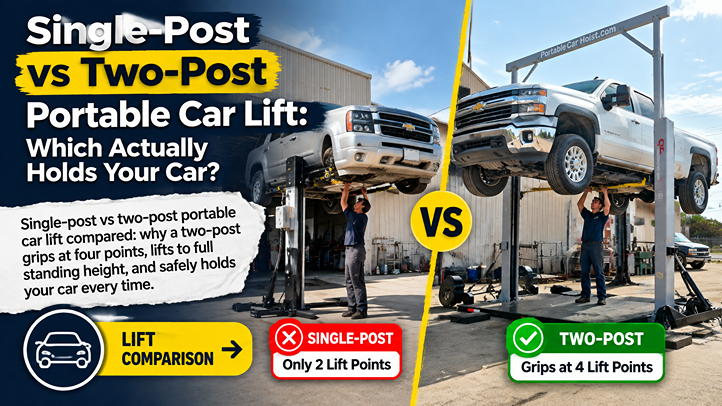
Short answer: a two-post portable car lift holds your car far better than any single-post design, because it grips the vehicle at four frame points and raises it straight up to a full standing height of 69–73.5 inches. A single-post lift leans on one column and usually lifts only one end or one corner a limited distance. Our two-post portable hoists carry 8,000 to 76,000 pounds and set up in about 15 minutes with zero concrete, zero anchors, and zero permits. If you want to actually walk under the car and work standing up, the two-post wins — and it is not close.
I have spent years around lifts of every shape, and the single-post-versus-two-post question comes up constantly from home mechanics and small shop owners who found a cheap one-column lift online. So let me break down what each design really does, where a single post falls short, and why the two-post portable hoist is the one that safely holds your car every single time.
The term gets used loosely, so let me clear it up first. When shoppers search for a portable single post car hoist, they usually mean one of three things. The first is a single hydraulic column that raises one end of the car, a bit like a heavy-duty bottle jack on a stand. The second is a single-post parking lift meant for stacking one car over another in a driveway, not for service work. The third is a mobile column setup, where you buy several individual columns and roll one to each wheel.
Each of those has a narrow use case. But none of them does what most people actually want, which is to lift the whole vehicle high enough to stand underneath and work in comfort. That is the job a two-post lift was built for. If you are still sorting out the basic categories, our portable car hoist buyer’s guide lays out every type in plain language.
A car wants to balance on its center of gravity. Lift it from a single point and the load fights you, because one column has to resist both the weight and the tipping force of an unbalanced vehicle. That is a lot to ask of one mast. Single-post designs deal with this by lifting less — less height, less of the car, or one axle at a time — which limits how much real work you can do.
Two posts change the math completely. The load splits across two columns and four contact arms, so the car sits level and stable the entire way up. There is a reason nearly every professional shop runs two-post and four-post lifts and almost none run a single mast for service. If you want the full picture on why frame support matters, read why jack stands are dangerous — the same balance problems that make a single jack point risky apply to single-post lifting.
Here is the part that surprises people. Our two-post hoist does not bolt into your floor at all. The two posts mount to a heavy black diamond-plate trailer deck, and that deck is the anchor. The weight of the vehicle presses down through the posts into the deck, which spreads the load across the ground instead of pulling up on anchor bolts. That is how you get a full-height lift with zero drilling. I explain the whole mechanism in how a portable car hoist works, and it is worth a read if the no-concrete claim sounds too good to be true.
Once the car is positioned, you swing four adjustable arms under the manufacturer lift points and raise. The synchronized top beam keeps both posts moving together, so the car rises level. Mechanical safety locks engage as it climbs, and the car parks on those locks — not on hydraulic pressure alone. That layered locking is the same standard professional lifts use, and I cover it in detail in our guide to portable car lift safety and locking systems.
Pro tip: Always set your lift arms to the vehicle manufacturer’s recommended pinch-weld or frame points, not to whatever looks flat and handy. A two-post lift is only as safe as the four points you place under it. Get that right and the car is rock solid at full height.
This is where the two-post really separates itself. A single-post or low-rise lift might get you 12 to 24 inches off the ground, which means you are still crouching, kneeling, or sliding around on a creeper. Our full-height hoist lifts to 69–73.5 inches, so you stand straight up under the car. The difference is not just comfort — standing access means faster jobs, better visibility, and fewer mistakes. If you are torn between a low-rise and a full-height design, the trade-offs are spelled out in half car lift versus full-height hoist.
Let me put the two head to head on the things that actually matter when you are lifting a car you care about.
A single post carries the whole load and the tipping force on one structure. A two-post splits the load across two columns and four arms, holding the car level and balanced. For anything heavier than a compact, or any job where you are pulling on wheels and suspension, the two-post is dramatically more secure. Capacity is a big part of this too — our hoists span 8,000 to 76,000 pounds, so you can match the lift to the vehicle instead of hoping a single mast holds. Our guide on picking the right hoist capacity walks through how to choose.
Single-post lifts almost always trade height for simplicity. Two-post full-height hoists give you true standing clearance, which changes what jobs you can take on — exhaust work, transmission service, brake lines, and full underbody inspection all become realistic. For a home shop, that is the line between a toy and a real tool. See our home garage setup and safety guide for what full access unlocks.
Here is a place single-post lifts sometimes win on paper — they are small. But our two-post portable hoist erases that advantage, because it is genuinely portable too. No concrete cutting, no anchor bolts, no permit, and roughly 15 minutes from parked to lifting. You can roll it into a rented shop, a driveway, or a job site and take it with you when you leave. That is a freedom a bolted-down lift can never offer, and it is why so many readers of our anchor-free portable hoist overview make the switch.
A cheap single-post lift looks tempting until you count what it cannot do. If it only lifts one end, you are still buying a second tool for the rest of the work. A two-post portable hoist does the whole job once, holds its value well, and pays for itself fast in a working shop. I break the numbers down in our portable car lift cost and pricing guide, and you can see the resale side in do portable car lifts hold their value.
Picture a typical Saturday. You want to rotate the tires, change the oil, and finally chase down that exhaust rattle. On a single-post lift you would raise one end, do what you can reach, lower it, reposition, and raise the other end — and the exhaust job under the middle of the car is basically off the table. On a two-post full-height hoist you set the arms once, raise the whole car to standing height, and knock out all three jobs without ever getting on the ground. That is the practical difference, and it shows up on every project. One thing to check before you buy is your overhead room, since a full-height lift needs vertical clearance; I cover the exact numbers in how much ceiling height you need for a two-post lift.
Home mechanics also worry about whether a full-height lift can really live in a normal garage without a bolted foundation. It can, and thousands do. Our hydraulic car lift for a home garage with no bolted-down posts post walks through exactly how the trailer-deck design keeps everything stable on a standard slab — or even in a rented space where you are not allowed to drill.
I will be fair here, because I do not think any tool is useless. A single-post design can be reasonable if you only ever need to raise one end for a quick tire rotation or an oil change, you are tight on both budget and space, and you never plan to do underbody work. A single parking post also has a real niche if your goal is stacking cars for storage rather than servicing them.
But be honest with yourself about the work you actually do. Most people who buy a single-post lift for service end up wishing they had the height and stability of a two-post within a few months. If your list includes brakes, exhaust, suspension, or anything that puts you under the car, skip the compromise. For a quick sanity check on the low-rise category, our QuickJack versus full-height comparison is a good reality check.
Worth a quick note, since some readers weigh a single-post against a bolted two-post as well. A traditional two-post lift holds a car beautifully but demands thick reinforced concrete, anchor bolts, and often a permit. Our portable version delivers the same level, four-point, full-height hold without any of that. If you have been comparing designs, our portable car hoist versus two-post car lift and MaxJax versus Portable Car Hoist breakdowns cover it, and shop owners should look at our complete two-post buyer’s guide.
If you have read this far, you already sense where I land. A single-post lift is a specialized tool for a narrow job. A two-post portable hoist is the versatile, safe, full-height solution that holds any car it is rated for and lets you work like a pro. It grips at four points, lifts level to standing height, locks mechanically, and moves wherever you need it — without touching your floor. That combination is exactly why we build the hoist the way we do. Before you buy anything, avoid the common pitfalls in our roundup of car lifting safety mistakes so your first lift is a safe one.
Still weighing your options or not sure which capacity fits your vehicles? Book a Free Quote and I will help you match the right full-height portable hoist to the work you actually do. No pressure, no permits, and no concrete required.
For getting fully under a vehicle, a two-post is the safer choice. A single post carries the whole load and the car’s tipping force on one structure, and most single-post designs only raise one end a short distance. A two-post portable hoist grips at four frame points, lifts the car level to a full 69–73.5 inches, and parks on mechanical safety locks, so you can stand and work underneath with confidence.
Yes. The two posts mount to a heavy diamond-plate trailer deck, and the vehicle’s weight presses down through the posts into that deck rather than pulling up on anchor bolts. That is how you get a full-height, four-point hold with zero concrete, zero anchors, and no permit — and why setup takes about 15 minutes.
Our hoists are built in capacities from 8,000 all the way up to 76,000 pounds, so you can match the lift to everything from a compact car to a loaded heavy-duty truck. The key is choosing a capacity comfortably above your heaviest vehicle’s weight.
Only if your needs are very narrow — occasional one-end lifting for tire or oil work, tight budget and space, and no plan to do underbody service. A single parking post also makes sense purely for stacking cars in storage. For real service work, the two-post full-height hoist is the better long-term buy.
Portable Two-Post Car Lift: Complete Buyer’s Guide 2026
Half Car Lift vs. Full-Height Hoist: Stop Kneeling, Start Standing
How to Pick the Right Car Hoist Capacity, From Miatas to Monster Trucks
Are Portable Car Lifts Safe? ALI Certification and Locking Systems