



Jader Gil
Marketing Expert
January 12, 2026
9 min read
For automotive enthusiasts, DIY mechanics, and homeowners who prefer to handle their own vehicle maintenance, having the right equipment can transform a cramped garage into a professional-grade workspace. A portable car lift for home garage use has become an increasingly popular solution for those who want the convenience of a professional lift without the permanent installation, high cost, or space requirements of traditional garage lifts.
Whether you're changing oil, inspecting your undercarriage, rotating tires, or performing more complex repairs, a portable lift gives you the access and working height you need while maintaining the flexibility to store it away when not in use. This comprehensive guide will walk you through everything you need to know to select, set up, and safely operate a portable car lift in your home garage.
Unlike fixed hydraulic lifts that require professional installation and permanent mounting to your garage floor, portable car lifts are designed for mobility and convenience. These lifts typically come in several configurations, including Portable Car Hoist Model A, Portable Car Hoist Model C, and Portable Semi Hoist (Model No: PCH 76).
Most portable lifts for home garages have lifting capacities ranging from 8,000 to 15,000 pounds, which is sufficient for sedans, SUVs, and light trucks. They operate using either hydraulic, pneumatic, or electric power systems, with many models featuring battery-powered or air-powered mechanisms for maximum portability.
The key advantage of these systems is their versatility. You're not committing to a permanent garage modification, and you can reposition or remove the lift entirely if you need to reclaim floor space for parking or other projects.
We provide a smarter, more accessible lifting solution that removes the most common barriers associated with traditional vehicle lifts. With no installation costs (saving up to $2,000) and no concrete work required (saving an additional $1,000–$3,000), our system delivers true value from day one. Its complete portability allows you to move it, resell it, or take it to events with ease, while a 6-week lead time ensures custom-built, American-made quality you can trust. Traditional concrete requirements often fail in older business locations, especially where post-tension slabs crack under anchored loads, leading to repairs exceeding $1,000, a major reason why 40% of the market cannot purchase conventional lifts even if they want to. Our product removes those limitations entirely. It stands as “The Professional Lift That Doesn’t Need Concrete”—offering 6-foot vehicle lifting, zero installation, and American-made reliability. You can now work like a professional shop from your own garage with a system that delivers performance, freedom, and convenience: No Concrete. No installation. No Limits.
The Portable Car Hoist Model A is a high-performance lifting solution designed for maximum versatility and convenience. It features a foldable top brace for easy transport and compact storage, along with durable two-post lifting arms that ensure stable and secure vehicle support. The system is powered by an efficient electric motor paired with a KTI single-acting hydraulic power unit, delivering smooth and reliable lifting performance. To accommodate different working environments, Model A offers flexible power options, including an electric-powered configuration for stationary workshop use and a battery-powered option for fully mobile operations, making it ideal for both fixed facilities and on-the-go service applications.
The Portable Car Hoist Model C is a stable and efficient two-post lifting system featuring robust lifting arms, an electric motor, and hydraulic cylinders, all operating without the need for any concrete foundation. Designed for rapid deployment, the setup takes just a few minutes, making it an ideal solution for both permanent and flexible work environments. It is available in an electric-powered configuration for stationary use or battery-powered for mobile operations, offering complete versatility. Additionally, the hoist is equipped with an automatic top brace that moves up and down seamlessly, enhancing ease of use, safety, and operational efficiency.
The Portable Semi Hoist—Model No. PCH 76 is engineered to bring unmatched flexibility and efficiency to both commercial workshops and home garages. This portable, mobile truck hoist system delivers exceptional lifting power, with each unit capable of handling up to 38,000 pounds and a combined lifting capacity of 76,000 pounds when used as a pair. It features a self-contained 24-volt hydraulic pump, eliminating the need for any concrete foundation or permanent installation. Designed for speed and convenience, the setup takes only a few minutes, allowing you to get to work quickly and efficiently. Additionally, the PCH 76 is available with a range of upgrade options to meet specific performance and operational requirements, making it a powerful, adaptable solution for heavy-duty lifting applications.
Before investing in a portable car lift for home garage applications, you'll need to assess several critical factors:
Always choose a lift rated significantly above your vehicle's weight. Check your vehicle's gross vehicle weight rating (GVWR) in the owner's manual or on the driver's side door jamb. Add at least 20% to this number for a safety margin, especially if you plan to work on the vehicle with parts, tools, or fluids still in place.
Consider what types of maintenance and repairs you'll be performing. Oil changes and tire rotations require minimal height, while transmission work, exhaust system repairs, or suspension modifications need greater clearance.
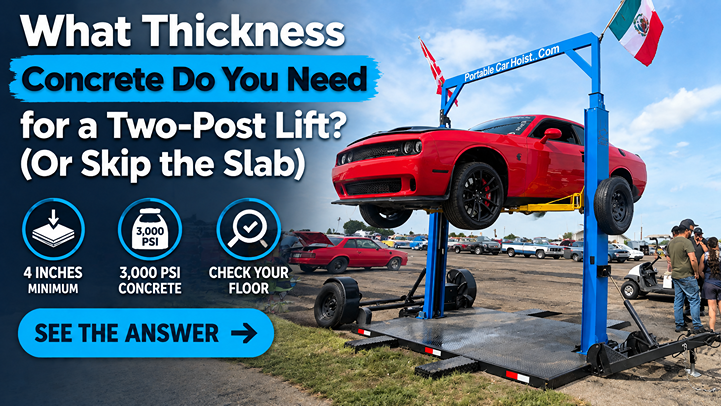
Measure your available floor space carefully, accounting for the lift's footprint and adequate working room around your vehicle. Most portable lifts require a flat, level concrete floor with a minimum thickness of 4 inches. Check for cracks, settling, or surface degradation that could compromise safety.
Consider your garage's existing infrastructure. Electric-powered lifts need access to a 110V or 220V outlet, while pneumatic lifts require an air compressor with sufficient CFM (cubic feet per minute) output. Battery-powered models offer maximum portability but may have slower lifting speeds.
Scissor lifts are compact and provide excellent access to the undercarriage but may limit side access to the vehicle. Four-post designs offer easier drive-on convenience and better stability, but have a larger footprint. Look for features like adjustable lifting arms, rubber contact pads to protect your vehicle's frame, automatic safety locks, and wheels for easier repositioning.
Before your portable car lift arrives, proper preparation will ensure a smooth setup process and safe operation:
Inspect your concrete floor thoroughly. It should be level within 3 degrees and free of significant cracks, oil stains, or surface damage. Clean the entire area where you'll position the lift, removing debris, oil, and any substances that could affect stability or traction.
Some heavier vehicles or lifts may benefit from reinforced floor sections or rubber mats designed specifically for lift use, though these should never be used as a substitute for a proper concrete foundation.
Measure your garage's ceiling height and ensure you have adequate clearance for your vehicle when raised. Don't forget to account for any garage door openers, light fixtures, or storage systems mounted overhead. A general rule is to have at least 2 feet of clearance above your vehicle's highest point when fully raised.
If your lift requires electrical power, ensure your circuit can handle the amperage requirements. Dedicated circuits are recommended for lifts drawing more than 15 amps. For pneumatic systems, verify your air compressor's CFM rating meets or exceeds the lift's requirements, and check that air lines are in good condition.
Gather essential tools and safety equipment before beginning setup: a socket set, wrenches, hydraulic fluid (if applicable), wheel chocks, jack stands (as backup safety devices), eye protection, work gloves, and the manufacturer's installation manual.
Safety should always be your top priority when operating any lifting equipment. These protocols are non-negotiable:
Always position your vehicle precisely over the lift's contact points. Consult your vehicle's manual to locate approved jacking and lifting points—these are reinforced areas of the frame designed to handle the vehicle's weight. Never lift from under the oil pan, transmission, or other components.
Before every lift operation, perform a visual inspection of the lift for hydraulic leaks, loose bolts, damaged lifting pads, worn cables or chains, and proper safety lock function. Also, inspect your vehicle for anything that could shift or fall during lifting.
Ensure your vehicle's weight is evenly distributed across all lift contact points before raising. Uneven loading can cause the vehicle to shift or tip, resulting in serious damage or injury.
Always engage mechanical safety locks at your working height—never rely solely on hydraulic pressure to hold the vehicle. Keep jack stands available as backup safety devices for critical repairs or extended work sessions.
Never allow anyone to stand under or near a lifted vehicle who isn't actively working on it. Keep children and pets away from the garage during lift operations, and ensure your work area is well-lit and free of tripping hazards.
Lower vehicles slowly and in a controlled manner. Watch for obstructions and listen for unusual sounds. Never leave a vehicle in a partially raised position unattended.
Regular maintenance extends your lift's lifespan and ensures continued safe operation:
Keep a maintenance log documenting all inspections, repairs, and part replacements. This record helps identify developing issues and demonstrates proper care should warranty claims become necessary.
Understanding common problems helps you address them quickly:
A portable car lift opens up numerous possibilities beyond basic maintenance:
By performing your own maintenance and repairs, you'll quickly recoup your investment in the lift while gaining valuable mechanical skills and the satisfaction of self-sufficiency.
Yes, they are safe when used correctly. Always follow setup instructions and engage safety locks or support stands.
Many portable lifts can lift SUVs, crossovers, and light-duty trucks—just verify the weight capacity before purchase.
No. Portable lifts sit on the surface without anchors, making them perfect for home garages.
Depending on the model, between 18 and 48 inches. Quick Jack-style lifts typically offer 20–24 inches.
Most setups take 10–20 minutes once you’re familiar with the process.
Investing in a portable car lift for home garage use represents a significant step toward automotive self-sufficiency and long-term cost savings. With proper selection, careful setup, and rigorous safety practices, you'll enjoy years of convenient, professional-quality access to your vehicle's undercarriage for maintenance, repairs, and modifications.
The key to success lies in choosing the right lift for your specific needs, adhering to safety protocols, and maintaining your equipment diligently. While the initial investment may seem substantial, the cumulative savings on mechanic labor, the convenience of working on your own schedule, and the satisfaction of mastering automotive repairs make a portable lift one of the most valuable additions to any serious home garage.
If you're ready to elevate your home garage and boost your automotive capabilities, now is the perfect time to upgrade.
Explore our premium portable car hoist options and take your garage setup to the next level!