



Jader Gil
Marketing Expert
June 6, 2026
9 min read
So you're looking at car lifts, and you want a straight answer on price. Just real numbers so you can plan your budget.
The truth is that how much a portable car lift costs depends on a few things, and those things matter a lot more than the sticker price. This guide walks you through the full picture: what you'll actually spend, what most buyers forget to factor in, and where portable hoists fit into that math for a shop, a mobile mechanic, or a serious collector.
Let's get into it.
You find a two-post car lift online for $2,500. Looks solid. Good reviews. Then you start making calls.
The electrician wants $1,200 to run a 220V circuit. The concrete contractor says your four-inch slab won't cut it and quotes you $3,000 to $5,000 to reinforce it. The lift installer adds another $900 to $1,500. And you still need permits in most commercial spaces, which can run $500 to $1,000 depending on your municipality.
Suddenly, that "$2,500 lift" is a $9,000 to $12,000 project. And that's before the first vehicle rolls in.
This is the part most pricing articles skip over. The equipment cost is real, but the installation ecosystem around a fixed lift is where shops get blindsided. According to data from auto shop building guides, vehicle lifts require a minimum six-inch concrete floor with steel reinforcement at 4,000 to 4,500 PSI, and thinner slabs crack under lift loads, causing anchor failure and safety hazards.
That's the problem. Let's look at the full landscape before we talk solutions.
Here's where the market sits right now across the main lift categories.
This range covers basic low-rise and mid-rise scissor lifts, entry-level portable two-post options, and imported models with limited lifting height. You're looking at max heights around 26 to 47 inches, 6,000 to 7,000 lb capacities, and warranties that often cap at one year.
These work fine for tire rotations, brake jobs, and light undercarriage access. But if you're doing transmissions, exhaust work, or anything that requires standing upright under a vehicle, you're still bent over or crawling around.
Standard two-post and four-post lifts from established brands land here. Models like the AMGO BP-9 sit around $2,335 at retail, and a commercial-grade AMGO OH-10 runs about $4,395. Add installation, electrical, and concrete work, and you're in the $6,000 to $12,000 range total.
These are the lifts you drill into the floor. They work well when your slab is solid, and you never plan to move the lift. The minute either of those things changes, you've got a problem.
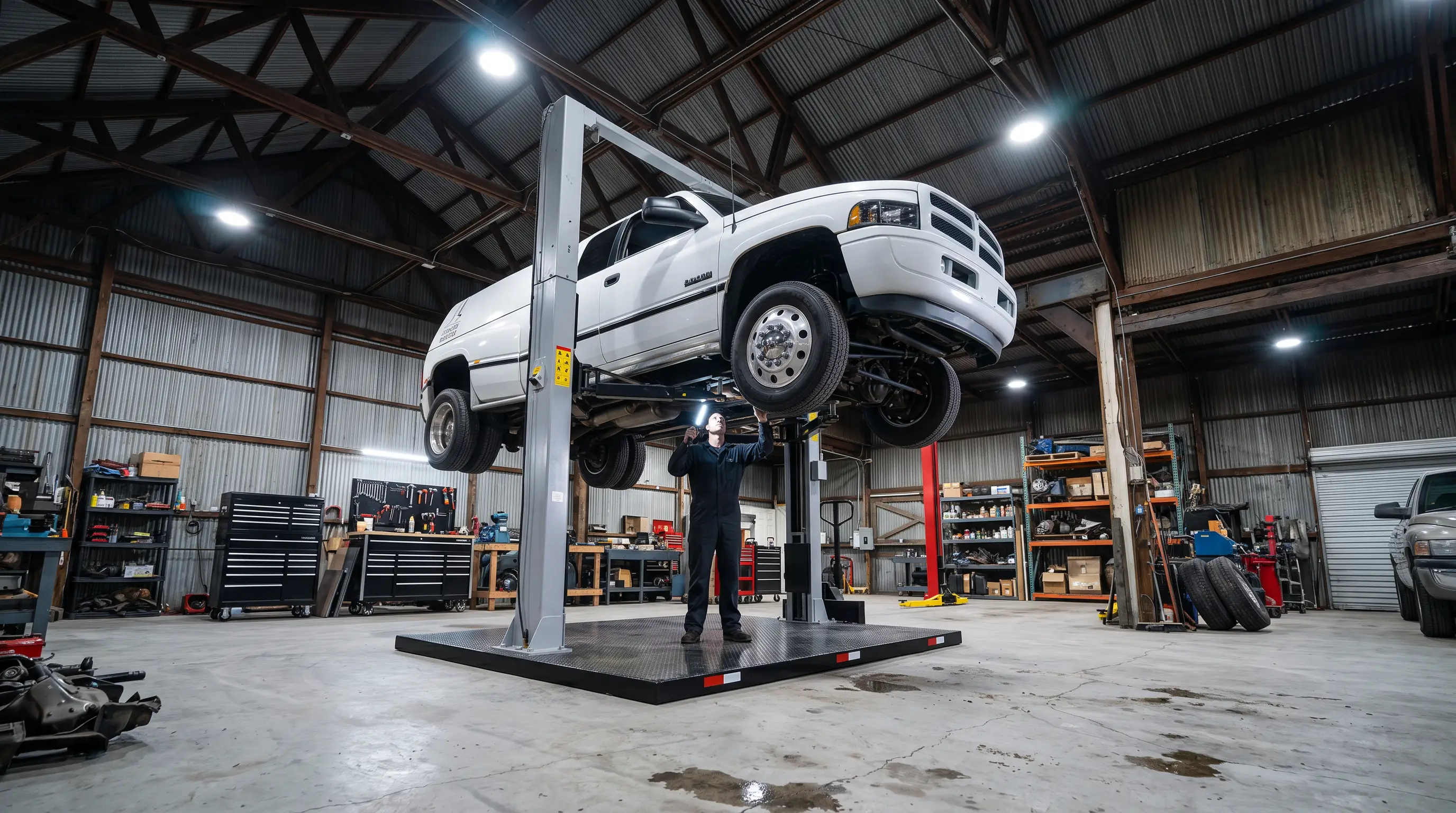
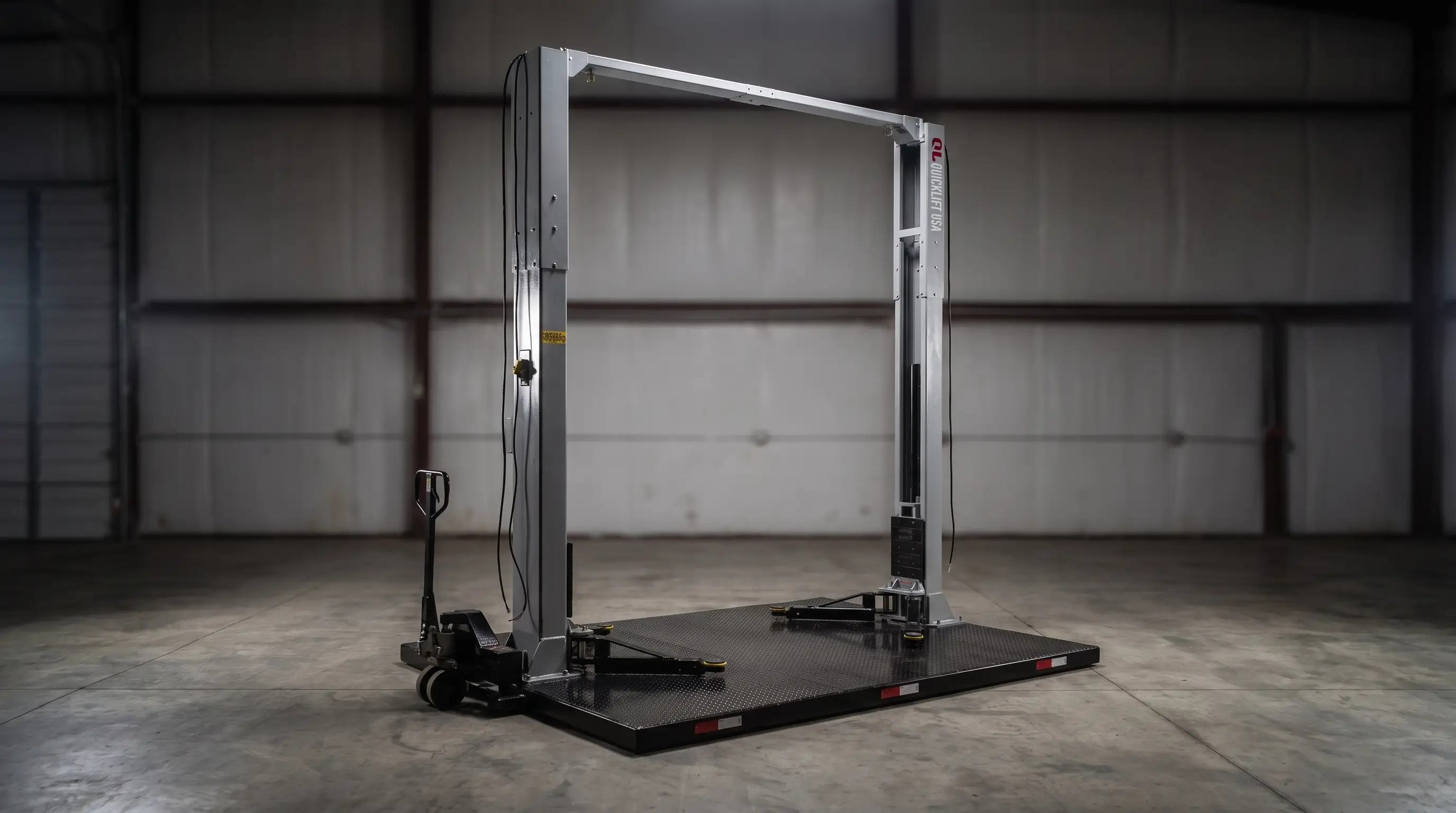
This is where full-height, full-capacity portable hoists live. These are not glorified scissor jacks. We're talking 8,000 to 76,000 lb capacities, 69 to 73.5 inches of true standing-height lift, no concrete, no anchors, no permits.
Portable Car Hoist models, for example, start at $17,300 for the Model A (designed for shops and mobile mechanics) and go up to $34,500 for the Model T semi-truck hoist. These are American-made, custom-built units with five-year structural warranties. You're not buying off a warehouse shelf; you're buying a piece of equipment built for your specific operation.
When people ask how much a portable car lift costs, and they're comparing portable options to fixed ones, they often focus on the wrong number. The unit price of a portable hoist looks higher at a glance. But the total cost of ownership tells a different story.
Here's the comparison that matters for a shop owner:
Fixed Two-Post Lift: True Total Cost
And then it's permanent. You can't reposition it when you want to reconfigure your shop. You can't take it when you move buildings. The resale value is essentially zero, because buyers don't want someone else's equipment bolted into their floor.
Portable Car Hoist Model A:
Net cost over five years after resale: roughly $3,500 to $7,000. That's competitive with, or less than, many fixed lift total investments, and you have a tool you can take with you anywhere.
If your shop is in a leased space, a portable hoist is the only lift investment that you actually own outright and can remove. You're not leaving $10,000 worth of equipment behind when you relocate or renegotiate your lease. That flexibility has real dollar value.
The Model A was designed specifically for mobile use. It folds down, loads into a standard pickup, and runs on battery power (8 to 12 full lift cycles per charge). For a mobile mechanic charging $100 to $150 per hour, having the ability to do full-height undercarriage work at a customer's location instead of referring jobs out is a direct revenue multiplier.
If you have three or more vehicles and you're doing regular maintenance yourself, you're losing time and risking safety every time you use floor jacks and stands. One serious jack stand failure costs more than the hoist. The math isn't complicated.
Portable hoists are increasingly common at events because they require no permanent setup, can move between venue spaces, and handle the kind of high-volume, fast-paced lifting that events demand.
For fleet managers handling trucks and heavy commercial vehicles, the Model T's capacity range (16,000 to 54,000 lb combined) means you can service full-size semis without an in-ground system. That alone can save $20,000 to $30,000 in installation versus a commercial in-ground lift.
Beyond the installation numbers above, there are a few costs that don't show up in any quote but will show up in your budget:
Whether you're shopping for a portable car hoist or comparing options elsewhere, these are the questions that will save you from a bad purchase:
Portable Car Hoist offers financing through Trio Capital and ClickLease. A Model A starting at $17,300 comes out to roughly $250 to $290 per month on a 60-month term with approved credit. For a shop doing 10 to 15 cars a week, that's less than the revenue from two brake jobs.
Yes, when it's built to the right standard. Full-height portable hoists like the Portable Car Hoist models use mechanical and hydraulic redundancy to hold position even if power cuts out mid-lift. The key is the base engineering. Wide-base weight distribution replaces the function of concrete anchors. Look for units that have been load-tested at 150% capacity before shipping.
It depends on the model. Budget portable options often cap at 6,000 to 7,000 lbs, which won't handle most full-size trucks. The Portable Car Hoist Model A handles 8,000 to 11,000 lbs, and the Model T reaches 76,000 lbs for commercial vehicles. Always verify the specific vehicle weight before assuming compatibility.
Quality full-height portable hoists are designed for a 5 to 15 minute setup. There's no concrete, no drilling, no electrician required. Battery-powered versions don't even need an outlet. For mobile mechanics, this means you can set up at a customer's driveway and be lifting in under 20 minutes.
American-made, commercial-grade portable hoists retain 60 to 80% of their resale value. Fixed lifts bolted to a floor have essentially zero resale value because buyers won't pay to remove someone else's anchored equipment. If you're treating your shop tools as business assets, that difference matters significantly.
The sticker price is one number. The total cost, including installation, floor prep, electrical, permits, and lost flexibility, is a completely different number.
For a shop owner who needs to lift vehicles every day without being locked into a floor plan, a location, or a lease, a full-height portable hoist from Portable Car Hoist makes the math work. Starting at $17,300 with zero installation costs, zero permits, and 60 to 80% resale value, you're looking at a tool that pays for itself, moves with your business, and lasts over 20 years.
If you're ready to stop turning away jobs because you don't have the right lift, or you're tired of the floor jack and jack stand routine, schedule a free 15-minute consultation with the Portable Car Hoist team. They'll match you to the right model, walk you through financing, and answer every question before you spend a dollar.