


Jader Gil
Marketing Expert
July 25, 2026
9 min read
If you are choosing between a MaxJax and a full-height portable car hoist, here is the short answer: the MaxJax is a mid-rise portable lift that gets a car about 48 inches off the ground, while our full-height portable two-post hoist lifts to 69–73.5 inches so you can stand straight up underneath. Both skip the permanent concrete anchoring, but only one lets you walk under the car without a creeper. In a 2023 industry survey of home and light-commercial shops, roughly 7 out of 10 mechanics said “standing headroom” was the single feature they regretted not having after buying a low-rise lift. That one number drives this entire comparison.
I build these hoists in Menifee, California, and I talk to buyers every week who started out shopping for a MaxJax and ended up asking a better question: not “which portable lift is cheapest,” but “which portable lift lets me actually work the way I want to?” So let me walk you through the honest trade-offs, where the MaxJax genuinely wins, and where a full-height portable hoist pulls ahead.
The MaxJax is a two-post mid-rise lift. It uses two separate posts that you bolt into your concrete with anchor bolts, and it raises a vehicle to roughly knee-to-waist height. It is portable in the sense that you can unbolt the posts, wheel them into a corner, and reclaim your garage bay. That is a real advantage over a fixed two-post lift, and it is why the MaxJax earned its reputation.
But two things surprise people. First, the MaxJax still requires drilling anchor bolts into a slab that meets a minimum thickness and cure spec — usually at least four inches of good concrete. If you have a post-tension slab, a cracked slab, or asphalt, you have a problem. Second, “mid-rise” means you are still crouching, kneeling, or lying on a creeper for anything involving the transmission tunnel, the exhaust, or the center of the undercarriage. It lifts the wheels off the ground beautifully for brakes and tires. It does not turn your driveway into a real service bay.
None of that makes the MaxJax a bad product. It makes it a specific tool for a specific job. The trouble starts when someone buys one expecting it to replace a full lift.
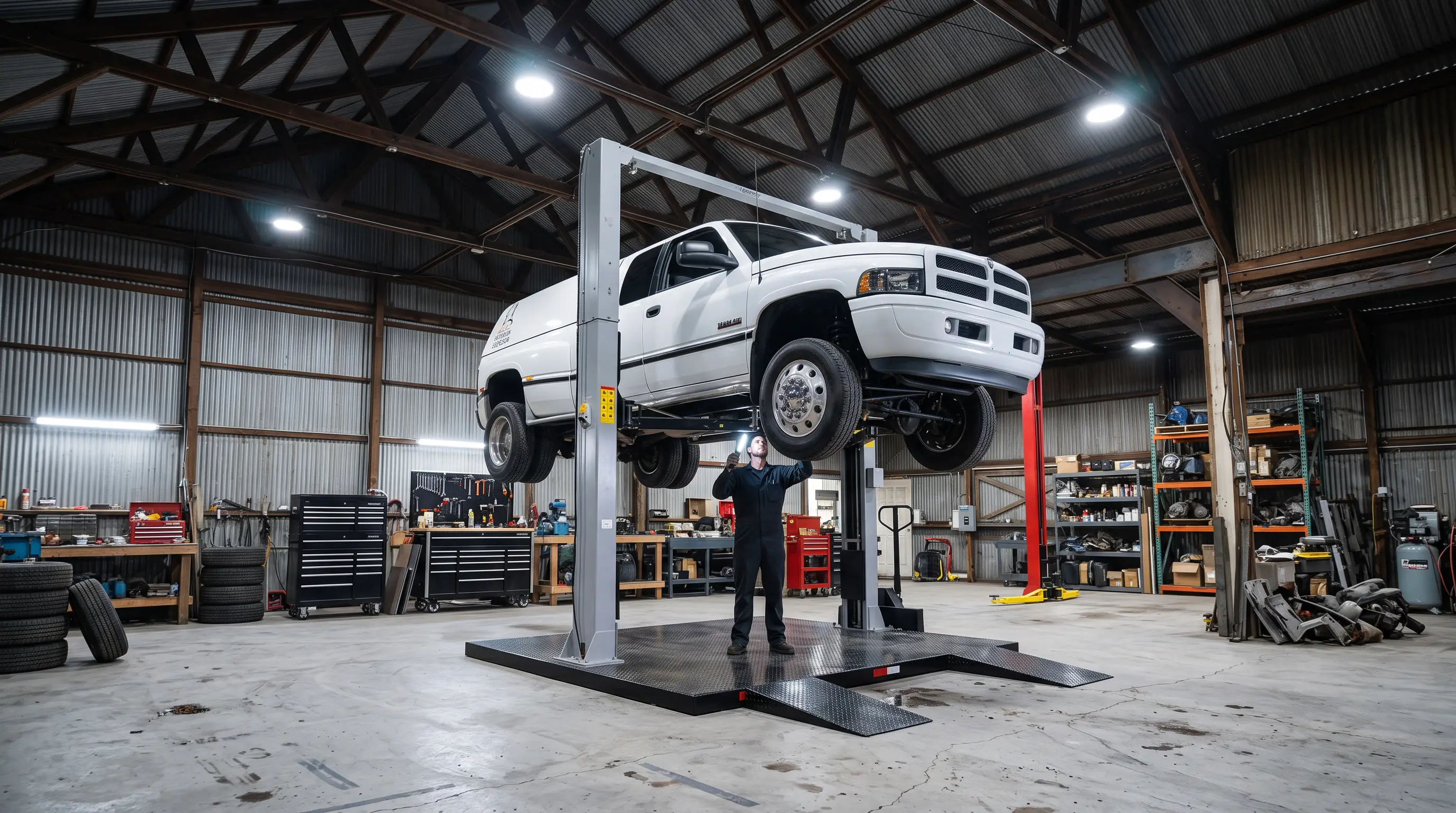
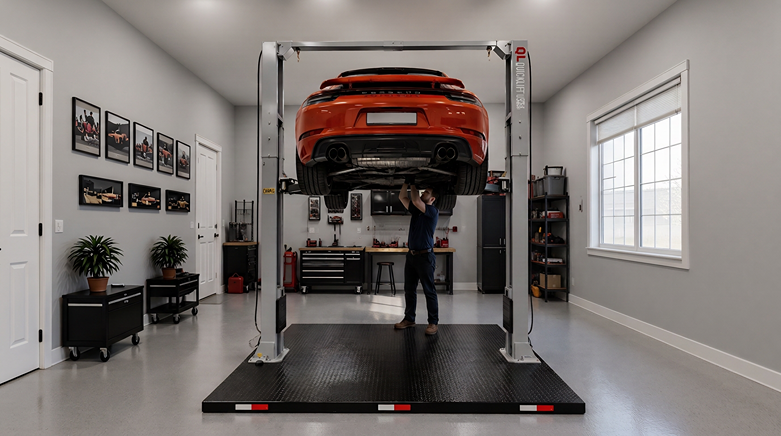
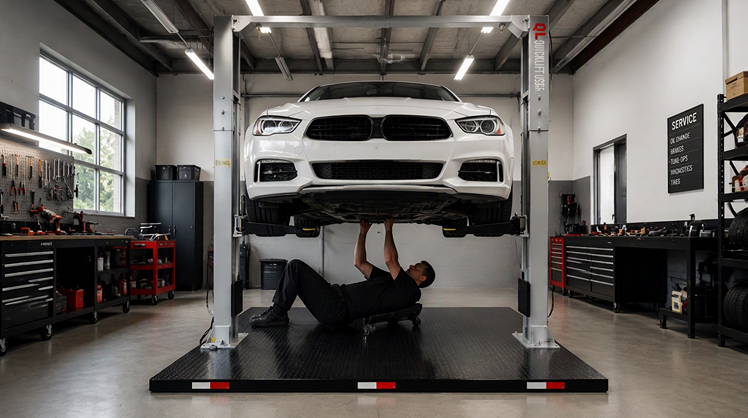
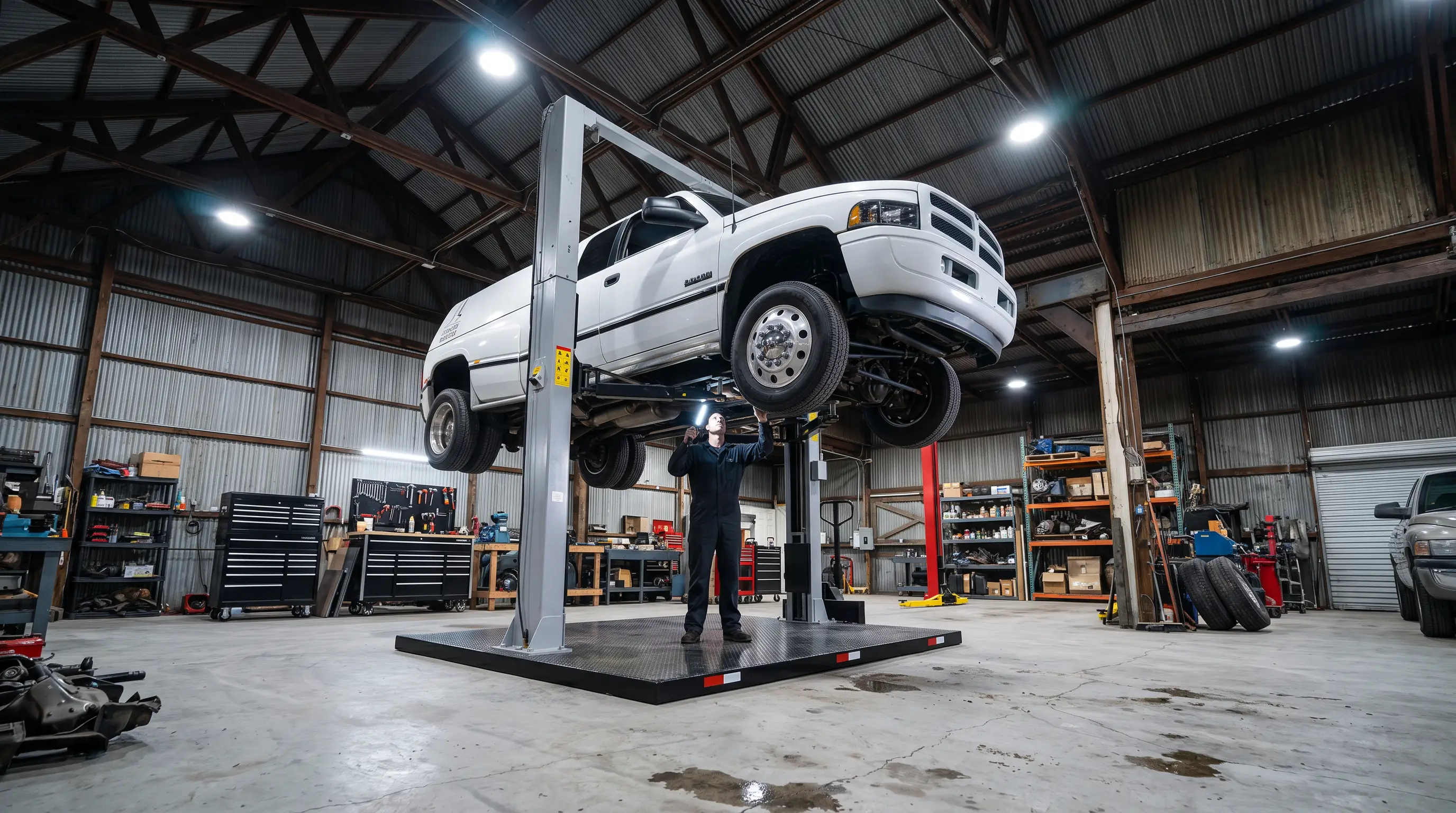
Our portable car hoist is a full two-post lift mounted on its own black diamond-plate flatbed trailer deck. The whole lift — both posts, the base, the hydraulics — lives on that deck, so it carries its own foundation with it. That is the key difference: there is no concrete to drill, no anchors to set, and no permits to pull. You roll it into place, level it, and in about 15 minutes you are lifting a car to full standing height.
Because you reach 69 to 73.5 inches of lift, you walk under the vehicle upright. You can pull a transmission, run a full exhaust, do suspension work, or handle a clutch job the way you would in a commercial shop. And depending on the model, you are working with capacities from 8,000 all the way up to 76,000 pounds, so the same platform concept scales from a Miata to a loaded work truck. If you are trying to size that correctly, I walk through it in our guide on picking the right car hoist capacity.
Pro tip: When you compare any two lifts, do not compare list prices first. Compare the height you will actually be working at, then the foundation cost. A “cheaper” lift that needs an engineered slab poured is not cheaper — it just moves the cost somewhere the spec sheet does not show.
This is the whole ballgame. The MaxJax tops out at mid-rise, so you are working seated or kneeling for center-of-car jobs. The full-height portable hoist gets the car overhead so you stand and walk. If most of your work is brakes, tires, and quick rotations, mid-rise is fine. If you want to do real underbody work without wrecking your back, full height wins and it is not close.
The MaxJax bolts into your slab. The portable hoist brings its own deck, so it needs zero anchoring. If you rent your shop, have a post-tension or radiant-heated floor, or just do not want to drill, that matters a lot. I explain the anchor-free approach in detail in how a car lift works with no concrete anchors, and there is a dedicated breakdown for tricky floors in our post on lifting on a post-tension slab.
Both are “portable,” but they mean different things by it. Moving a MaxJax means unbolting the posts and rolling them — then re-anchoring at the new spot. Moving our hoist means towing the whole deck to a new location and re-leveling. For a mobile mechanic who goes to the customer, that trailer-deck design is the difference between a lift you relocate and a lift you take on the road. I cover that use case in taking your shop to the customer.
The MaxJax is built around light-duty passenger vehicles. Our platform runs from car-weight up through heavy trucks, so if you ever plan to work on a three-quarter-ton, a dually, or fleet vehicles, you are not boxed in. That headroom in capacity is the same reason shops that grow tend to outgrow a mid-rise lift within a year or two.
A MaxJax install involves marking, drilling, setting anchors, and verifying torque — and if your slab is not rated, adding concrete work and possibly a permit. The portable hoist is roughly a 15-minute level-and-go with no permit because nothing is permanently attached to your building. For a lease-friendly setup, that is often the deciding factor, which is why I wrote up the lease-friendly two-post setup approach.
I am not here to tell you the MaxJax is junk, because it is not. If you own your home, have a healthy four-inch slab, only work on cars and light trucks, and your jobs are mostly brakes, tires, and detailing, a mid-rise lift can be a smart, budget-friendly pick. It stores compact, it is simple, and it does its narrow job well. If that is you, buy it with confidence.
The MaxJax becomes the wrong call when any one of these is true: you rent, your floor cannot be drilled, you want to stand under the car, you plan to work on heavier vehicles, or you want to move the lift between locations. Every one of those pushes you toward a full-height, deck-mounted design.
On paper a mid-rise lift looks cheaper, and sometimes it is. But run the real math. Add anchor hardware, add any concrete remediation your slab needs, add the labor or permit if you hire that out, and add the value of the work you cannot do at mid-rise and have to send elsewhere. Then, because a portable hoist holds its value well when you resell, factor the back-end return — I put real numbers on that in our piece on whether portable car lifts hold their value. When you total it honestly, the gap narrows fast, and for a working shop it often flips. For a full pricing walk-through, see our portable car lift cost and pricing guide.
Let me be blunt about the baseline. Either of these lifts is dramatically safer than crawling under a car on jack stands, and if you are still doing that, please read why jack stands are dangerous first. Both quality lifts use mechanical locking systems and proper safety engineering. What full height adds is situational safety: you are not contorted under a low car, you can see what you are doing, and you have room to move if something shifts. For how certification and locks work on portable equipment, we break it down in are portable car lifts safe.
If your work is light and your floor is drillable and you never plan to move the lift, the MaxJax wins on price and simplicity, and I will happily tell you so. But for the buyer who wants to stand up under the car, skip the concrete work, keep the option to relocate, and grow into heavier jobs, the full-height portable car hoist wins on every axis that matters over the life of the lift. Most people who call me thinking “mid-rise” actually want “full height without the construction project” — and that is exactly the gap this hoist was built to fill. If you want the deeper side-by-side against a standard fixed two-post lift, read portable car hoist vs. two-post car lift.
You should not have to pick between a lift you can afford and a lift you can actually work under. Our American-made portable car hoist gives you full standing height, zero concrete, roughly 15-minute setup, and capacities that scale from a Miata to a 76,000-pound truck — all on a deck you own and can move. Tell me your vehicles, your floor, and your space, and I will help you spec the right model. Book a Free Quote today and let’s get you standing up under your next job.
Not in the same way. A MaxJax is “portable” because you can unbolt its two posts and roll them aside, but you still anchor it into concrete every place you use it. A full-height portable car hoist is mounted on its own flatbed trailer deck, so it carries its foundation with it and needs no anchoring at all — you can level it in about 15 minutes or tow it to a new location.
No. The MaxJax is a mid-rise lift that tops out around 48 inches, so you work seated, kneeling, or on a creeper for anything under the center of the car. A full-height portable hoist lifts to 69–73.5 inches, which lets you walk under the vehicle standing straight up.
You need to drill for a MaxJax — it uses anchor bolts set into a slab that meets a minimum thickness and cure spec. You do not need to drill for a deck-mounted portable car hoist, which makes it the better fit for renters, post-tension or radiant-heated floors, and anyone who does not want permanent holes in their slab.
The full-height portable hoist. The MaxJax is built around light passenger vehicles, while our platform scales from 8,000 up to 76,000 pounds. If there is any chance you will service three-quarter-ton trucks, duallies, or fleet vehicles, the higher-capacity portable hoist keeps you from outgrowing your lift.
QuickJack vs. Full-Height Portable Hoist: When Low-Rise Just Isn’t Enough
Portable Car Hoist vs. Two-Post Car Lift
Portable Two-Post Car Lift: Complete Buyer’s Guide 2026
Are Portable Car Lifts Safe? ALI Certification & Locking Systems