


Jader Gil
Marketing Expert
April 1, 2026
9 min read
You don't have a garage. Maybe you rent. The garage may be packed with stuff that's never moving. Maybe you work out of a van, and your "shop" is wherever your customer parks their car.
That's the reality for many people who work on cars, whether you're a mobile mechanic squeezing jobs between 8 am and sunset, a car collector who stores vehicles in a storage unit, or a weekend warrior who just wants to change their oil without lying on the cold ground.
Here's the thing: not having a garage doesn't mean you can't work safely under a car. You just need the right equipment. And that's exactly what a driveway car lift is designed for.
Let's be honest about what working without a lift actually looks like.
Floor jacks and jack stands work, but they're not exactly confidence-inspiring when you're sliding under a 4,000-pound vehicle on an uneven driveway. According to the U.S. Bureau of Labor Statistics, "jacks, jackstands, hoists, and lifts" account for a significant share of mechanic injuries in non-shop environments. The Consumer Product Safety Commission has also documented hundreds of injuries annually from improper use of jack stands at home.
Beyond safety, there's the time problem. Setting up jack stands on all four corners, double-checking stability, adjusting height, re-checking, and crawling around the floor is slow. And when you're a mobile mechanic charging by the job, slow kills your margin.
Then there's the visibility problem. Jack stands give you about 12—14 inches of clearance on a good day. That's enough to change a drain plug, but not enough to really see what's going on with suspension, exhaust, or brake lines, especially on trucks or SUVs.
So the question isn't "Should I use something better?" It's, "what's actually practical outside of a garage?"
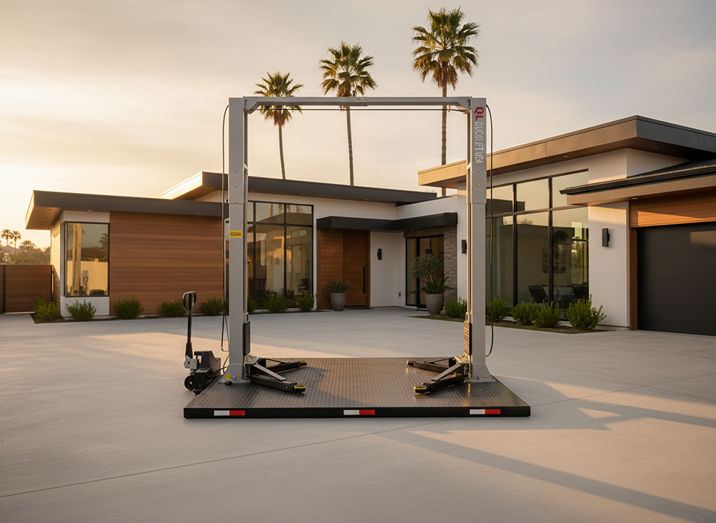
A driveway car lift is not just a fantasy. It's a category of portable lifting equipment specifically designed to work on surfaces you don't own, can't drill into, and might use once and then move somewhere else entirely.
The Portable Car Hoist models, for example, are built with a self-supporting frame that doesn't require floor anchors, concrete bolts, or any kind of permanent installation. You roll it out, set it up on a flat surface, lift the vehicle, and work. When you're done, you break it down and move it.
That's a fundamentally different product than a traditional two-post or four-post shop lift. Those require:
A portable car hoist needs none of those things. You can use it in a driveway, a storage unit, a parking lot, or a racetrack paddock. The surface needs to be reasonably flat and solid, but that's about it.
This is a fair question and one worth taking seriously. Driveways vary a lot, so here's a quick checklist before you set anything up:
Surface type:
Slope: OSHA guidelines for vehicle lift safety recommend a surface grade of no more than 1 percent for most lift types. On a home driveway, that's approximately a 1-inch drop over 8 feet. If your driveway slopes more than that, you'll want to use leveling pads or position the vehicle perpendicular to the slope.
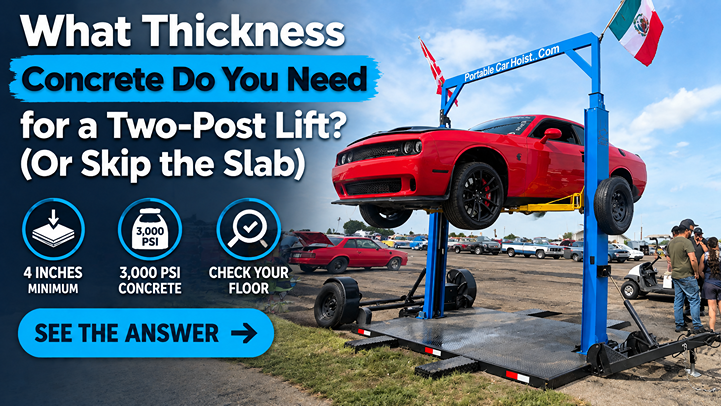
Load capacity: Most residential driveways are poured at 3,500 to 4,000 PSI strength, which is more than sufficient for a standard passenger vehicle. Where people run into trouble is with load concentration, meaning all the weight pressing through small contact points. Good portable hoists use wide-base outriggers and spread the load across a larger footprint to reduce that risk.
Here's a practical picture of what a real setup looks like, step by step.
Step 1: Assess the surface. Walk the driveway. Look for cracks, soft spots, or drainage dips. You want 4 clear feet on each side of where the vehicle will sit.
Step 2: Position the vehicle. Drive or push the car into the center of your workspace. Make sure the front or rear (depending on which end you're lifting) is accessible and level.
Step 3: Set up the hoist frame. Portable Car Hoist models use a self-supporting A-frame or gantry-style structure that assembles without tools in most cases. Extend the outriggers fully and confirm they're sitting flat.
Step 4: Locate the lift points. This is where most people make mistakes. Every vehicle has OEM-specified lift points, usually indicated in the owner's manual or the service manual. Using the wrong spot can bend the frame, crush a rocker panel, or, worst case, drop the car. Consult the manual. Every time.
Step 5: Attach and lift slowly. Bring the lifting beam into contact with the vehicle's lift points. Apply tension gradually. Watch for any flex or movement in the frame before committing to full lift height.
Step 6: Verify stability at partial height. Stop at 6-8 inches, rock the vehicle gently, and confirm the setup is stable before lifting to full working height.
Step 7: Use safety locking pins or stands. Never work under a vehicle supported only by hydraulic pressure. Portable Car Hoist units include locking mechanisms, but you should also place secondary stands as backup. This is non-negotiable.
The honest answer is a lot more people than you'd expect.
Mobile mechanics are one of the fastest-growing segments in automotive service. The mobile mechanic market in the U.S. is projected to grow at roughly 3.5 percent annually through 2030, driven by convenience-focused consumers who'd rather not take a day off work to sit at a dealership. A portable car hoist is often the single piece of equipment that separates a mobile mechanic who can only do top-side work from one who can handle full brake jobs, exhaust repairs, and suspension work.
Car collectors with limited garage space frequently store vehicles outdoors or in commercial storage units. Many storage facilities don't allow motorized equipment or have low ceiling clearance, making a portable hoist the only viable option for inspection and maintenance without transporting the vehicle to a shop.
Mechanic shops in expansion mode sometimes use portable hoists as overflow capacity. A shop that's booked solid on its two installed lifts can set up a portable unit outside to handle additional jobs without a $10,000 to $40,000 installation project.
Race event support crews use them in paddocks and at trackside where there's simply no installed infrastructure. Between heats, a crew needs to get under a car fast. A portable hoist makes that possible anywhere with a flat surface.
Not all portable lifts are built for outdoor or non-garage use. Here's what actually matters:
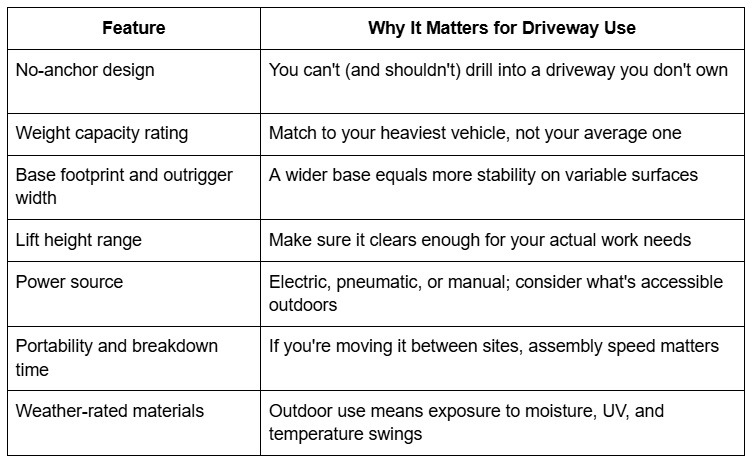
Portable Car Hoist's Model A, for example, is designed specifically as a no-anchor unit with a wide outrigger stance and an electric power option that can run off a standard generator, which matters a lot when you're working in a driveway with no power outlet nearby.
Skipping the surface check: Asphalt can look solid and be soft underneath. Always check for sponginess, especially near the edges of the driveway where base material is thinner.
Rushing the lift point identification: A bent subframe or crushed rocker sill is expensive. Spend the 3 minutes looking up the correct lift points. It's worth it.
Working alone under the vehicle: This isn't about being paranoid. It's about having someone who can call for help if something goes wrong. Two people are better.
Ignoring the locking mechanism: Hydraulic pressure can fail. Seals wear. If your lift has a locking pin or ratchet safety mechanism, use it. If it doesn't have one, that's a problem with the equipment, not something to work around.
Setting up on a slope: Even a slight grade creates lateral load on the lift frame. If your driveway has any angle to it, use leveling pads before lifting.
Here's the reframe worth sitting with: a portable car hoist isn't what you settle for when you can't afford a real lift. For mobile mechanics, it's how you build a business that goes to the customer. For collectors, it's how you maintain vehicles stored outside a shop. For shops, it's how you handle overflow without a capital project.
The garage-free mechanic or enthusiast used to be at a real disadvantage. That gap has closed. The equipment exists. The question is whether you're using it or still lying on a creeper, hoping the jack stands hold.
You don't need four walls and a concrete slab to work safely under a car. You need the right lift and the right setup process. A properly used driveway car lift, specifically a portable car hoist built for non-anchored outdoor use, gives you the same access, stability, and safety as a shop lift without the permanent installation.
If you're a mobile mechanic who wants to take on bigger jobs, a collector who's tired of trucking your car to a shop for basic maintenance, or a mechanic shop looking for flexible overflow capacity, this is the conversation worth having.
Talk to the team at Portable Car Hoist. They'll walk you through which model fits your vehicle weight, surface type, and use case—no pressure, no guesswork. Visit portablecarhoist.com or call +1 (951) 400-5290 to get started.