

.png)

Jader Gil
Marketing Expert
April 1, 2026
9 min read
If you run a shop in Menifee or the surrounding Inland Empire area, you already know the pressure. Vehicle count in Southwest Riverside County has climbed steadily alongside population growth, and the demand for reliable, fast vehicle service keeps going up. At some point, you look at your bays and think, "I need a lift that actually works for the way I run this place."
So you start researching two-post lifts, and suddenly there are a hundred options, six confusing specs, and a hundred salespeople all claiming their lift is the best. It gets overwhelming fast.
This guide cuts through all of that. Whether you are buying your first lift or replacing old equipment, here is what actually matters before you spend a single dollar on a two-post car lift in Menifee.
Walk into any busy independent shop, and you will almost certainly see a two-post lift. There is a reason for that. A two-post lift uses two upright columns with four adjustable arms that engage the vehicle's frame or lift points, which means the car's wheels hang completely free. That open undercarriage access is what makes this style of lift ideal for brakes, suspension work, tire rotation, oil changes, and general diagnostics.
According to market data, two-post and scissor lifts are the most popular choices among compact and mid-sized shops, specifically because of their small footprint and low installation costs. The global automotive lift market was valued at roughly $4 billion in 2025 and is expected to grow to nearly $5.4 billion by 2035, driven largely by rising vehicle ownership and the ongoing demand for maintenance services.
For a shop in Menifee, that growth is very real. The city's population has grown significantly over the last decade, and more residents mean more vehicles that need servicing. If your bays are not equipped to handle volume efficiently, you are already leaving money on the table.
Getting the wrong lift is not just a budget problem. It can be a safety problem. Here are the four things you absolutely need to verify before signing anything.
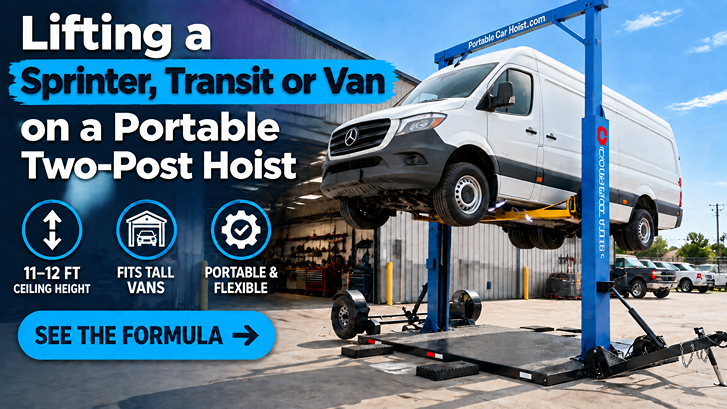
Most two-post lifts require a minimum ceiling clearance of 11 to 12 feet. That measurement needs to account for rafters, lighting fixtures, HVAC equipment, and any garage door hardware above the work area. Measure from the floor to the lowest obstruction, not just the ceiling deck itself. If you are close to that minimum, check the manufacturer's spec sheet carefully because some lifts sit a few inches taller than others once the arms are extended at full height.
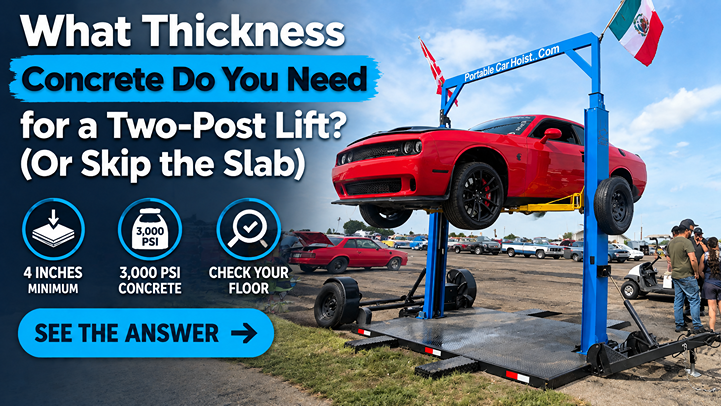
Most surface-mounted two-post lifts require concrete that is at least 4 to 6 inches thick, with a minimum compressive strength of 3,500 PSI. If you are in a leased space in Menifee, this matters a lot. Many commercial shops in the area are in flex-industrial or converted retail units, and the slab may not meet those specs, or your lease may prohibit anchoring. Before you order a lift, know your concrete situation. Getting this wrong can void your warranty and create a serious liability risk.
Most two-post lifts run on 220V single-phase power. If your shop only has 110V service available at the lift location, you will need an electrician to run a dedicated circuit before the lift can be installed. Factor that cost into your budget. It is not unusual for electrical upgrades to add a few hundred to over a thousand dollars, depending on your panel location and building layout.
A two-post lift needs at least two feet of clearance between the posts, the vehicle, and your bay walls. That sounds like a lot, but it adds up fast in a tight space. The good news is that compared to a four-post lift, a two-post version takes up significantly less floor real estate, making it a better fit for smaller bays. But you still need to physically walk through the measurement with a tape before ordering.
This is one of the questions that comes up constantly, and a lot of buyers skip past it without thinking it through.
A symmetric lift has arms that extend equally front and back from the column. The vehicle sits centered between the posts. A symmetric setup works well for general repair, and it is easy to position most sedans, trucks, and SUVs.
An asymmetric lift has the rear arms longer than the front arms. The vehicle sits rotated slightly, with the B-pillar (the structural post between the front and rear doors) closer to the center of the lift. This configuration means the driver-side door swings open more freely when the car is on the lift, which makes getting in and out to check things much easier. For high-volume shops doing a lot of oil services, that matters to your techs.
The short answer: if you do mostly maintenance and repair work on passenger cars, an asymmetric lift saves a lot of awkward door-opening contortions throughout the day. If you service a lot of trucks, vans, or vehicles with longer wheelbases, a symmetric setup tends to be more forgiving.
Most shops operating near Menifee see a mix of passenger cars, crossovers, full-size pickups, and the occasional work van. A 10,000 lb lift is the most common starting point for general repair shops, and it covers the vast majority of passenger and light commercial vehicles without issue.
But here is the thing. Buying into your current vehicle mix is a mistake most experienced shop owners make once and then regret. Your customer base will change. Trucks are getting heavier. If you service fleets or commercial vehicles, a 12,000 lb or higher capacity lift gives you more flexibility as your business grows.
As one industry buyer's guide from Pitstop Pro notes, the right move is to choose based on your heaviest vehicle, not your most common one. That cushion protects you from having to rebuy in two years.
If you are shopping around and comparing prices, here is something to know: most lifts on the market are not ALI certified. The Automotive Lift Institute is North America's only recognized authority for lift safety and quality standards. An ALI-certified lift has been independently tested to meet or exceed specific safety benchmarks.
For a shop in Menifee, this matters from a liability standpoint. If a lift fails and injures a tech or damages a customer's vehicle, your insurance carrier is going to ask questions about whether the equipment met safety standards. An uncertified lift is a risk that simply is not worth the upfront savings.
Look for the ALI Gold Label on any lift you are seriously considering. If the seller cannot produce documentation of certification, keep shopping.
Here is something that surprises a lot of shop owners when they first hear it. You do not always need to anchor a lift to the floor to get professional-grade performance.
If you are in a leased bay, working in multiple locations, doing mobile mechanic work across Menifee and surrounding areas like Murrieta, Temecula, or Winchester, or just do not want to deal with permits and concrete anchoring, a portable car hoist gives you real lift performance without any of the installation headaches.
American-made portable hoists are designed specifically for mechanics who need professional capability without permanent infrastructure. Basic hydraulic models require no drilling, no concrete requirements, and no electrician. You set it up, use it, and move it when you need to. For mobile mechanics operating throughout the Menifee Valley, that flexibility is not just convenient; it is genuinely a business advantage.
For car collectors in the area, portable lifts also solve the problem of working on classic or specialty vehicles without risking permanent modifications to a home garage or storage facility. You get the access you need without committing to a fixed installation.
The lift itself is not your only cost. Here is a realistic breakdown so you are not caught off guard.
If you go the portable route, most of those additional costs simply disappear. For hydraulic models, there is no need for an electrician, anchoring, or permits. The total cost is closer to the unit price itself, which is a meaningful difference for a small shop managing cash flow.
A few things are worth keeping on your radar as you make this investment decision.
Electric vehicles are coming to Menifee driveways faster than most shop owners expected. EV servicing requires attention to battery placement and underbody weight distribution when lifting. If you are buying a lift that will be in your shop for the next decade, make sure the capacity and arm reach can handle heavier EV platforms. Some current lifts are already marketing EV-specific arm adapters and weight ratings.
The number of automotive service centers in the US is expected to exceed 200,000 by 2025, which means competition is growing. The shops that win are the ones that turn vehicles faster and take on more job types. A lift that limits your vehicle range, or one that sits unusable because of installation delays, directly costs you revenue.
The DIY and enthusiast market is also growing, especially in communities like Menifee, where many residents have garages large enough to support a serious home setup. If your customer base includes gearheads and collectors, understanding what they are looking for in a portable or compact lift can help you make better referral recommendations, too.
Use this as a quick checklist when you are talking to any lift seller, whether that is a local dealer, an online retailer, or a manufacturer representative.
Buying a two-post car lift in Menifee is not just a purchasing decision. It is a capacity decision. The right lift lets you take on more jobs, turn them faster, and keep your techs working comfortably instead of crawling around on a creeper all day.
But the right lift depends heavily on your specific situation: your bay dimensions, your concrete, your lease terms, your vehicle mix, and whether you need something permanent or portable. There is no universal answer, and anyone who tells you otherwise is guessing.
If you are a mobile mechanic working across the Menifee valley, or a shop owner in a leased space who does not want to deal with permits and anchoring, a portable car hoist from Portable Car Hoist might be exactly what you need. American-made, no concrete required, and built for professionals who need real performance without the permanent commitment.
If you are still figuring out which lift configuration fits your shop, reach out for a free 15-minute consultation. The team at Portable Car Hoist works with mechanics, collectors, and shop owners throughout the Menifee and Inland Empire area and can help you match the right equipment to your actual workflow. Call +1 (951) 400-5290 or visit portablecarhoist.com to get started.