



Jader Gil
Marketing Expert
April 1, 2026
9 min read
If you are still using jack stands or a floor-level creeper, you are likely familiar with the challenges. Your back hurts. The job takes longer. And there's always that little voice in the back of your head, wondering if this is the lift cycle where something slips.
You're not imagining it. According to the Bureau of Labor Statistics, musculoskeletal disorders account for nearly 30% of all worker injury and illness cases in auto repair settings. Bending, crawling, and contorting yourself under vehicles is not just uncomfortable; it's genuinely wearing your body down.
So why haven't you made the switch yet?
For most mechanics, shop owners, and serious enthusiasts, the answer is the same: traditional car lifts come with a nightmare of concrete requirements, permits, electricians, and a price tag that quietly climbs past $14,000 before you lift a single car. That's before you factor in the fact that you can never move it.
But here's what many people don't realize. You can now buy a portable car hoist that gives you full professional-grade lift height, the same safety redundancy as a fixed lift, and zero concrete requirements. And getting started is a lot more straightforward than you'd think.
This guide walks you through every step.
Let's be honest about what working at ground level actually costs you.
Time is the first thing. A job that takes 45 minutes on a lift can take twice as long when you're rotating between a creeper, a floor jack, and a set of stands. You're repositioning constantly, your tools are harder to reach, and your sightlines are terrible.
Then there's the safety piece. Jack's stands fail. It doesn't happen often, but when it does, the consequences are severe. OSHA data consistently shows that vehicle falls are among the leading causes of serious injury in automotive workplaces. The more floor-level jobs you perform, the more often you face this risk.
And if you own or run a shop, there's a revenue angle too. A mechanic working off the floor can realistically handle one fewer vehicle per day than one working on a proper lift. Over a full week, that's not a small number.
The solution isn't complicated. You need a lift. The question is which one and how to set it up without overspending on concrete and installation.
This is where it's worth slowing down, because "portable lift" means unique things depending on who's selling it.
Many budget portable lifts have a maximum clearance of 47 inches. That sounds fine until you're halfway through a transmission job and realize you can't stand upright or get your torso under the drivetrain at a comfortable angle. You end up hunched anyway.
A proper car lift for home or shop use should give you full standing clearance. The Portable Car Hoist models, for example, deliver a lift height of 69 to 73.5 inches. That's the same working clearance you'd get from a commercial two-post fixed lift, but without the concrete anchor requirement.
Here's a quick breakdown of what separates professional-grade portable hoists from the cheaper alternatives:
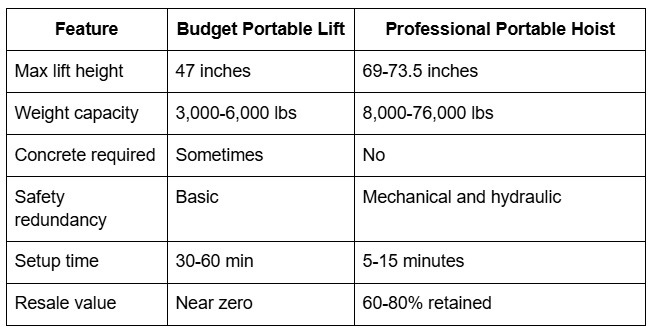
That last row matters more than people realize. A cheap portable lift is essentially a consumable. A well-built, American-made hoist holds its value and moves with your business.
Before you buy a portable car hoist, you need to get specific about your workload. This is the step most people skip, and it's the one that causes regret.
Ask yourself these questions:
What vehicles are you working on most? Sedans and light trucks are in one category. Full-size trucks, SUVs, and vans are another. Commercial vehicles and semis are a third. Each one has different weight requirements and lift geometry.
How many vehicles per day? A mobile mechanic doing two to three jobs is in a different category than a shop turning 10–12 cars. Higher volume means you want faster setup time and more durability.
Where will this type of equipment be used? Your shop floor, a customer's driveway, a track event, or a storage facility all have different surface conditions and space constraints.
What's your ceiling height? If you have at least 8 feet of clearance, most professional portable hoist models will work fine. If you're tight on clearance, that's worth confirming before you order.
Getting these answers clear first saves you from buying a Model A when you needed a Model C or ordering a single unit when your fleet maintenance operation really needs two.
One of the most common reasons people delay the switch is sticker shock. A professional portable hoist is not a $500 item. But the math changes completely when you look at the full picture.
Here's a realistic cost breakdown for a traditional fixed two-post lift installation:
And that lift never moves. If you relocate, you leave it behind. If your shop layout changes, it stays where it is.
Now compare that to a Portable Car Hoist Model A, which starts at $16,800. No concrete. No permits. No electrician. Five- to fifteen-minute setup. And it retains 60–80% of its value if you ever sell or upgrade it.
The net cost over five years is dramatically lower, especially when you factor in the flexibility and the fact that you're not locked into one floor location forever.
If upfront cost is a concern, there are financing options available through partners like Trio Capital and Clicklease, with typical monthly payments around $250–$375, depending on the model.
Now that you know what you need and what it actually costs, here's a plain-language breakdown of the three main options:
Model A: Built for small shops, mobile mechanics, and serious home enthusiasts. It folds for transport, runs on batteries or electric power, and handles up to 8,000–11,000 lbs. If you're a mobile mechanic who needs something that fits in a pickup truck bed and runs on battery between jobs, this model is your unit.
Model C: Designed for professional shops with higher daily volume. The top beam rises with the lifting arms, so you can work on extended cab trucks and taller vehicles without any overhead clearance issues. Same weight range as the Model A, but built for harder daily use.
Model T: For commercial operations, fleet maintenance, and anyone working on semi trucks. Combined lifting capacity: up to 54,000 lbs. This model is the unit you want if your shop handles heavy commercial vehicles.
All three models are made in Menifee, California. All three were set up in under 15 minutes. None of them requires concrete.
This is the part nobody tells you about, and it matters because it sets your expectations correctly.
You can't just click "add to cart" on a professional hoist. These are custom-built units, not warehouse inventory. Here's how the process actually works:
The lead time is real, so if you have a seasonal deadline, a race event, or a shop opening coming up, factor that into your timeline.
You don't need to do much. That's kind of the whole point. But here are a few things worth handling ahead of delivery:
Confirm your power setup: Most models operate on 110V or 220V electric power or a 12V/24V battery. Know which you have and which option you ordered.
Measure your floor space: The footprint of a portable hoist is larger than a floor jack but smaller than a fixed two-post lift with its anchor bolts and safety cones. Leave yourself enough room to walk around all four sides of the vehicle.
Verify your ceiling: You need at least 8 feet of clearance for a full lift. More is better.
Clear a staging area: When the unit arrives, you'll want a clear space to unpack and roll it into position without obstacles.
That's genuinely it. No contractor calls. No permit applications. No waiting on an inspector.
Ask anyone who made the switch from jack stands to a proper car lift for home or shop use, and you'll hear a version of the same thing. The first job feels different. You're standing. Your tools are where you need them. You can see what you're doing without a flashlight held in your teeth.
One customer put it plainly in a review: "Being able to fix your junk at the track on a lift is an absolute game changer."
That's not an exaggeration. When you're working at full standing height with both hands free and good sightlines, you're faster, more accurate, and a lot less tired at the end of the day.
For shop owners, that translates directly into throughput. For mobile mechanics, it means doing more jobs in less time without destroying your body. For collectors and enthusiasts, it means actually enjoying the work instead of dreading the setup.
If you've been putting this off because the process seemed complicated or the cost seemed too high, this guide is for you.
The short version: you can buy a portable car hoist that performs at the level of a commercial fixed lift, sets up in minutes with no concrete, and moves wherever your work takes you. The buying process is straightforward, the financing options are real, and the lead time is predictable.
The only thing that doesn't change is that the longer you wait, the more jobs you're doing on the floor.
Ready to figure out which model fits your setup? Schedule a free 15-minute consultation at portablecarhoist.com. No sales pressure. Just a real conversation about your space, your vehicles, and which unit makes the most sense. You'll walk away knowing exactly what you need or knowing this isn't the right fit yet. Either way, you'll have clarity.