


Jader Gil
Marketing Expert
April 1, 2026
9 min read
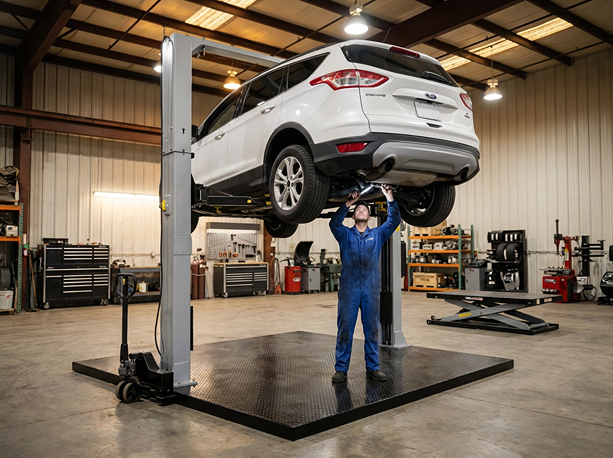
You've probably already searched it. Maybe you watched a few YouTube videos, got a quote from a local dealer, and started budgeting for the install. A two-post car lift seems like the obvious answer if you're serious about doing real automotive work.
But here's the thing: many people don't find out until after they've already committed: the lift itself is only part of the cost. And for a growing number of mechanics, collectors, and shop owners, it's not even the right tool for the job.
This comparison isn't a sales pitch dressed up as advice. It shows the real cost of each option, what you get, and which one wins based on your work style.
Let's start with the number you see on the product page. A solid commercial-grade two-post car lift runs between $3,000 and $6,000. That sounds manageable.
Then the real quote arrives.
According to industry data from the Automotive Lift Institute (ALI), a properly installed two-post lift requires concrete that is at least 4 inches thick with a minimum strength of 3,000 PSI. If your floor doesn't meet that spec, and a large percentage of older commercial buildings don't, you're looking at slab reinforcement before a single bolt goes in.
Here's what a realistic installation budget actually looks like:

That's not a fringe case. That's what thousands of shop owners run into every year. And once that lift is in the ground, it's in the ground. You can't take it with you. You can't reconfigure your shop around it. And if you ever sell or move, the resale value is effectively zero because buyers don't want your old lift bolted to their floor.
Here's where the real problem sits, and it's not the upfront cost.
Say you installed the lift two years ago. Business is growing, you're thinking about expanding or relocating to a bigger space, or you've picked up mobile work and need to get to a customer site. Your two-post car lift cannot help you with any of that.
It's a permanent fixture. It belongs to the building now, not to you.
According to a 2023 survey from the Independent Garage Owners of America, nearly 38% of shop owners said their fixed lift placement became a workflow problem within three years of installation. They couldn't move it, couldn't add a bay beside it without clearance issues, and couldn't adapt when their service menu changed.
That's the agitation most people don't feel until they're living it.
Fair question. The phrase "portable car hoist" makes some people think of cheap, low-profile jacks that barely get a car off the ground. That's not what this is.
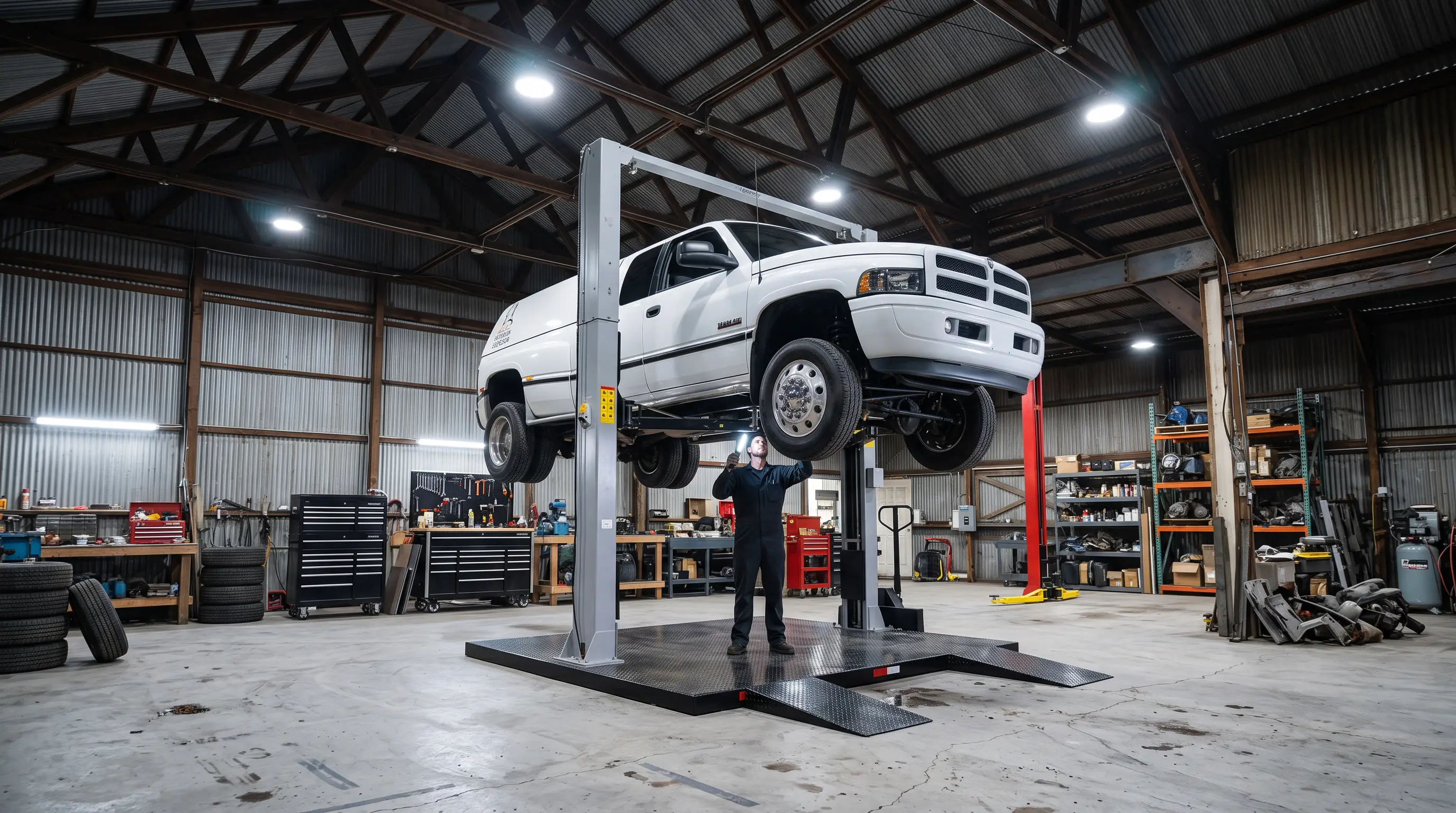
A professional-grade portable car hoist is a full two-post style lift system that requires no concrete anchors, no drilling, and no permits. It achieves stability through wide-base weight distribution instead of floor anchors. Units like the Portable Car Hoist Model A and Model C, which are American-made in Menifee, California, deliver 69 to 73.5 inches of lift height and capacities from 8,000 to 11,000 lbs, with higher capacities available on request.
That's not compact lift territory. That's standing-height, full-service work.
Setup takes 5 to 15 minutes. And when you're done, you can fold it, roll it, and load it onto a truck.
Let's put this side by side in an actually useful way.

Looking at that table, the fixed two-post car lift wins on name recognition and nothing else. The portable car hoist excels in cost flexibility, setup speed, portability, and long-term value.
A traditional two-post car lift can make sense if you own your building, your floor already passes inspection, you never plan to move, and your service mix stays consistent. You'll take the upfront hit and then have a lift that's always ready for the same spot.
But that describes a smaller slice of shop owners than you might think.
This is where the portable car hoist genuinely changes things.
Mobile mechanics have been the most vocal about this. The Portable Car Hoist Model A was literally designed with them in mind. It folds to fit a standard pickup truck, runs on battery power with 8 to 12 full lift cycles per charge, and recharges overnight. You can pull up to a customer's driveway, set up in under 15 minutes, and do transmission work, brake jobs, or full suspension swaps without a shop floor anywhere in sight.
Car collectors love it for a different reason. If you're storing and maintaining multiple vehicles, you don't want a permanent lift taking up a fixed bay in your garage. You want something you can use on any car, any day, and then put away when you're done.
And for shops that are growing, the logic is pretty simple. A fixed lift locks you into your current layout. A portable car hoist gives you the freedom to reconfigure your floor as your business evolves.
This is the first objection most people raise, and it's a fair one.
The Automotive Lift Institute (ALI) certifies lifts against the same safety standards regardless of installation type. The difference is HOW stability is achieved. Fixed lifts use anchor bolts to resist lateral movement. A properly engineered portable car hoist uses a wide-base footprint and hydraulic redundancy to achieve the same result without drilling into the floor.
Portable Car Hoist units use mechanical locking plus hydraulic redundancy, so the load holds position even if power is lost mid-lift. The company reports zero stability-related incidents across 100-plus units sold when operated per the instructions.
That's not a guarantee, and no lift manufacturer can guarantee against misuse. But the safety argument against portable lifts is mostly outdated thinking, not engineering reality.
Here's a detail that actually surprises people.
When you install a fixed two-post car lift, that equipment becomes part of the building in the eyes of most buyers. If you sell your shop or upgrade equipment, you're looking at a near-zero return on that lift. Removing it and reinstalling it somewhere else costs almost as much as buying a new one.
A portable car hoist retains 60 to 80% of its resale value. That's real money. A unit you bought for $17,000 is still worth $10,000 to $14,000 on the used market because it's transferable, it's American-made, and there's a growing market of buyers who understand the value.
The math gets even more interesting when you compare against renting:
Renting makes sense for one or two jobs a year. Ownership at that scale isn't even close.
If you had to summarize this in one sentence, it would be this: a fixed two-post car lift is a commitment, and a portable car hoist is a tool.
Both can do serious automotive work. Both can handle real vehicle weights at real working heights. But one of them locks you into a floor plan, a location, and a layout. The other one goes wherever your work takes you.
For mobile mechanics, the choice is obvious. For car collectors and event planners, it's not even a debate. For growing shop owners who want to stay flexible without sacrificing capability, the portable car hoist is the smarter buy.
The question isn't really which one is stronger. It's which one fits how you actually work.
You don't have to pour concrete, pull permits, or wait three days for an installation crew to show up. Portable Car Hoist builds American-made, full-height portable hoists that set up in minutes and work wherever you do.
Schedule a free 15-minute consultation with the Portable Car Hoist team. They'll match you to the right model for your space, your vehicles, and your workload.
Call +1 (951) 400-5290 or visit portablecarhoist.com to get your free quote today.