


Jader Gil
Marketing Expert
October 28, 2026
9 min read
A scissor lift is fast and compact for tire, brake, and suspension work, but its center frame sits under the car and blocks true undercarriage access, and most models still bolt down to a 4-inch slab. A portable full-height two-post hoist gives you an open center, full standing room, and a clean reach to the exhaust, transmission, and frame — with zero concrete, zero anchors, and about a 15-minute setup. For a pro shop that wants one lift to do real underbody work and still move with the business, the portable two-post wins. Here is the honest, side-by-side breakdown so you can match the lift to the work you actually bill for.
I have set up both styles in working shops, and the choice almost always comes down to two questions: what do you repair most, and do you own the floor you are standing on? The vehicle-lift market runs into the hundreds of millions of dollars a year because shops keep buying the wrong lift first, then buying again. Let me save you the second purchase.
A scissor lift raises a car on a pair of folding arms that cross like scissors, pushing a platform or a set of pads straight up. A two-post hoist lifts from two upright columns with swing arms that tuck under the pinch welds, so the whole underside of the car hangs free in open air. That one structural difference drives almost everything else — access, height, footprint, and whether you can move the thing.
Scissor lifts come in two main flavors. Mid-rise scissors lift roughly to waist height and are built for quick brake, tire, and suspension jobs. Full-rise scissors go higher and can give you walk-under room, but the platform or the crossed arms still live under the middle of the vehicle. A full-height two-post, by contrast, puts the car up around 69 to 73.5 inches with nothing under the center at all. If you have ever compared a half lift against a full-height hoist, you already know how much that open center changes a shift.
If you want the full family tree of lift styles before you shop, our guide to the different types of car lifts lays out two-post, four-post, scissor, in-ground, and portable side by side.
I will not pretend a scissor lift is useless — it is not. For a high-volume tire bay or a quick-service lane, a drive-on scissor is quick and low-profile. You roll the car on, lift, rotate the tires, and drop it. The small footprint folds nearly flat into the floor, which matters when a bay has to double as parking at night. For brake pads, rotors, and lower-control-arm work, a mid-rise scissor keeps the car at a comfortable height without tying up a full two-post column.
The trouble starts the moment the work moves to the center of the car. Exhaust systems, transmissions, drive shafts, fuel tanks, and full undercarriage service all live right where the scissor mechanism sits. You end up working around the platform instead of under an open car. That is lost time on every ticket, and it quietly pushes certain jobs — the profitable ones — to the shop down the road that has a two-post. For undercarriage-heavy work like detailing and rust proofing, the open center is not a nice-to-have, it is the whole job.
Here is the number that matters on a busy day: how fast can a tech get to the part and stand up straight while working on it? A full-height two-post lifts the car high enough to walk under and work with your arms up, not over your head on your knees. Both front wheels and both rear wheels hang free, and the entire underbody is exposed. That is why two-post lifts are the default in serious general-repair shops.
A scissor lift keeps the vehicle balanced on its mechanism, so the center spine of the car is always partly blocked. Full-rise scissors improve the height but not the access — the arms are still in the way. If your bread and butter is exhaust, clutches, transmissions, oil pans, and suspension cradles, you will fight that platform all day.
Pro tip: Before you buy any lift, pull your last 90 days of repair orders and tally how many jobs needed real center-underbody access versus edge-of-the-car access. If more than a third of your tickets touch the exhaust, transmission, or frame, a scissor lift will bottleneck your most profitable work — buy the open-center two-post.
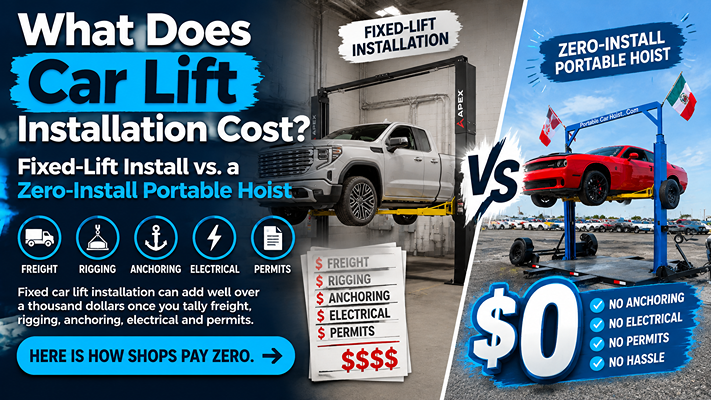
Shop owners usually compare sticker prices and stop there. The real comparison is total cost on your floor. Most fixed scissor lifts and every fixed two-post lift need a rated slab and anchors. Fixed lifts typically call for about four inches of concrete at 3,000 PSI, often more for higher-capacity columns, plus edge distance and proper reinforcement. If your slab is thin, cracked, post-tensioned, or you are leasing the building, that spec turns into a real problem fast. We break the numbers down in our guide to concrete thickness for a two-post lift, and the install side in what car lift installation actually costs.
This is where a portable two-post hoist changes the math entirely. It carries its own black diamond-plate trailer deck, so the deck is the foundation. No core drilling, no anchors, no slab engineering, no electrician running a dedicated circuit. You set it, level it, and lift — our walkthrough of how a portable car hoist works with no concrete and no bolts shows exactly why the deck replaces the slab. A scissor lift that bolts to a questionable floor does not give you that freedom, and neither does a fixed two-post.
A bolted lift is a building alteration. That can mean a landlord conversation, a permit, and an inspection — and when you move, you leave holes in someone else’s floor. A freestanding portable hoist is equipment, not construction, so it usually sidesteps all of that. We cover the permit and lease angle in whether you need a permit or inspection to add a lift and in our lease-friendly, no-concrete shop setup guide.
A scissor lift and a fixed two-post are permanent fixtures. Where you bolt them is where they live. A portable full-height two-post hoist, on the other hand, moves. You can reconfigure a bay in an afternoon, roll a lift to the far corner for a long project, run it outside a roll-up door on a busy day, or tow the whole rig to a second location or a job site. For a mobile mechanic business or a multi-location operation, that is not a luxury — it is the business model. If you want to see that flexibility in action, our post on taking your shop to the customer and the one on towing the hoist trailer down the road spell it out.
Setup is faster than most owners expect. A seasoned tech can level and ready a portable two-post in about 15 minutes — the full step-by-step is in our 15-minute setup walkthrough. Compare that to pouring or verifying a slab, drilling anchors, and scheduling an inspection for a fixed lift.
Capacity is where a lot of scissor lifts quietly fall short for a pro shop. Many mid-rise scissors top out well below what a loaded 3/4-ton or a lifted truck weighs. A full-height portable two-post hoist is built across a wide range — from about 8,000 pounds up to 76,000 pounds depending on the model — so one platform can handle everything from a Miata to a work truck. If capacity planning is new to you, our guide on picking the right hoist capacity walks through the math.
On safety, do not judge a lift by its style — judge it by its locks, its load rating, and its lift points. A quality two-post hoist uses mechanical safety locks that catch the load at intervals, so the car rests on steel, not on hydraulic pressure. Whatever you buy, confirm the certification and the locking system; we cover what to look for in are portable car lifts safe. And remember that arm geometry and pad placement matter as much as the columns — our breakdown of symmetric versus asymmetric lift arms explains why.
The spec sheet rarely tells you how a lift feels to live with. Many fixed scissor lifts and shop two-post lifts run a hydraulic power unit that wants a 220-volt circuit, which means an electrician and a dedicated line before you lift a single car. A portable two-post hoist is friendlier here — several models run on a standard 110-volt single-phase outlet, and some mobile-ready units even run on battery for job sites with no power at all. We cover the exact hookup in whether a portable car lift needs 220V, and it is worth reading before you assume you need to rewire the bay.
Then there is the simple matter of clearance. A full-height two-post needs vertical room, so a low garage ceiling can rule it out — measure first with our guide to the ceiling height a two-post lift needs. A scissor lift forgives a low ceiling but gives it back in access. Every lift trades something; the trick is trading away what you do not need. A shop that mostly stands cars up to work underneath should not pay for that with a blocked center, and a tire-only lane should not pay for height it will never use.
Buy a scissor lift if nearly all of your work is tires, brakes, and alignments, you own a rated floor, and you need a lift that folds flat so the bay can park cars overnight. It is a specialist tool and it is good at that narrow job.
Buy a portable full-height two-post hoist if you do general repair, you want open-center undercarriage access, you lease or have an unknown slab, or you plan to grow, move, or add locations. It is the lift that does the widest range of work and refuses to lock you to one spot. For most independent and growing shops, that is the one that keeps earning. If you are weighing it against other full-height options, see our head-to-heads on the QuickJack versus a full-height portable hoist, the MaxJax versus a portable car hoist, and the two-post versus four-post for a pro shop. The small-shop buyer’s guide ties it all together.
Ready to see which model matches your bay, your vehicles, and your floor? Book a Free Quote and we will help you spec the exact American-made portable hoist for the work you actually bill for — no concrete, no anchors, no second purchase down the road.
For general repair, a two-post lift is better because it leaves the entire center of the car open for exhaust, transmission, and undercarriage work. A scissor lift is better only when your work is almost entirely tires, brakes, and suspension and you need a lift that folds flat into the floor. Match the lift to the jobs you bill most.
Not easily. The scissor mechanism or platform sits under the middle of the vehicle, so the center spine — where the exhaust, driveshaft, fuel tank, and transmission live — is partly blocked. A full-height two-post hoist hangs the whole underbody in open air, which is why serious underbody and undercarriage detailing work goes faster on a two-post.
No. A portable full-height two-post hoist carries its own diamond-plate trailer deck, so the deck is the foundation — no slab spec, no anchors, no core drilling. Most fixed scissor lifts and every fixed two-post lift need about four inches of 3,000 PSI concrete plus anchors. See our anchor-free, no-concrete hoist overview for the details.
Compare total cost, not the sticker. A fixed scissor or two-post lift adds concrete, anchors, an electrician, and sometimes a permit on top of the lift price. A portable two-post is zero-install and moves with you. Run the full picture with our cost and ROI payback calculator.
QuickJack vs. Full-Height Portable Hoist: When Low-Rise Just Isn’t Enough
Half Car Lift vs. Full-Height Hoist: Stop Kneeling, Start Standing
2-Post vs. 4-Post Car Lift for a Professional Shop
Types of Car Lifts Explained: Two-Post, Four-Post, Scissor & Portable