


Jader Gil
Marketing Expert
August 12, 2026
9 min read
The best portable car lift for a small auto shop is a full-height, two-post portable hoist that needs zero concrete, zero anchors, and zero permits — and sets up in about 15 minutes. I’ve helped small-shop owners choose lifts for years, and the math is hard to argue with: a single full-height portable hoist that lets one tech stand upright under a car can add up to $50,000 a year in billable work to a two-bay shop, because you stop losing hours to jack stands, creepers, and half-lifted vehicles. If you run a lease bay, a startup shop, or a garage that has to stay flexible, this is the lift I’d put my own money on.
But “portable” covers a lot of ground, and not every unit on the market is built for a shop that fixes real cars all day. So in this 2026 buyer’s guide, I’ll walk you through exactly what I check before I recommend a lift to a small shop, why full-height wins for a working bay, and how to make the numbers pencil out even on a tight budget.
Small shops live and die by two things: floor space and flexibility. A traditional in-ground or bolted two-post lift ties you to one spot forever. You core the slab, you anchor the posts, and if your landlord says no — or you move next year — that investment stays behind. For a leased bay, that’s a dealbreaker.
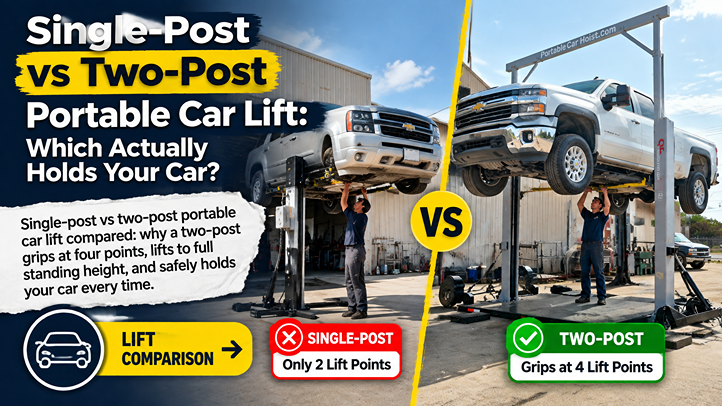
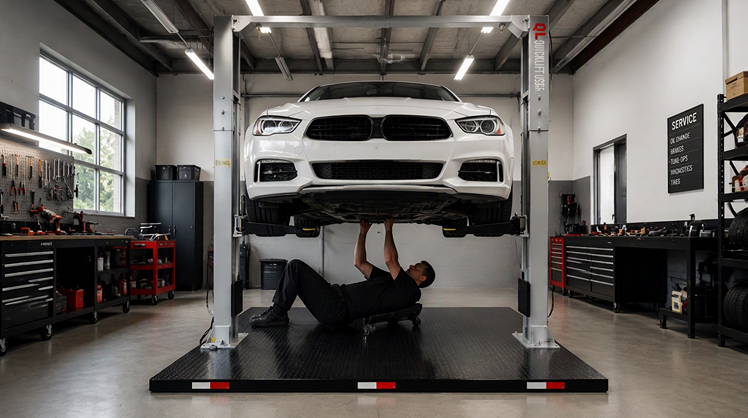
A portable full-height hoist flips that around. The whole two-post structure rides on its own black diamond-plate trailer deck, so the lift is the foundation. There’s no drilling into your floor, which is exactly why so many owners are switching from fixed lifts to a portable car hoist. If you’ve ever wondered how a lift can hold 8,000-plus pounds with no bolts in the ground, I broke down the engineering in how a portable car hoist works — it’s all in the counterweighted deck, not the concrete.
This is the single biggest reason small shops go portable. Anchored lifts often require a minimum slab thickness of 4 to 6 inches of properly cured concrete, plus an electrical permit and sometimes a building inspection. A portable hoist skips all of it. You can run one in a lease-friendly shop with no concrete work at all, which keeps your deposit safe and your buildout costs near zero. For shops on thin slabs, radiant-heated floors, or asphalt, going anchor-free is often the only lift that’s even an option.
Here’s the part small-shop owners underestimate. Because the lift sits on its own deck, you can roll it out of the way, reposition it, or reconfigure the whole floor in an afternoon. When a big job comes in, you move the lift; when it’s done, you move it back. I go deeper on this in reconfiguring a shop floor with a movable lift, but the short version is that a portable hoist gives a two-bay shop the flexibility of a four-bay shop. If square footage is your real constraint, a compact car lift built for small commercial shops is worth a hard look.
Not all portable lifts are equal, and the cheap ones will cost you more in downtime than you saved at purchase. Here is my actual checklist.
For a small general-repair shop, I want a minimum of 8,000 to 11,000 pounds of capacity so you can handle everything from a Miata to a loaded three-quarter-ton pickup without sweating the rating. Buy the capacity you’ll need in three years, not the one you need today. If your work skews toward trucks, vans, or fleet vehicles, size up — I explain how to match rating to your vehicle mix in picking the right car hoist capacity.
A working shop needs a tech to stand fully upright under the car. Full-height portable hoists reach roughly 69 to 73.5 inches of lifting height, which is the difference between billing eight productive hours and fighting a stiff back by noon. Low-rise and mid-rise lifts have their place for tires and brakes, but for a shop that does suspension, exhaust, and driveline work all day, full-height is non-negotiable.
Check whether the lift runs on standard shop power or offers a battery-powered option. If your electrical is limited or you want to lift vehicles outside the bay on a busy day, battery capability matters. This flexibility is one of the quiet advantages that makes a portable unit feel like two lifts in one.
This is where I refuse to compromise. Look for mechanical locking systems, dual safety redundancy, and quality certification. Cheap imports often skip the very safety hardware that keeps a car in the air. I laid out what to look for in portable car lift safety and certification — read it before you buy anything.
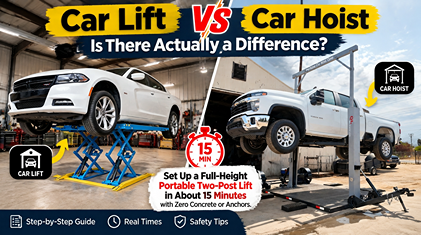
A lift that takes half a day to move isn’t really portable. The full-height hoist I recommend sets up in about 15 minutes and rolls on its own trailer deck, so one person can reposition it. That speed is what turns a fixed asset into a flexible one.
Steel quality is not marketing fluff on a machine that holds cars over your head. A hoist built from heavy-gauge American steel will outlast two or three bargain imports, and it holds its resale value far better. On a small-shop budget, buying once beats buying twice.
The last thing I check is payback. A good lift should pay for itself in added throughput, not sit as dead weight on your books. Run your own numbers with the cost and ROI payback calculator before you commit — most small shops are surprised how fast the lift clears its own cost.
Pro tip: Don’t buy the lift that barely fits your current cars. Buy the one that still has margin when you land your first fleet account or that lifted-truck customer. The extra capacity and height costs a little more up front and saves you an entire second purchase later.
If I had to equip a small auto shop tomorrow, I’d put a full-height portable two-post hoist in the main bay and never look back. It checks all seven boxes: 8,000 to 11,000 pounds of capacity, full standing height, no concrete, certified locking systems, 15-minute setup, American-made steel, and a payback most owners hit inside a year. For a complete spec-by-spec breakdown, the complete two-post portable lift buyer’s guide for 2026 covers every detail I can’t fit here.
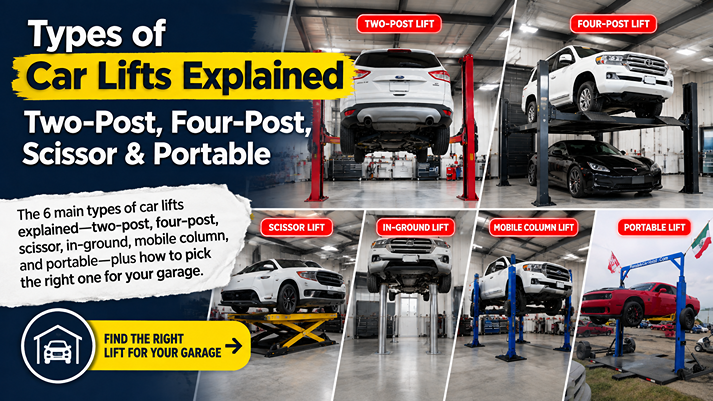
Owners often ask me about low-rise scissor lifts and mid-rise units because the sticker price looks friendlier. The problem is productivity. A tech who can’t stand up under the car works slower, gets tired faster, and bills fewer hours. I compared a popular mid-rise option head-to-head in MaxJax vs. portable car hoist, and for a full-service shop the full-height unit wins on nearly every metric that touches revenue. If you’re weighing lift styles more broadly, my two-post vs. four-post comparison for professional shops will help you settle the layout question too.
Here’s the part that keeps a lot of good owners on the fence: cash flow. The trick is to stop thinking of a lift as a lump-sum expense and start treating it as a tool that earns while you pay for it. Financing a portable hoist often costs less per month than the extra jobs it lets you take on, which means the lift is cash-flow positive almost from day one. I walked through real monthly-payment scenarios in car lift financing made easy.
And the upside isn’t theoretical. One owner I profiled added roughly $50,000 in annual revenue after dropping a single portable hoist into an existing bay — the full story is in how one shop added $50k with a single lift. When a lift can move that kind of number, the real question isn’t whether you can afford it. It’s whether you can afford to keep working without it.
Spec sheets are one thing; living with a lift is another. In a small shop, the portable hoist quickly becomes the most-used tool on the floor. A tech rolls it into position, levels it, and it’s lifting inside a quarter hour — no waiting on a concrete cure, no electrician, no inspector. When a low-clearance job or a big detail comes in, you slide the lift aside and reclaim the whole bay. That single habit is what makes a two-bay shop feel like it grew a third bay overnight.
Maintenance is refreshingly boring, too. Because there’s nothing anchored into your slab, there’s no cracked concrete to chase, no re-torquing of floor bolts, and no epoxy repairs when a lag pulls loose. You keep the hydraulics serviced and the locks inspected, and the machine just works. That low upkeep is a big reason these units hold their resale value so well — a well-kept American-made hoist is an asset you can sell, not a fixture you abandon.
The intangible win is confidence. Working under a car on a certified full-height lift with redundant locks feels nothing like fighting jack stands on a creeper. Your techs work faster because they aren’t nervous, and faster, calmer work is more profitable work. For a small shop where every billable hour counts, that shift in day-to-day rhythm is worth as much as the raw capacity.
For a small auto shop in 2026, the best portable car lift is a full-height, two-post portable hoist on its own trailer deck: enough capacity to grow into, real standing height, certified safety, no concrete, and a payback you can calculate before you sign. It fits leased bays, protects your floor and your deposit, and turns a two-bay shop into a far more productive one. Buy for build quality and capacity headroom, run the ROI numbers, and you’ll have a lift that earns its keep for a decade.
Want a straight answer on the right model and capacity for your shop, your bays, and your vehicle mix? Book a Free Quote and I’ll help you spec the exact hoist that pays for itself — no pressure, no concrete, no guesswork.
For most small general-repair shops, I recommend a full-height two-post portable hoist rated for 8,000 to 11,000 pounds. That range covers everything from compact cars to loaded half-ton and three-quarter-ton pickups with safe headroom to spare. If you regularly service larger trucks, vans, or fleet vehicles, step up to a higher-capacity model rather than running your lift at its limit every day.
Yes — that’s one of its biggest advantages. Because a portable hoist sits on its own trailer deck and needs no concrete anchors, you can run it in a leased bay without drilling the floor, pulling a construction permit, or risking your deposit. When your lease ends or you relocate, the lift comes with you instead of staying behind as a sunk cost.
Pricing depends on capacity and features, but the more useful number is payback. Many small shops recover the cost within a year through added throughput, and financing often runs less per month than the extra billable work the lift unlocks. Run your own figures with our ROI calculator before deciding — the math usually surprises owners in a good way.
A quality portable hoist uses mechanical locking systems and dual safety redundancy, and its stability comes from an engineered counterweighted deck rather than floor anchors. The key is buying a certified, American-made unit — not a bargain import that skips safety hardware. Check the certification and locking details before you buy any lift, portable or fixed.