



Jader Gil
Marketing Expert
April 21, 2026
9 min read
You found a fantastic deal on a two-post lift. Then the quote arrived.
$2,500 for installation. $1,200 for an electrician. $4,000 for concrete reinforcement. Your "deal" just became a $12,000 commitment, and that's before you've lifted a single car.
Here's the part nobody tells you upfront: if your shop has a post-tension slab, hairline cracks, or a floor that's just "old," you may not be able to install a traditional lift at all. According to industry estimates, nearly 40% of shop owners discover these issues only after they've already purchased their equipment. That's a painful and expensive lesson.
But there's another way. You can get a car lift with no concrete floor required, with full professional lifting height, zero installation cost, and the freedom to move it wherever you need it. That's what this post is about.
Every conventional two-post lift requires floor anchors. Typically, four bolts per column are drilled into concrete that must meet strict structural specs:
Most shop floors in buildings older than 20 years fail to meet all these criteria. Post-tension slabs are especially common in California and other Sun Belt commercial spaces. Drilling into one can sever a tension cable, and that causes catastrophic structural damage that runs $30,000 or more to repair.
According to data from lift installation professionals, floor inspections fail about 40% of the time. That means nearly half of shop owners who budget for a traditional lift end up either reinforcing their floor for $3,000–$8,000 or simply giving up on the lift altogether.
The problem isn't the lift. The problem is the floor it has to sit on.
Here's where most mechanics assume there's a catch. There isn't one.
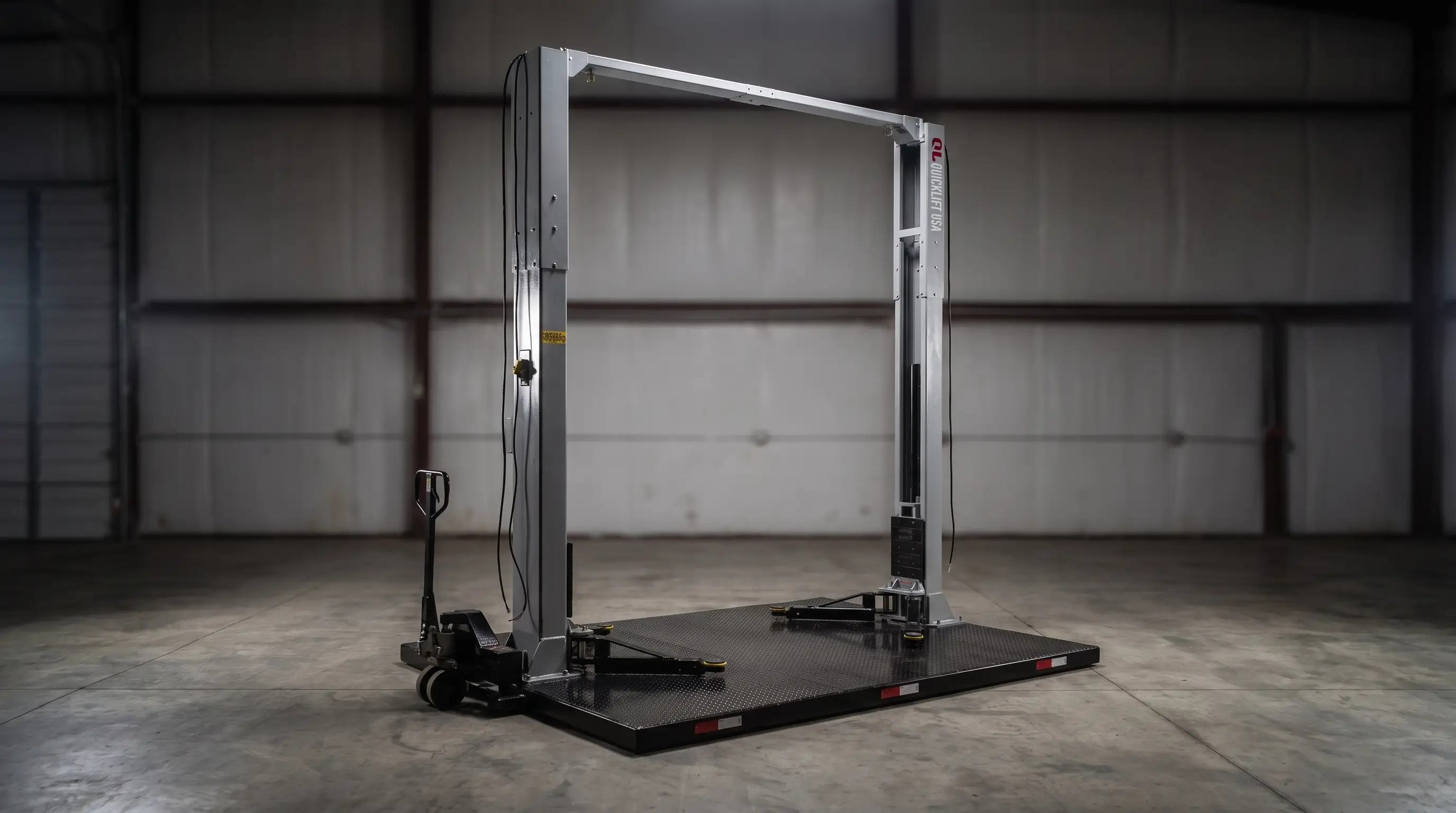
A Portable Car Hoist uses a wide-base engineering design to distribute vehicle weight safely across any level surface, without drilling a single hole. The physics work because the load spreads over a much larger footprint than a standard anchor point. Think of it like snowshoes versus stilettos: same weight, very different pressure per square inch.
The system works on:
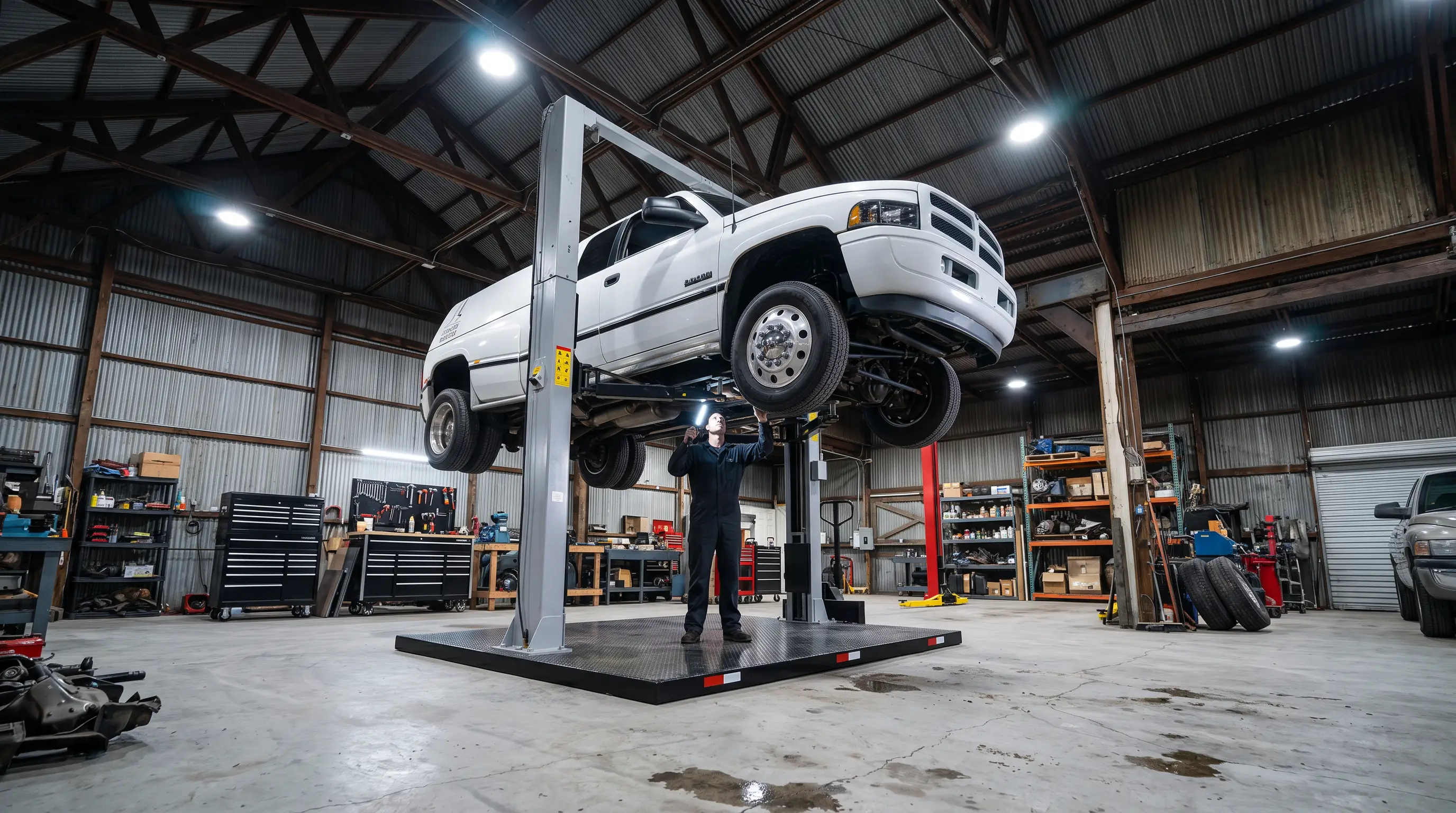
And here's the part that separates a Portable Car Hoist from those low-rise "portable" scissor lifts you've probably seen: the lift height. Most frame-style portable lifts max out at 18-24 inches. You're still kneeling or crawling. A Portable Car Hoist gives you 69 to 73.5 inches of clearance, the same standing height as a permanently installed shop lift.
That's real work: transmissions, exhaust systems, full suspension rebuilds, undercoating, brake jobs. All done standing up.
Lift capacity ranges from 8,000 lb on the Model A to 76,000 lb on the Model T, which is built for commercial vehicles and heavy fleets. Setup takes under 15 minutes—no concrete crew. No permits. No licensed electrician required for most models.
Most mechanics don't do this math until it's too late. Let's do it now.
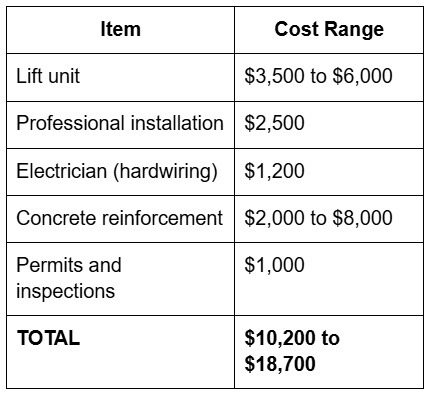
And it never moves again. If you leave that space, you leave that lift, or you pay to have it uninstalled and reinstalled, which adds another $3,000 to $5,000.
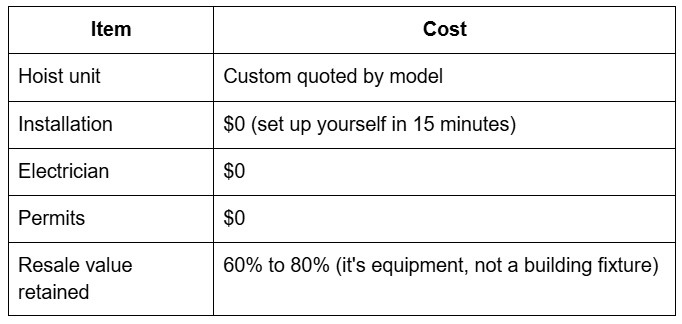
Most shops recoup the cost of the portable system in the first year, even before factoring in its mobility.
This is precisely why mechanics who operate on leased space are switching. Why would you spend $10,000 improving a floor you don't own?
A Portable Car Hoist makes practical sense for a specific kind of operator. You're probably a good fit if you:
Operate in a leased commercial space. You have no business spending $10K+ on permanent infrastructure inside a building you don't own. When your lease ends, that fixed lift is the landlord's problem, not your asset.
Have a post-tension slab, older concrete, or a floor that won't pass inspection. This is the most common situation. You didn't pick a bad floor on purpose. The building just doesn't cooperate with traditional installation requirements.
Work as a mobile mechanic. You need a professional-grade lift that travels with you to client locations. Low-profile scissor lifts don't cut it for real repair work. A portable hoist gives you shop-quality height at any address.
Run a shop that needs layout flexibility. Multiple bays, seasonal reorganization, or shared spaces where the layout changes. A portable hoist moves when you need it to, instead of locking you into a fixed configuration forever.
Maintain heavy trucks, semis, or commercial fleets. The Model T handles up to 76,000 lb. That's territory most fixed shop lifts can't touch.
Plan automotive events. Car shows, racing events, and automotive expos increasingly use portable hoists to display vehicles at eye level without any permanent floor modification at the venue.
Yes, when properly engineered. The Portable Car Hoist uses a wide-base design that distributes weight across a large surface area, making tipping physically impossible under normal operating conditions. Every unit is tested under full load before shipping and includes multiple redundant locking systems. The safety case isn't based on anchors. It's based on geometry and load distribution.
That's exactly why it was designed. No drilling, no anchors, no modification to the building. It installs on any level surface, including post-tension slabs, and leaves no permanent footprint. When you're done, the floor looks the same as when you started.
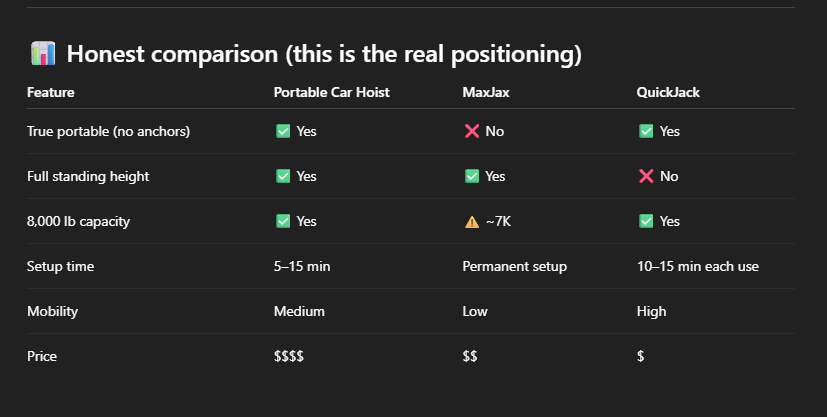
Most lifts marketed as "portable," like QuickJack or MaxJax, are low-rise frame systems. They lift your car 18 to 24 inches off the ground. You're still kneeling, crawling, or squeezing under. A Portable Car Hoist gives you 69 to 73.5 inches of height, full standing clearance, the same as a permanent shop lift. That's not a minor difference. It determines what kind of work you can actually do.
The surface needs to be level and stable. Severely uneven pavement, soft ground, or unstable surfaces are not appropriate. On any standard commercial floor, asphalt lot, or prepared surface, you're good to go.
Most models run on standard power, and some configurations are battery-powered. You do not need to hire an electrician or run dedicated circuits, which is a significant cost difference from traditional two-post installations.
A few things are happening in the industry right now that make this conversation more relevant than ever.
First, more mechanics are working independently. The Bureau of Labor Statistics reports continued growth in self-employed auto service technicians, a group that overwhelmingly works in leased or non-permanent shop spaces.
Second, commercial real estate lease terms are getting shorter and more complicated. Landlords in many markets are adding clauses that prohibit permanent structural modifications, which directly rule out traditional lift installation.
Third, mobile mechanics are growing fast. A 2023 report from IBISWorld noted that mobile auto repair services have grown at a compound annual rate of roughly 4.2% over the past five years, driven by convenience demand and reduced overhead compared to traditional shops.
Fourth, heavy commercial vehicle maintenance is booming. Fleet operators managing delivery trucks, utility vehicles, and semi-trailers are actively looking for lifting solutions that don't require specialized shop facilities, so technicians can service vehicles at depots and yards without full shop infrastructure.
All of these trends push toward the same solution: a car lift with no concrete floor required that works in the real world, not the idealized shop environment where every floor is perfect and every landlord says yes.
It's worth being honest about the alternatives so you can make a real decision.
Low-rise portable lifts (QuickJack, MaxJax, similar): Good for oil changes, tire swaps, and light underbody access. Not adequate for transmission work, suspension rebuilds, or anything requiring full standing access underneath. They also aren't designed for commercial or fleet-weight vehicles.
Four-post runway lifts: These don't require concrete anchors in the traditional sense, but they do require significant floor space, are not truly portable, and don't provide walk-under clearance for most repair work without a rolling bridge jack.
Traditional two-post lifts: Full working height, but concrete requirements remain the hard stop for a significant percentage of commercial spaces. No portability. High installation cost.
The Portable Car Hoist is the only category that combines full standing height, anchor-free installation, portability, and heavy-duty capacity (up to 76,000 lb) in one system.
If your floor won't support a traditional lift, you've already tried to make it work, or you've been burned by the true cost of installation before, the Portable Car Hoist is the professional-grade solution designed specifically for shops like yours.
You don't need perfect concrete. You don't need a building permit. You don't need to spend $10,000 on someone else's floor.
American-made. Set up in under 15 minutes. Full standing clearance. Capacity from 8,000 to 76,000 lb.
If you need a car lift no concrete floor required, that works like a permanent shop lift without any of the permanent commitments, this is it.
Get a custom quote today at portablecarhoist.com and find out which model fits your operation.
Related Reading: