


Jader Gil
Marketing Expert
August 15, 2026
9 min read
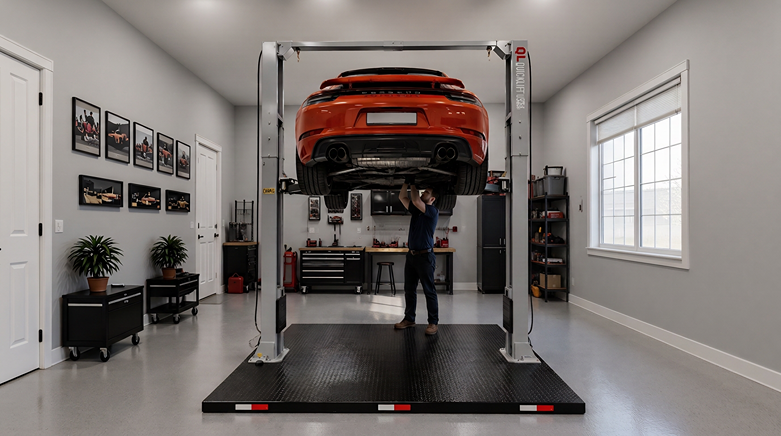
Yes — you can run a full-height hydraulic car lift in a home garage without bolting a single post to your floor. The trick is that the posts stand on their own steel trailer deck instead of your concrete, so there is zero drilling, zero anchoring, and zero permits. Our American-made portable two-post hoist sets up in about 15 minutes and lifts 8,000 to 76,000 lb, which means the vehicle you park in your garage tonight can be shoulder-high tomorrow morning without a contractor ever touching your slab.
I get the “without posts” search all the time, and I know exactly what people mean by it. They are not really against posts — they are against the idea of a permanent structure drilled into their garage, the epoxy anchors, the concrete inspection, and the giant “you can never move this” commitment. So let me show you the version of a home-garage lift that keeps the strength of a two-post design and throws out everything you were dreading.
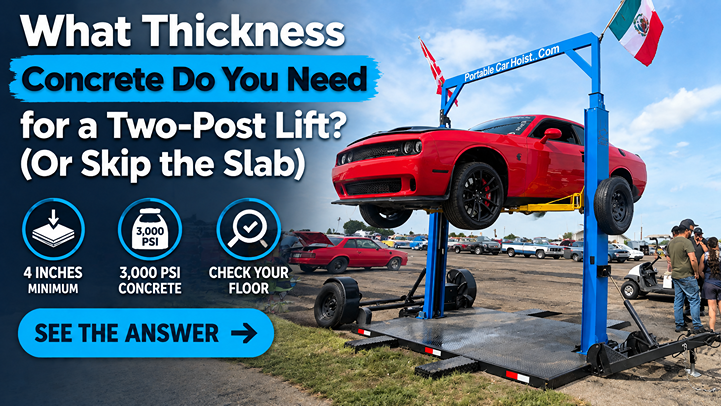
When folks type “hydraulic car lift for home garage without posts,” nine times out of ten they are picturing the traditional two-post lift you see at a dealership: two tall columns lag-bolted straight into 4 inches of reinforced concrete. That install is the part nobody wants. It ties the lift to one spot forever, it demands a specific slab thickness, and in a lot of neighborhoods it needs a permit.
Here is the reframe that changes everything: you do not need to get rid of the posts, you need to get rid of the anchors. A portable full-height hoist mounts both posts to a heavy black diamond-plate flatbed deck. The deck is the foundation. Your garage floor just holds the deck the same way it holds your car — by gravity. Nothing bites into the concrete. If you want to read the deeper mechanics, I broke it all down in how a portable car hoist works with no concrete and no bolts.
The whole system rests on one idea: a wide, engineered base spreads the load so you never have to fight it with anchor bolts. Let me walk through the two parts that make that safe.
A permanent two-post lift transfers all of its weight through two small footplates, which is exactly why it has to be bolted down — otherwise it would tip. Our portable design puts both columns on a single rigid steel deck, so the lifting forces stay inside the frame instead of trying to pull your floor apart. That is the engineering reason we can skip anchors entirely. It is the same principle that lets you set one up on a post-tension slab where drilling is flat-out forbidden, and it is why guys use them on rental-property floors they are not allowed to modify. If you have ever needed to lift a vehicle without floor anchors, this is the mechanism that makes it possible.
Lifting is handled by a hydraulic power unit driving the carriages up the columns. But hydraulics are only the motion — they are not what holds your car in the air. Once you reach working height, spring-loaded mechanical locks click into a ladder of steel safety positions, and the car rests on solid steel, not on oil pressure. Even if a hose failed, the locks are already carrying the weight. I put the full breakdown in our hydraulic portable car lift technology and maintenance guide, and if safety certification is your first question, start with are portable car lifts safe.
This is where most home buyers get nervous, so let me be concrete. There are really only three things to check before a portable full-height hoist works in your space.
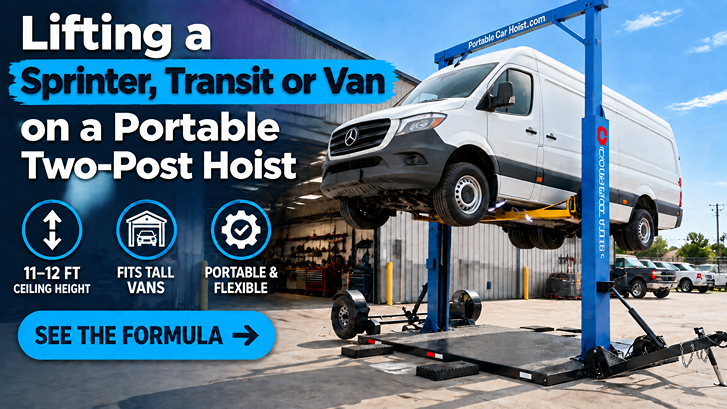
A full-height lift raises a car to standing height, so you want the tallest bay you have — most home garages with a 10 to 12 foot ceiling handle it comfortably. If your ceiling is genuinely low, that is a different conversation, and I would point you at the half car lift versus full-height hoist comparison before you buy anything.
You need a standard outlet the power unit can reach, a reasonably level concrete floor, and enough width to walk around the deck. That is it. No sub-panel, no 3-phase, no core samples of your slab. If you are working in a single bay, my space-saving car lifts for a tight one-car garage guide shows exactly how the footprint fits, and the home garage setup and safety guide covers the walk-around clearances.
Pro tip: Measure from your floor to the lowest object on your ceiling — a garage-door track, an opener rail, or a light fixture — not to the ceiling drywall. That single measurement decides whether you go full-height or step down to a mid-rise, and it is the number I ask every home buyer for first.
If you are shopping the “no drilling” category, you will run into three real choices, and they are not equal. A low-rise scissor or mid-rise lift gets the car up a few feet — handy for brakes and wheels, useless for standing under it. A QuickJack-style pair of frames is genuinely portable but tops out low and only lifts by the pinch welds. A full-height portable two-post gives you the dealership experience — walk fully upright under the car — with none of the concrete work. I laid the trade-offs out in the complete portable two-post buyers guide, and if a truly permanent shop lift is still on your list, compare it against the anchor-free portable hoist before you pour money into an install.
People assume “portable” means flimsy or fiddly. It is the opposite. Because the whole unit is engineered as one folding platform, getting it working is a short, repeatable routine rather than a construction project. Here is what a first setup actually looks like in a home garage.
You roll the deck into position and level it on your existing floor — no shimming into anchors, just checking that the concrete under the deck is flat. You raise and pin the two columns up from their travel position, connect the hydraulic power unit to a standard outlet, and run the carriages up and down once with no vehicle to confirm smooth travel and that the safety locks are clicking through their positions. Then you set the drive-on ramps, roll your car onto the deck, position the arms under the manufacturer lift points, and lift. That is the entire process, and after the first time it takes a fraction as long.
The reason this matters for a home garage is that the same folding design lets you tuck the lift out of the way — or move it to a friend’s place, a new house, or the driveway — instead of surrendering a bay forever. If you do not even have a garage to work in, the same unit works outside, which I covered in no garage, no problem: how to lift cars in your driveway safely.
This setup is not for everyone, and I would rather tell you that up front than sell you the wrong thing. It shines for a few very specific home situations. It is perfect for the renter or the homeowner with a newer slab who is not allowed — or not willing — to drill. It is ideal for anyone on a radiant-heated or post-tension floor where anchoring would ruin the slab. And it is the obvious answer for the enthusiast who knows they will move in a few years and refuses to leave a four-figure lift bolted to a house they are selling.
Who should think twice? If your ceiling is genuinely under about 10 feet, or if you truly never plan to move and want the absolute lowest-cost fixed column lift regardless of install hassle, a permanent unit might edge it out. For everyone in between — which is most home mechanics — the portable no-anchor route wins on flexibility, resale, and the simple fact that you are not modifying your house to work on your car.
Short answer: it is far safer than what most home mechanics are doing right now, which is crawling under a car balanced on a jack and a couple of stands. A portable full-height hoist puts the vehicle on steel columns with mechanical locks and a rated capacity that dwarfs anything a floor jack offers. If you want the honest, slightly scary version of why the old way fails, read why jack stands are dangerous. And because capacity matters as much as the lock system, size your lift with how to pick the right car hoist capacity so you never run it near its limit.
The number that surprises people is the total. Because there is no install crew, no concrete pour, and no permit, a portable hoist often lands cheaper all-in than a “cheap” fixed lift once you add up what the fixed one costs to actually put in. You are also not writing off the value the day you move — the lift rolls with you. Run your own numbers with the cost and ROI payback calculator, or get the full range in the portable car lift cost and pricing guide.
If you have been holding off on a home lift because you did not want to drill your floor, take a hard look at your slab, apply for a permit for nothing, and pour concrete — you have been solving the wrong problem. The posts were never the issue. The anchors were. And you can skip those entirely.
Tell me your ceiling height and the heaviest vehicle you plan to lift, and I will spec the exact model that drops into your garage this week. Book a Free Quote and let us get your car off the ground the smart way.
Yes. A portable full-height two-post hoist mounts both columns to a steel trailer deck, so the deck carries the lifting forces instead of your floor. There are no anchor bolts, no drilling, and no concrete work — you just need a level floor, a standard outlet, and enough ceiling height. It sets up in about 15 minutes.
Usually not. Most people searching that phrase want to avoid columns bolted permanently into their concrete, not the columns themselves. A portable two-post lift keeps the strength and full standing height of a two-post design while eliminating the anchors — the posts stand on the deck, and nothing attaches to your slab.
Most home garages with a 10 to 12 foot ceiling work well for a full-height lift. Measure to the lowest object on your ceiling — the garage-door track, opener rail, or a light — not the drywall. If your ceiling is too low, a mid-rise or half lift is the better fit.
It is dramatically safer than a floor jack and stands. The vehicle rests on steel columns held by spring-loaded mechanical safety locks, not on hydraulic pressure, and the rated capacity ranges from 8,000 to 76,000 lb. Set it on level concrete, engage the locks at working height, and you can stand fully upright underneath.