


Jader Gil
Marketing Expert
July 18, 2026
9 min read
Yes, you can fit a real, full-height car lift inside a tight one-car garage—you just have to pick the right one. The average single-car garage in the U.S. measures roughly 12 by 22 feet, and a surprising number of lifts are engineered to work in exactly that footprint. In fact, a portable two-post hoist needs about 10 feet of ceiling and zero permanent floor anchors, which means you can raise a car to standing height in a space most people write off as "too small."
I've spent years helping home mechanics and weekend restorers squeeze a lift into garages that looked hopeless on paper. The trick isn't a bigger building — it's choosing a lift whose design respects the three dimensions you actually have: width, length, and ceiling height. Below are the seven space-saving car lifts I recommend most, ranked by how well they solve the tight-garage problem, plus exactly what to measure before you buy.
Every "will it fit?" question comes down to three numbers. Grab a tape measure and write these down before you look at a single product page.
This is the deal-breaker. A full-rise two-post lift needs roughly 10–11 feet of clearance to get a car fully overhead. Most attached garages run 8 to 9 feet, which rules out permanent full-rise columns but leaves the door wide open for mid-rise, scissor, and portable full-height options that are built for lower ceilings.
Two-post lifts need room for the columns plus door swing on both sides of the vehicle. In a 12-foot-wide bay, you want a lift with a narrow column spread so you can still open the car doors. Single-post and scissor lifts sidestep this problem entirely because there's nothing beside the car.
Permanent lifts demand 4 inches of properly cured concrete and bolt anchors. If your slab is thin, cracked, post-tension, or you're renting, that's a wall — unless you go with a portable unit that carries its own base and needs no anchoring at all. I break down that exact scenario in my guide on how to lift vehicles without floor anchors.
Pro tip: Measure your ceiling at the lowest obstruction — a garage door track, a light fixture, or an HVAC duct — not at the peak. That lowest point is your real ceiling height, and it's usually 6 to 10 inches less than people assume.
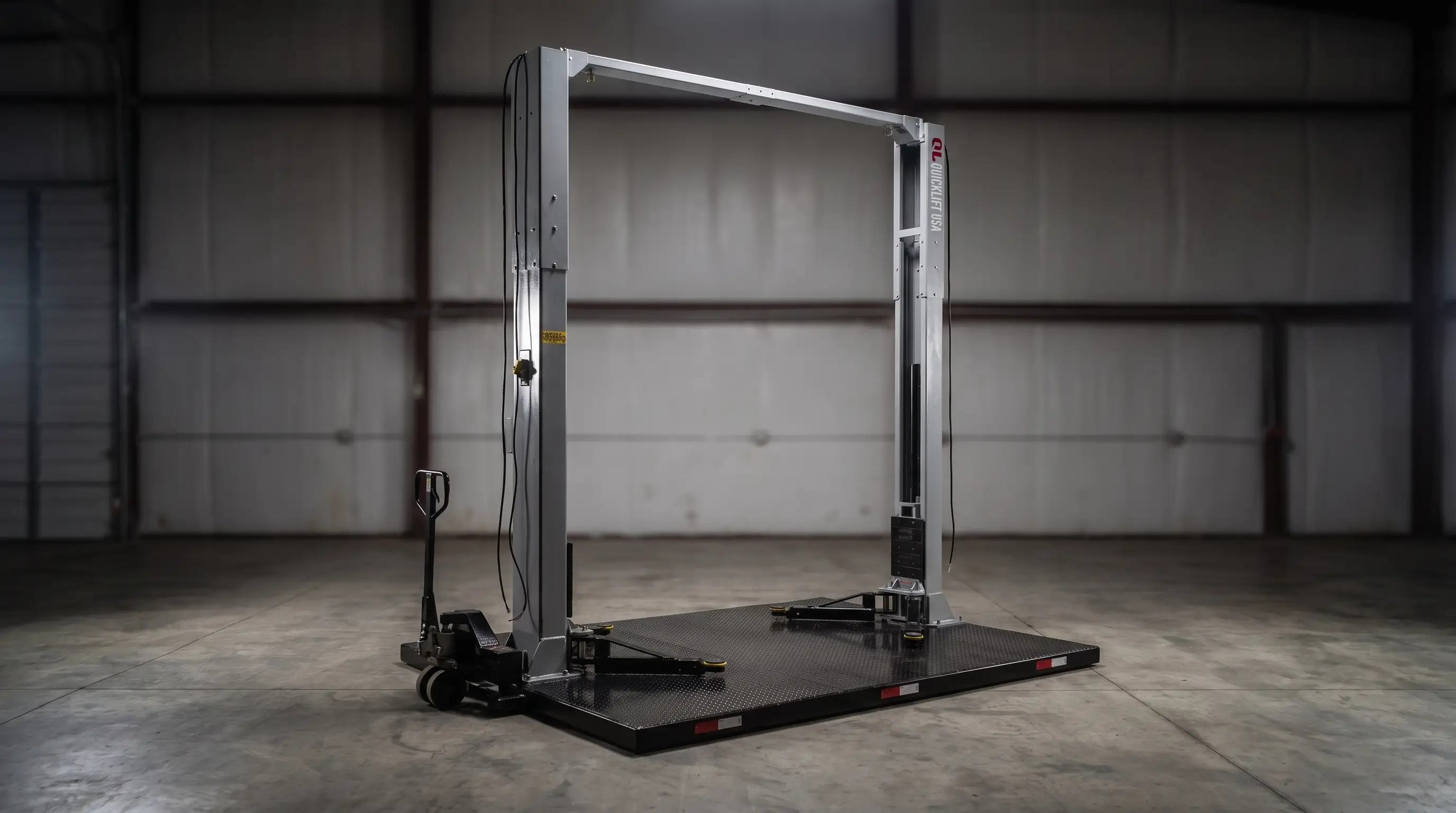
This is the one I keep coming back to, because it's the only design that gives you true standing-height access without pouring concrete or drilling anchors. The columns mount to their own trailer-style flatbed deck, so the lift is a self-contained unit — no bolts, no permits, and about a 15-minute setup. It handles 8,000 pounds on the base model and can be repositioned or rolled out of the way when you need the floor back. For a tight garage where you can't (or won't) commit to permanent hardware, nothing else comes close. See how it stacks up against a bolted unit in my portable car hoist vs. two-post car lift comparison.
A low-rise scissor lift sits flat on the floor and raises a car 24 to 36 inches — enough for brakes, tires, and exhaust work while you sit on a stool. It stores flat against a wall and takes almost no vertical space, which makes it a favorite for 8-foot ceilings. The trade-off is you never get to stand fully upright under the car, so it's a comfort compromise, not a replacement for a full-height hoist.
Step up to a mid-rise, and you get 48 inches of lift—high enough to work sitting on a taller stool or to reach most of the underbody. It's still self-contained and needs no overhead clearance, so it slides into low garages easily. Great for suspension and driveline jobs; still not standing height.
A single asymmetric post means zero columns on the passenger side, so you keep full door access and a genuinely narrow footprint. These are lighter-duty and better suited to smaller cars, but for a compact garage that only ever sees one sedan or hatchback, the space savings are real.
If your priority is parking two cars in one bay as much as it is service, a compact four-post drive-on lift is worth a look. It rolls on casters, needs no anchoring, and doubles your parking. It's wider than a two-post, so measure carefully — but for storage-first garages, it's unbeatable. I compare the geometry in a portable 4-post vs. 2-post lift.
These twin-frame lifts slide under the car and raise it about 21 inches, then store on edge against a wall in inches of space. They're the most portable option here and perfect for oil changes and wheel work, but the low height and per-frame weight limits make them a supplement, not a main lift. Here's my honest take on QuickJack vs. portable car hoists.
If you do have 10-plus feet of ceiling and a solid slab, an asymmetric two-post with a tight column spread is the classic space-saver. The columns rotate the car slightly so doors clear the posts. It's permanent and anchored, so it's only for owned garages with the right concrete, but it delivers full standing height at the lowest cost per lift. My complete two-post buyer's guide for 2026 walks through the specs.
Here's how I sort it in plain terms. If your ceiling is under 9 feet and you mostly do brakes, tires, and fluids, a low- or mid-rise scissor lift is the easy answer. If you want to actually stand under the car — the real reason most people buy a lift—and you can't or won't drill into your floor, the portable full-height two-post hoist is the pick, full stop. If parking is half your motivation, look at the four-post. And if you own the space and have tall ceilings with good concrete, the anchored asymmetric two-post is the budget champion.
The mistake I see most often is people forcing a permanent lift into a garage that can't safely hold anchors, then propping the car on questionable supports in the meantime. Don't do that — it's exactly the kind of setup I warn about in why jack stands are dangerous. A portable hoist removes that risk because it's engineered as one certified system.
The lift is only half the equation—how you arrange the room around it decides whether the space actually works. A few habits have saved my clients more square footage than any single product ever did.
First, go vertical with everything that isn't the lift. Wall-mounted cabinets, pegboards, and an overhead rack for seasonal gear clear the floor so the car and the lift own the ground. Second, put your lift on casters or pick a portable model you can reposition; being able to roll the hoist a few feet changes the whole geometry of the bay when you need to open a hood against the back wall. Third, plan your door swing before you plan anything else — mark the arc of both car doors in chalk and keep that zone clear, because a lift that blocks the driver's door turns every job into a contortion act.
I also tell people to think about the ceiling as workspace, not just clearance. Once a car is raised, the area beside it at standing height becomes usable for a rolling tool cart that tucks under the vehicle. And if your garage doubles as storage, a portable hoist you can break down and stand against the wall gives you the bay back on days you're not wrenching — a flexibility permanent lifts simply can't match.
Budgets range widely. Ultra-low-rise frame lifts start a few hundred dollars, scissor lifts land in the low thousands, and a full-height portable two-post hoist is a larger investment that pays for itself the first time you skip a shop visit for a brake or clutch job. Because the portable unit needs no concrete work, no permits, and no installer, the all-in cost is often lower than a "cheaper" permanent lift once you add the slab and installation. I break the numbers down in my portable car lift cost and pricing guide, and if your garage is truly unworkable, my piece on lifting cars safely in your driveway covers the outdoor option.
One more thing worth saying: a compact commercial shop faces the same math a home garage does, just at a bigger scale. If you're outfitting a small business bay, my notes on compact car lifts for small commercial shops and the home garage setup and safety guide both apply.
You don't need a bigger building — you need the right lift. Our American-made portable car hoist fits tight one-car garages, sets up in about 15 minutes, needs zero concrete anchors, and raises vehicles to full standing height. Tell us your ceiling height and vehicle, and we'll confirm the exact fit for your space. Book a free quote today and turn that cramped bay into a real workspace.
For a full-rise two-post lift, you generally want 10 to 11 feet of clearance to raise a car fully overhead. If your ceiling is 8 to 9 feet — typical for an attached garage — a mid-rise or low-rise scissor lift works, or a portable full-height hoist designed for lower ceilings. Always measure at the lowest obstruction, like the garage door track, not the peak.
Yes. A portable two-post hoist mounts to its own flatbed base, so it needs no floor anchors, no permits, and no permanent installation. That makes it ideal for thin slabs, post-tension floors, or rented spaces where drilling isn't an option. It sets up in about 15 minutes and can be repositioned whenever you need the floor back.
Often, yes — if you choose a lift with a narrow column spread or an asymmetric design that lets the car doors clear the posts. In very tight bays, a single-post or scissor lift removes the width problem entirely because there are no columns beside the vehicle. Measure your usable width and leave room for door swing on both sides.
For most home mechanics who want to stand fully upright under the car without pouring concrete, a portable full-height two-post hoist is the best all-around pick. If you mainly do brakes, tires, and fluids and have a low ceiling, a mid-rise scissor lift is a smaller, lower-cost alternative.
Portable Car Lift for Home Garage: Setup & Safety Guide
Portable Car Hoist vs. Two-Post Car Lift