

November 4, 2026
9 min read
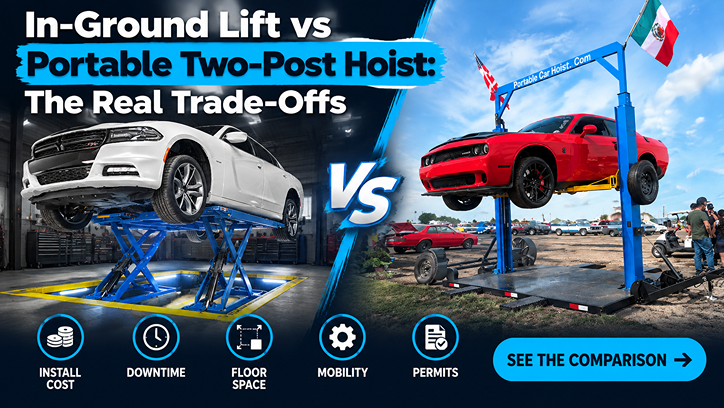
If you are weighing an in-ground lift against a portable two-post hoist for your shop, here is the short version: an in-ground lift is a permanent building project — you cut the slab, excavate a pit, set a cassette, pour concrete, wait for inspection, and lose days of bay time — while a portable two-post hoist rolls in on its own trailer deck and is lifting cars in about 15 minutes, with zero concrete, zero anchors, and no permit. Both are real two-post-class lifts that put a vehicle at full standing height. The difference is everything that happens before, under, and around the lift. Our portable hoists run from 8,000 all the way to 76,000 pounds, so capacity is usually a wash — the trade-offs are about install, floor space, mobility, and what you are even allowed to build into your bay.
I have had this conversation with a lot of shop owners, mobile techs, and serious collectors, and almost every one of them starts out assuming an in-ground lift is the “real” professional choice and a portable hoist is the compromise. By the end they usually see it the other way around. Let me walk you through the real trade-offs the same way I would if you called us.
An in-ground lift hides its lifting mechanism below the shop floor. When the arms are down, the bay looks almost empty — that clean, open look is the whole reason in-ground lifts exist. There are two broad styles: the older single- or dual-cylinder hydraulic design that drives a piston straight down into the earth, and the newer frame-contact “cassette” systems that sit in a sealed box set into the slab.
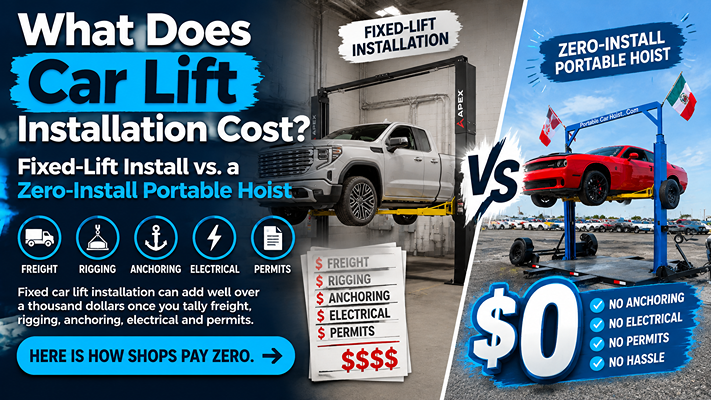
That buried mechanism is also the catch. To install one, a contractor cuts into your concrete, excavates a pit, sets and levels the cassette or cylinders, pours new concrete around it, and runs the power unit and plumbing. On a leased slab you often need the landlord’s written blessing and sometimes an engineer to sign off that the floor can take it. If you want the full breakdown of what a buried or bolted install runs, I covered that in our car lift installation cost guide.
Here is what shop owners underestimate: the lift is the easy part. It is the excavation, the fresh concrete cure time, the electrical, the inspection, and the days your bay is torn up and earning nothing that add up. A fixed two-post or four-post lift at least bolts to the surface; an in-ground lift goes into the surface, so the build-out is bigger than almost any other lift type. We break down the whole lineup — two-post, four-post, scissor, in-ground, mobile column, and portable — in our types of car lifts explained overview if you want to see where each one fits.
And once it is in, it is in. An in-ground lift is married to that building. If you move shops, lose the lease, or want to re-arrange your floor, you cannot take it with you — it stays with the concrete.
There is a long-tail cost to an in-ground lift that rarely makes it into the first quote. The lifting mechanism lives under your floor, so the day it needs a seal, a cylinder, or a leak repair, the service turns into an excavation project all over again. Older in-ground hydraulic designs also raised real environmental questions — a cylinder driven into the earth can leak fluid into the ground, which is exactly why modern systems moved to sealed cassettes and containment. None of that makes an in-ground lift a bad machine; it just means the maintenance picture is heavier and harder to predict than it looks on day one. A portable hoist keeps its power unit and cylinders above the floor, where you can see them, reach them, and service them in minutes instead of digging to find the problem.
A portable two-post hoist gives you the same full-height, open-center access as a shop two-post lift — you can walk under the car, pull wheels, drop an exhaust, and stand up straight — but it carries its own foundation with it. Instead of bolting into your slab, the two posts mount on a heavy black diamond-plate trailer deck. The deck is the anchor, so the lift never touches your concrete and never needs it. If you are curious about the mechanics of how that holds a car safely without floor bolts, I wrote a full explainer on how a portable car hoist works.
Because the hoist stands on its own deck, there is nothing to excavate and nothing to bolt down. You roll it into position, level it, run the power unit, and you are lifting — about 15 minutes once you have done it a couple of times. No slab spec to meet, no pit to dig, no electrician hard-wiring a 220V circuit. That matters more than people expect, because a fixed lift usually forces a conversation about how thick your concrete needs to be and whether your bay can even pass it. A portable unit skips that spec entirely — our whole anchor-free, no-concrete hoist approach was built around exactly that problem.
Pro tip: before you commit to any lift, measure your ceiling, not just your floor. A full-height two-post hoist needs real overhead clearance to raise a vehicle to standing height. I put the actual measuring method in our guide to ceiling height for a two-post car lift — it is the one spec that quietly kills more lift purchases than concrete ever does.
When you line them up honestly, the two lifts win on different things. Let me break it down by what actually drives a buying decision.
This is the one area where an in-ground lift has a genuine edge. With the arms retracted, the bay floor is completely clear — great for a showroom-clean detail bay or a tight footprint where you want the space back between jobs. A portable hoist keeps its trailer deck on the floor, so the footprint is always there. For most working shops that is a non-issue, but if a spotless open floor is your top priority, weigh it honestly. On the access side they are even: both give you open-center, drive-through, full-standing-height service, unlike a center-post or scissor-style lift that blocks the middle of the car.
Capacity is where buyers expect the biggest gap, and it mostly is not one. Our portable hoists span 8,000 to 76,000 pounds, which covers everything from a Miata to a loaded dually to heavy equipment — if you are not sure where your fleet lands, our guide to picking the right hoist capacity walks through it. Where the two differ is flexibility: a fixed in-ground lift is set in place for the vehicle mix it was specced for, while a portable two-post gives you the same symmetric and asymmetric arm options on a deck you can reposition for the next job. For a shop whose vehicle mix changes week to week, that adaptability is worth real money.
This is where portable pulls ahead for most buyers. An in-ground lift’s sticker price is only the start — add excavation, concrete, electrical, inspection, and lost bay days. A portable hoist’s install cost is effectively zero, and your downtime is the 15 minutes it takes to set it up. On permits, a buried or bolted lift usually triggers a building permit and inspection because you are altering the structure; a freestanding portable unit is equipment, not construction, so in most places it does not. I dug into that whole question in do you need a permit or inspection to add a car lift to your shop. If you are running the numbers, our cost and ROI payback breakdown shows how fast the install savings alone pay for the unit.
An in-ground lift is permanent — it stays with the building, which is a problem if you lease your bay or ever plan to move. A portable hoist travels with your business. You can reposition it, move it to a second location, tow it to a job, or take it with you when a lease ends. That is a big deal for independent shops and mobile operations, and it is a large part of why shop owners are switching from fixed lifts to portable hoists. Being able to reconfigure your shop floor without touching concrete is something no in-ground lift can ever offer. It also helps the resale story — a machine you can relocate holds its value better than concrete you walk away from.
Here is how I frame it. Buy an in-ground lift if you own your building, you are certain you will never move, an absolutely clear floor between jobs is your single highest priority, and you have the budget and the downtime for a full build-out. For a permanent flagship bay in a building you own, it can be the right call.
For almost everyone else — independent and multi-bay shops, leased commercial bays, mobile mechanics, dealerships and fleets, detailers, and serious collectors — a portable two-post hoist is the smarter buy. You get the same full-height, open-center service without the excavation, the concrete, the permit, the electrician, or the downtime, and you keep the freedom to move it. If you are still deciding between lift types rather than install methods, our two-post vs four-post comparison and the complete portable two-post buyer’s guide are the next two things worth reading. And if safety is driving your decision, which it should be, see how our lifts handle it in are portable car lifts safe.
Let me make it concrete. Say you run a three-bay independent shop on a five-year lease, and your work swings from daily-driver brake jobs to the occasional lifted truck. An in-ground lift would mean asking your landlord to let you cut their floor, carrying the excavation and permit cost on a building you do not own, and leaving the lift behind if you ever relocate. A portable two-post hoist drops into any of those three bays, sets up the same morning it arrives, moves when your floor plan or your address changes, and still handles the truck. For that shop — which is most shops I talk to — it is not a close call.
The same logic holds for a serious collector building out a private shop. A portable hoist lets you service and store cars at full height, reconfigure the space as the collection grows, and avoid turning your floor into a permanent construction project — while keeping the equity in a machine you can move or resell later instead of concrete you would walk away from.
We build these in Menifee, California, and ship nationwide, in capacities from 8,000 to 76,000 pounds. If you tell us the heaviest thing you need to lift and the bay you are working with, we will point you to the right model — no pit required. Book a Free Quote and we will help you spec it out.
Neither style is safer by default — safety comes from load rating, mechanical locks, and lifting on the factory lift points, not from whether the mechanism is buried. A quality portable two-post hoist uses the same mechanical safety locks and lift-point geometry as a fixed lift. Always match the lift’s rated capacity to the vehicle and settle the car onto its locks before you go underneath.
Yes. A full-height portable two-post hoist gives you the same open-center, standing-height access an in-ground lift does, in capacities from 8,000 to 76,000 pounds. The main thing an in-ground lift offers that a portable does not is a completely clear floor when the arms are down. For nearly every other working priority — cost, downtime, mobility, leasing — the portable comes out ahead.
An in-ground lift’s install is a real build-out — excavation, fresh concrete, electrical, and inspection on top of the lift price — and costs vary widely by region, floor, and installer. A portable hoist’s install cost is effectively zero because it sets up on its own trailer deck in about 15 minutes. See our installation cost breakdown for the full picture.
A buried or bolted-down lift usually triggers a building permit and inspection because you are altering the structure and often the electrical. A freestanding portable hoist is treated as equipment rather than construction, so in most jurisdictions it does not require a permit — but always confirm with your local building department and, if you lease, your landlord.
2-Post vs 4-Post Car Lift: Which Fits a Professional Shop?
Scissor Lift vs Portable Two-Post Hoist: Which Fits a Pro Shop?
What Does Car Lift Installation Cost? Fixed-Lift Install vs. a Zero-Install Portable Hoist
Types of Car Lifts Explained: Two-Post, Four-Post, Scissor & Portable