

November 11, 2026
9 min read
If you are wondering whether OSHA and your shop insurance will cover a portable car lift the same way they cover a bolted-down one, here is the short answer: yes, in virtually every case — because neither OSHA nor your insurer actually cares whether the lift is portable or permanent. What they care about is whether the lift is rated for the load, kept in good repair, inspected on schedule, and run by trained people using the mechanical safety locks. In fact, there is no OSHA standard written specifically for automotive lifts at all; OSHA enforces lift safety through its General Duty Clause and the recognized industry consensus standard, which calls for a qualified inspection of any vehicle lift at least once a year. Meet those conditions and a portable two-post hoist sits on exactly the same footing as a fixed lift — sometimes a better one.
I hear this worry a lot from shop owners and fleet managers who are otherwise sold on a portable hoist. They assume “portable” is a red flag to an OSHA inspector or a claims adjuster. It is not. Let me walk you through how OSHA and insurers really look at a lift, what actually protects your coverage, and where a portable hoist stands on each point — the same way I would if you called us.
The first thing to understand is that OSHA does not certify, approve, or register individual car lifts, and it does not publish a rule that says “a lift must be bolted to the floor.” There is no automotive-lift-specific OSHA standard. Instead, OSHA holds every employer to its General Duty Clause — the requirement to provide a workplace free of recognized hazards — and it leans on the published consensus standards from the Automotive Lift Institute (ALI) to define what “safe” looks like for vehicle lifts.
In practice, that means an OSHA inspector who walks into your bay is not checking whether your lift is in-ground, surface-mounted, or portable. They are checking whether it is being used safely: Is it rated for the vehicle on it? Are the mechanical safety locks engaged? Are your people trained to position the arms on the factory lift points? Is there a legible load-capacity label? Has the lift been inspected and maintained? Those questions apply identically to a buried in-ground lift and to a portable two-post hoist on a trailer deck.
The relevant consensus standards come from ALI. One governs how a lift is built and tested; another — the operation, inspection, and maintenance standard — governs how it is run once it is in your shop, and it is the one that calls for a periodic inspection by a qualified lift inspector at least annually. A third covers safety signage and labeling. Lifts that pass independent third-party testing carry the ALI Gold Label, which is the cleanest way to show an inspector or an insurer that the equipment meets the recognized standard.
If certification and locking systems are the piece you are most worried about, that is the right instinct — it is the thing that actually decides whether a lift is safe. I wrote a full breakdown of it in are portable car lifts safe, including how the mechanical locks hold a vehicle independent of hydraulics. The headline for this article: a quality portable hoist is engineered to the same safety expectations as a fixed lift, so ask any manufacturer — us included — about certification and the locking system before you buy, and keep that documentation on file.
Here is the part shop owners sometimes miss: most lift-related OSHA citations are not about the hardware, they are about how the hardware is used. Untrained operators, arms set on the wrong point, a vehicle that outweighs the lift’s rating, skipping the safety locks — those are the recognized hazards that get a shop written up, and they are the same mistakes that cause real injuries. I laid out the worst offenders in car lifting safety mistakes, and if your team still reaches for the old method on quick jobs, it is worth reminding them why jack stands are dangerous. A portable hoist does not change any of this — train your people, use the locks, respect the capacity, and you are doing what OSHA expects.
Now the insurance side, which is where most of the anxiety actually lives. Your shop is almost certainly carrying some mix of commercial general liability, commercial property, and workers’ compensation coverage. None of those policies typically single out “portable” versus “fixed” equipment. What an underwriter and, later, a claims adjuster look at is whether the equipment was appropriate, maintained, and used correctly when something went wrong.
Think about how a claim actually plays out. If a car comes off a lift and someone is hurt, the adjuster asks: Was the lift rated for that vehicle? Was it inspected and maintained? Were the safety locks set? Was the operator trained? If the answers are yes, your coverage does its job whether the lift was bolted down or rolled in on a deck. If the answers are no — an overloaded, uninspected lift run by an untrained tech — that is where claims get contested and premiums climb, and again, that is true for any lift type.
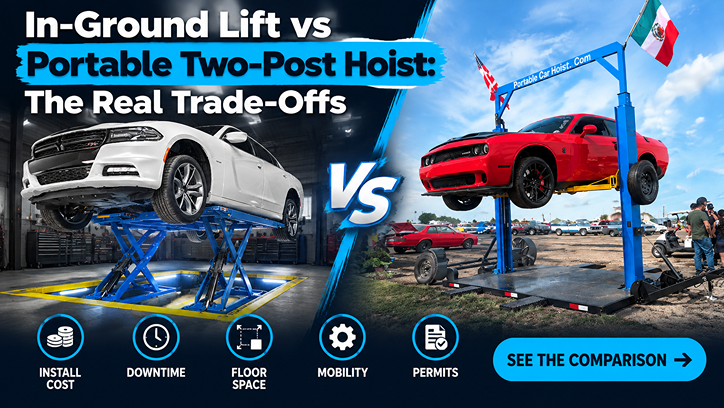
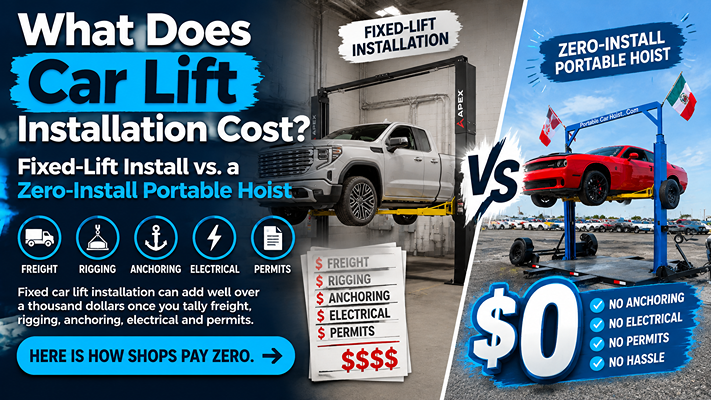
A portable hoist is insured like any other piece of business equipment — it is covered property, and the liability it creates is covered liability, subject to the same rules as everything else in your bay. But being movable quietly works in your favor in a couple of ways. Because it is not permanently attached to the building, it travels with your business, so the equipment you insured does not get stranded when a lease ends or you relocate — it is still your covered asset at the new address. And because a portable unit needs no structural alteration to your building, you avoid the separate permitting and building-inspection exposure that a bolted or buried lift can create. I went deep on that in do you need a permit or inspection to add a car lift to your shop.
Pro tip: before your next renewal, send your agent three things for each lift — the capacity rating, the certification or Gold Label documentation, and your most recent inspection record. Underwriters price the unknown as risk. Handing them proof that your equipment is rated, certified, and inspected is the single easiest way to keep a lift from becoming a question mark on your policy, and it takes about ten minutes.
If there is one theme that ties OSHA and insurance together, it is documentation. The shop that keeps a capacity label on every lift, a training sign-off for every operator, and a dated annual inspection report is the shop that sails through an OSHA walk-through and never has a coverage fight. The shop that cannot produce any of that is exposed no matter how expensive its lifts were. A portable hoist makes this easier, not harder, because the whole machine — power unit, cylinders, locks, labels — is above the floor where you can see it, inspect it, and photograph it, instead of buried under concrete.
A big share of lift incidents — and the coverage disputes that follow — come down to one thing: the vehicle outweighed the lift, or sat on it wrong. This is where spec’ing the right machine up front is itself a safety and insurance decision, not just a purchasing one.
Our portable hoists run from 8,000 all the way to 76,000 pounds, which covers everything from a Miata to a loaded dually to heavy equipment. The reason that range matters for OSHA and insurance is simple: a lift used within its rated capacity is being used as designed, and a lift that is overloaded is a recognized hazard on its face. If you are not certain where your vehicle mix lands, our guide to picking the right hoist capacity walks through it. Buying enough capacity for the heaviest thing you service is one of the cleanest ways to stay on the right side of both.
The other half is where the arms meet the car. Setting the pads on the manufacturer’s factory lift points, with the arm restraints engaged, is what keeps a vehicle stable — and getting it wrong is exactly the kind of operator error that generates both injuries and denied claims. A portable two-post hoist gives you the same symmetric and asymmetric arm options as a fixed shop lift, so your techs use the same correct technique they already know. If you want to see how the whole machine carries and locks a load without floor anchors, I explained it in how a portable car hoist works.
Yes — with the same conditions that apply to any lift. Buy a hoist that is rated for your heaviest vehicle and certified to the recognized standard. Train every operator to use the factory lift points and settle the car onto the mechanical locks before going underneath. Keep it inspected at least once a year by a qualified inspector, and hold onto the paperwork. Do those things and an OSHA inspector has nothing to cite and your insurer has nothing to question — the fact that the lift is portable simply does not enter into it.
Let me make it concrete. Picture a leased three-bay shop that adds a portable two-post hoist. The owner keeps the capacity label visible, has the techs sign a short training sheet, and schedules an annual inspection the same week every year. When their GL carrier renews, they attach the certification and the latest inspection report. When OSHA eventually stops by, the inspector sees rated equipment, engaged locks, trained operators, and current records, and moves on. The portable hoist was never the issue — the documentation and the habits were what mattered, and this shop has both. That is the entire playbook, and it is why so many owners are comfortable switching from fixed lifts to a portable hoist without losing a minute of sleep over compliance.
If you are building out a bay and want to get this right from the start, our best portable car lift for a small auto shop guide and the complete portable two-post buyer’s guide cover capacity, setup, and safety in one place. None of it requires cutting your floor, pulling a building permit, or hiring an electrician.
We build these in Menifee, California, and ship nationwide, in capacities from 8,000 to 76,000 pounds, engineered around the safety locks and lift-point geometry that keep you compliant and covered. Tell us the heaviest vehicle you service and the bay you are working in, and we will point you to the right model and send over the certification and specs your inspector and your insurer will want to see. Book a Free Quote and we will help you spec it out.
No. There is no OSHA standard that requires a vehicle lift to be anchored, and OSHA does not certify individual lifts. OSHA enforces lift safety through its General Duty Clause and the recognized ALI consensus standards, which focus on load rating, condition, inspection, safety locks, and operator training — not on whether the lift is fixed or portable. A properly used portable two-post hoist meets the same expectations as a bolted-down lift.
In almost every case, yes. A portable hoist is insured like any other piece of business equipment and the liability it creates falls under your existing commercial coverage. Carriers do not typically distinguish portable from fixed; they look at whether the lift was rated for the load, maintained, inspected, and used correctly. Keep your capacity rating, certification, and inspection records on file, and tell your agent about the equipment so it is properly reflected on your policy.
The recognized industry standard for vehicle lift operation, inspection, and maintenance calls for a periodic inspection by a qualified lift inspector at least once a year, along with routine daily and monthly checks by your own staff. Annual inspection is also what most insurers and OSHA inspectors expect to see documented. A portable hoist is easier to inspect because the entire mechanism sits above the floor.
Certification depends on the specific lift, so always ask the manufacturer directly and request the documentation. Lifts that pass independent third-party testing to the ALI standard carry the ALI Gold Label. When you are evaluating any hoist — portable or fixed — ask about its certification and its mechanical locking system, and keep that paperwork with your shop records for OSHA and insurance purposes.
Are Portable Car Lifts Safe? ALI Certification & Locking Systems
Do You Need a Permit or Inspection to Add a Car Lift to Your Shop?
Car Lifting Safety Mistakes That Put Mechanics in the Hospital