



Jader Gil
Marketing Expert
December 16, 2025
9 min read
You can observe mechanics working quickly under cars that are lifted high on typical two-post lifts at any professional auto shop. The scene appears like it will go on forever, is professional, and costs a lot of money, which it generally does. But more and more people in the automobile industry are finding that they can get the same results without the concrete anchors, installation crews, or long-term commitment. What is the secret? Modern portable car lift systems offer professional-level features with more versatility than ever before.
In the last ten years, the automobile lifting sector has quietly changed a lot. What started off as simple movable platforms has turned into complex portable vehicle hoist systems that can lift as much, be as safe, and work as well as their fixed counterparts. Today's professional-grade portable lifts can lift everything from little sedans to three-quarter-ton pickups. They are also quite portable, which makes them very useful for current car firms.
This change is important since getting a professional lift system has always been too hard to do in the past. The usual method needs a lot of concrete construction, professional installation, electrical changes, and often permits. This makes it too expensive for small businesses and DIYers, and it locks bigger establishments into permanent floor plans. Portable vehicle lifts get rid of these problems, making professional-grade lifting available to a far larger group of people.
Many people don't know that the phrase "portable car lift" (also known as "portable vehicle hoist" or "automotive portable lift") covers a wider range of tools than they think. A portable car lift is a way to elevate a car for maintenance or repair without having to install it permanently. These elevators are easy to move and store, so they are great for tiny shops or home garages with limited space. They can lift and lower cars from 47 inches to 8 feet using hydraulic systems, and many variants may be stored against a wall when not in use.
A real portable car hoist can be relocated, stored, or transported without needing to be taken apart by a professional or making permanent changes to your workstation. This portability is possible because of new engineering that spreads weight in a way that doesn't require concrete anchors. This model keeps safety standards set by groups like the Automotive Lift Institute (ALI) and OSHA workplace safety rules.
Like their fixed counterparts, full-height portable lifts usually work with hydraulic systems. The base design is the most important change. Deep concrete anchors that withstand the overturning moment caused by raising a vehicle give traditional two-post lifts stability. Portable systems use broader bases, lower centers of gravity, and advanced weight distribution engineering to attain the same level of stability. The result is a lift that is stable while it is in use but can be rolled away when it is not.
Low-rise options are another type of portable lifting. Brands like QuickJack made these systems popular. They only elevate cars 18 to 24 inches off the ground, which is enough for simple maintenance like oil changes and brake work, but not enough for full access to the undercarriage or transmission work. These have a place in the market, but they are not the same as professional-height portable lifts.
Comparison: Portable vs Fixed vs Low-Rise Lifting Systems
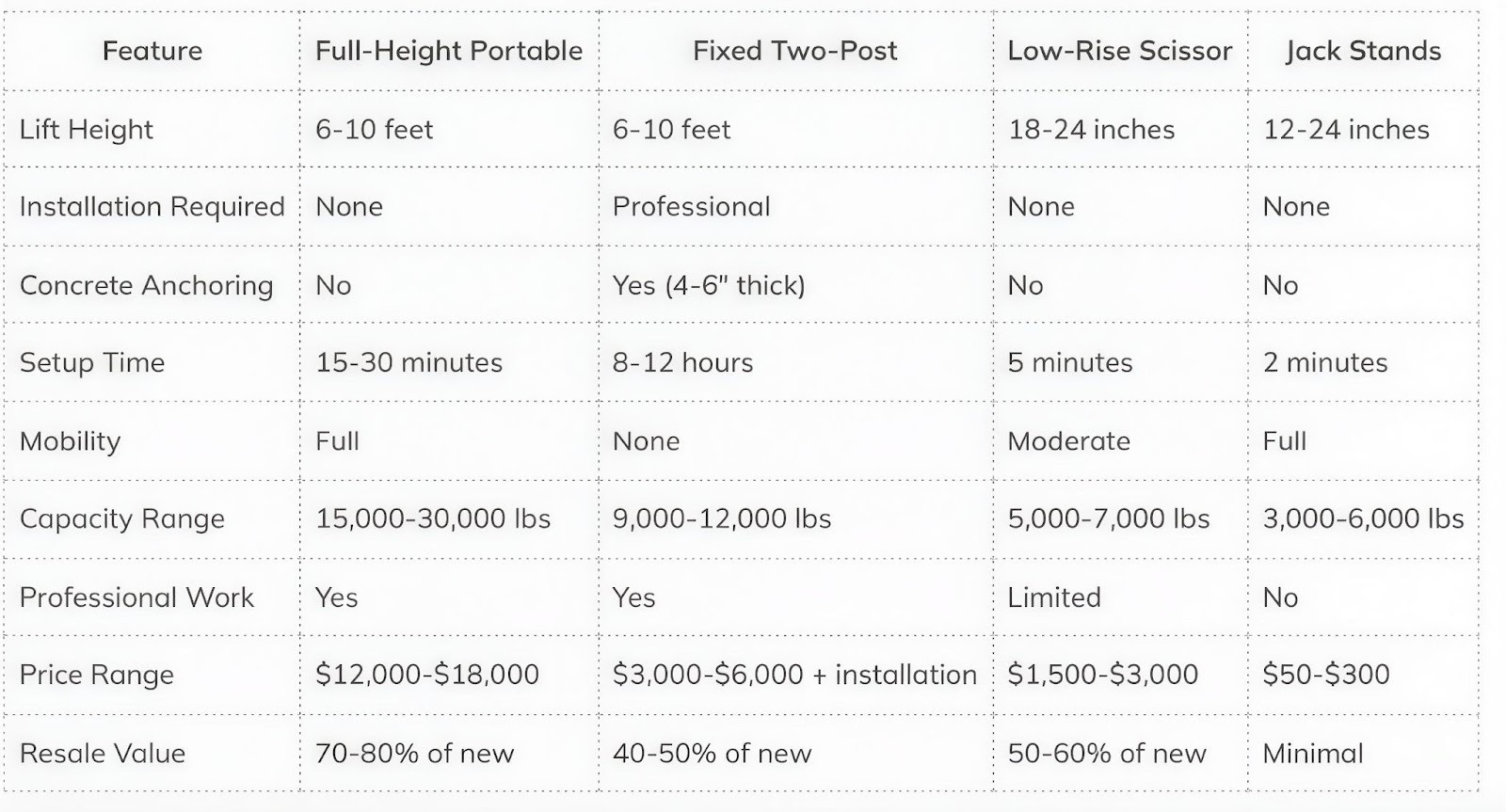
The comparison shows an important fact: the portable vehicle lift category includes anything from cheap items to professional-grade gear. To make the appropriate choice, you need to know where a certain system fits on this spectrum.
The market for portable lifting has grown into four separate groups, each with its own needs and price range. Before making a purchase, professional mechanics and serious aficionados should know the differences.
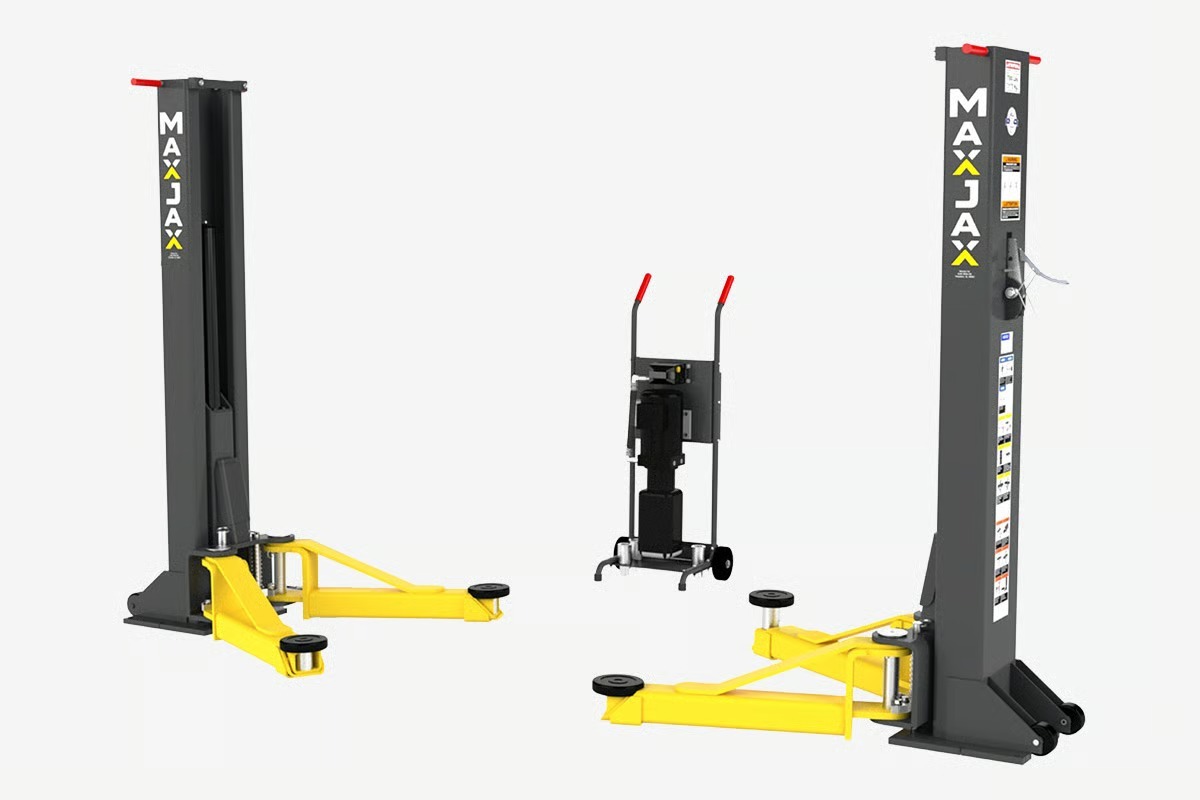
They are the best portable lifting tools out there. These systems have two vertical columns that are joined by crossbars overhead (symmetric designs) or arms that are not straight (asymmetric designs). This gives the best door clearance. The main difference between portable and fixed lifts is that portable lifts have broader bases and built-in mobility elements instead of concrete anchors. American-made examples from companies in places like Menifee, California, have set standards for engineering that do away with installation restrictions while keeping professional capacity ratings. These lifts usually have a capacity of 15,000 to 18,000 pounds and can be used at heights of six feet or more, giving you full access to the underside.
There are, nevertheless, a number of crucial things to think about and standards to meet while installing a two-post portable lift:
Requirements for permits
Before you can install it, you'll need to get the right permits. Usually, you need to get permission from the local building department to make sure the lift fulfills your area's safety and building codes.
Costs for Installation
There are charges that come with hiring professionals to do the work. These fees cover the work, knowledge, and making sure the lift is set up correctly according to the manufacturer's instructions and safety regulations.
Installing Electrical Units
The lift needs its own electrical service, which includes:
Setting up concrete
It's important to prepare the floor correctly:
Requirements for Anchoring
To keep the object from moving or tipping over while in use, it is very important to install the bolts correctly.
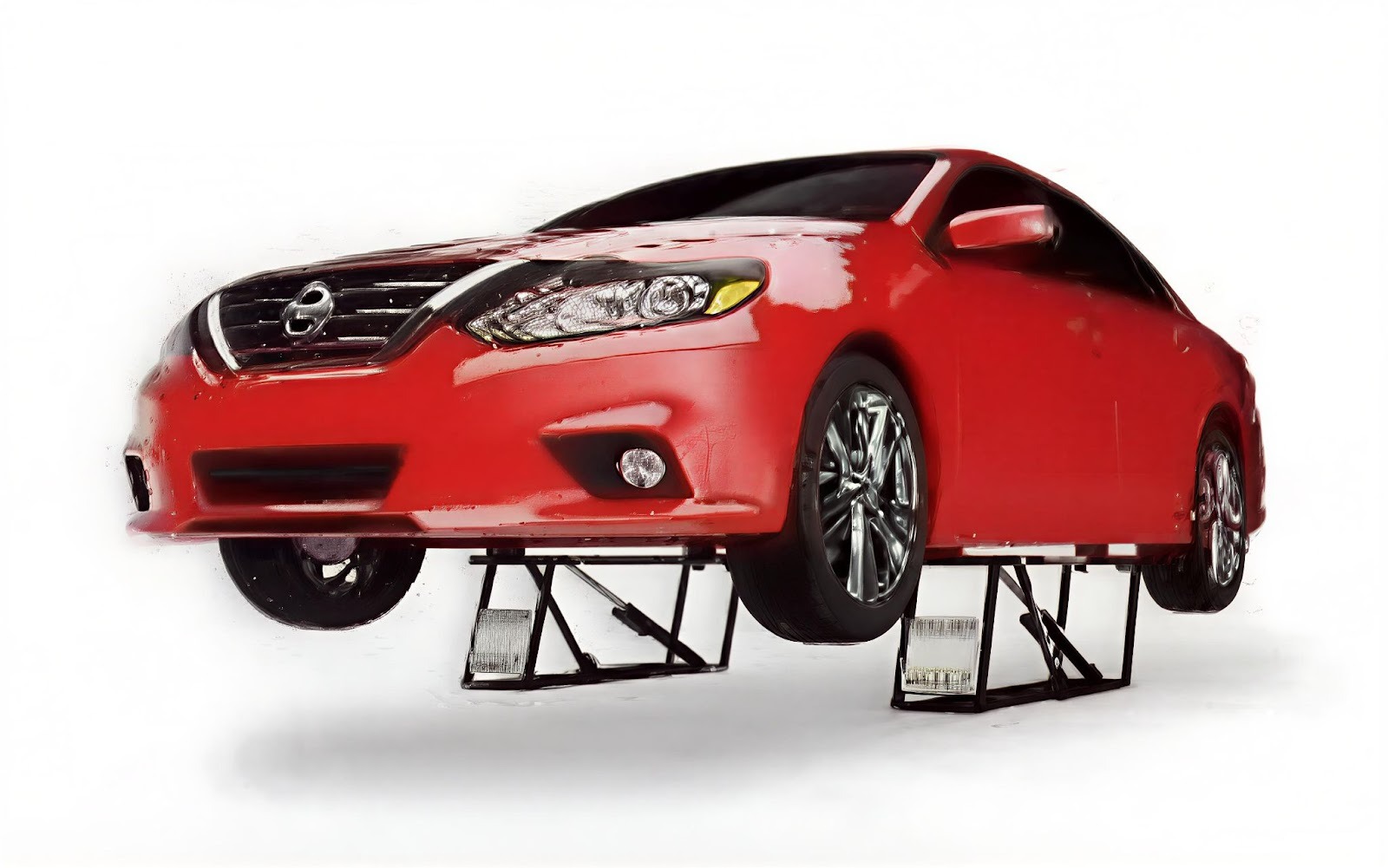
They are at the bottom of the market. QuickJack systems employ electric or hydraulic cylinders to lift two platforms that are on the floor of your garage. The vehicle drives onto these platforms, which then scissor up to provide room for work underneath. The 18 to 86-inch maximum height makes them great for changing oil and doing basic maintenance, but not so great for professional work. These systems don't give you enough space for transmission services, exhaust system work, or full inspections.

They provide a different way to lift things that some professionals like for certain jobs. Four-post lifts move the whole car onto ramps held up by four columns, instead than lifting it from the frame like two-post systems do. This design is great for storing things and working without wheels, which is why historic automobile collectors who need to rotate their seasonal vehicles like it so much. Brands that make fixed four-post lifts like Challenger's now also provide portable versions that can be taken apart for storage or transit. The downside is that you can't get to suspension parts as easily, and you can't drop wheels for brake or tire service without extra tools.
What you need for Four-Post Portable Lifts
There are a number of key needs and circumstances that must be satisfied when constructing a four-post portable vehicle lift to make sure it works properly, is safe, and lasts a long time. These lifts are very strong, and putting them in requires getting permission, setting up the electricity, and meeting certain solid standards.
1. Requirements for a Permit
Most places require a permit before putting in a four-post lift, especially in businesses or professional settings.
2. Costs for Installation
Putting a four-post lift on the floor is not the only thing you need to do. Typically, professional installers charge for:
3. Time and Cost of Installing Electrical Units
You need a separate electrical connection for four-post lifts. Look forward to:
4. Time to Set Up Concrete
5. Bolts and Anchors
You must use hardware that the manufacturer says is safe to attach a four-post lift to the floor. This includes:
They work in the heavy-duty part of the market. These battery-powered wireless columns can hoist buses, commercial vehicles, and semi-trucks in groups of four, six, or eight. Each column works on its own, yet they all talk to each other wirelessly to stay in sync. They are theoretically portable because they roll on wheels, but their size and specific use make them clearly commercial. When combined, the capabilities of numerous columns can exceed 76,000 pounds. This makes them necessary for fleet maintenance operations that need to be able to service vehicles of different sizes.
Traditional portable lifts need permits, installation costs, electrical setup, concrete compliance, and permanent anchoring. Our method is designed to get rid of almost all of these problems.
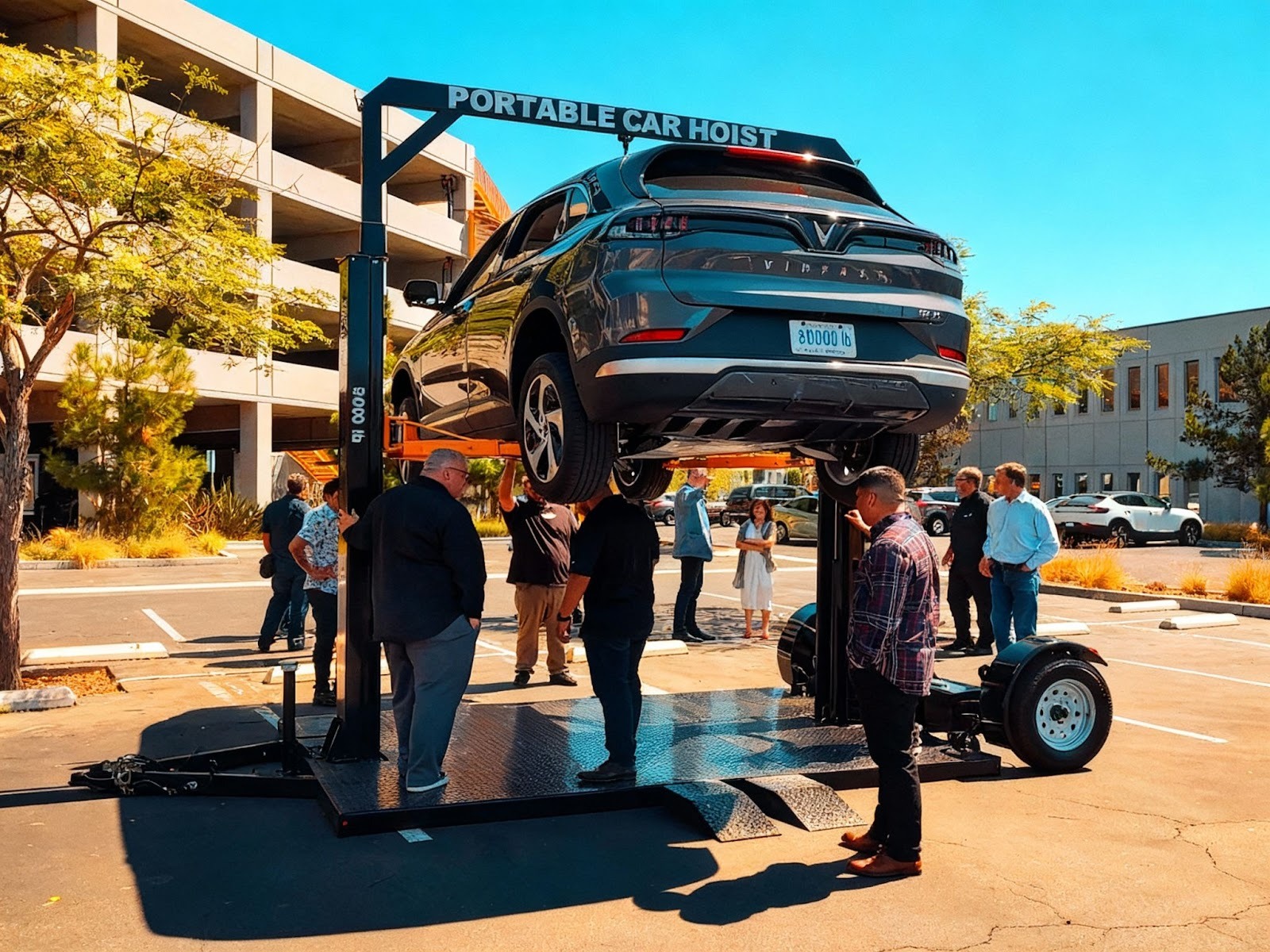
Our Portable Car Hoist is a new idea that was conceived and built in the United States. It makes car repair easier, faster, and more portable than anything else. This solution was made to tackle the most typical problems that come up with fixed or semi-permanent lift installations.
Perfectly Portable
The Truly Portable Car Hoist is more mobile than typical four-post lifts:
No permits. No fees for installation. No specific requirements.
The Portable Car Hoist doesn't need to be permanently installed or anchored; therefore, it eliminates almost all of the problems that come with regular lifts:
It really is a plug-and-play lifting solution that is ready when you are.
Quality, Strength, and Dependability
The Portable Car Hoist device gives you:
No matter if you're a skilled mechanic or a devoted DIYer, every hoist is made to make your work easier, faster, and more productive.
Made for All Kinds of Cars
Portable Car Hoist can lift:
Because it can be used in so many ways, it's perfect for stores, residential garages, mobile mechanics, and events.
At first, the portable vehicle hoist market was aimed at mobile mechanics and tiny firms that didn't have a lot of room. These are still the main users, but the client base has grown a lot as the technology has improved and more professionals see the strategic benefits of portability.
The group of customers that is expanding the fastest is small store owners. With traditional fixed elevators, you have to stick with a certain floor plan for good. Once they are attached, they will determine how the workstation is set up for decades. Shops can change the arrangement of their portable systems annually, make room for new types of vehicles as needed, or grow their business without having to remove and reinstall expensive lifts. A shop that restores historic cars might put many portable lifts together during show season and then scatter them out across the shop for winter projects. This flexibility leads directly to better operations and more money-making opportunities.
Mobile mechanics have been a big part of the development of portable lifts. When you take service to consumers, whether they are fleet accounts, collector vehicle owners, or rural clients, you have to give up some lifting capacity. In the past, mobile setups used floor jacks and jack stands, which limited the amount of work that could be done at customer locations. Professional-height portable lifts change the way mobile mechanics work by letting them do full repairs anywhere there is enough space and power. A mobile mechanic may fix the transmission or the exhaust system or do full inspections right in the customer's driveway, which used to mean transporting the car to a shop.
Serious collectors who own more than one vehicle have special problems with storage and upkeep. To move seasonal vehicles in and out of storage, you need either several fixed lifts or to keep moving jack stands about. A portable automotive lift lets collectors hoist cars for storage, undertake repairs, and then lower them back down without taking up room like permanent lifts do. Collectors who have home garages built on post-tension concrete slabs (which were widespread from 1990 to 2010) profit the most because these slabs can't hold anchor bolts without severing tension cables.
People who like to do things themselves and operate in garages that aren't made of concrete have historically not been able to use professional lifting equipment. Asphalt, gravel, or dirt floors can't hold up typical anchored lifts. Some portable systems function well on gravel that has been adequately compacted or thick asphalt. This makes it possible for those who have always used jack stands to do professional-grade lifting. Many home mechanics who have had to work beneath a car with four points of possible failure know how stressful it can be. The safety enhancement alone makes the expense worth it.
People who plan car shows and automobile exhibitions found that portable lifts can help with display problems that are unique to those events. Show off the underbelly of a car, show off restoration work, or create dramatic display angles using lifts that come on a trailer, are easy to set up, and are just as easy to take down. The exhibition and event sector currently drives a lot of demand for mid-range portable systems that put speed of setup ahead of maximal capacity.
The price tag on a fixed automotive lift only tells part of the tale of owning one. Many consumers don't realize how much more money they will have to spend on installation until they get their first price.
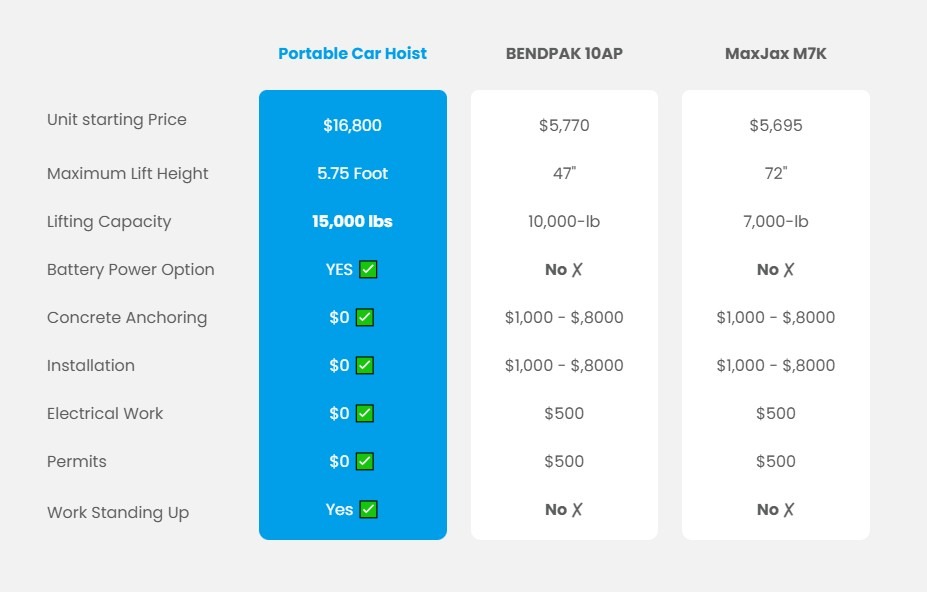
This comparison shows a surprising truth: when you take into account installation costs and resale value, premium portable lifts are typically a better long-term value than inexpensive fixed lifts. The increased initial cost of a good portable system is worth it because you don't have to pay for installation, and it keeps its value better.
In addition to installation issues, expert mechanics need to know how portable and fixed systems work in real life. As portable lift engineering has gotten better, the performance gap has gotten a lot smaller.
The time it takes to set up is the most evident difference. You don't have to set up a fixed lift; it's always ready to use. To use a portable vehicle lift, you need to set up the columns, connect the hydraulic hoses (on some models), and make sure it is stable before lifting. Modern portable systems make this less of a problem with quick-connect fittings and features that let them move about. The first time you use a professional portable lift of the day, it should take between 15 and 30 minutes to set up. For the next car lifts, all they need is time to get into position, which might be as little as five minutes. For shops that undertake many lifts every day, fixed methods are still more efficient. Setup time is not important for businesses that hoist vehicles from time to time or need to be flexible.
There is now a lot of overlap in capacity ranges between portable and fixed categories. Most passenger cars and light trucks can fit in a traditional fixed two-post lift with a capacity of 9,000 to 12,000 pounds. Some heavy-duty units can handle more than 20,000 pounds, while premium portable systems can lift between 15,000 and 18,000 pounds. When using mobile column systems, the total weight of several wirelessly synchronized columns can be as high as 76,000 pounds. The capacity advantage that used to belong only to fixed commercial lifts is no longer true for most uses.
Safety certifications are the best way to compare things objectively. The Vehicle Lift Institute (ALI) sets the requirements for certifying vehicle lifting equipment sold in North America. Structural integrity, hydraulic systems, locking mechanisms, and safety measures are all tested by an outside party as part of the ALI certification process. Both fixed and portable lifts can get ALI certification. What counts is whether a certain manufacturer wants their goods to be certified. OSHA's safety regulations for workplaces apply to both types of lifts. This means that both types of lifts must have certain safety features, be inspected regularly, and have trained operators, even if the lift is bolted to the floor.
When it comes to resale value, portable systems are far better. A fixed elevator is a permanent change to a property. Taking it down needs professional disassembly, which can harm the concrete where the anchors were put in, and it may void the warranty. People who want to buy secondhand fixed lifts need to have the right tools and money to install them. These things lower resale prices to 40 to 50 percent of the initial price after five years. Portable lifts keep 70 to 80 percent of their worth over the same time period since consumers can use them right away without having to pay for installation. The fact that it can be moved about is valuable; the next owner could need such flexibility for reasons that the first purchaser didn't think of.
There are a lot of specs in marketing materials for car lifts, but competent mechanics soon understand which statistics really matter for daily use. Knowing these important numbers helps you avoid expensive mistakes when it comes to matching equipment capabilities with real-world needs.
The height of the lift dictates how much work can be done under an elevated vehicle. The usual height of six feet has been the norm since it gives technicians of average height enough area to stand comfortably while working on undercarriage parts. This clearance makes it much easier to work on transmissions, exhaust systems, and suspensions. Some portable systems say they can reach "professional height," but they only go up to five feet, which isn't high enough for long-term work. Check the highest point of the lifted car from the ground to the lowest point. Premium portable vehicle hoist systems can lift up to 5.75 to 6. Fixed commercial lifts usually go up to 16 feet high.
You need to be careful when you read capacity ratings. Manufacturers may state either the capacity per post, the capacity combined, or both. A lift that says "15,000 pounds" could imply 15,000 pounds total (7,500 pounds per post) or 15,000 pounds per post (30,000 pounds total). Always check which specification is being used. Also, keep in mind that capacity requires that the loads be balanced and that the lifting points are in the right places. When you lift a car with a very uneven front-to-back weight distribution, it loses its ability to carry things. To stay safe, professional mechanics should use lifts that can hold at least 20% more than their heaviest typical vehicle.
Power options change the cost of running and installing things. Depending on the model, electric-powered lifts can be plugged into either normal outlets (110V) or 220V circuits. They have steady lift speeds and don't need the upkeep that gasoline engines do. Battery-powered devices, which are ubiquitous in mobile column lifts, are completely portable and may be used without wires, but they need to be charged and replaced when they run out of power. Electric motors or manual pumps can power hydraulic systems. Manual pumps let you use the system even when the power is down, but they take a lot of work to use.
There are two times when footprint concerns are important. The operating footprint tells you how much floor area the lift takes up when it's in use. This is important for stores with more than one lift or not enough space. Operators who break down the lift between usage care about the stored footprint. Premium portable lifts frequently have telescoping or folding parts that make them only 24 to 30 inches wide when not in use. This lets them be stored against walls or in corners. The weight of each part impacts how easy it is to travel. If a lift breaks into sections that are too heavy for one person to handle, it loses a lot of its portable benefit.
Portability brings up safety issues that don't come up with permanent installations. Knowing these things makes sure that portable lifts work as safely as tethered lifts.
The most important safety component on any car lift is the locking mechanism. Multi-position mechanical locks must automatically engage when the lift rises. This way, if the hydraulic pressure drops, the lift won't break down. The Automotive Lift Institute's certification method puts these systems through their paces by testing them with different weights. The same redundant mechanical locking systems that are found in fixed commercial lifts are also found in good portable lifts. These systems usually consist of spring-loaded pawls that fit into grooves cut into the lift columns. These locks should work on their own, so they will still work if the hydraulic system fails. Operators should regularly test the locks by trying to lower the lift by hand while it is locked. It should be physically difficult to get around the locks without purposefully disengaging them.
There are substantial differences between the floor surface requirements for portable and fixed elevators. Some of the stability of fixed lifts that are anchored into concrete comes from the floor itself. Portable systems can't anchor; thus, their foundation design has to make them stable on their own. This means that portable automotive lifts need to be more level than stationary lifts. The Automotive Lift Institute says that lifts should be placed on floors that are less than an inch different over the whole lift footprint. Steep slopes can make the weight unequal and make things less stable. Most portable lifts function well on asphalt, compacted gravel, or concrete that has been properly built. The most important thing is to make sure the surface is level, stable, and able to hold the lift and vehicle's combined weight without settling. Some manufacturers give standards for surfaces other than concrete. Always check before using anything else.
When using portable lifts, load distribution and vehicle balance are particularly important since the wide base design needs the weight to be evenly distributed to stay stable. Every lift comes with a range of center of gravity parameters, which tell you how far forward or backward the weight of the car can sit in relation to the lift columns. Going beyond these limits puts you at risk of tipping over. Professional technicians have an innate feel for how to position things correctly, but beginners should take their time measuring and following the manufacturer's instructions. Most passenger cars are easy to park if you do it right, but extreme vehicles (those with engines located far forward or backward or with a lot of extra weight in one place) need extra care.
OSHA rules apply to all lifting equipment used in businesses, whether it is fixed or movable. Operator training, regular inspections (usually once a month), maintenance records, and precise ways of doing things are all important criteria. OSHA doesn't make a difference between portable and fixed lifts; all must fulfill the same safety criteria. This regulatory equivalence actually proves that portable systems that are designed correctly are safe. They couldn't be utilized in commercial shops if they didn't fulfill OSHA standards.
The ALI certification criteria are the strictest third-party checks that are offered for car lifts. This optional accreditation means that manufacturers have to send lifts in for destructive testing and regular quality checks. Certified lifts have ALI gold labels that show the certification number and the maximum weight they can hold. When looking at different portable car lifts, you should make sure that they are ALI certified if you plan to use them for work. There are some good lifts that don't have certification (especially imports), but certification is proof that the lift fulfills strict safety and performance standards.
There are rules for even portable lifts. Let's talk about the concrete and floor questions that people often forget about.
Post-tension concrete slabs are used in a lot of garages in residences built between 1990 and 2010. After the concrete cures, steel tendons are pulled tight in these slabs. Drilling anchors or bolting big loads into these slabs might be hard since you might cut the tendons or damage the slabs. If the lift is fixed, that could imply having extra support or a different pad. Portable lifts might not need to be deeply anchored, but you still need to check the slab's load capability and quality.
You might need to construct an independent pad, add steel reinforcement, lay a topping slab, or make other improvements if your slab isn't thick enough, level, or meeting PSI standards. These improvements can cost $1,000 to $3,000 or more. This makes the benefits of portable lifts even stronger: they don't need heavy slab retrofitting.
If you have a conventional slab in your home garage, a portable car lift might still work. Just make sure the surface parameters are correct, obtain advice from the manufacturer, and maybe even talk to a structural engineer.
Let's look at the different price levels and what each one represents for installation costs and capabilities.
You can usually find portable low-rise scissor lifts or extremely simple portable frames made for residential garages or light work in this price range. These lifts can only go up a few feet, so they are best for modest maintenance, detailing, and wheel and tire care, not extensive undercar work. A good deal for people who do their own work or light service.
You can start to see full-rise portable two-post systems that can stand under the car in this price range. These are good for tiny stores, hardcore do-it-yourselfers, and mechanics who work on the go. They have more features and come with superior power units and safety systems.
Here you can find heavy-duty portable lifts that can hold more weight, have full certification (ALI Gold Labels), strong hydraulics, longer posts for trucks and SUVs, and maybe even modular four-post or column systems. These are for professional shops that wish to be able to move around but yet have complete shop capabilities.
This level is for fleet service centers, mobile heavy truck mechanics, and industrial uses. These lifts can raise big trucks, buses, and huge machinery. The installation may still be small (in relative terms), but the equipment is quite expensive.
Here are some well-known brands in the industry and how they stack up against each other.
The Portable Car Hoist (Model C) is one brand that clearly says "no concrete." It has two-post lifting arms, an electric engine, hydraulic cylinders, and no concrete anchors needed. Mechanics who want full access and professional-level functionality with as little installation as possible will find this type of system highly appealing.
The BendPak brand is well-known, and its website has portable car lifts for sale. However, a lot of models still talk about how to install or anchor them. They are expensive and only good for high-end stores. The safety credentials (ALI certification) are very good. If you have the money and the right floor space, BendPak is a great choice.
MaxJax makes portable two-post style lifts that can be moved around and are meant for homes or small professional shops. The BendPak portfolio includes choices like the M7K portable two-post that can hold up to 7,000 pounds. This is perfect for mechanics who work on cars that are not too big and not too expensive.
The QuickJack line is worth checking out if you simply require minimal service and want equipment that won't break the bank. These frames are more low-rise than full-height, but they are cheaper and easier to move around. They also let professional mobile technicians or hobbyists skip the headache of installation. For instance, the QuickJack 6000TL portable auto lift, which can lift 6,000 pounds, is on the list.
Here's how to choose the best portable vehicle lift for you (or your firm). Use a decision tree, a capacity worksheet, and a calculator for space and footprint.
How high do you have to lift?
What kinds of cars and trucks do you work on?
What is your floor or infrastructure?
How vital is it to be able to move about and change the layout?
How much money do you have?
For professional mechanics, mobile service providers, passionate car fans, and collectors, a portable car lift, portable vehicle hoist, or automobile portable lift isn't just a nice thing to have; it's a smart method to "skip installation" and get the most out of it in terms of usability, flexibility, and cost-effectiveness. You don't have to be stuck in a set bay with expensive concrete slabs, anchoring, permits, and downtime. Instead, you may use a high-performance lift that satisfies ALI safety regulations, lets you get to the bottom of the car, and lets you change your business as it grows.
If you're ready to improve your bay, add mobile service, or make room for seasonal trucks with professional-level access, think about getting a portable lift that suits your height, capacity, and mobility needs.
Don't give up on capability or get stuck with infrastructure that can't be changed. Check out the Portable Car Hoist, a full-height portable two-post hoist (no concrete needed), today. You may request a demo, check your floor dimensions, and get started lifting intelligently. You need full professional access for your next job, your mobile service upgrade, or your collector car project. Get it with the correct portable vehicle hoist.