


Jader Gil
Marketing Expert
June 6, 2026
9 min read
You only have two bays. Or three, but one is always blocked by the parts car that never seems to move.
That is the reality for a lot of small commercial shops. You are not running a 10-bay dealership with a dedicated alignment room. You are running a tight operation where every square foot has a job to do, and you need your equipment to do double duty without taking up half the floor.
That is exactly where a compact car lift makes sense. Not a hobby jack. Not a low-rise scissor lift. A real, full-standing-height hoist that you can readjust when you are done with it.
Let us talk about what that actually looks like, what it takes to run one, and how small shops are using them to stop turning away jobs.
Here is something worth saying out loud: a lot of small commercial shops still rely on floor jacks and jack stands for most of their undercar work. Not because the owners do not know better. It is usually because a traditional two-post lift feels out of reach.
Think about what a standard fixed lift actually requires. You need 4 to 6 inches of concrete rated at 3,000 PSI minimum. Many shops built between 1990 and 2010 have post-tension concrete slabs, which you absolutely cannot drill into without risking catastrophic structural failure. Then add the professional installation ($2,000 to $2,500), the permits and inspections ($300 to $800), possible floor remediation ($3,000 to $8,000 in bad cases), and 220V electrical work ($800 to $1,200). Before you ever lift a car, you can be looking at $6,400 to $12,800 in upfront costs, not counting the lift itself.
For a small shop, that math does not work. So you stay on jack stands.
But here is the problem with that: a shop without a lift services roughly 40% fewer vehicles per day than one with professional lifting equipment, according to industry data cited by lift manufacturers in the commercial repair sector. Your techs spend 30 to 60 extra minutes per job crawling on concrete, setting up stands, and doing work they should be standing up for. That is lost time you can never get back, and it is also how back injuries happen.
The good news: this is a solved problem. It just took the industry a while to solve it in a way that actually works for small commercial operators.
When people hear "compact" in the context of car lifts, they often picture those low-profile, drive-over scissor lifts you see in oil change places. That is not what we are talking about here.
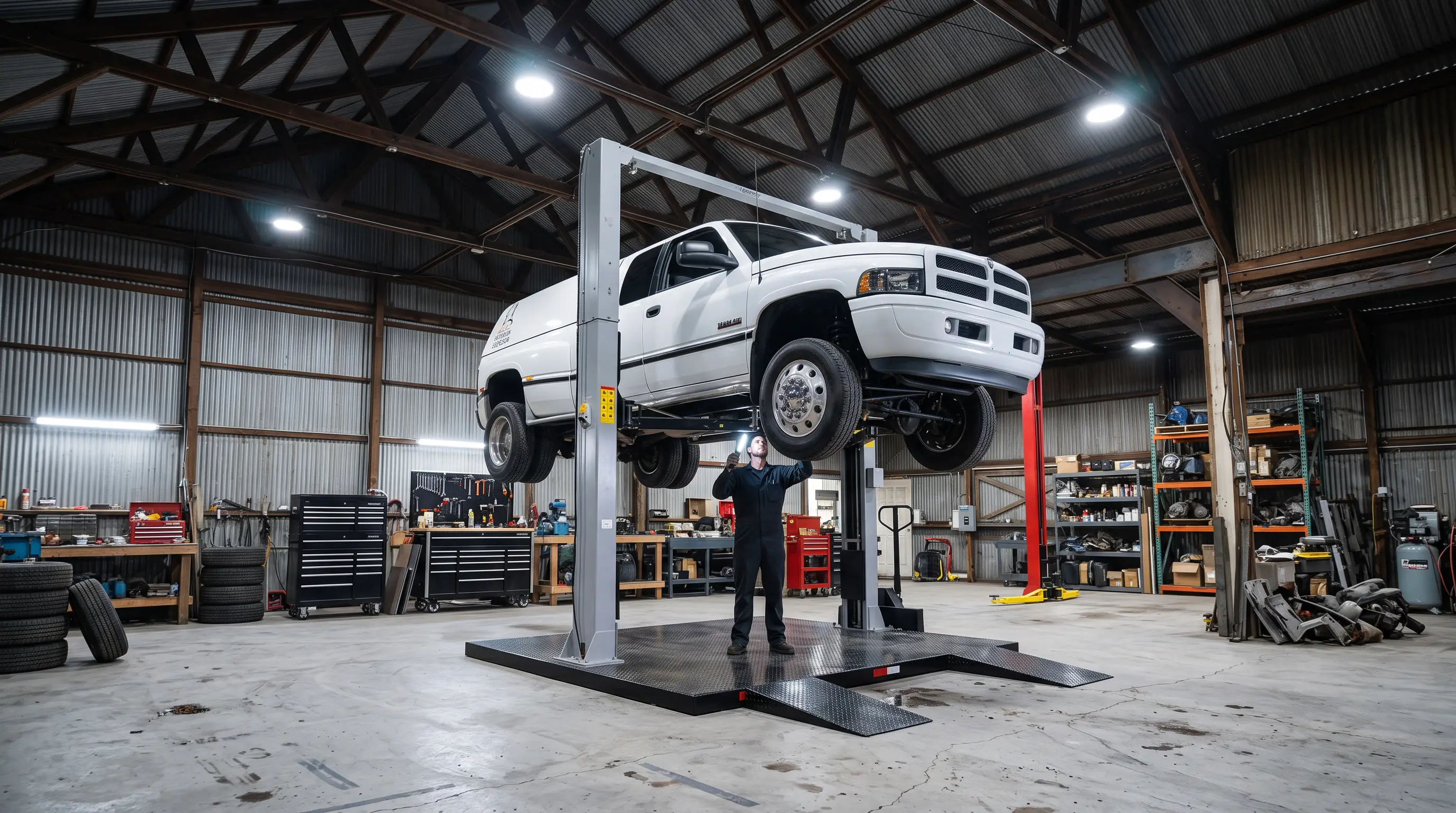
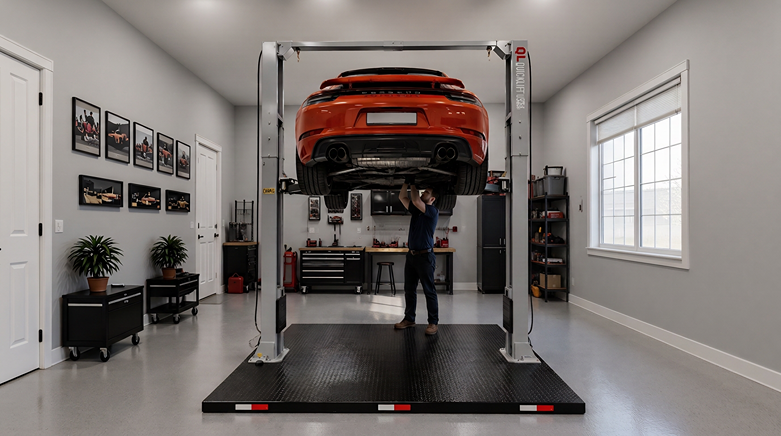
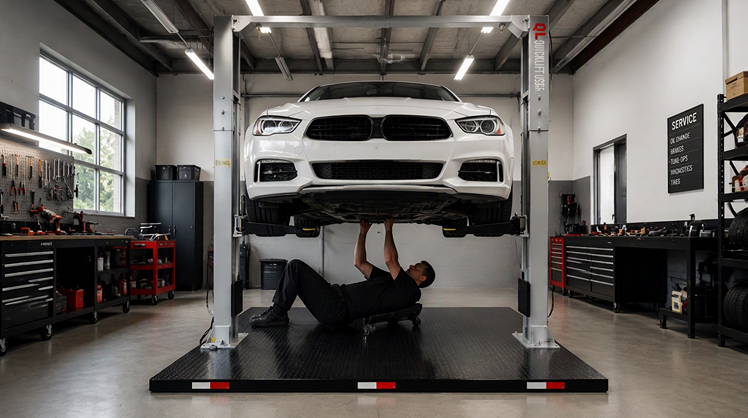
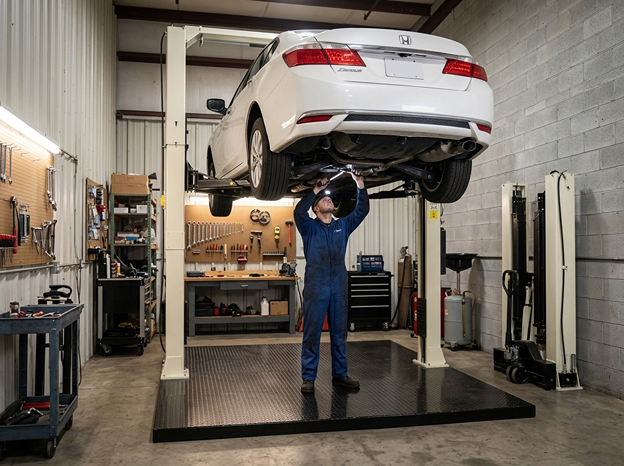
A compact car lift built for commercial use should give you full working height, the same 69 to 73.5 inches you would get from a fixed two-post lift, just in a form factor that does not permanently eat a bay. The key difference is portability and footprint. A well-engineered portable hoist folds down for storage, sets up in 5 to 15 minutes on any solid surface (concrete, epoxy-coated concrete, well-compacted asphalt), and requires zero anchors or floor penetration.
For a small shop with two or three bays, this changes the math entirely. You can run the hoist in Bay 1 for a transmission job in the morning, fold it and slide it against the wall, and open that same bay for a detail or alignment in the afternoon. Fixed lifts cannot do that. They are bolted to the floor. That bay is a lift bay forever.
According to a 2024 IBISWorld report on automotive repair shops in the U.S., the number of single-bay and two-bay repair operations grew by 7.3% from 2021 to 2024, largely driven by mobile mechanics and small independent shops. These operators need equipment that is flexible by design, not flexible as a marketing tagline.
Let us get specific. If you are a small commercial shop comparing options, here are the specs that actually matter, and what numbers you should insist on.
Lift Height: 69 to 73.5 inches minimum
This is non-negotiable for standing work. Anything under 65 inches, and your techs are still crouching. Full undercar access on a sedan or light truck requires at least 69 inches of clearance. If a manufacturer is vague about this number, walk away.
Lift Capacity: 8,000 to 15,000 lb
For a shop doing standard passenger cars and light trucks, 8,000 to 15,000 lb handles most jobs. If you are regularly working on full-size pickups or larger SUVs, you want to go higher. The Portable Car Hoist Model A and Model C both come in at 8,000 to 15,000 lb capacity, with higher capacity versions available on request.
Setup Time: Under 20 minutes
A compact hoist is only useful if you can actually set it up and break it down quickly. Five to fifteen minutes is the benchmark. If it takes 45 minutes to configure, it is not really portable in a commercial sense.
Power Options: 110V, 220V, or battery
Commercial shops typically have 220V available, which is the faster and more reliable option. But battery-powered versions (12V or 24V) are worth considering if you ever need to work at a second location or outside the bay. The battery option is also a good backup if your electrical panel is already loaded.
Footprint When Stored
Ask the manufacturer for the folded dimensions. A hoist that folds down and leans flat against a wall is genuinely space-saving. One that just sits in a corner, taking up floor space, does not solve your problem; it just moves it.
Let us think through a real scenario. You have a 1,200 square foot shop with two main service bays and a small parts and storage area in the back.
Bay 1 is your primary work bay. Bay 2 is used for customer waiting, overflow, and the occasional bigger job. Right now, you might have a floor jack and stands set up in Bay 1 about 60% of the time.
Here is what changes with a portable, space-saving hoist:
This is the flexibility that small commercial operations have been missing. And because there is no anchor in the floor, your landlord has no claim to it if you ever move shops. It comes with you.
One shop owner in Southern California, who runs a two-bay independent repair business, put it simply: "I was turning down exhaust and suspension work because the floor jack setup took too long for what I was charging. The portable hoist changed that. Now I can price those jobs properly and actually make money on them."
A fair question: Is a portable hoist as safe as a fixed lift bolted into concrete? The physics says yes when the unit is properly rated and engineered. Here is why.
The Portable Car Hoist units are tested at twice the rated capacity before shipping. That is the same load-testing standard used on fixed commercial lifts certified by the Automotive Lift Institute (ALI), which sets the safety benchmarks for the U.S. market.
For commercial use, you want to confirm that any lift you buy, portable or fixed, is ALI-certified or meets equivalent testing standards. This matters for your insurance, your OSHA compliance, and most importantly, for your techs.
A couple of things are happening in the automotive repair market right now that make this conversation timely.
First, shop space is expensive and getting more expensive. According to CoStar data, commercial real estate for light industrial and auto repair use in the U.S. saw average rent increases of 11 to 14% between 2022 and 2024 in major metro markets. Small shop owners are paying more per square foot than ever, so every foot has to work harder.
Second, the independent repair market is growing. The U.S. Bureau of Labor Statistics projects a 5% growth in automotive service technician employment through 2032. More techs means more shops, and many of those are small, owner-operated operations that need to be lean on equipment costs and flexible on space.
Third, vehicle complexity is increasing the need for proper lift access. Modern ADAS systems, EV battery inspection, and multi-layer suspension designs all require full undercar access to diagnose correctly. You cannot do that job properly from under a jack stand. The trend toward more complex vehicles is pushing even small shops toward investing in real lift capacity.
A: Yes, if the lift is rated for it. Most commercial-grade portable hoists handle 8,000 to 15,000 lb, which covers full-size pickups and SUVs comfortably. For heavier vehicles like one-ton trucks or large commercial vans, look for a unit rated at 15,000 lb or higher, and confirm the arm spread accommodates wider wheelbases.
A: No inspection needed, but your floor does need to be reasonably level (within 1 to 2 degrees) and structurally solid. Standard concrete, epoxy-coated concrete, and well-compacted asphalt all work. The big advantage over fixed lifts is that you never drill, so post-tension slabs are completely compatible.
A: Most techs get it down to 5 to 15 minutes once they have done it a few times. First-time setup, working from the manual, typically takes 20 to 30 minutes. That includes unfolding, positioning, and power connection.
A: On well-designed units, nothing dangerous happens. Mechanical locks engage automatically every 3 inches of lift height, so even a complete power loss leaves the vehicle locked safely in place. You can manually release the locks to lower the vehicle, or simply restore power and continue normally.
If you are running a small commercial shop and you are still telling customers you do not have the equipment for undercar work, that is a business problem. And it is one you can fix without breaking ground on your floor or spending $12,000 before you ever lift a car.
A compact car lift built for commercial use gives you full professional working height, a foldable footprint that stores flat against a wall, and the flexibility to use your bays however the day demands. No permits. No concrete. No locked-in bay configurations.
The shops that are adding capacity right now are not the ones building additions. They are the ones being smarter about the square footage they already have.
If you are ready to find out which portable hoist fits your bay dimensions, your vehicle mix, and your budget, the team at Portable Car Hoist will give you a straight answer in a free 15-minute call. Get your free quote here or call +1 (951) 400-5290 today.