



Jader Gil
Marketing Expert
June 6, 2026
9 min read
Picture this. A customer calls you. They need a transmission replacement done at their apartment parking lot. Great job. Good money. But then you remember, there is no outlet anywhere near their spot. You picture yourself dragging a loud generator through the complex, the building manager coming out, and the customer's face when they hear the noise.
You pass on the job.
Now multiply that by every driveway, condo lot, or street-side call you have declined in the last year. According to data from Portable Car Hoist's own mobile mechanic customer research, mechanics without a proper lift setup are effectively locked out of roughly 60% of potential jobs because they cannot handle anything requiring full under-vehicle access away from a power source.
That is not a small number. That is the majority of high-value repair work, including transmissions, exhaust systems, brake overhauls, and suspension jobs.
The good news? There is a straightforward fix, and it does not involve hauling a generator or wiring a van.
A lot of mobile mechanics think the solution to the power problem is a generator. So they buy one, drag it to jobs, and quickly realize it creates three new problems.
First, the noise. Customers in residential areas hate it, and some HOA communities flat-out will not allow it. Second, the weight and bulk. A generator capable of running a lift weighs well over 100 lbs on its own and eats up space in your truck. Third, the optics. You are trying to build a professional reputation, and showing up with a gas-powered generator rattling on someone's driveway is not the look.
There is also the matter of what a standard mobile setup allows you to do physically. A popular option like the QuickJack maxes out at 47 inches of lift height. That is fine for oil changes. But try doing a transmission on a customer's full-size truck at 47 inches and you will be folded like a lawn chair. Shop mechanics work standing upright on professional two-post lifts at 69 to 73 inches of height. The gap between what you can do and what a shop can do gets painfully obvious on complicated jobs.
Here is something nobody talks about enough. When you crawl under a $50,000 truck propped up on $90 Harbor Freight jack stands in a customer's driveway, the customer watches. And they think about it.
Shop mechanics have professional lifts. You show up with jack stands. That visual comparison alone can make a customer quietly decide to just take the car to a shop next time, even if your work was excellent.
Trust is built on what people see, not just what you do.
The mobile mechanic industry is growing fast, and the opportunity is real. The global mobile mechanic services market is projected to reach USD 22.7 billion by 2033, expanding at a CAGR of 10.6% from 2025 onward. The mobile mechanic segment alone grew by 15% in the past year, driven by customers who want repairs done at their home, office, or wherever they are parked.
Survey data from 2025 shows that over 71% of vehicle owners under the age of 45 prefer booking car repair services via mobile apps over visiting a physical workshop. These customers expect you to come to them fully equipped. They are not going to drive to a shop if they booked a mobile. So when you show up and cannot do the job because of a power problem, you lose both the job and the customer relationship.
The mechanics who figure out their lift setup now are the ones who will own this market as it keeps growing.
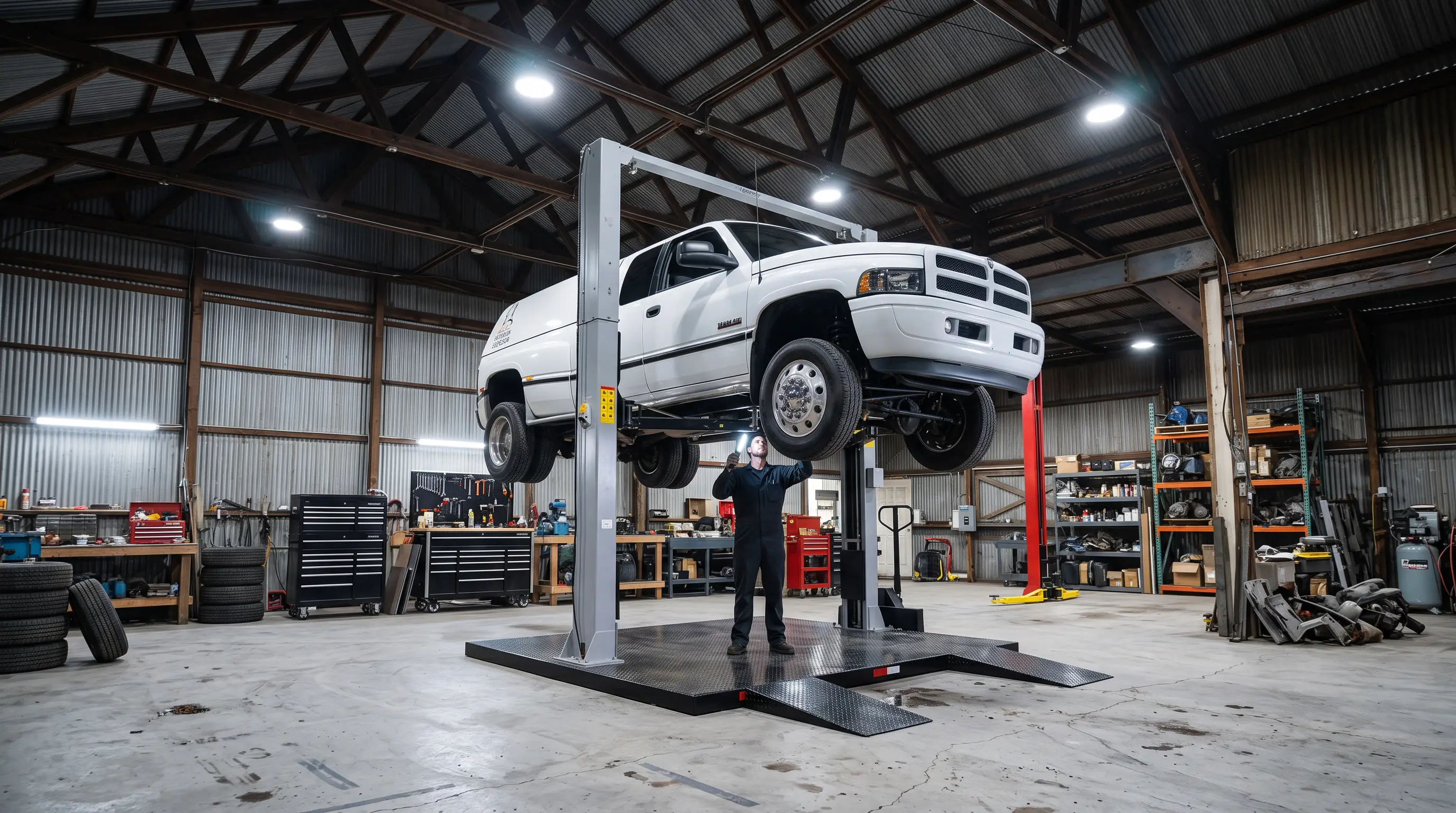
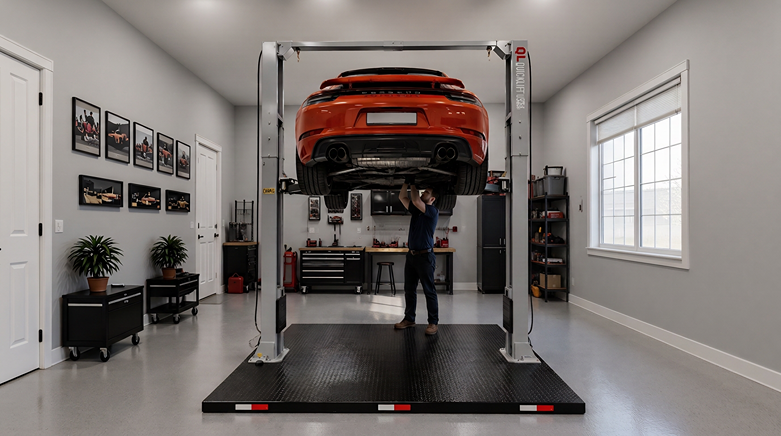
A battery-powered car lift for mobile mechanic use is exactly what it sounds like. A full-height, professional two-post lift that runs on a lithium battery pack instead of a 110V or 220V outlet. No generator. No extension cords. No begging the building manager for access to an outlet.
The Portable Car Hoist Model A, for example, runs 8 to 12 full lift cycles on a single charge. That translates to 4 to 6 full transmission-level jobs before you need to plug in overnight. It lifts to 69 to 73.5 inches, which is the same working height as a fixed shop lift. And it carries up to 15,000 lbs, covering everything from compact cars to full-size SUVs and light-duty trucks.
The whole unit weighs 600 lbs and folds down to fit a standard 6.5-foot truck bed. Two people can load it in about 10 minutes. Setup on-site takes 5 to 20 minutes, depending on the surface and your familiarity with the system.
A lot of people hear "portable lift" and think of low-profile options that keep you on your knees. This is not that. The difference between a low-rise portable unit and a full-height battery-powered car lift for mobile mechanic use is the difference between an oil change setup and a real service bay.
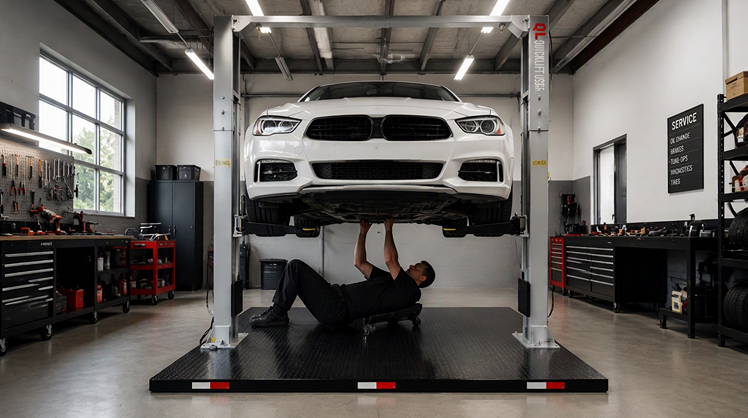
At full height, you can do transmissions, exhaust replacements, full brake jobs, suspension work, and anything else that requires a standing mechanic with complete under-vehicle access. That is the work that pays well. That is the work that makes customers loyal.
When you roll up with a professional two-post lift, set it up cleanly, and raise the vehicle to working height in front of the customer, something shifts. They see professional equipment. They stop comparing you to a shop and start comparing you to a full-service technician who comes to them.
The Model A also has automatic mechanical locks that engage every 3 inches of lift. If the battery dies mid-job, the vehicle stays locked at height. You can swap the battery or plug into the customer's outlet to finish lowering. The vehicle cannot drop.
That is a story you can tell customers. And it closes the trust gap.
The no-generator car lift setup works on level concrete and well-compacted asphalt. Gravel, dirt, and sloped driveways over 1 degree are out. You will spend about 30 seconds assessing the surface when you arrive. Most residential driveways and apartment parking lots are fine.
The 15,000 lb capacity covers:
Heavy commercial trucks and dual-wheel diesel rigs over that capacity need a different model. For your standard mobile mechanic customer base, the Model A handles the vast majority of vehicles you will encounter.
You charge the battery overnight in your garage. In the morning, you load the lift with one helper in about 10 minutes. You drive to the customer's location. You assess the surface (30 seconds), set up the lift (5 to 20 minutes), raise the vehicle, do the work standing at full height, lower it, break down, and drive to the next job. You repeat that 4 to 6 times before the battery needs recharging.
Compare that to your current setup, and the difference is obvious.
The Model A starts at $17,300. That sounds like a lot until you do the math.
A single transmission replacement on a half-ton truck typically costs $1,500 to $2,500, depending on your market. If you were previously turning down two of those per week because of power limitations, that is $3,000 to $5,000 a week in lost revenue. The lift pays for itself in a matter of days of recovered work, not months.
Financing is available through partners like Trio Capital and ClickLease. Typical terms on the Model A run around $250 to $300 per month over 60 months with approved credit. Equipment financing rates are usually well below credit card APR, often coming in at 4 to 7% versus the 18 to 24% you would pay carrying a balance.
The question is not really whether you can afford the lift. It is whether you can afford to keep saying no to 60% of the jobs in your market.
The Model A's lithium battery runs 8 to 12 full lift cycles per charge. Most jobs that require a lift involve one to two lift cycles, so a typical day gets you 4 to 6 full jobs. You recharge overnight on a 110V outlet in 4 to 6 hours.
Nothing drops. Automatic mechanical locks engage every 3 inches of lift height, and there is a redundant hydraulic hold system as a backup. The vehicle stays safely locked at height. You can either swap the battery or plug into a nearby outlet to finish the job.
Yes, as long as the asphalt is well-compacted and level. Concrete is ideal. The lift does not work on gravel, dirt, or driveways with more than a 1-degree slope. You do a quick surface assessment when you arrive, which takes about 30 seconds.
More professional, in practice. When customers see a two-post lift being set up cleanly in their driveway with no generator noise and a clear safety system, they associate your service with a real shop experience. The contrast with Jack stands is significant, and it works in your favor.
You got into mobile mechanics because you wanted freedom. Freedom to work without a boss, set your own schedule, and bring real skills directly to customers. But if you are still turning down 60% of the available work because your lift setup does not go where you go, that freedom is costing you a serious amount of money.
A battery-powered car lift for mobile mechanic use is not a luxury upgrade. It is the piece of equipment that bridges the gap between what you can do and what a full shop can do, and it fits in your truck bed.
The market is growing. Customers want mobile service. The jobs are there.
Ready to stop saying no? Schedule a free 15-minute consultation with the Portable Car Hoist team at portablecarhoist.com. They will match you to the right model for your truck, your typical vehicles, and your market, no sales pressure, just the right answer.