


Jader Gil
Marketing Expert
September 2, 2026
9 min read
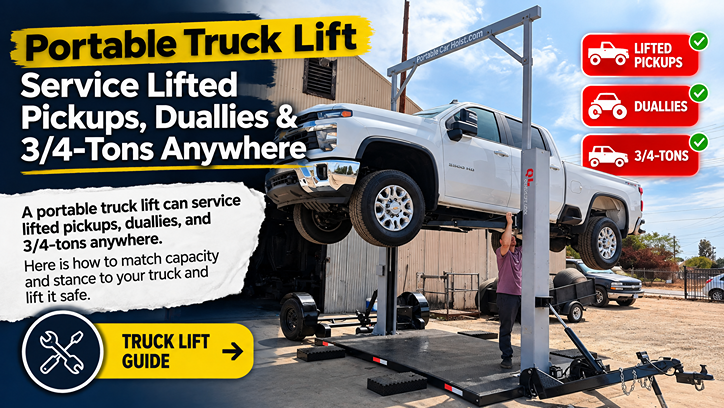
Yes — a portable truck lift can absolutely service lifted pickups, duallies, and 3/4- and 1-ton work trucks, as long as you match the lift's capacity and stance to what you are raising. That last part is where most people trip up. A half-ton pickup rolls in around 5,000 to 6,000 pounds, a loaded 1-ton dually can push 9,000 to 10,000, and a lifted rig with a steel bumper, winch, and a bed full of tools climbs higher still. Our portable hoists run from 8,000 all the way to 76,000 pounds of capacity, so the machine is not the limitation — picking the right one for your truck is. Get that match right, and you can lift a big truck on a driveway, a gravel yard, or a customer's job site without a single anchor in the ground.
I talk to a lot of guys who assume a “car lift” means cars only. It does not. A properly sized portable two-post hoist lifts trucks the same way it lifts a sedan — it just needs the capacity and the arm reach to do it safely. Below I will walk through exactly what to look for when the vehicle is a pickup, a dually, or a heavy 3/4-ton, and how a portable makes servicing them possible in places a bolted-down lift never could.
Lifting a truck is not just “a car, but heavier.” Three things change the moment you roll a pickup onto a lift: total weight, weight distribution, and width. A three-quarter-ton with a diesel up front is nose-heavy, a loaded bed shifts weight rearward, and a dually is simply wider than anything a compact lift was designed for. If you ignore any of those, you end up with a lift that is technically “rated” for the weight but still wrong for the truck.
Capacity is the headline number, but arm reach and stance matter just as much. This is exactly why I always send truck guys to our guide on picking the right hoist capacity from Miatas to monster trucks before they buy anything. The rule of thumb: your lift's rated capacity should comfortably clear your truck's heaviest real-world weight — curb weight plus fuel, plus any bumper, winch, plow, or bed load you carry. Buying right at the edge is how people get in trouble.
The standard half-ton pickup — think a common crew-cab — is the sweet spot for a portable truck lift. Most sit in the 5,000-to-6,000-pound range empty, so an 8,000- to 11,000-pound-class hoist handles them with a healthy safety margin. That margin is not a luxury; it is what lets you lift the same truck after you have thrown a topper, a bed slide, and 500 pounds of tools in the back.
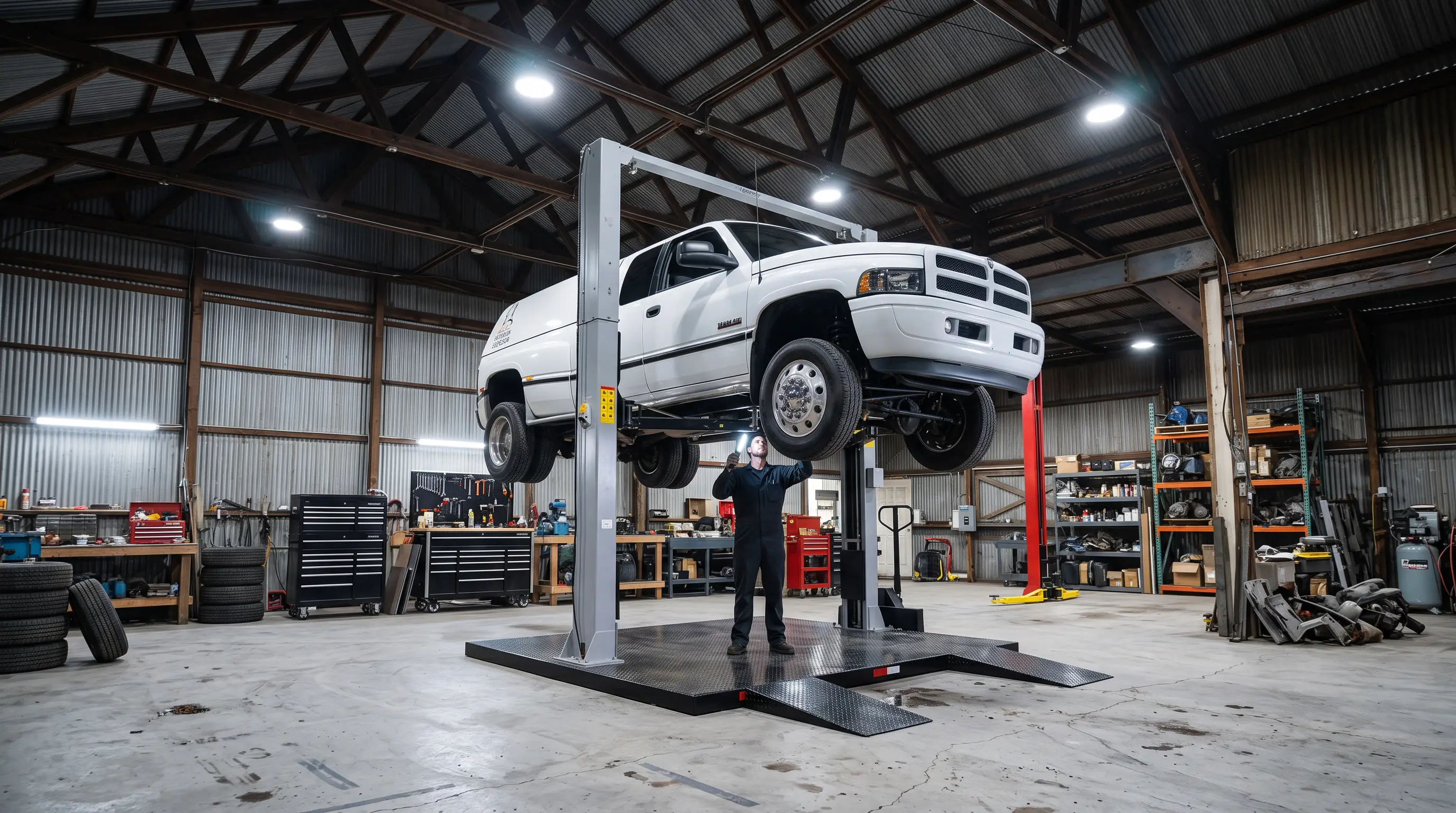
Because our lift works with zero concrete and zero anchors, a half-ton is easy to service in a home garage, a rented bay, or out in the open. The truck lifts on the same diamond-plate trailer deck that carries the whole system, which means the pickup's weight spreads across a big footprint instead of loading two bolt patterns in a slab. For a lot of owners, that is the difference between working on their own truck at home and hauling it to a shop.
Duallies are where a lot of lifts quietly fall short. The weight of a one-ton dually is manageable on a high-capacity hoist, but the width of those rear fenders is the thing to plan around. You need a lift whose stance and arm geometry give you room to position the truck and reach solid lift points without the rear duals fighting the posts.
A loaded dually can run 9,000 to 10,000-plus pounds, so this is firmly in higher-capacity territory. The good news is that the same portable design scales up — the heavy-duty models carry the capacity for these trucks while keeping the anchor-free, go-anywhere setup. If your work regularly includes one-tons, it is worth reading how guys already service heavy trucks at home with the right high-capacity lift — the same principles apply to a dually as to a much bigger rig.
Three-quarter-tons and lifted trucks bring a wrinkle beyond raw weight: modifications. A leveling kit or lift changes ride height and where your lift arms contact the frame. A steel front bumper and winch add a few hundred pounds right over the nose. A flatbed or service body changes the balance entirely. None of this makes a truck un-liftable — it just means you size for the truck as it actually sits, not as it left the factory.
Pro tip: Weigh your truck loaded, the way you actually drive it. Roll across a public scale at a truck stop or landscape-supply yard with your normal gear in the bed and a full tank. That single number — real, loaded weight — is what you size your lift against, not the sticker curb weight. I have watched people size off the brochure number and come up short by a thousand pounds once the winch, bumper, and toolboxes were counted. Thirty seconds on a scale settles it for good.
Here is what a portable truck lift really unlocks: you are not tied to a bay with a poured, rated slab. The whole rig sets up in about 15 minutes with no anchoring, so you can lift a truck at a job site, a fleet yard, a ranch, or a customer's driveway. For mobile guys, that is the entire business model — and it pairs perfectly with a mobile mechanic van built to lift vehicles anywhere.
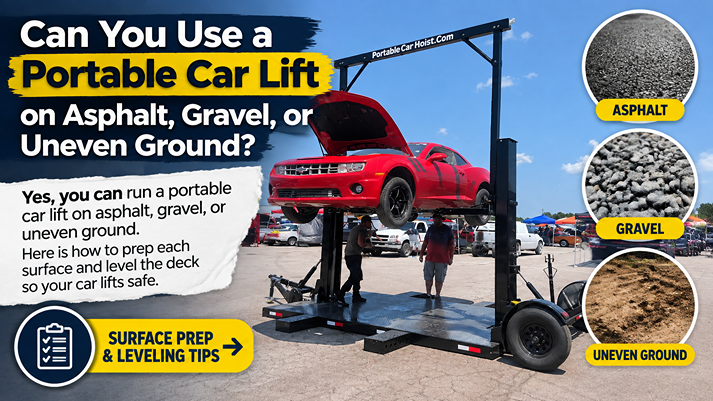
Surface flexibility matters even more with trucks, because heavy vehicles show a soft surface faster than a light one. The lift will run on asphalt, firm gravel, or packed dirt, but you spread the load with plywood or steel plates and confirm the deck is level first — the full playbook is in our guide to using a portable car lift on asphalt, gravel, or uneven ground. Being able to take the lift to the truck, instead of the truck to the lift, is what lets mobile techs bring the shop to the customer — and it is a huge edge when the “truck” is a work vehicle a business cannot afford to leave parked.
There is a real difference between a lift that gets a truck a foot off the ground and one that raises it to full standing height. With a big truck, low-rise setups leave you crouched under a heavy vehicle, fighting for clearance on exactly the jobs — exhaust, transmission, driveline, fuel tank — where trucks eat the most time. A full-height portable hoist gets you standing straight up under the truck, which is faster, safer, and a lot easier on your back over a full day. Because the system needs no anchors, it delivers that full lift height without a single bolt in the floor.
That height advantage is amplified on trucks because they sit taller to begin with. A raised or lifted rig that already has ground clearance still buries its hardest work up in the frame and driveline, and only a true full-height lift gets you comfortably underneath it. This is a big part of why a serious truck owner is better served by a full-height portable than by a low-rise pad — and it is covered in depth in our complete two-post portable lift buyer's guide if you want to compare styles before you commit.
For anyone who services trucks for a living, the math is hard to ignore. Every truck you can lift at your own shop, a job site, or a customer's yard is a truck you do not have to send elsewhere or turn away. Skipping the poured, rated slab a fixed lift demands also erases a big up-front install cost — an anchor-free portable hoist just needs solid, level ground. Between the jobs you keep in-house and the install you never pay for, a truck-capable portable tends to earn its keep quickly, which is the whole point of the tool.
Everything you do on a lift matters more when the vehicle is heavy, so the safety basics are non-negotiable. Set your lift points on the truck's designated frame or pinch-weld points, raise a few inches, and confirm the truck is stable and level before going higher. Our locking systems are built to hold a load securely — you can read the details in our breakdown of portable lift safety and locking systems — but the lock only does its job when the truck is positioned and balanced correctly first.
The other half of safety is never exceeding your rated capacity, which loops right back to weighing the truck loaded. A lift running well within its rating, on a level and solid surface, with the load resting on mechanical locks, is a safe lift. Cut a corner on any of those and you are gambling with a very heavy object — exactly the mistake we cover in our roundup of common car-lifting safety mistakes.
If you service a mix of vehicles, size for the heaviest and widest truck you expect to lift, then everything lighter is easy. A shop that sees the occasional one-ton is better off with capacity to spare than one that is maxed out on every dually that rolls in. And if your work is genuinely fleet-scale — multiple heavy trucks, vans, or box trucks — the same portable approach scales into dedicated fleet and semi solutions worth comparing in our pieces on portable truck and van lifts for fleets and dealerships and portable semi-truck lifts for fleet managers.
The bottom line: a portable truck lift is not a compromise for pickups, duallies, and 3/4-tons — it is often the better answer, because it lifts big trucks to full standing height, needs no concrete or anchors, and goes wherever the work is. The whole reason our customers keep switching from fixed lifts to portable hoists is that freedom, and it counts double when the vehicles are heavy work trucks. Not sure which capacity fits your truck? Book a Free Quote and tell us your make, model, and how you load it — we will point you to the right lift for the trucks you actually service.
Yes. The key is capacity. A half-ton pickup runs about 5,000 to 6,000 pounds, a loaded one-ton dually can reach 9,000 to 10,000, and our portable hoists are rated from 8,000 up to 76,000 pounds. As long as you size the lift above your truck's real, loaded weight, a portable two-post hoist lifts trucks to full standing height just like it lifts a car.
Size for the truck as it actually sits — curb weight plus fuel, plus any bumper, winch, or bed load. For most 3/4-tons and one-ton duallies that means a higher-capacity model with room to spare, not a lift maxed out at its rating. Duallies also need enough stance and arm reach to clear the wide rear fenders, so plan for width, not just weight.
Yes, but account for the extras. A leveling kit or lift changes ride height and where the arms meet the frame, and steel bumpers, winches, or a service body add weight and shift balance. Weigh the truck loaded, set your lift points on the designated frame points, and size your hoist above that real number rather than the factory curb weight.
Almost anywhere solid and level. Because it needs no concrete and no anchors, you can service trucks in a home garage, a fleet yard, a job site, or a customer's driveway, and it sets up in about 15 minutes. On asphalt, gravel, or dirt, spread the load with plywood or steel plates and confirm the deck is level before lifting — heavier trucks reveal a soft surface faster than light ones.
Can You Work on Heavy Trucks at Home? Yes, With the Right 76K-Pound Lift
How to Pick the Right Car Hoist Capacity, From Miatas to Monster Trucks