



Jader Gil
Marketing Expert
June 6, 2026
9 min read
Think about every truck or van that rolled into your shop or onto your lot this month. Now think about how many of those jobs you actually accepted.
If you run a dealership service center, a fleet maintenance operation, or a busy mechanic shop, you already know that certain vehicles are money left on the table. The full-size vans. The heavy-duty pickups. The transit vehicles have high rooflines. Some of those jobs you turn down. Others you take but spend twice as long on because your current lift wasn't built for them.
Here's the uncomfortable truth: studies suggest that shops without the right lift equipment can decline upwards of 60% of the truck and van work that comes through the door. Not because of skill, but because of equipment. That's not a small number. That's your revenue walking out the bay door.
A portable truck lift changes that math, and this post is going to show you exactly how.
Most service shops were designed for passenger cars. A standard two-post lift handles a sedan just fine. It handles most SUVs well, too. But then a Ford Transit, a Sprinter, or a Ram 3500 pulls in, and things get complicated.
The issues stack up fast:
And if you're a dealership? You're dealing with all of these issues while also managing a used truck inventory, pre-delivery inspections, and warranty work. Your service lane has to flex, and fixed equipment doesn't flex.
Let's get specific for a second.
The fleet management market was valued at approximately $27 billion in 2025 and is growing fast, driven largely by companies trying to cut downtime and speed up maintenance cycles. At the same time, the global automotive lift market is on track to reach $5.23 billion by 2035, with mobile column lifts and portable systems gaining market share specifically because of their flexibility.
Why are buyers shifting? Rigid, permanent equipment is ineffective for modern operations. Shops move. Fleets grow. Service areas get reconfigured. What made sense five years ago doesn't necessarily make sense now.
And the cost of getting it wrong isn't just losing a job here and there. Commercial truck maintenance costs hit $0.202 per mile recently. Every hour a truck sits in a bay that can't properly lift it adds up. Multiplied across a whole fleet or a full month of service appointments, that's a significant number.
"Fleet operators need equipment that adapts to changing demands," as experts in commercial vehicle maintenance often note. A fleet vehicle lift that can roll to wherever the vehicle is, rather than forcing the vehicle to fit the equipment, is a fundamentally different way of thinking about shop productivity.
Here's where the solution gets practical.
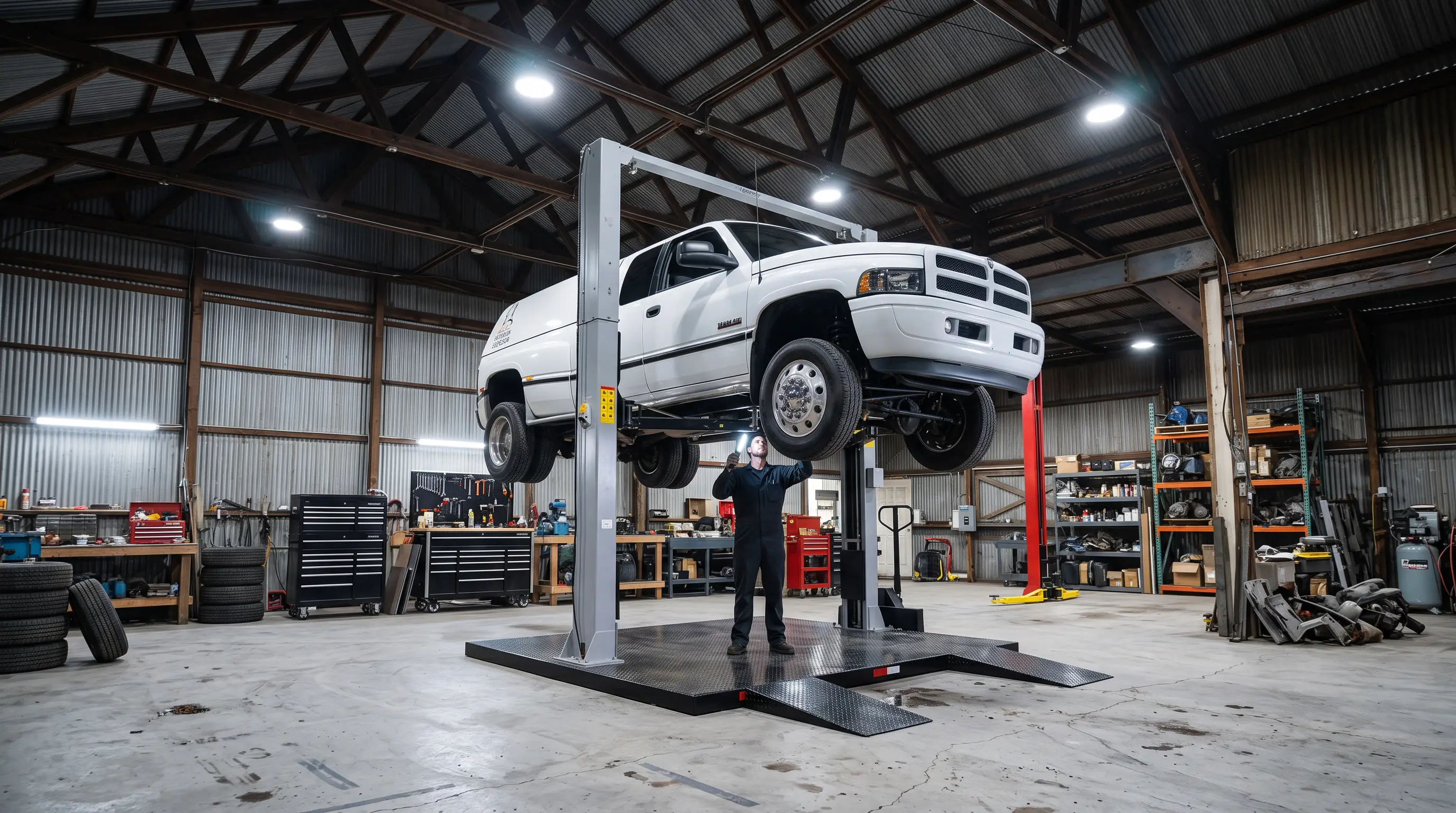
A quality portable truck lift system uses two independent column units that work together to raise a vehicle from both sides. No floor anchors. No concrete cutting. No permit applications. You roll the units into position, attach the lifting arms to the vehicle's lift points, and raise it.
The battery-powered versions, which are where the real flexibility lives, run on self-contained 24-volt hydraulic systems. That means you don't need a power outlet anywhere near the bay. You're not running extension cords across the shop floor. You just work.
Here's what that unlocks in a real shop environment:
You can serve vehicles you couldn't before. High-roof vans, heavy-duty trucks, and commercial vehicles with unusual wheelbase dimensions. A proper movable truck lift system rated at 38,000 pounds per column (with combined capacity reaching 76,000 pounds for two-unit setups) handles the full range of commercial vehicles.
You can work where the vehicle is. Is the dealership lot too far from the main service bay? Customer vehicle broke down on-site? Fleet yard without a fixed service building? Battery-powered portability means the lift goes to the job, not the other way around.
You can reconfigure your space without calling a contractor. Need to run two small vehicles faster? Move the columns. Running a big F-250 today and Sprinters tomorrow? Adjust the arm configuration. A movable truck lift gives you a bay layout that changes with your workload instead of dictating it.
You can grow without a construction budget. Adding a portable system doesn't require floor demolition, concrete work, or a permit. The North American Vehicle Lift Market is valued at over $3.2 billion and growing, partly because shops are realizing that permanent installation costs eat into ROI before a single job gets done. No-install systems get you working on day one.
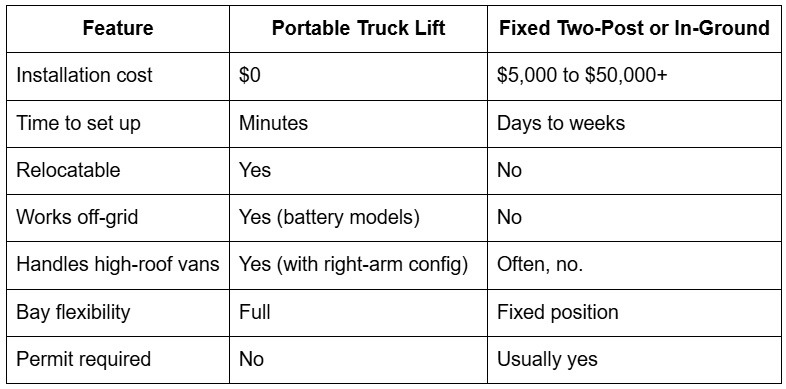
Numbers are realistic estimates based on industry averages. Actual costs vary by location, system type, and facility conditions.
You're running pre-delivery inspections, warranty work, and customer service appointments all at the same time. When a heavy-duty truck or full-size van comes in for service, you need to get it in and out fast. A portable truck lift lets you set up a dedicated lane for those vehicles without permanently carving up your floor plan. If your service volume shifts seasonally, the equipment shifts with it.
Whether you manage 10 vehicles or 100, your uptime numbers depend on how fast you can get a vehicle serviced and back on the road. Portable systems let you service trucks at your primary facility, a satellite location, or even at a customer's yard. One set of equipment serves multiple sites. The math on that ROI is usually simple.
If your business model is going to the customer, you already know the problem. You show up with skills, but you show up without a lift. That limits every job to whatever can be done without getting under the vehicle. A battery-powered, portable system that loads onto a trailer changes your service menu entirely. Brake jobs, exhaust work, suspension inspections, all of it becomes possible on-site.
The commercial vehicle segment is a real growth opportunity for independent shops, but you need the right equipment to go after it. Shops that can service a full-size delivery van or a work truck become the go-to shop for local businesses with fleets. That's recurring work, not one-off appointments.
The portable car lift market was valued at approximately $2.54 billion in 2025 and is projected to reach $4.5 billion by 2035, growing at roughly 5.9% annually. That growth is being driven by a few clear trends.
First, battery-powered and electric lift systems are gaining ground. Search interest in electric car lifts has been growing steadily, and commercial buyers are moving toward cordless operation specifically because it removes the constraints of fixed power infrastructure.
Second, the aging vehicle fleet in North America is pushing more vehicles into the repair cycle. Older trucks and vans need more maintenance, and shops that can handle them are in a better position than those that can't.
Third, the rise of mobile mechanics and on-site fleet service has created demand for equipment that travels. A system that only works in one shop doesn't fit that model.
The shops winning right now are the ones that matched their equipment to where the market is going, not where it was five years ago.
Not all portable lift systems are built the same. Here are the things that actually matter for truck and van applications:
Weight rating per column, not just total. Make sure each column can handle an uneven load distribution because trucks and vans don't always weigh perfectly.
Arm reach and adjustability. High-roof vans need a different arm geometry than pickup trucks. Check that the system accommodates the specific vehicles you service most.
Battery runtime. For battery-powered models, look at how long a charge lasts under real load conditions and how long a recharge takes. For busy shops, having a spare battery pack matters.
Build quality and origin. American-manufactured systems generally offer better parts availability and support. When something needs service, you want to be able to get a replacement part without a multi-week wait.
Safety lockout systems. Any lift you put under a commercial vehicle needs mechanical safety locks that engage automatically at height. Hydraulic failure shouldn't mean the vehicle drops.
Certification. Look for systems that meet Automotive Lift Institute (ALI) standards. This matters for shop liability and insurance.
Yes, provided the lift is rated for the vehicle's gross weight. A two-column system with 38,000 pounds per column covers the full range of commercial vans, including Ford Transit, Mercedes Sprinter, and Ram ProMaster, at their maximum load ratings. Always confirm the GVW of the specific vehicle before lifting.
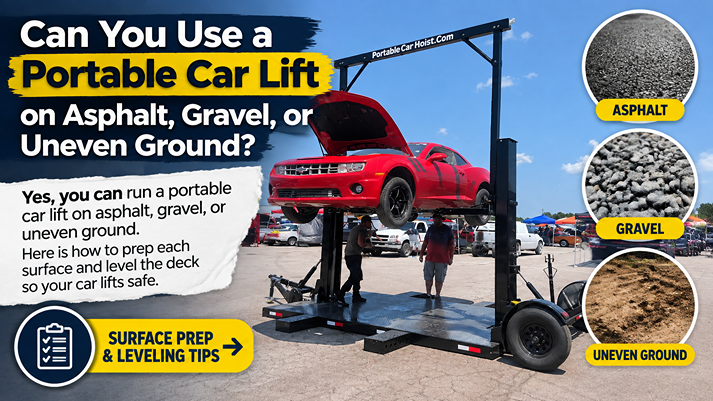
No excavation or anchoring is required. You need a reasonably flat, stable surface, which is typically standard concrete in any commercial service bay or dealership lot. For outdoor use, a solid, compacted surface works. Avoid soft or uneven ground without a leveling base.
Most operators have a portable two-column system deployed and ready to lift in under 10 minutes once they're familiar with the equipment. Breakdown is similar. For shops running multiple vehicles per day, the time investment is minimal compared to the flexibility gained.
Mobile column rental for commercial vehicles typically runs $800 to $2,000 per week. If you need that capability more than 15 to 20 days per year, ownership pays for itself. For fleet operations or dealerships with consistent truck and van volume, ownership is almost always the better financial decision.
You've got the skills. You've got the team. You may lack equipment that lets you say yes to every vehicle that pulls into your bay.
A battery-powered portable truck lift is how you stop turning away the full-size vans, the heavy-duty pickups, and the commercial vehicles that represent real, recurring revenue for your shop or dealership. It sets up in minutes, needs no floor modifications, and goes wherever you need it to go.
The market for fleet vehicle lifts is shifting toward portable, battery-powered systems for a reason. Flexibility wins. Permanent equipment made sense when shops and fleets stayed in one place and serviced the same vehicles for decades. That's not how most operations work anymore.
Ready to see which system fits your shop or fleet? Call Portable Car Hoist at (951) 400-5290 or visit portablecarhoist.com to get a free consultation. We'll match you to the right lift for the vehicles you actually service, not the ones a fixed lift was designed for.