

.png)

Jader Gil
Marketing Expert
January 12, 2026
9 min read
You're managing a fleet. Maybe 10 trucks, maybe 100. Either way, you know the problem: when a semi goes down, every hour it sits waiting for service costs you money. Loads get delayed. Customers get upset. Revenue walks away.
Here's what most fleet operations figure out too late: your lifting equipment determines how fast you can get trucks back on the road. Fixed lifts lock you into one bay configuration. Can't service a truck at a remote location? Too bad. Need to reconfigure your shop? Start budgeting for floor demolition and reinstallation.
Let me show you what's actually working for commercial operations handling heavy-duty vehicles.
Repair and maintenance costs for commercial trucks hit $0.202 per mile in 2023, up 3.1% from the previous year. Every hour of downtime multiplies those costs. Your fixed overhead keeps running whether trucks are earning or sitting in the shop.
The fleet management market is projected to reach $52.50 billion by 2030, driven partly by companies trying to solve this exact problem. Better equipment means faster turnarounds. Faster turnarounds mean more revenue.
The Portable Semi Truck Lift system represents American-designed and American-manufactured excellence in lifting technology. Our portable semi-truck lifts are mobile lifting systems engineered to raise heavy commercial vehicles safely and efficiently. Unlike traditional installations that tie you to one location, our solutions can go anywhere and set up in just minutes.
Permanent installations seemed like the answer until you hit their limitations:
Better than floor lifts but still restrictive:
Popular for good reason, but expensive:
Delayed or overlooked preventive maintenance stems from the complexity of maintaining diverse fleets, but equipment limitations make it worse. When you can't quickly service trucks as they rotate through, you push maintenance. Pushed maintenance becomes breakdowns. Breakdowns become expensive emergency repairs.
Average commercial truck breakdown: $448-$760 per incident. Towing for a disabled semi: $500-$2,000+ Lost revenue per day: varies wildly based on your operation
Add it up. How much does inadequate lifting equipment actually cost annually?
This is where portable heavy-duty lifting changes the economics completely.
The Portable Semi Hoist uses two independent units working together. Combined lifting capacity: 76,000 pounds. That handles loaded semi-trucks, buses, RVs, and heavy commercial vehicles that fixed systems can't touch.
Two-post design with hydraulic lifting arms and a self-contained 24-volt hydraulic pump per unit. No external power hookup is required during operation. Battery-powered operation works anywhere. Setup takes minutes, not hours. Safety mechanisms prevent system failure. Adjustable arms accommodate different vehicle configurations
The key difference: you're not locked to one floor position or dependent on facility power. Need to service a truck at a customer site? Load the units and go. Shop layout changing? Roll them to new positions.
76,000 pounds combined capacity covers:
Semi-truck lifts typically handle 20,000 to 100,000 pounds or more, and portable systems now compete with fixed installations on capacity while offering the flexibility those systems never will.
Here's what "portable" actually means for fleet operations:
Service Multiple Locations: One system serves multiple facilities. Schedule rotation between sites based on maintenance needs. Pay for one set of equipment, and get capacity at three locations.
Emergency Response: Truck breaks down at a customer location? Show up with lifting capability. Fix it there instead of expensive towing and shop time.
Shop Reconfiguration: Mobile column lifts provide greater flexibility and can be moved and stored easily when not in use, unlike permanent hoists that restrict shop space. The same principle applies to portable two-post systems.
No Installation Costs: Zero excavation. Zero concrete work. Zero downtime waiting for installation. Set it up where you need it, when you need it.
Facility Changes: Lease ending? Moving to a larger facility? Take your equipment with you. No expensive reinstallation or abandoning capital equipment.
The 24-volt self-contained hydraulic pump matters more than you might think. Mobile column lifts reduce the time trucks spend in the shop and get vehicles back on the road faster, and portable systems offer the same benefit.
Battery operation means:
Standard electrical systems for stationary operation are also available. Choose based on how you'll use the equipment.
Let's talk about where portable semi-truck lifts actually solve problems.
The U.S. has 13 million large trucks, accounting for 5% of all registered vehicles. Those trucks need service, and fleet operators need equipment that adapts to changing demands.
Portable systems work because:
Cities and counties run diverse fleets: refuse trucks, fire apparatus, buses, and heavy equipment. One portable system handles multiple vehicle types.
Budget advantages matter for government operations. One equipment purchase serves multiple departments. Share costs, maximize utilization.
Independent repair shops face different challenges than fleet operations. You need capacity for the heaviest vehicles customers bring, but you can't dedicate floor space to specialized equipment that sits idle most days.
Portable systems let you:
Commercial vehicle service operations continue to offset increases driven by factors outside their control. Equipment utilization matters. Portable lifts serve both your fleet maintenance needs and become billable equipment for customers needing on-site service.
Farms and agricultural service providers handle heavy equipment seasonally. Harvest season brings intense maintenance demands. Off-season, that equipment capacity sits unused.
Portable systems make sense when demand fluctuates. Set up when needed, store when not. No permanent floor space commitment for seasonal work.
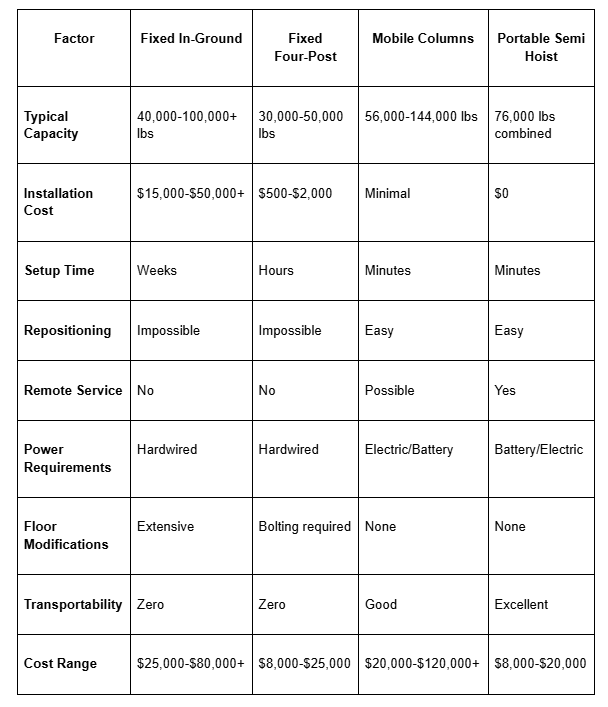
Numbers are realistic estimates. Actual costs vary based on specifications, capacity, and features.
Here are the practical considerations that matter when evaluating portable semi-truck lifts.
Deployed footprint: approximately 12-15 feet in length and 8-10 feet in width per unit. Working clearance: add 3-4 feet around the perimeter. Storage: units can be repositioned to shop edges when not in use. Ceiling height: typically needs 14+ feet for full lift height
Your shop dimensions determine feasibility. Measure before specifying equipment.
Concrete: ideal surface, no preparation needed. Asphalt: works fine if level and solid. Compacted gravel: acceptable for temporary setups. Grass/dirt: requires plywood or mat base
The equipment distributes weight effectively, but the surface must be stable and reasonably level. Some models feature adjustable wheels or suspension systems to handle minor unevenness.
Battery operation: 4-6 hours typical runtime per charge Charging time: 6-8 hours for full recharge Electric operation: standard 220V for stationary use Backup power: battery systems work during power outages
Plan for charging infrastructure if running battery-powered units. Multiple battery packs extend operational time.
Modern portable lifts include:
Every lift should be inspected by a qualified lift inspector at least annually. Portable equipment follows the same safety standards as fixed installations.
Basic operation requires:
Budget 2-4 hours for initial training. Experienced technicians pick it up quickly. Less experienced staff need more time and supervision.
Regular maintenance keeps equipment running:
Maintenance costs run significantly lower than complex mobile column systems with multiple synchronization points.
Let's talk real numbers about whether portable semi-truck lifts make financial sense.
Portable Semi Hoist system: $8,000-$20,000, depending on specifications. Installation: $0 (no permanent installation required) Power infrastructure: minimal (standard electrical or charging setup) Training: $500-$1,000 for professional training Total: $8,500-$21,000 approximate range
Compare to: Fixed in-ground system: $40,000-$130,000 all-in Fixed four-post: $9,000-$27,000 all-in Mobile column set: $25,000-$125,000 for adequate capacity
Annual maintenance: $300-$800 Power costs: minimal (battery charging or electric) Inspection and certification: $200-$500 annually Replacement parts (10-year horizon): $1,000-$3,000
No excavation repairs. No floor maintenance. No complex hydraulic synchronization systems to service.
Calculate based on:
Example scenario: Fleet operates 50 trucks. Average 2 heavy maintenance jobs per truck annually. The portable system reduces service time by 2 hours per job. Technician rate: $75/hour loaded cost
Savings: 50 trucks × 2 jobs × 2 hours × $75 = $15,000 annually. Payback period: 6-14 months, depending on system cost
Add value from avoided downtime, the ability to service remotely, and revenue from previously declined heavy-duty work.
"Can portable systems really handle loaded semis safely?"
Yes, when properly rated. The Portable Semi Hoist, combined with a 76,000-pound capacity, handles loaded Class 8 trucks. Safety systems match or exceed fixed installations. Semi-truck lifts are engineered to handle substantial weight with robust construction and advanced engineering
"What about uneven shop floors?"
Minor irregularities work fine. Significant slopes or heavily damaged floors need attention regardless of lift type. Most commercial shop floors are adequate. Worst case, use leveling plates or move to a better section.
"How often do batteries need replacing?"
Battery life depends on usage patterns and charging practices. Typical commercial batteries last 3-5 years with proper maintenance. Replacement cost: $200-$500 per battery, depending on the system.
"Can we use these outdoors?"
Yes, for temporary setups. Not designed for permanent outdoor installation. Weather protection extends equipment life. Rain during operation isn't ideal, but the equipment handles it.
"What if we need more capacity later?"
The two-unit system provides 76,000 pounds. Need more? Either size up to higher-capacity portable units or add mobile columns for extreme applications. Most commercial operations never exceed this capacity in real-world use.
"How does this compare to renting lift equipment?"
Rental mobile column sets: $800-$2,000 per week, typically. Annual rental cost if needed regularly: $15,000-$40,000+ Purchase portable system: $8,000-$20,000 one time
Renting makes sense for rare use. Own if you need heavy-duty capacity more than 15-20 days annually.
How much weight can portable car hoist systems handle?
Our Portable Truck Hoist can lift 38,000 pounds per unit. When using two units together, you achieve a combined lifting capacity of 76,000 pounds—sufficient for most semi-trucks and heavy commercial vehicles.
Are portable lifts safe for full-time commercial use?
Absolutely. When properly maintained and operated according to guidelines, our portable lifts provide the same safety and reliability as fixed installations. In fact, many professional shops prefer them because of their flexibility and modern safety features.
Do your portable semi-truck lifts require special installation?
No extensive installation is required. Our systems don't need excavation, concrete work, or permanent mounting. You simply need a reasonably flat, stable floor surface. Setup takes just minutes, and you can start lifting immediately.
Can I use these lifts outdoors or at job sites?
Yes! Our battery-powered models are specifically designed for mobile operations, making them perfect for roadside service, outdoor maintenance areas, or temporary job sites. However, you should always consider weather conditions and ground stability for safe operation.
What makes American-manufactured equipment worth the investment?
Quality, reliability, and support. Our American-designed and American-manufactured systems are built to last with superior materials and engineering. You also get better support, faster parts availability, and the confidence that comes with proven domestic manufacturing standards.
Fleet maintenance costs have stabilized recently after significant increases, but costs continue to rise in certain areas. Equipment investments that reduce labor time and downtime pay back faster when maintenance costs stay high.
Choose Portable Semi Hoist if:
Fixed systems make sense if:
Mobile columns work better when:
Portable Car Hoist manufactures American-designed and American-made lifting systems built for commercial heavy-duty applications.
Portable Semi Hoist Specifications:
American manufacturing means:
Stop losing revenue because your lifting equipment can't handle your heaviest vehicles or adapt to changing needs. The operations winning right now are the ones with equipment that works where they need it, when they need it.
Ready to discuss portable semi-truck lift options for your fleet?
Call (951) 400-5290 or visit PortableCarHoist.com to speak with our team about heavy-duty commercial solutions.
We'll discuss:
American-designed. American-manufactured. Built for commercial operations that can't afford downtime. Find out what portable heavy-duty lifting can do for your fleet operation.