



Jader Gil
Marketing Expert
April 1, 2026
9 min read
You know that feeling when you buy a piece of shop equipment and spend the next two days waiting for installation crews, permits, and concrete work to be done? That is basically the standard experience with a traditional car lift. But it does not have to be.
This post walks you through exactly what happens when you unbox a Portable Car Hoist, set it up, and get a vehicle lifted, all within 30 minutes. No concrete. No drilling. No anchors. Just a fast setup car lift that actually works.
If you are running a mechanic shop, working as a mobile mechanic, or collecting vehicles in a garage where permanent installation is not an option, this one is for you.
Most shop owners and mechanics do not realize how much a traditional two-post or four-post lift actually costs until they get the final invoice. The lift itself might be $4,000. But then you get the real bill:
According to Portable Car Hoist, nearly 40% of shop owners cannot install traditional lifts because their floor does not meet code. Forty percent. That is almost half of the shops locked out of an upgrade they need, just because of a concrete slab issue.
And if you are a mobile mechanic or working at a rented space, you have zero chance of anchoring anything to a floor you do not own.
That is the problem. Now here is what the alternative actually looks like.
The Portable Car Hoist system is built around one core idea: you should be able to lift vehicles anywhere, at any time, without tearing up a floor or waiting on a construction crew.
Here is the actual setup sequence, step by step, in real time:
The hoist ships in a manageable package. Once you have it unboxed, you roll or carry the base plates wherever you need to work. No crane, no forklift, no extra crew. The base sits directly on the floor without any anchoring, and the design uses counterbalanced weight distribution to stay stable during operation.
The uprights slot together and lock into position. The assembly process uses standard hand tools, and the manual is straightforward. You do not need specialized knowledge or a crew. One or two people can handle the task comfortably.
The hoist connects to standard power. There is no hardwiring required, which means no electrician and no permit for electrical work. Plug it in, and you are ready to go.
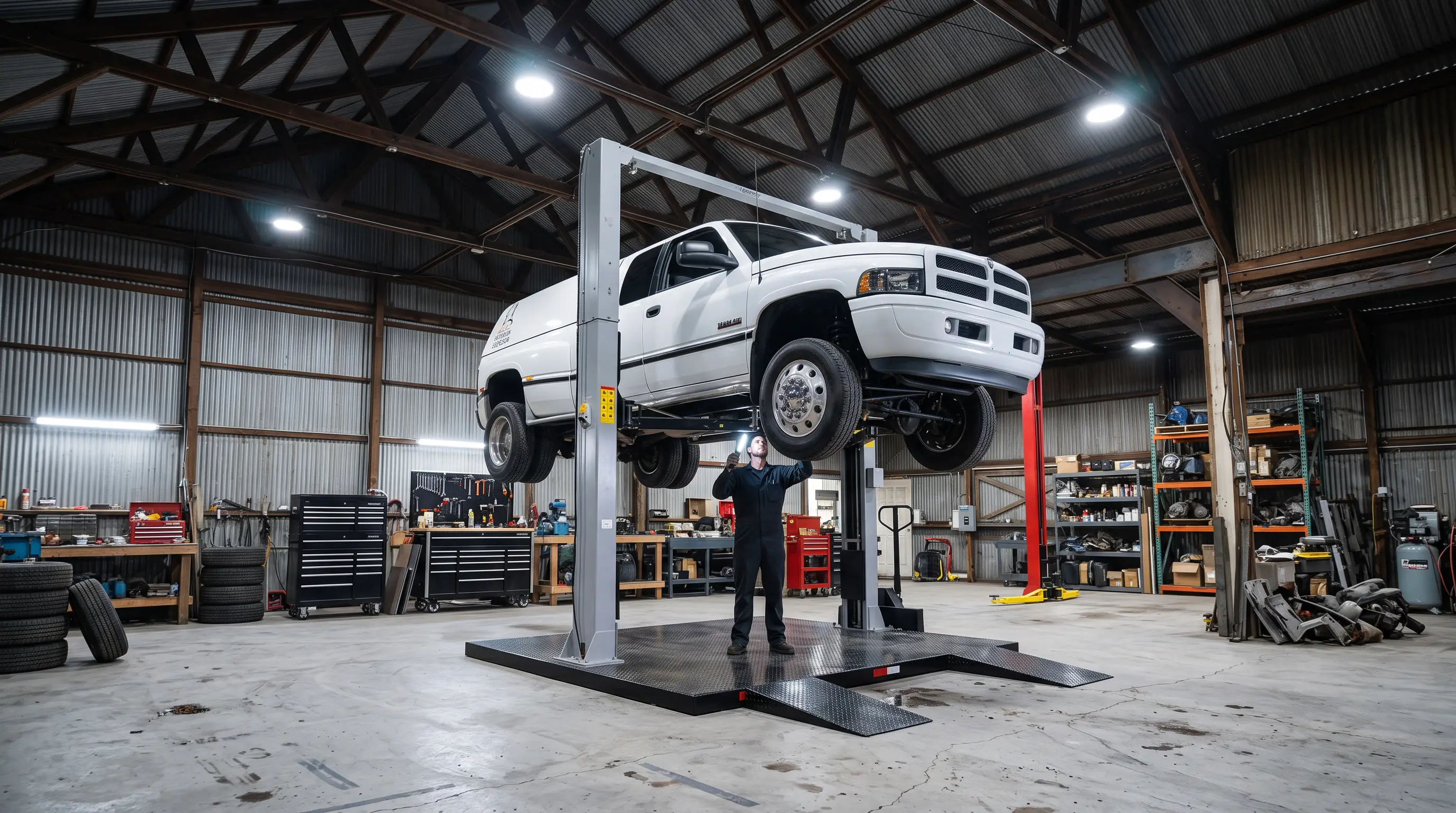
Drive or push the vehicle into position, line up the lift points, and raise it. The Portable Car Hoist reaches up to 73.5 inches of lift height and handles capacities from 8,000 lb to 76,000 lb, depending on the model. That covers passenger cars, trucks, and even semi-trucks.
Total time from unboxing to a vehicle in the air: under 30 minutes.
The financial case is pretty simple when you lay it out. A no-anchor car hoist from Portable Car Hoist starts saving you money before you even use it.
Consider what you skip:
Portable Car Hoist estimates their customers save $3,000 or more on installation costs compared to a traditional anchored lift. But the bigger number is the opportunity cost of downtime. Every day you are waiting on permits or concrete crews is a day you are not lifting vehicles and generating revenue.
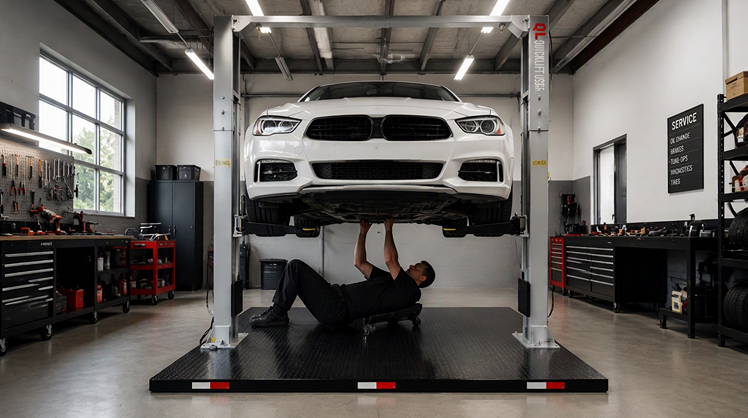
For mobile mechanics, the math is even more obvious. You literally cannot use a traditional lift at a customer site. But a no-anchor car hoist rides with you, sets up in a driveway or parking lot, and gets you working standing up instead of on your back under a car with jack stands.
According to the Bureau of Labor Statistics, automotive service technicians and mechanics experience one of the highest rates of injury among skilled trades workers, with sprains, strains, and musculoskeletal issues being among the most common. Working at full lift height rather than ground level is not just a convenience; it is a real safety improvement.
This is not a one-size-fits-all piece of equipment. Different users have completely unique reasons for choosing a portable setup, and the benefits hit differently depending on your situation.
If you are in a leased space, dealing with a post-tension slab, or working in a building where drilling into the floor is not allowed, the portable option removes a wall you probably thought was permanent. You get full-height lifting capacity without touching the floor.
Going to the customer is the foundation of your business model. A fast setup car lift that goes with you means you can do underbody work, brake jobs, exhaust repairs, and more at any location. That expands your service menu and your ability to charge higher rates for on-site convenience.
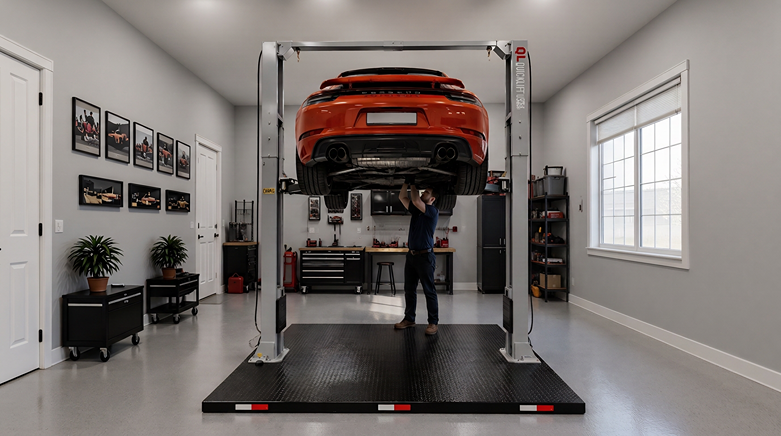
If you have a personal garage and a collection of vehicles that need maintenance or display work, a portable hoist gives you professional-grade lifting without committing to a permanent installation. You can store it when you are not using it and set it up only when you need it.
Race events often need lifts for pre-race inspection, quick pit setups, or display purposes. A lift that you can truck to a venue, set up in 30 minutes, break down, and move to the next event is genuinely useful in a way that a bolted-down shop lift is not.
Fleet managers maintaining vehicles across multiple sites benefit from a hoist that can travel between locations. You are not locked into one fixed bay, and you can respond to maintenance needs wherever the vehicles actually are.
Fair question: if it is not bolted down, how stable is it?
This is the most common thing people ask when they first look at a portable hoist. It sounds counterintuitive that something not anchored could be as safe as something bolted to a concrete floor.
The answer is in engineering. The Portable Car Hoist uses a wide base footprint with weight distribution that keeps the system stable under load. The physics of stadium bleachers and shipping cranes work the same way, relying on geometry and load path rather than anchors.
The Portable Car Hoist is American-made in Menifee, California, and the system is designed and tested for professional shop use. The manufacturer notes that the hoist is trusted by more than 100 professional shops nationwide, which is not a number you reach if the equipment is not actually safe to use.
That said, like any lifting equipment, there are best practices to follow: level ground, proper vehicle positioning, and correct load capacity for the model you are using. Those basics apply regardless of whether the hoist is anchored or not.
The automotive repair industry is shifting. More mechanics are working independently or running mobile operations. Commercial real estate costs are pushing shops into smaller spaces or temporary locations. The emergence of electric vehicles is altering service requirements in yet-to-be-determined ways.
In this context, equipment flexibility is evolving from a mere convenience to a competitive advantage. The global automotive lift market was valued at over $2.5 billion recently and is expected to keep growing, with portable and mobile solutions representing one of the fastest-growing segments as mobile mechanic businesses expand.
The IBISWorld report on mobile auto repair services notes that the industry has grown steadily as consumers prioritize convenience, which translates directly to demand for tools that support that model, including lifts that can go wherever the mechanic goes.
If you are building a service business right now, being anchored in place is increasingly a liability. A fast setup car lift gives you options that a fixed installation does not.
Here is a practical side-by-side view of what each path actually looks like:
Setup time, portable: under 30 minutes.
Installation cost, portable: $0 beyond the equipment itself.
Floor requirements, portable: any flat surface.
Mobility, portable: moves with you to any location.
Portable: yes.
The lift height and capacity numbers are comparable. The Portable Car Hoist reaches 73.5 inches and handles up to 76,000 lbs on the heavy-duty models. You are not giving up capability for portability here.
The 30-minute setup is not a marketing number. When you roll out the hoist, set up the uprights, plug it in, and lift a vehicle, this is what happens. You have seen the steps above. There is nothing complicated about it.
If you have been putting off adding lift capability to your shop, your mobile rig, your garage, or your event setup because of the cost or complexity of traditional installation, a no-anchor car hoist is the answer you have probably been looking for without realizing it existed.
You get full-height professional lifting, zero installation costs, and the ability to work anywhere. That is a real upgrade, not a compromise.
Ready to see it for yourself? Contact us to explore models, request a custom quote, or talk to the team about which setup makes the most sense for your operation. Your 30-minute setup is waiting.