


Jader Gil
Marketing Expert
April 1, 2026
9 min read
Here is the thing nobody tells you when you own a class 6, 7, or 8 truck: finding someone to work on it is genuinely hard. And if you want to do it yourself? Most people assume you just can't.
Not because of skill. Because of the lift.
The average two-post shop lift caps out around 10,000 to 12,000 lbs. A loaded F-450 can push 14,000 lbs. A box truck sits at 26,000. A medium-duty commercial vehicle can easily hit 40,000 lbs. So, unless you happen to own a commercial fleet shop, you are stuck handing your truck over to someone else and hoping they get it right.
That frustration is real, and it is shared by a lot of people: independent shop owners who want to serve fleet clients but can't justify the installation costs of a fixed overhead lift, mobile mechanics who service trucks at customer locations with no lift at all, and serious enthusiasts who own a diesel truck or a work van and just want to be able to get under it safely without lying on a creeper in a parking lot.
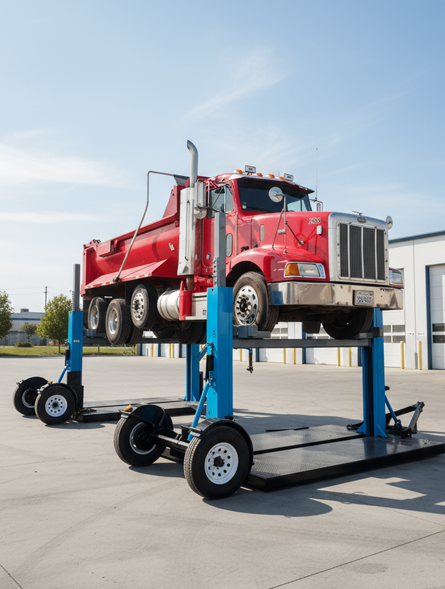
The good news is that the equipment gap that used to force all of this has closed. A heavy duty portable car hoist rated for up to 76,000 lbs changes the math completely.
Before we get into what is now possible, let's talk about why so many shops still turn away heavy vehicle work.
It comes down to three things: installation cost, floor requirements, and the sheer weight ratings needed.
A fixed commercial lift rated for 40,000 to 76,000 lbs typically requires a concrete slab that is six to eight inches thick, rated at 4,000 PSI or higher, with anchor bolts drilled and set by a certified installer. The equipment alone can cost $25,000 to $60,000. Add in installation, concrete prep, permits, and inspections, and you are looking at a total project that can exceed $80,000 before a single truck rolls in.
According to the Automotive Lift Institute (ALI), improper concrete and installation failures are among the top causes of lift-related incidents in the U.S. That means even shops that spend the money are not always safe if the floor prep was done wrong.
So most small shops just skip it. They focus on passenger cars and light trucks. Anything heavier gets turned away. Which means a huge portion of the truck-owning market is completely underserved.
This is where things get interesting.
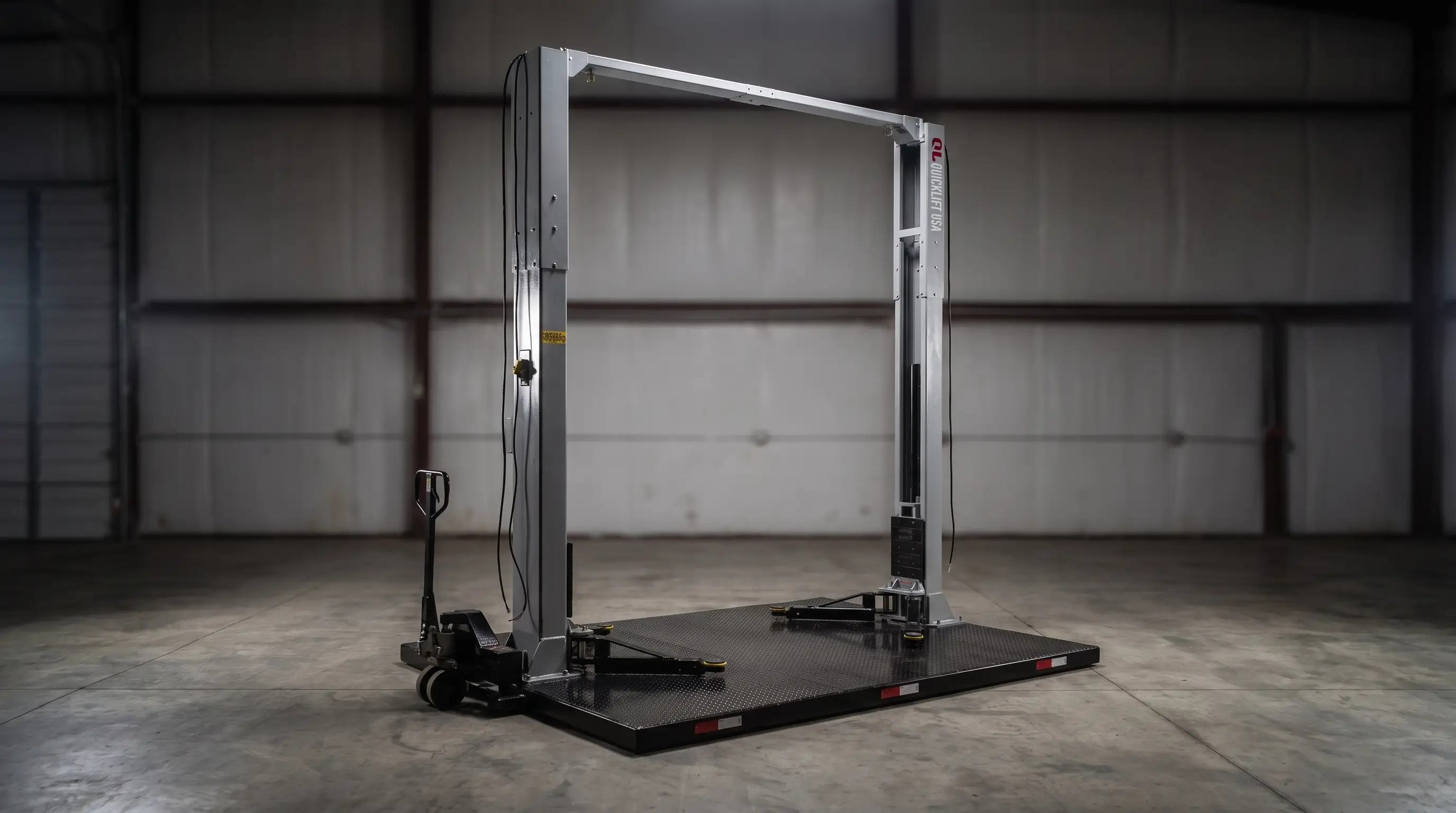
A heavy-duty portable car hoist like the PCH-76 from Portable Car Hoist uses a dual-platform design, with one positioned under the front of the vehicle and one under the rear, to distribute weight evenly across a wide base footprint. No drilling. No anchors. No concrete requirements.
The combined lifting capacity goes up to 76,000 lbs. Lift height reaches 69 to 73.5 inches. Setup takes 5 to 15 minutes. It runs on 110V, 220V, or 24V battery power, so you can use it in a garage, a parking lot, a job site, or anywhere you have a level surface.
Let that settle in for a second.
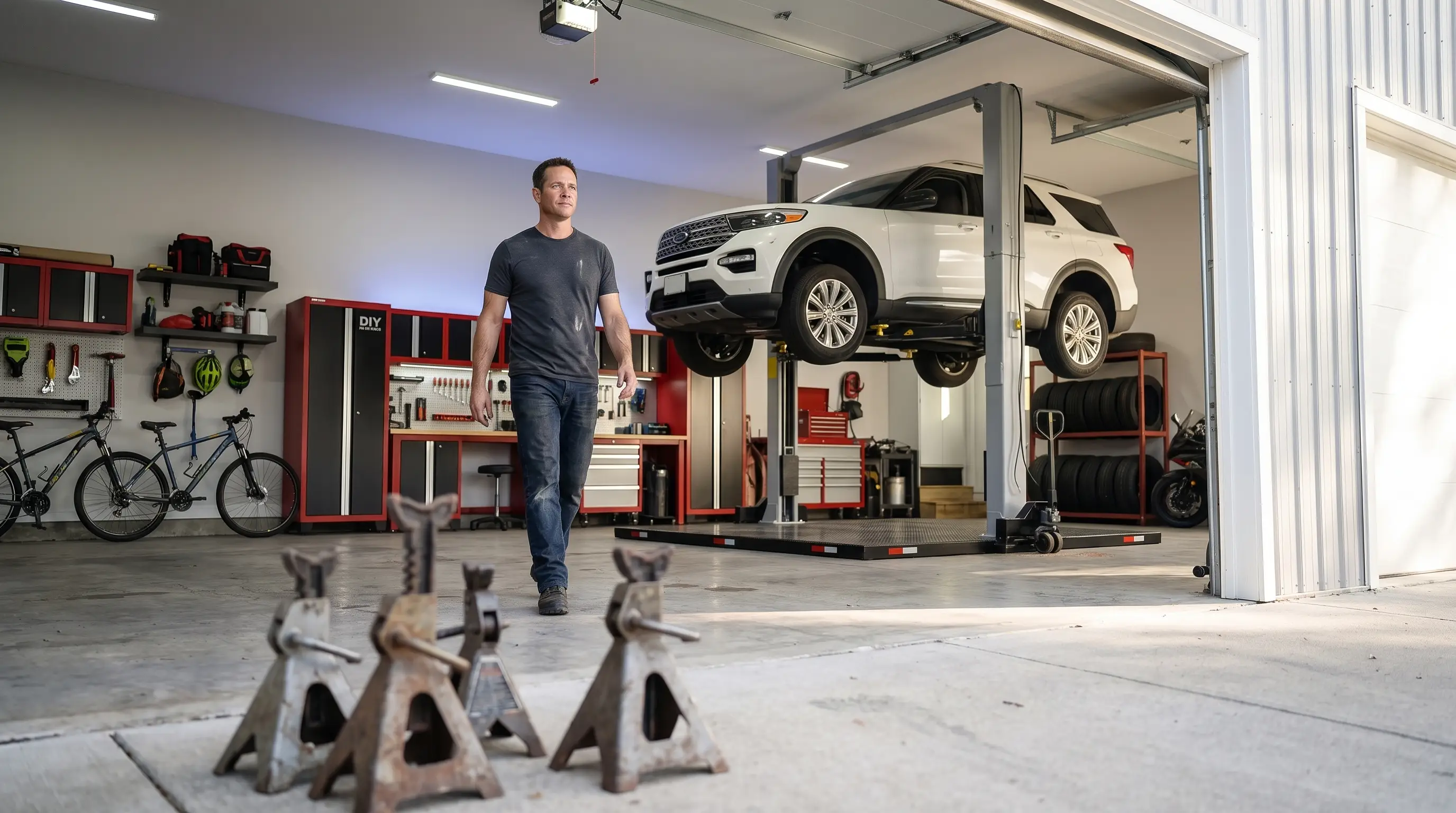
You can set this up in your home garage, on a commercial lot, at a fleet yard, or even at a racing event. You can lift a vehicle that weighs as much as a fully loaded semi-truck front axle, do your work standing fully upright, and then pack it up and move it somewhere else the next day.
That is a fundamentally different capability than anything that existed five years ago at this price point.
For mechanics serving fleets, this means you can take your service to the truck instead of hoping the fleet manager will haul a vehicle to your shop. For shop owners, it means you can start accepting heavy vehicle work without committing to a $60,000 concrete project. For enthusiasts who own a dually or a diesel work truck, it means you can do your own maintenance safely and without lying on the ground.
Let's not be vague about this. Here are the people who genuinely benefit from a heavy duty portable car hoist at this weight rating.
Independent mechanic shops that want to grow. If you are already doing car and light truck work, adding a portable heavy-duty lift is one of the fastest ways to open a new revenue stream. Fleet and commercial vehicle maintenance is one of the most consistent and high-margin segments in automotive service. According to IBISWorld, the heavy-duty truck repair industry in the U.S. generates over $14 billion annually, and independent shops capture a growing share of that as fleet operators look for faster turnaround options.
Mobile mechanics. This one is underrated. A mobile mechanic with a portable lift rated for heavy vehicles can offer a service that virtually no one else in their market provides. You show up at the fleet yard, the construction site, or the warehouse. You can set up in 15 minutes. You repair. You are done. No tow truck needed, no shop downtime for the client.
Truck owners and diesel enthusiasts. If you own an F-350, a Ram 3500, a Sprinter, or any medium-duty work vehicle, you know how annoying it is to take it somewhere for basic maintenance. A portable lift rated for your vehicle means you can do your own brake jobs, suspension work, and undercarriage inspections at home, safely.
Commercial fleet operators. Having on-site lift capability at a fleet yard cuts vehicle downtime dramatically. Instead of sending a truck to a shop and waiting days for a bay to open up, you service it in-house. That kind of turnaround time matters when your trucks are revenue-generating assets.
Car racing event organizers and support crews. Race teams running large chase trucks or transport rigs need lift access at events. A portable unit that can travel with the rig and be set up anywhere is exactly what support crews have been asking for.
People tend to focus on the purchase price of a lift and stop there. But that is the wrong calculation.
Here is a more complete picture.
A traditional fixed commercial lift installation, including concrete prep, permits, and labor, runs $40,000 to $80,000 for a heavy-duty unit. That lift is then permanently attached to your building. If you move, you leave it behind. Resale value is essentially zero because it's now part of someone else's floor.
The PCH-76 system from Portable Car Hoist starts at $16,800 for a unit, which is the dual-platform setup you need for heavy vehicles. No installation cost. No permits. No concrete. The unit retains 60 to 80 percent of its value because it is portable, American-made, and in demand.
Run the math on a five-year horizon, and the difference is significant. The fixed lift costs more upfront, delivers no resale value, and permanently constrains your shop layout. The portable unit gives you flexibility, portability, and residual value.
The break-even on additional service revenue is also faster than most people expect. If you add just four heavy truck service jobs per month at an average ticket of $800, that is $38,400 in new revenue per year. The equipment pays for itself in under 12 months in that scenario.
The engineering behind this is worth understanding, especially if you are skeptical that something portable can handle this kind of weight.
The key is load distribution. Traditional fixed lifts achieve stability through concrete anchors that resist lateral force. The Portable Car Hoist system achieves the same result through a wide-base footprint design that spreads the load across the floor surface instead of concentrating it on anchor points. The physics are sound, and the engineering has been validated through ALI-equivalent load testing at 150 percent of rated capacity.
The dual-platform setup for heavy vehicles places one lift under the front axle area and one under the rear. Both lift simultaneously and in coordination, so the vehicle rises evenly. Hydraulic and mechanical locking systems hold the vehicle in position even if power is interrupted mid-lift.
Power options include 110V and 220V electric, as well as a 24V battery for off-grid locations. The battery option runs 8 to 12 full lift cycles per charge and recharges overnight.
Setting up on a level surface takes under 15 minutes. You don't need an electrician. You don't need a permit. You need a flat floor and a power outlet.
This section is about being honest, because not every lift is right for every situation.
First, you do need a level surface. The wide-base design works because weight is distributed evenly. If your floor has a significant slope or is in rough condition, that needs to be addressed before you use any lift, portable or fixed.
Second, your ceiling height matters. The lift reaches 69 to 73.5 inches of vehicle clearance. If you have a low ceiling in a home garage, you need to check the math on combined vehicle height plus lift travel before you commit. The Portable Car Hoist team will help you confirm the measurements before you order.
Third, the PCH-76 system is built to order. Lead time is typically around six weeks. That is not a complaint; it is a quality indicator. The unit is fabricated and load-tested in Menifee, California. You are not pulling pre-made inventory off a shelf; you are getting something built for your application.
Heavy truck work has always been a high-value, underserved segment of the automotive service market. The barrier was never skill. It was always equipment.
A heavy-duty portable car hoist rated for up to 76,000 lbs removes that barrier without the permanent commitment, the installation bill, or the concrete contractor. You can set it up at your shop, your home garage, a fleet yard, or a job site. You can lift vehicles that most independent shops can't touch. And you can do it safely, at full standing height, without drilling a single hole in the floor.
If you have been turning away heavy truck work, or if you have been crawling under a diesel jack stand longer than you care to admit, this is the equipment that changes that.
Schedule a free 15-minute consultation with the Portable Car Hoist team. They'll walk you through which configuration fits your specific vehicles, your space, and your power setup. There will be no sales pressure, just the right answer for your situation.